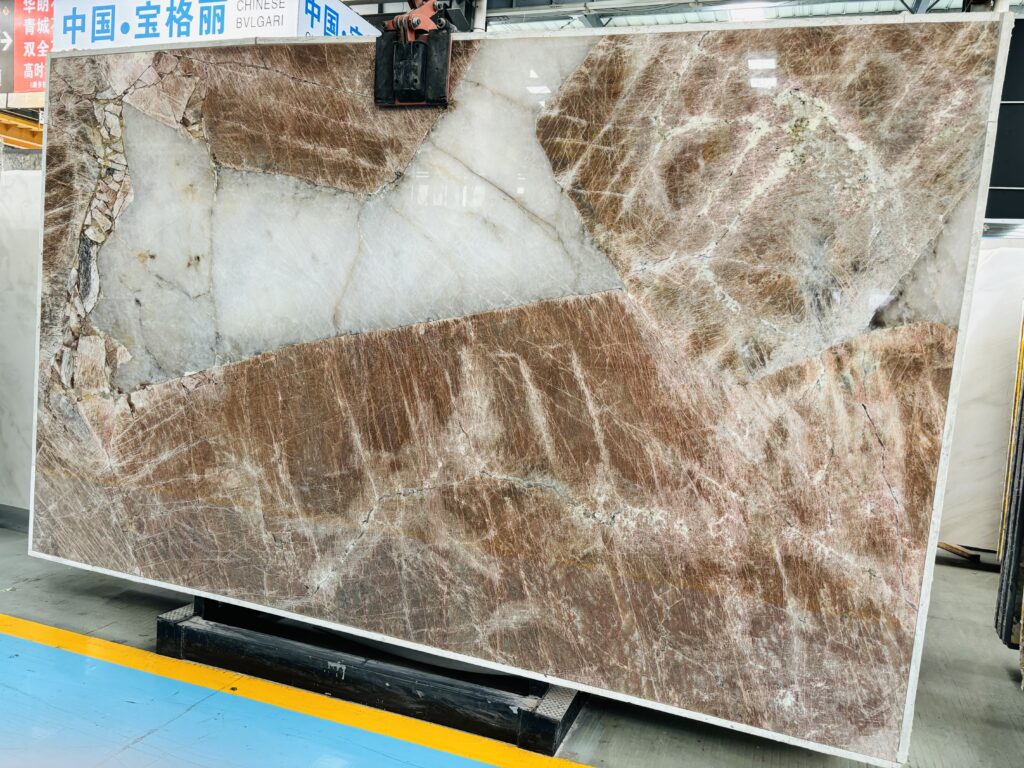
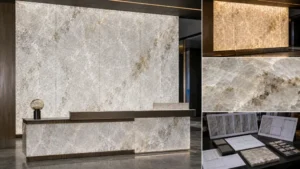
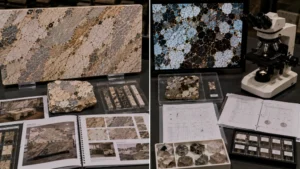
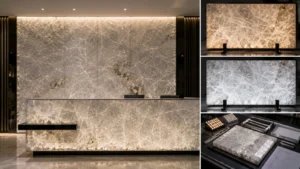
백라이트가 켜진 크리스탈로 쿼츠라이트는 LED를 켰을 때만으로는 승인해서는 안 됩니다. 백라이트가 켜지면 투과된 빛이 반투명한 결정질 부분을 빛나게 하고, 투명한 영역과 불투명한 광물 구역 간의 대비를 더욱 강조합니다. 반면 백라이트가 꺼져 있을 때는 주로 반사된 자연광이나 주변 조명을 통해 석재를 관찰하게 되므로, 그 본래의 기본 색상, 회색 부위, 광물 구조, 균열, 이음새, 판별의 변이 및 배치 등이 더욱 중요해집니다. 시각적으로 중요한 프로젝트에서는 크리스탈로 쿼츠라이트를 최소 두 가지 상태—백라이트 꺼짐과 켜짐—에서 직접 확인하고, 주변 조명이 크게 변화하는 경우 낮과 저녁 각각의 상태에 대한 별도 검토를 고려해야 합니다.
크리스탈로 쿼츠라이트는 천연석의 일부가 결정 구조를 통해 빛을 투과할 수 있기 때문에, 백라이트를 활용한 포인트 벽, 바, 리셉션 카운터, 아일랜드 등 다양한 건축 표면에 자주 선택됩니다.
그러나 성공적인 백라이트 설치에는 두 가지 면모가 있습니다.
조명 시스템이 켜졌을 때의 극적인 외관과, LED가 꺼졌을 때에도 여전히 남아 있는 자연 그대로의 석재 표면이 바로 그것입니다.
이 두 가지 상태는 의외로 매우 다르게 보일 수 있습니다.
투과광 아래에서는 빛나고 층이 느껴지며 결정성이 매우 높아 보이는 크리스탈로 판재라도, 낮 시간대의 주변 조명 아래에서는 유백색 부위, 옅은 회색의 광물 구조, 불투명한 영역, 자연 균열, 더 어두운 내포물, 이음새, 그리고 판재 간의 차이 등이 전혀 다른 모습으로 드러날 수 있습니다.
이로 인해 중요한 프로젝트 규칙이 생깁니다:
백라이트 효과를 승인하는 것과 백라이트가 꺼진 상태에서의 크리스탈로 쿼츠라이트를 승인하는 것은 동일하지 않습니다.
낮과 밤 모두에서 관찰되는 프로젝트라면, 두 가지 조건 모두가 중요합니다.
왜 크리스탈로 쿼츠라이트는 백라이트가 꺼졌을 때 다르게 보일까요?
빛이 관람객에게 전달되는 방식이 달라지기 때문입니다.
크리스탈로 쿼츠라이트가 백라이트를 적용받으면, 시각적 효과의 일부는 석재의 반투명한 부분을 통과하는 빛에서 비롯됩니다.
백라이트가 꺼지면, 관람객은 주로 석재 표면과 주변 환경에서 반사된 빛을 통해 석재를 바라보게 됩니다.
가장 간단한 구분은 다음과 같습니다:
백라이트 ON = 투과광 + 반사광 백라이트 OFF = 주로 반사된 주변광
이로 인해 외관을 지배하는 지질학적 특징이 달라집니다.
반투명한 결정질 영역은 뒤에서 조명을 받으면 빛나게 될 수 있습니다. 반면 더 불투명한 광물들은 이러한 투과를 방해하며 상대적으로 어둡게 보일 수 있습니다.
백라이트가 꺼지면, 같은 영역들이 더 이상 얼마나 많은 빛이 통과하는지에 의해 주로 규정되지 않습니다. 그 표면의 색상, 광물 구조, 대비, 마감 처리, 그리고 주변 자연광과의 관계가 더욱 중요해집니다.
석재 자체는 변하지 않았습니다. 변화한 것은 조명 경로뿐입니다.
투과광 vs 반사광: 무엇이 달라질까요?
이 구분은 반투명한 천연 쿼츠라이트 설치를 이해하는 데 핵심적입니다.
검토 포인트
백라이트 ON
백라이트 OFF / 낮 시간대
주요 시각적 빛
투과광과 반사광의 결합
주로 반사된 주변광 또는 자연광
반투명한 결정 영역
빛나고 더 깊어 보이며 시각적으로 우위를 점할 수 있음
자연스러운 결정질 광물 구조로 더 읽혀짐
불투명한 영역
조명된 영역에 비해 더 어두운 섬이나 실루엣처럼 보일 수 있음
전체 판재 패턴에 더욱 자연스럽게 녹아들 수 있음
회색 광물 구조
투과광과 LED 색온도에 따라 시각적으로 변화할 수 있음
자연스러운 낮 시간대의 외관에서 더욱 중요해지는 경우가 많음
자연 균열
빛의 투과가 달라지는 지점에서 뚜렷하게 윤곽이 잡힐 수 있음
표면의 반사, 질감, 광물 대비 등을 통해 살펴봄
전체적인 대비
석재 전반에 걸쳐 반투명함이 다양하기 때문에 극적인 효과를 낼 수 있음
자연스러운 판재 색상과 주변 조명에 더욱 크게 좌우됨
주요 승인 질문
우리는 빛나는 효과를 승인할까요?
우리는 석재를 자연스러운 건축 표면으로서 승인할까요?
크리스탈로-쿼츠라이트-조명-on-vs-off
백라이트가 켜진 크리스탈로 쿼츠라이트에 대한 “낮 시간대 승인’이란 무엇을 의미할까요?
낮 시간대 승인은 프로젝트가 의도한 낮 시간대의 주변 조명 조건 하에서 장식용 백라이트를 끈 상태로 크리스탈로 쿼츠라이트를 검토하는 것을 의미합니다.
이는 반드시 판재를 직사광선 아래에 두는 것을 의미하는 것은 아닙니다.
The relevant viewing condition might be:
Natural daylight entering through windows
Indirect daylight in a lobby
Daylight combined with general interior lighting
Artificial ambient lighting in an interior with little natural daylight
A project-relevant mock-up that approximates the final daytime environment
The purpose is to answer a different question from the backlighting test:
Will the client still approve this Cristallo Quartzite when it is functioning as stone rather than as a luminous feature?
What Should You Look for with the Cristallo Backlight Off?
A lights-off review should not be treated as simply looking at whether the slab is still “beautiful.”
The buyer, designer, or project team should review specific visual conditions.
1. Natural Base Color
Without transmitted light, the natural white, milky, pale grey, ivory, or other mineral tones become the primary color information.
A slab that looked almost luminous white when backlit may appear greyer or warmer when the LEDs are off.
2. Crystalline Structure
Cristallo’s crystalline areas remain visible without backlighting, but their visual depth changes.
Instead of appearing illuminated from within, they are read through surface reflection and natural mineral contrast.
3. Opaque Mineral Zones
Opaque areas deserve particular attention.
Under backlighting they may create strong dark contrast because less light passes through them. With the lights off, those areas may become more integrated with the overall stone pattern—or they may remain visually prominent because of their natural color.
4. Grey and Dark Mineral Features
Backlighting can change the perceived hierarchy of darker mineral structures.
A daytime review shows whether grey or darker areas are acceptable when they are viewed as part of the natural stone rather than as silhouettes against a luminous background.
5. Natural Fissures and Mineral Boundaries
Transmitted light can emphasize internal transitions that are less noticeable under ordinary front lighting.
The project should therefore review these features in both conditions rather than assuming one represents the other.
6. Slab-to-Slab Variation
If several Cristallo slabs are installed together, compare their natural base colors with the backlighting off.
Two slabs may produce similar luminous effects but still have visible differences in their unlit background tone.
7. Seams and Joints
A seam that becomes visually secondary when the entire wall is glowing may become more noticeable in daylight.
Joint position, vein direction, slab sequence, and adjacent mineral structures therefore remain important even when the primary design concept is backlighting.
Why Opaque and Translucent Areas Need Separate Review
One of the defining visual characteristics of Cristallo Quartzite is that translucency is not necessarily uniform across the slab.
Different areas can contain different mineral structures and transmit different amounts of light.
Under backlighting, this can create a dramatic composition:
More Translucent Area → More Light Transmission More Opaque Area → Less Light Transmission
But this should not be confused with the stone’s daytime color composition.
An opaque area that looks very dark during backlighting may have an attractive natural mineral character when viewed with reflected daylight.
Conversely, a highly translucent zone that dominates the illuminated design may become visually quieter with the lights off.
This is why the buyer should evaluate both:
Where does the slab transmit light?
and:
What does that same area look like when it does not?
cristallo-quartzite-opaque-vs-translucent-zones
Lights On vs Lights Off: Which Condition Should Control Approval?
Neither condition should automatically replace the other when the project will regularly be seen in both states.
A backlit bar may operate with the LEDs on throughout service hours, making the illuminated condition dominant.
A residential feature wall may remain unlit for most of the day and become illuminated only in the evening.
A hotel lobby may experience strong daylight during the day, artificial ambient light in the evening, and backlighting throughout both periods.
The approval priority should therefore follow the real use pattern.
프로젝트 조건
What You Are Approving
Key Review Points
Backlight Off — Daytime
Natural stone appearance
Base color, slab matching, mineral structure, seams, joints, fissures, layout
Backlight On — Daytime
Backlighting effect under stronger ambient light
Visible translucency, brightness balance, contrast, hotspot control
Backlight On — Evening / Low Ambient Light
Maximum luminous feature effect
Brightness, LED uniformity, dark zones, luminous contrast, atmosphere
For many premium projects, these are three separate visual approval conditions—not one.
Why Daylight Can Change the Appearance of Cristallo Quartzite
Daylight is not a single fixed lighting condition.
The amount, direction, and character of natural light in an interior can change throughout the day.
A Cristallo installation near large glazing may therefore appear different in the morning, afternoon, and evening even before the backlighting system is switched on.
Factors include:
Window orientation
Distance from glazing
Direct versus indirect daylight
Cloud conditions
Interior wall and ceiling colors
Adjacent materials
Artificial room lighting operating during daytime
The goal is not to approve every possible lighting condition.
The goal is to identify the conditions that matter to the actual project and make sure the approval is not based only on a dramatic dark-room photograph.
Should Cristallo Be Approved in Direct Sunlight?
그렇지는 않습니다.
If the installed stone will never receive direct sunlight, a direct-sunlight test may not represent the intended project condition.
The more useful approach is to reproduce or approximate the expected viewing environment.
For example, a reception wall located ten meters from glazing may primarily receive diffuse ambient daylight. A mock-up reviewed in strong direct sun would answer a different question.
Project-relevant lighting is more useful than simply choosing the brightest available daylight.
Why the Actual Slab Matters More Than a Small Cristallo Sample
A small sample can show color, crystal structure, and some degree of translucency, but it cannot necessarily represent the distribution of features across a full slab.
A full Cristallo slab may contain:
Large translucent crystalline zones
More opaque mineral masses
Pale grey areas
Warm ivory transitions
자연 발생 균열
Localized darker mineral features
Changes in translucency across the slab
These variations affect both backlit and unlit appearance.
For visually important work, approval should therefore progress from:
Small Sample → Actual Slab → Proposed Cutting Layout → Project Mock-Up Where Required.
Should the Cutting Layout Be Reviewed with the Lights Off?
Yes, when the unlit daytime appearance is important to the project.
Backlighting can strongly influence where the eye is drawn, but the same layout must also function when the stone is not illuminated.
Review:
Vein and mineral movement
Orientation
슬래브 순서
Seam positions
Bookmatched or mirrored relationships where applicable
Opaque zones
Highly translucent zones
Visible edge returns
Cut-outs
A cutting layout optimized only for the illuminated condition may not provide the preferred visual balance during daytime.
How Do Seams Read Differently Without Backlighting?
Seams interrupt both the physical slab and the visual mineral movement.
With backlighting on, strong transmitted light can dominate the viewer’s attention. Depending on the design, the seam may appear secondary—or it may become more obvious if light levels differ across the joint.
With the backlighting off, the seam is viewed against the natural surface color and pattern.
The project should therefore consider:
Whether mineral movement crosses the joint logically
Whether adjacent slabs have compatible daytime color
Whether the joint interrupts a major crystal zone
Whether one panel is naturally greyer or warmer than the next
Whether the seam position works in both lighting states
This is particularly important on large feature walls and long reception or bar fronts assembled from several stone pieces.
Does Surface Finish Matter in a Lights-Off Review?
Yes.
Surface finish influences how light is reflected from the face of the stone.
A polished surface can create stronger reflections and visual depth, while a honed or lower-sheen finish changes the way ambient light spreads across the surface.
For this reason, a daytime approval should use the intended project finish wherever practical.
Approving a polished sample and then fabricating a different finish introduces another variable into the visual result.
Daytime Approval vs Backlighting Approval
These should be treated as related but distinct decisions.
Approval Type
Main Question
Typical Evidence
Daytime / Lights-Off Approval
Do we approve the natural stone appearance without decorative backlighting?
Actual slab, slab photographs, layout, project-relevant ambient-light review
Backlighting Approval
Do we approve the illuminated effect?
Actual stone, LED system, CCT, cavity depth, diffuser, brightness, mock-up
Layout Approval
Do the selected slab areas and joints work as one composition?
A signature on one condition should not automatically be interpreted as approval of all three unless the project record explicitly says so.
Worked Example: Cristallo Quartzite Feature Wall
Consider a hypothetical Cristallo Quartzite feature wall for a luxury residential living area.
The selected slabs contain large milky-white crystalline areas, pale cool-grey mineral zones, subtle ivory variation, and a limited number of darker natural mineral features.
Review 1 — Backlight On in Low Ambient Light
The large crystal areas become luminous. Some pale-grey zones transmit less light and create internal contrast. Darker mineral features become stronger visual accents.
The client approves the dramatic illuminated effect.
Review 2 — Backlight Off During Daytime
With the LEDs switched off, the wall no longer reads primarily as a luminous surface.
The natural pale-grey structure becomes more noticeable. The difference between adjacent slabs is easier to judge through their base color rather than their translucency. Seams and mineral movement become more important to the composition.
The project team adjusts the proposed slab sequence before fabrication.
Review 3 — Backlight On During Daytime
The same LED output now competes with stronger ambient daylight.
The luminous effect is more restrained than it was in the evening review.
This does not mean the lighting system has failed. It means the surrounding illumination has changed the visual hierarchy.
The three reviews answer three different questions.
Common Cristallo Daytime Approval Mistakes
Common Mistake
중요한 이유
더 나은 접근법
Approving only a dramatic backlit photograph
It does not show the normal unlit stone appearance
Review lights-on and lights-off conditions separately
Using only a small sample
It may not represent full-slab mineral distribution or translucency
Review actual slabs before final layout approval
Ignoring opaque areas
Their appearance can change substantially between transmitted and reflected light
Evaluate the same areas both on and off
Reviewing daytime appearance in unrealistic direct sunlight
The condition may not represent the installed environment
Use project-relevant ambient lighting
Approving the layout only with backlighting on
Seams and slab color relationships may read differently when unlit
Check the final layout in both conditions
Assuming daytime-on and evening-on are identical
Ambient-light level changes the perceived strength of the backlighting
Review both where the project experience depends on them
Cristallo Quartzite Lights-Off Approval Checklist
Before final fabrication or installation approval, review the following where relevant:
Actual Slab: Is the review based on the selected project slab rather than only a generic sample?
Daytime Condition: Does the review approximate the project’s intended ambient-light environment?
Backlight Off: Has the natural stone appearance been approved without decorative illumination?
Base Color: Are the natural white, grey, ivory, or other tones acceptable?
Crystal Structure: Does the unlit crystalline movement suit the design?
Opaque Zones: Are less-translucent mineral areas acceptable when viewed naturally?
Dark Features: Are darker mineral structures positioned appropriately?
Natural Fissures: Have visually significant natural features been reviewed?
Slab Matching: Do adjacent slabs coordinate when the backlight is off?
Vein Direction: Is the mineral movement oriented as intended?
Seams: Do joint positions work in the unlit composition?
Finish: Is the review using the intended surface finish?
Layout: Has the cutting proposal been reviewed in both illuminated and unlit conditions?
Daytime Backlight: If relevant, has the lighting effect also been checked against daytime ambient light?
Evening Backlight: Has the intended low-ambient-light effect been reviewed?
Approval Record: Are the approved conditions clearly documented?
cristallo-quartzite-final-daytime-approval-mockup
구매자 FAQ
1. Why should Cristallo Quartzite be reviewed with the lights off?
Because backlighting changes how the stone is perceived. With the LEDs on, transmitted light can make crystalline areas luminous and increase contrast with opaque zones. With the backlight off, reflected ambient light reveals the stone’s natural base color, mineral structure, seams, fissures, and slab variation more directly.
2. What does daytime approval mean for backlit Cristallo Quartzite?
주간 승인은, 실제 설치될 주간의 주변 조명 조건 하에서 장식용 백라이트를 꺼둔 상태로 석재를 검토하는 것을 의미합니다. 이는 반드시 직사광선을 뜻하는 것은 아닙니다. 최종 목표는 크리스탈로가 실제로 시각적으로 적용될 환경에서 자연스러운 건축 마감재로서 적합함을 확인하는 것입니다.
3. Can I approve Cristallo Quartzite from a backlit slab photo?
A photograph can be useful for preliminary review, but a backlit image does not fully represent the slab’s unlit appearance. For visually important projects, review current slab images without backlighting and, where practical, the actual slab or a project-relevant mock-up.
4. Do opaque areas look different when the backlight is off?
그럴 수 있습니다. 백라이트가 켜져 있을 때는 불투명한 광물이 있는 부분이 빛에 비친 반투명한 석재와 대비되어 매우 어둡게 보일 수 있지만, 반사된 자연광 아래에서는 그 자연색과 광물 특성이 슬랩 내에서 다르게 어우러져 나타날 수 있습니다.
5. Should the cutting layout be approved with Cristallo backlighting off?
네, 주간의 시각적 효과가 중요한 경우에 해당합니다. 정맥의 방향, 판상 구조의 배열, 이음새, 기본 색상의 변이, 불투명한 영역 및 광물의 움직임 등은 투과광이 없을 때에는 다르게 나타날 수 있으므로, 디자인 레이아웃은 조명이 있는 상태와 없는 상태 모두에서 잘 작동해야 합니다.
6. Is backlight-on daytime approval different from nighttime approval?
이는 크게 달라질 수 있습니다. 강한 주간의 자연광은 조명된 석재와 경쟁하며, 반면 저녁의 약한 주변광은 동일한 역광 효과를 훨씬 더 극적이고 인상적으로 보이게 할 수 있습니다. 두 가지 상황 모두에 크게 의존하는 프로젝트에서는 두 가지 조건을 모두 검토해야 합니다.
7. Does every Cristallo Quartzite slab have the same daytime appearance?
아니요. 크리스탈로 석회암은 천연석으로, 판재는 기본 색상, 결정 구조, 회색 또는 아이보리색 부분, 더 어두운 광물질, 균열 및 반투명도 등에서 차이가 있을 수 있습니다. 따라서 시각적 감수성이 중요한 프로젝트에서는 실제 판재를 직접 검토하는 것이 중요합니다.
8. Which Cristallo Quartzite lighting conditions should be approved?
하루 종일 및 저녁 시간대에 사용되는 프로젝트의 경우, 다음과 같은 세 가지 조건을 고려해야 합니다: 주간에는 백라이트를 꺼두고, 주간에는 백라이트를 켜며, 저녁 시간대나 주변 조도가 낮은 환경에서는 백라이트를 켭니다. 최종 설치 시 실제 사용 방식을 반영하여 승인 절차를 정확히 설정해야 합니다.
마지막 메모
A successful Cristallo Quartzite backlighting project should work when the lights are on and when they are off. Backlighting reveals the stone through transmitted light; daytime lights-off review reveals it primarily through reflected ambient light. These conditions can emphasize different crystalline zones, opaque minerals, grey areas, fissures, seams, and slab relationships. For that reason, backlighting approval should not automatically be treated as daytime stone approval. Review the actual slabs, the proposed layout, and the project-relevant lighting conditions before final fabrication so that both the luminous feature and the natural stone surface are intentionally approved.
Hi, I am the author of this article. I have been working in the field of Natural Stone for more than 15 years. If you need customized Natural Stone services, please feel free to contact me.