Riepilogo rapido
A Quartzite layout approval form should tell the customer exactly what is being approved: the identified Natural Quartzite slabs, current layout revision, finished-piece positions, visible faces, orientation, important pattern placement, seams or joints shown, and any specifically marked visual priorities. It should also state what the approval does not cover. Slab reservation, layout approval, technical fabrication review and authorization to begin cutting are related project stages, but they should not be treated as the same decision.
The customer receives a PDF showing three Natural Quartzite slabs with countertop pieces drawn over them.
At the bottom is a signature box:
APPROVED.
The customer signs it.
Two weeks later, a question appears:
What exactly did that signature approve?
Did it approve the slabs?
The position of every piece?
The vein direction?
The waterfall relationship?
The seam?
The sink cutout?
The fabrication method?
Or did it authorize the factory to begin cutting?
Un professionista Quartzite layout approval form should answer those questions before the signature is added—not after fabrication has started.
The Customer Should See the Approval Scope Before the Signature Box
The most important part of a layout approval form is not the signature.
It is the statement immediately above it.
LAYOUT APPROVAL — WHAT IS BEING APPROVED?
Materiale: [Nome della quarzite naturale]
Slab / Board IDs: [Exact identified slabs]
Layout Revision: [Revision number / date]
Finished Pieces Shown: [Island / waterfall / perimeter / vanity / panels]
Customer Visual Approval: Piece placement, visible orientation, major pattern positioning, relationships between identified adjacent pieces, and specifically shown seam or joint positions.
Open Conditions: [List any unresolved item]
Production Release: [Included in this approval / separate release required]
If the form cannot explain the approval in ordinary language, the signature is carrying too much ambiguity.
What the Customer Is Actually Signing Off On
For a visually sensitive Natural Quartzite project, customer layout approval normally concerns the visible result represented by the current layout.
Depending on the project and the actual approval document, that may include the following.
1. The Exact Quartzite Slabs Shown
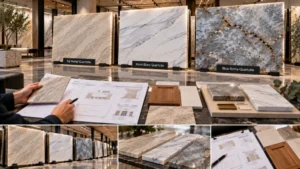
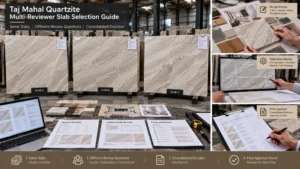
The approval should identify the physical slabs used in the proposal.
Ad esempio:
Taj Mahal Quartzite — TM-231 / TM-232 / TM-233
This is much more precise than:
Taj Mahal Quartzite — 3 slabs
Natural Quartzite varies from slab to slab, so approving a layout prepared on TM-231 does not automatically approve a different slab substituted later.
This is also why slab reservation should remain traceable by board number. The related Quartzite slab reservation form guide explains how exact board IDs, reservation status and substitution rules can be controlled before production.
2. The Position of Finished Pieces on Those Slabs
The customer may also be approving where important finished pieces are positioned within the actual slab.
Ad esempio:
TM-231 → Island Top
TM-232 → Left + Right Waterfall Returns
TM-233 → Perimeter Countertops + Spare Material
This matters when the stone contains areas that the customer specifically wants to feature or avoid.
3. The Visible Orientation
Natural Quartzite often has a readable visual direction.
A piece can be cut from the correct slab and still look different from the approved design if it is rotated or reversed relative to the reviewed layout.
The approval record should therefore make orientation understandable where it matters.
ACTUAL SLAB
↓
PIECE POSITION
↓
TOP / BOTTOM ORIENTATION
↓
VISIBLE FACE
↓
INSTALLED VIEW
4. Major Vein, Crystal or Pattern Placement
A buyer may approve a particular crystalline area in the center of an island.
Another project may intentionally keep a darker mineral zone toward one end.
A Blue Roma Quartzite layout may be reviewed for the relationship between its larger geological movement and the finished island geometry.
The form does not need to describe every mineral feature.
It should preserve the visual priorities that materially influenced the approved layout.
5. The Relationship Between Adjacent Visible Pieces
This becomes especially important for:
- island top + waterfall end;
- left waterfall + island + right waterfall;
- backsplash + countertop;
- adjacent wall panels;
- fireplace surround components;
- reception desk faces; and
- other intentionally coordinated stone pieces.
The customer may be approving the relationship, not merely each piece in isolation.
A Waterfall Approval Is More Than “I Like This Slab”
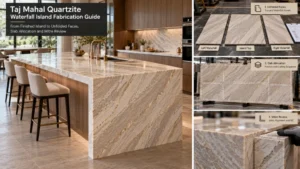
Consider a Taj Mahal Quartzite waterfall island.
The layout shows:
LEFT WATERFALL ← ISLAND TOP → RIGHT WATERFALL
The customer reviews all three visible faces together, including their orientation, major visual movement and intended relationships at the mitred ends.
Signing that visual layout should mean that the customer accepts the represented arrangement within the stated approval scope.
It should not silently mean that the customer has personally verified the bridge-saw sequence, mitre preparation method, reinforcement method or another fabrication decision outside the customer’s approval role.
The Customer Is Usually Not Approving These Things
This is where a good approval form becomes significantly safer and clearer.
NOT A MATERIAL TEST
Visual layout approval does not certify geological identity, physical properties or laboratory performance.
NOT A FABRICATION METHOD
The customer is not normally specifying saw sequence, tooling, reinforcement or fabrication procedure merely by approving the visual layout.
NOT AN INSTALLATION METHOD
Layout approval does not automatically approve supports, fixing, substrate, adhesive or site installation conditions.
NOT A UNIVERSAL WARRANTY
A visual approval should not be interpreted as a guarantee covering every natural feature or future condition.
Layout Approval Is Not the Same as Slab Selection
A customer can approve the slabs before approving how those slabs will be cut.
SLAB SELECTION
“Yes, these are the physical slabs we want to use.”
↓
LAYOUT APPROVAL
“Yes, we accept this represented allocation and visual arrangement of the finished pieces.”
↓
PRODUCTION RELEASE
“The required project approvals are complete and fabrication may proceed according to the controlling production documents.”
Depending on the project, these decisions may occur together or separately.
The form should say which one is happening.
Layout Approval Is Also Not Automatically Production Release
This distinction deserves its own line on the form.
PRODUCTION RELEASE STATUS
□ Visual layout approved — production release remains pending
□ Visual layout approved subject to listed conditions
□ Final project release issued under the identified controlling documents
This prevents a visual “looks good” message from automatically becoming an instruction to cut.
What Should Be Visible on the Drawing the Customer Approves?
The approval drawing should contain enough information for the customer to understand the visual decision without becoming an unreadable fabrication document.
| Approval Information |
Scopo |
| Material + Board ID |
Identifies the physical Natural Quartzite being reviewed. |
| Complete Slab Image |
Preserves the relationship between the proposed pieces and actual slab. |
| Finished-Piece Outlines |
Shows where each relevant component is proposed. |
| ID dei pezzi |
Connects the layout to project drawings and later fabrication records. |
| Orientamento |
Clarifies intended visible direction where visually important. |
| Relevant Seams / Joints |
Shows visible divisions included in the review. |
| Revision + Date |
Defines which layout the signature applies to. |
What Does the Signature Apply To?
A signature should be attached to a revision, not merely to a project name.
Ad esempio:
APPROVAL BASISProgetto: Residence A — Kitchen Island
Materiale: Quarzite della Patagonia
Boards: PQ-116 / PQ-117
Layout: LAYOUT-R04
Drawing Date: [Data]
Approval Scope: Island-top position, left/right waterfall allocation, visible orientation and represented visual relationships
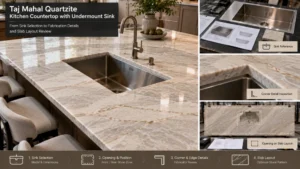
Open Item: Final sink-cutout geometry remains subject to current fabrication drawing and responsible fabricator review
The customer is approving R04.
Not every future drawing carrying the same project name.
What Happens If the Drawing Changes After Signature?
Not every change requires the entire approval process to restart.
But the team should ask one question:
Does the revision change something that was inside the customer’s approval scope?
CHANGE OUTSIDE VISUAL APPROVAL
An internal production annotation changes without changing the approved visible layout.
Action: Control through the appropriate fabrication document; customer re-approval may not be required solely because the internal note changed.
CHANGE INSIDE VISUAL APPROVAL
Island position moves, waterfall allocation changes, visible orientation reverses, or a seam moves.
Action: Return the affected visual decision for review.
Do Not Hide Revisions Behind the Same File Name
Suppose the customer approves:
Layout R03
Then the island is shifted to avoid a condition on the slab.
The new proposal is:
Layout R04
R04 should not overwrite R03 and continue using the old signature as though nothing changed.
Revision Control
Preserve the previous approved record, identify what changed, issue the new revision, and state whether the change affects the customer’s previous approval.
Conditional Approval Is Better Than an Ambiguous “Approved”
Sometimes the customer is ready to approve the visual arrangement while another issue remains open.
That does not always require rejecting the entire layout.
It may require a conditional approval.
EXAMPLE
The visual placement and orientation of the identified Taj Mahal Quartzite island and waterfall components shown in Layout R05 are approved.
Final sink-cutout geometry remains subject to the current fabrication drawing and responsible fabricator review.
This approval does not authorize a change of slab, piece orientation or visible layout without further review.
That is much clearer than:
“Approved with comments.”
What If the Customer Writes “Looks Good” on WhatsApp?
That message can be useful evidence of a conversation.
But before treating it as a controlled Quartzite layout approval, connect it to:
- the exact slab IDs;
- the exact layout revision;
- the drawing or image reviewed;
- the approval scope;
- any conditions;
- the approver; and
- the date.
A short confirmation can then convert an informal conversation into a usable project record.
The Customer Does Not Need to Approve Every Fabrication Detail
The approval form should not force the customer to sign technical statements that belong to the responsible fabricator.
For example, a customer may approve:
“Keep this crystalline area in the center of the island.”
The fabricator may still need to determine how that design intent interacts with:
- actual slab condition;
- sink or cooktop openings;
- remaining stone geometry;
- la lavorazione dei bordi;
- mitres;
- equipment;
- handling; and
- other production considerations.
The two roles are related but not interchangeable.
What If a Different Slab Has to Be Used?
If the customer approved a layout on one identified slab and that slab later changes, the visual basis of the approval may also change.
APPROVED BOARD
↓
BOARD CHANGES
↓
NEW SLAB IMAGE
↓
NEW PIECE POSITION
↓
NEW VISUAL REVIEW
Do not assume that another slab with the same commercial Quartzite name automatically inherits the previous layout approval.
The Approval Form Should End with an Explicit Statement
A good form should not make the customer infer what the signature means.
CUSTOMER LAYOUT APPROVAL STATEMENT — EXAMPLE
I confirm that I have reviewed the identified Natural Quartzite slabs and the finished-piece layout shown in the revision referenced above. Within the scope shown on this approval record, I accept the represented piece positions, visible orientation, major pattern placement, identified visible relationships and seam/joint locations shown for customer review.
I understand that Natural Quartzite has natural variation and that this approval applies to the identified slabs and current layout revision.
Items specifically listed as open, conditional or subject to fabricator/technical review are not closed by this visual approval.
Any later change to the identified slab, approved visible-piece allocation or other item within this approval scope requires review according to the project’s change-control process.
The exact wording should be adapted to the project’s contract, responsibility structure and production process rather than copied as a universal legal clause.
A Practical Quartzite Layout Approval Form
PROJECT / MATERIAL
Project: ______________________________
Area / Application: ____________________
Natural Quartzite: _____________________
Board IDs: ____________________________
Finish: _______________________________
CONTROLLING LAYOUT
Drawing / Layout Number: _______________
Revision: ______________________________
Date: _________________________________
Related Slab Images: ___________________
CUSTOMER VISUAL REVIEW
□ Slab identity shown
□ Finished-piece positions reviewed
□ Visible orientation reviewed
□ Major pattern / feature placement reviewed
□ Relevant adjacent-piece relationships reviewed
□ Relevant visible seams / joints reviewed
OPEN / CONDITIONAL ITEMS
1. _____________________________________
2. _____________________________________
3. _____________________________________
RELEASE STATUS
□ Visual layout approved
□ Approved subject to listed conditions
□ Revision required before approval
□ Production release remains separate
□ Production release included under identified project procedure
APPROVAL RECORD
Approver: ______________________________
Role: __________________________________
Signature / Recorded Approval: __________
Date: __________________________________
FAQ
1. What is a Quartzite layout approval form?
A Quartzite layout approval form is a project record that connects an identified Natural Quartzite slab or slab set to a specific layout revision and records the customer’s approval of the defined visual arrangement before the next project stage.
2. What does the customer actually approve on a Quartzite layout?
Depending on the stated approval scope, the customer may approve the identified slabs, finished-piece placement, visible orientation, major pattern positioning, adjacent-piece relationships, and visible seam or joint locations shown in the current revision. The form should explicitly state which items are included.
3. Is Quartzite layout approval the same as approving the slabs?
No. Slab selection identifies which physical slabs the project accepts, while layout approval addresses how finished pieces are proposed within those slabs. A project may complete these decisions at different stages.
4. Does signing a layout approval form authorize cutting?
Only if the project’s documented process explicitly makes the layout approval part of production release. Otherwise, the form should state that visual approval and authorization to begin fabrication are separate decisions.
5. Does the customer approve fabrication methods on the layout form?
Not merely by approving the visual layout. Saw sequence, reinforcement, detailed cutout assessment, edge fabrication, handling and other technical matters should remain within the scope of the responsible fabricator or other qualified project party unless the governing project documents state otherwise.
6. What happens if the Quartzite layout changes after approval?
Identify the new revision and determine whether the change affects something inside the customer’s previous approval scope. A changed slab, piece position, visible orientation, major pattern placement or visible seam may require renewed visual review.
7. Can a customer approve a Quartzite layout with conditions?
Yes. A conditional approval can accept the current visual direction while keeping identified items open, such as a revised dimension, final cutout review or another fabricator-controlled question. The form should clearly identify each condition and the action required to close it.
8. Is a WhatsApp or email message saying “looks good” enough?
It can form part of the project record, but the approval is clearer when the message is tied to the exact slab IDs, current layout revision, approval scope, conditions, approver and date. This reduces ambiguity about what the customer actually reviewed.
From Quartzite Layout Review to Controlled Fabrication
For project-based Natural Quartzite orders, HRST STONE can coordinate current slab photographs, board references, CAD/shop drawings, proposed cutting layouts, visible-piece orientation, customer review records, fabrication information, dry-lay photographs, QC records and reinforced fumigated wooden-crate packing around the confirmed order scope. Send Josh the selected slabs, current drawings, dimensions, finish, visible priorities, cutouts and required approval stage so the review can be tied to the correct project revision.
© HRST STONE / XIAMEN HRST STONE CO., LTD. Tutti i diritti riservati.