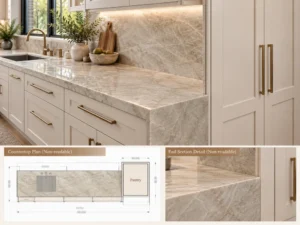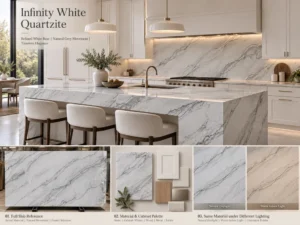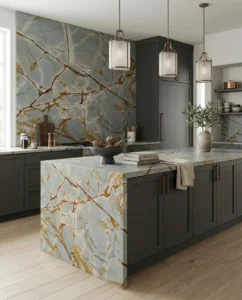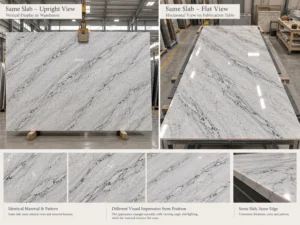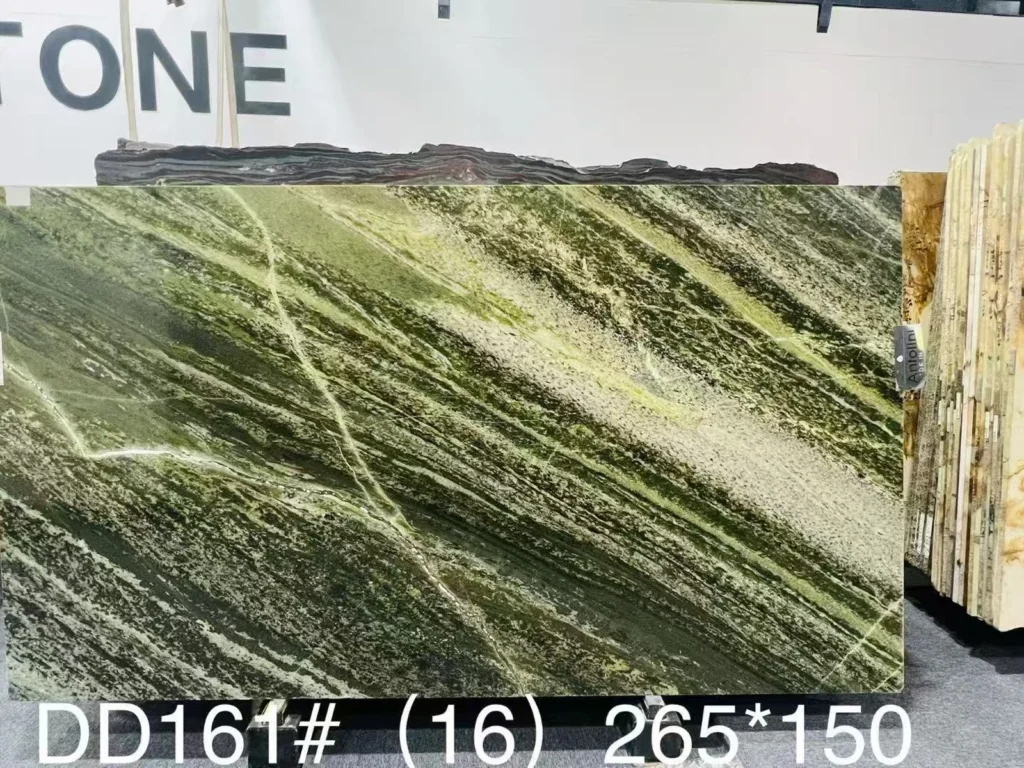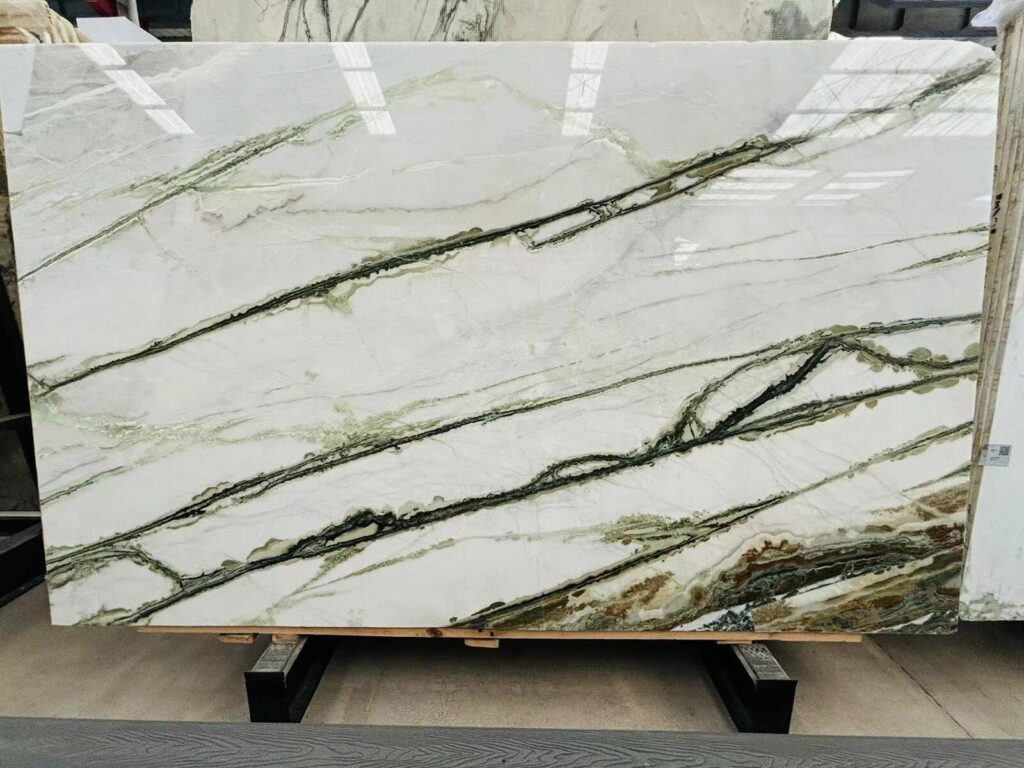

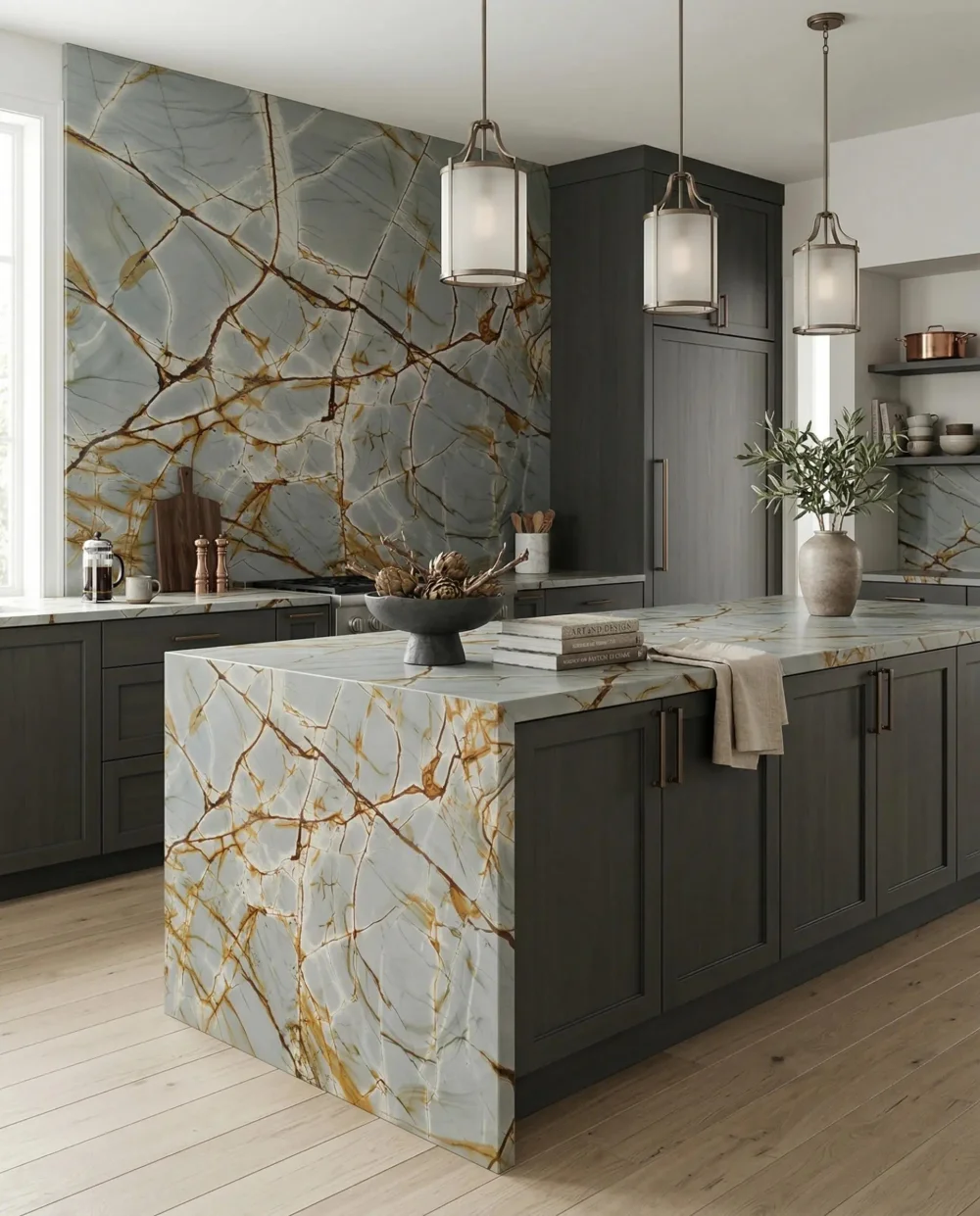
The best orientation for a Blue Roma Quartzite waterfall island depends on the actual slab, the island proportions, and the surfaces that matter most from the room. Compare the same finished island with the slab movement running along its long axis and across its width. Then examine how the pale blue-grey fields, dark coffee-brown mineral lines, and warmer crystalline areas appear on the top and waterfall ends. Choose the orientation based on the complete three-dimensional composition—not the slab photograph alone—and have the cutting arrangement confirmed before fabrication.
A large Blue Roma Quartzite slab may look convincing in several directions. Its pale blue-grey background, irregular dark brown movement, and warmer mineral areas can create very different compositions depending on how the island outline is placed over the stone.
For a conventional countertop, the orientation decision often focuses on the main horizontal surface. A waterfall island adds another challenge: the stone must also work vertically. The selected movement travels toward an outside corner, and a different portion of the slab becomes a visible end panel.
That is why choosing the Blue Roma Quartzite waterfall island orientation deserves its own design review.
The question is not simply which way the veins run. It is what the entire island looks like after the selected layout is transformed into a finished object.
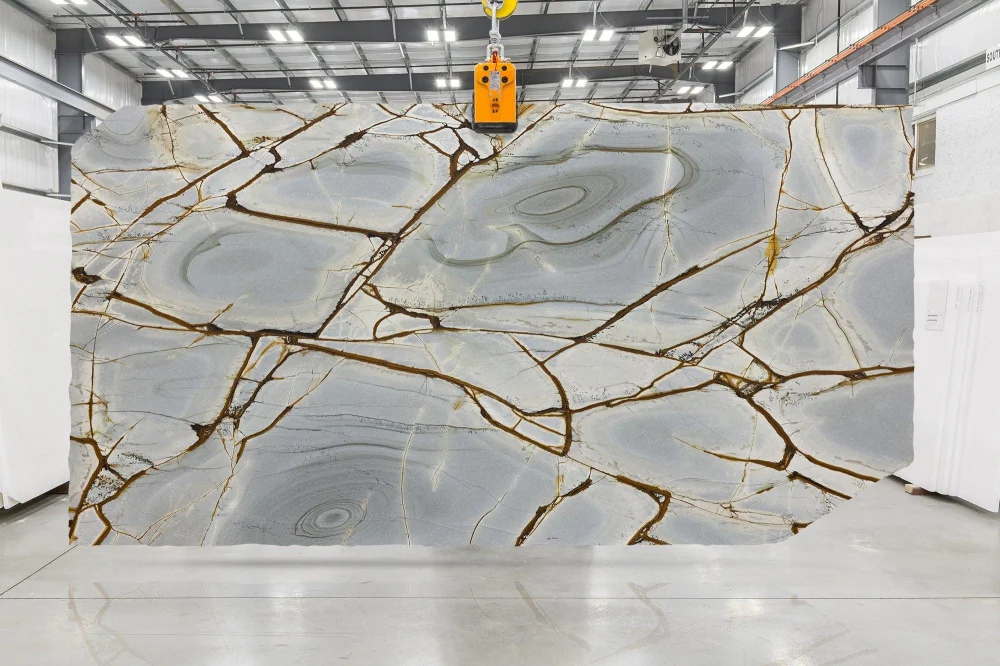
Blue Roma is often recognized by its cool blue-to-blue-grey background, irregular coffee-brown to dark brown mineral lines, and areas of warmer beige or cream mineral character. However, the relative amount and placement of these features vary between actual slabs.
One slab may have a strong diagonal fissure-like movement. Another may contain several competing darker areas. A third may have more widely distributed movement and larger uninterrupted blue-grey fields.
These differences become significant when an island occupies a prominent position between the kitchen and living or dining area.
For example, a dark feature travelling toward the long end of an island can make the composition feel directional. Turn the finished island outline relative to that feature, and the same stone movement may instead cross the island width, intersect the seating edge, or terminate near a waterfall corner.
None of these placements is automatically preferable. Their success depends on the specific slab and the intended interior composition.
For a reference to the material’s characteristic blue-grey and darker mineral movement, see the Blue Roma Quartzite material page. Final layout choices should still use photographs of the actual slabs proposed for the project.
Start by drawing the island as a simple rectangle with a clearly identified long axis, short axis, seating side, kitchen side, and waterfall ends. Use the project’s measured dimensions and current revision.
Now compare two initial orientations against the same candidate slab.
Position the dominant Blue Roma movement so that it generally follows the length of the island. This can emphasize the long horizontal dimension when the selected slab contains a sufficiently directional feature.
From above, the movement may travel through much of the island top. From a lower room viewpoint, it may also guide the eye toward one waterfall end.
However, a long-axis arrangement does not guarantee that the relevant feature will continue attractively down that end. The proposed waterfall piece may capture a different part of the slab, or fabrication allowances may change the relationship near the corner.
Rotate the island template relative to the slab so that the dominant movement generally crosses the island width. This may make the pattern more visible from the seating side or create several shorter visual events across the long countertop.
For some Blue Roma slabs, this arrangement gives the broad blue-grey field more continuous space along the length of the top while the stronger brown movement appears as a crosswise accent.
The trade-off is that a strong mineral feature may intersect the long finished edge, pass close to an opening, or become visually concentrated near one particular section.
| समीक्षा बिंदु | Long-Axis Option | Cross-Axis Option |
| Pattern on the top | Dominant movement generally follows the island length. | Dominant movement generally crosses the width. |
| Visual emphasis | Potential emphasis on longitudinal movement. | Potential emphasis on crosswise pattern events. |
| Waterfall relationship | Check which movement reaches each end. | Check whether the ends contain stronger or quieter fields. |
| Layout constraint | May require sufficient usable slab length in the selected direction. | May change how the island fits the usable slab width. |
| Best way to compare | Full slab overlay plus finished room view. | The same overlay and room view, with only orientation changed. |
These are comparison scenarios, not universal rules about how Blue Roma must be cut. Strongly diagonal slabs may require a third, intermediate orientation, provided the actual dimensions and fabrication constraints allow it.
A reliable comparison begins with one full-slab photograph. It should show the complete slab, identifiable board reference, and sufficient visual detail to recognize the major mineral areas.
Place a scaled island-top outline over that image. Then compare alternative positions and rotations of the outline. Keep the sink, cooktop, seating overhang, and other fixed geometry in the same relationship to the finished island.
Same Blue Roma slab
+ Same island dimensions
+ Same cutout locations
+ Different template orientation
= Two genuinely comparable slab-layout proposals
Do not redraw, stretch, mirror, or invent the natural pattern to make a layout look more convincing. The material itself is the fixed reference. Only the proposed cutting geometry changes.
Also check whether the rotated island template still fits inside the usable slab. A composition may be visually appealing but impossible to obtain from the selected board once finished dimensions, edge processing, cut allowances, and areas requiring technical review are considered.
This is an important distinction between rotating a digital image for inspiration and approving a physical cutting layout.
After comparing the island tops, add the proposed waterfall panels to each option. A single-waterfall island and a double-waterfall island may lead to different orientation choices.
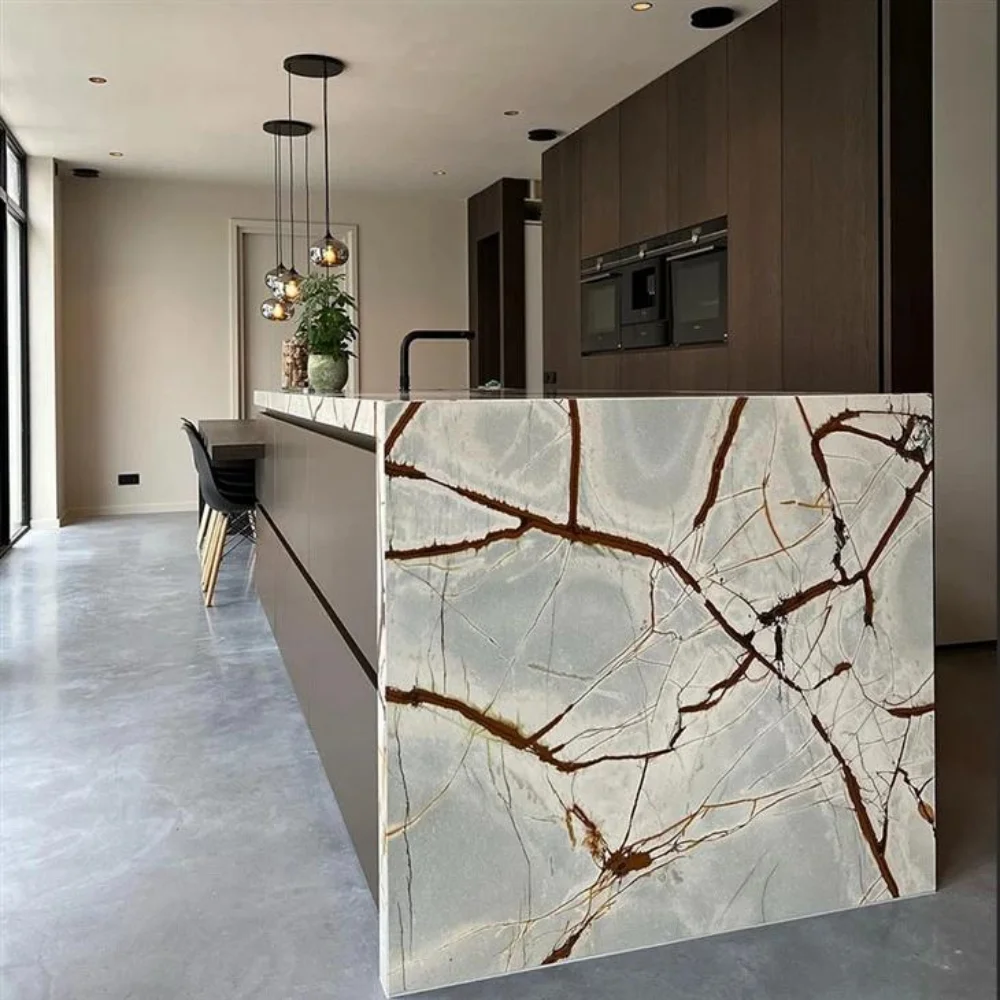
If the island has one waterfall, determine whether the end should carry the strongest Blue Roma feature or provide a calmer conclusion to the top.
An island facing a living area may have one particularly prominent end. In that case, the end-panel pattern can influence the room more strongly than the less visible portions of the countertop.
For a dark brown feature approaching the corner, compare what happens when that feature is located on the horizontal top, near the transition, or mainly within the vertical panel.
A striking dark feature on the end can create a deliberate visual anchor. But if that same feature competes with a very active top, the finished island may feel more visually concentrated than expected.
A double-waterfall island contains three principal visible planes: the top, left end, and right end.
One possible design aims for similarly weighted ends. Another intentionally places stronger movement on the primary viewing side and quieter blue-grey material on the secondary end.
Because Blue Roma is natural stone, equivalent left and right dimensions do not imply matching natural patterns. The actual slab allocation determines the resulting visual relationship.
Review both ends together before approving either one. Do not select a perfect-looking top crop and assume suitable waterfall panels can always be found in the remaining material.
Orientation is especially important because a waterfall island is not experienced from one fixed viewpoint.
An overhead review makes the overall mineral structure easier to understand. It shows how the darker brown movement crosses the blue-grey fields and how major features relate to the island boundaries and cutouts.
Use this view to compare the placement and direction of important stone features. It is valuable for planning, but it should not be the only approval image.
From normal standing height in the adjacent living or dining area, the viewer may see only a compressed portion of the top surface. The waterfall end, exposed edge, cabinetry, and island silhouette become more significant.
A dramatic pattern visible in a full overhead slab photograph may have less impact from this viewpoint. Conversely, an important mineral feature near the visible edge may become more prominent than it first appeared on the plan.
For this reason, compare both orientation options from the same realistic camera position.
Stand virtually or physically at the principal end of the island. Examine the blue-grey field, concentration of dark brown movement, and distribution of warmer mineral areas on the waterfall face.
This view often reveals whether the proposed end panel has become an intentional part of the design or merely a remaining piece selected after the top.
एक Blue Roma Quartzite waterfall island, the most effective orientation is the one that serves the specified viewing priorities while remaining feasible on the actual slab set.

Not every Blue Roma slab has a simple linear vein that can be followed continuously. Some contain irregular intersecting fissure-like features, patches of cream-colored mineral character, and areas where movement changes direction.
Near a waterfall corner, these features can create three quite different visual situations.
Corner A — Strong Pattern at the Turn
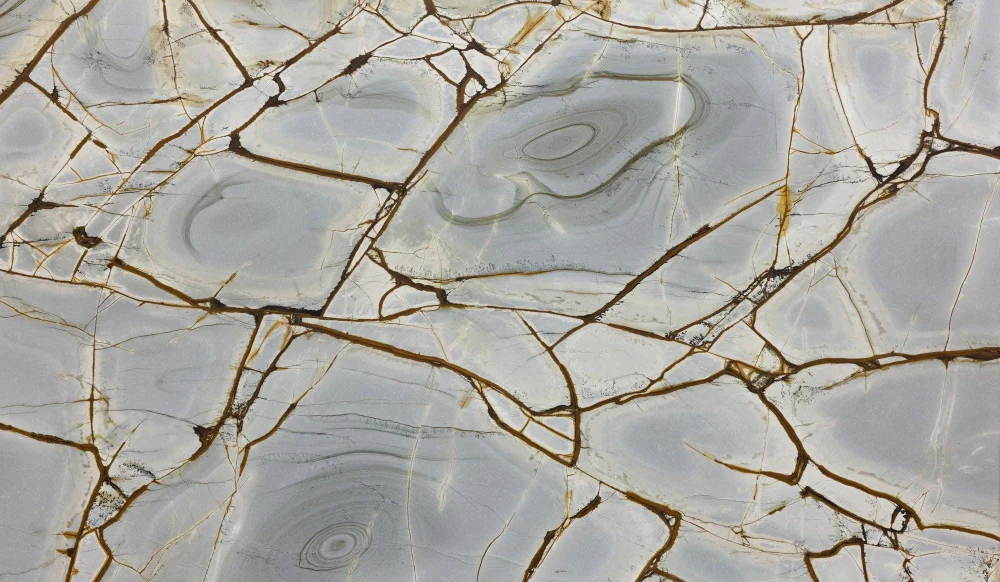
The prominent mineral movement approaches the corner and becomes part of the top-to-end visual transition.
Corner B — Quiet Transition
A calmer blue-grey area occupies the visible corner, allowing stronger movement to remain elsewhere.
Corner C — Contrasting Faces
The top and waterfall contain visibly different mineral concentrations, creating a deliberate contrast rather than an assumed continuous vein.
The third option is not necessarily a mistake. The issue is whether the resulting contrast is understood and accepted before cutting.
When a project requires a convincing continuation, the selected pieces should be reviewed as adjacent visible faces in the actual slab layout. The appearance at a real mitre can change during fabrication because of cutting, trimming, and edge preparation.
For a detailed explanation of that separate production issue, see क्वार्ट्जाइट वॉटरफॉल मिटर्स: कटिंग सीक्वेंस क्यों मायने रखता है. This orientation guide focuses on deciding where the stone movement should appear before the fabrication method is finalized.
A sink or cooktop can influence the orientation choice because its opening removes part of the stone that would otherwise contribute to the visual composition.
Consider a Blue Roma slab with one concentrated dark mineral feature. In the long-axis option, that feature might travel toward the waterfall while passing through the planned sink opening. In the cross-axis option, more of it might remain visible beside the opening.
That does not automatically make the cross-axis option preferable. The alternative orientation may create different constraints near the finished edges, support zones, and waterfall allocation.
Use the same confirmed opening geometry on both options. Then examine what remains visible around the opening, including the portions of the top that will actually be seen from the principal room viewpoints.
The visual review should remain separate from the fabricator’s assessment of opening geometry, supports, handling, and other project-specific requirements. Neither a conceptual layout nor a photograph establishes technical suitability on its own.
There is often tension between visual orientation and material utilization. One layout may present the most desirable blue-grey and brown mineral composition but consume more usable slab area. Another may be more economical in its allocation while producing a less desirable focal view.
The right sequence is to identify the visual priority, establish which layouts are technically feasible, and then compare material use within those feasible alternatives.
Do not assume a rotated option has the same material yield. The usable length and width of the actual slab, required component sizes, finishing allowances, and whether waterfall panels come from the same or another board can all affect the allocation.
| Decision | Buyer Should Confirm | Evidence |
| Visual priority | Which view matters most? | Current room perspective |
| अभिविन्यास | Long-axis, cross-axis, or another reviewed direction? | Actual slab A/B overlay |
| वॉटरफॉल के छोर | Which geological features appear on each end? | Developed three-face layout |
| Usable material | Can the proposed pieces be allocated with fabrication allowances? | Reviewed cutting proposal |
| Final decision | Which exact layout revision is accepted? | Dated slab-layout approval |
For a premium project, the quotation should make clear whether alternative slab allocations, additional boards, special pattern selection, or matching-related work are included in the offered scope. A general material rate cannot describe those project-specific differences.
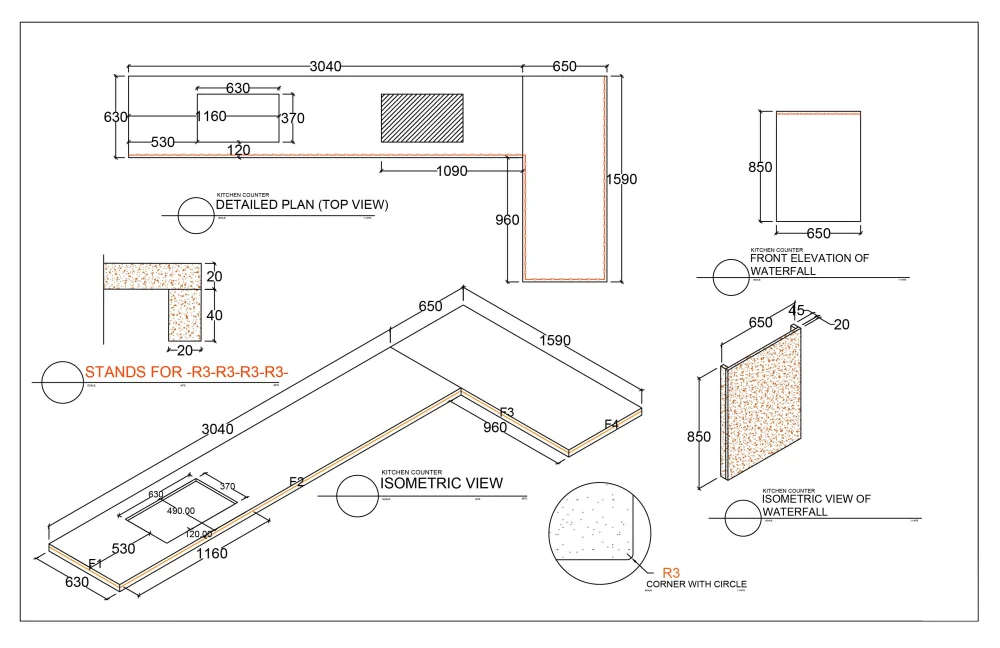
After selecting a preferred option, convert the visual decision into a traceable drawing package. The package should distinguish the intended visual movement from the physical orientation of each fabricated component.
For example, an arrow on the island top may indicate a desired direction of mineral movement. It should not be assumed to tell the fabrication team everything about the cutting position, finished face, or installation orientation.
Record the actual slab reference, island plan, waterfall elevations, piece IDs, visible faces, direction marks, mitre positions, cutouts, finish, and current revision. If the stone allocation is changed, revisit the visual comparison before accepting the new layout.
The related guide to शॉप ड्राइंग्स के लिए क्वार्टज़ाइट वेन डायरेक्शन सिंबल्स explains how to define directional marks so different teams interpret them consistently.
For remote projects, photographs and inspection records should use the same component references. This is particularly helpful when the people approving Blue Roma in the design stage are different from those coordinating fabrication, packing, and site installation.
The final Blue Roma orientation review should answer the following questions clearly:
The buyer’s decision should concern the approved material, visible composition, and agreed project scope. Fabrication processes, structural details, installation interfaces, and other specialist requirements must be reviewed by the responsible professionals.
The best Blue Roma Quartzite orientation is not necessarily the direction that looks most dramatic on a slab photograph. It is the feasible arrangement that creates the intended visual relationship across the finished island’s most important surfaces.
कोई सार्वभौमिक प्राथमिकता वाली दिशा नहीं है। एक ही तैयार आइलैंड आउटलाइन की वास्तविक ब्लू रोमा स्लैब पर दोनों अवस्थाओं में तुलना करें। प्राथमिक विकल्प चुनने से पहले, ऊपरी हिस्से, झरने के सिरों और प्राथमिक कमरे के दृश्य पर उत्पन्न पैटर्न की समीक्षा करें।.
प्रस्तावित लेआउट को घुमाने से स्लैब के कौन से हिस्से शीर्ष और वॉटरफॉल पक्षों पर दिखाई देते हैं, इसमें काफी बदलाव आ सकता है। यह मटेरियल आवंटन और कटिंग की संभावना को भी बदल सकता है। जब भी अभिविन्यास में परिवर्तन हो, वास्तविक कटिंग स्थितियों की एक बार फिर से समीक्षा की जानी चाहिए।.
नहीं। डिजाइन में एक आकर्षक पैटर्न संबंध, एक शांत ट्रांज़िशन, या फेसों के बीच जानबूझकर किया गया विपरीत हो सकता है। चूंकि पत्थर को अलग-अलग घटकों में काटा जाता है और निर्माण के दौरान सामग्री को हटाया जाता है, इसलिए धारी से धारी तक ठीक से निरंतरता की अपेक्षा नहीं की जानी चाहिए।.
यह देखने की प्राथमिकता पर निर्भर करता है। कुछ द्वीपों में क्षैतिज शीर्ष प्रमुख होता है, जबकि अन्य में लिविंग या डाइनिंग एरिया से एक झरने का अंत प्रमुख होता है। मुख्य दृश्य बिंदुओं की पहचान करें और प्रत्येक तैयार सतह पर वास्तविक भूवैज्ञानिक विशेषताओं की तुलना करें।.
प्रस्तावित स्लैब सेट की समग्र समीक्षा करें और यह दर्ज करें कि प्रत्येक दृश्यमान घटक के लिए कौन सी बोर्ड सामग्री प्रदान करती है। लेआउट को मंज़ूरी देने से पहले, उपस्थिति, भिन्नता, उपयोगी क्षेत्र और टुकड़ों के बीच के दृश्य संबंधों पर विचार करना आवश्यक है।.
नहीं। एक तीर एक निर्धारित दिशा या अभिप्रेत गति को व्यक्त करता है, लेकिन वह वास्तविक स्लैब लेआउट का स्थान नहीं ले सकता। अनुमोदन में संबंधित टुकड़ा आईडी, दृश्य पृष्ठ, स्लैब की स्थिति, जॉइंट्स, आयाम और ड्राइंग संशोधन की पहचान भी की जानी चाहिए।.
Send Josh the proposed Blue Roma slab references or material requirements, current island dimensions, kitchen plan, waterfall-end details, sink or cooktop positions, preferred finish, key room views, quantity, and delivery destination. Mark the main visual priority and any orientation options that need comparison.
HRST STONE can help coordinate available material information, slab photographs, CAD/shop drawing requirements, visual layout proposals, fabrication communication, QC records, and export-packing information for the confirmed project scope. Send Josh your island drawings and preferred viewing directions to discuss the actual Blue Roma Quartzite slab options and the next review steps.
कॉपीराइट © HRST STONE / XIAMEN HRST STONE CO., LTD. सभी अधिकार सुरक्षित हैं।.