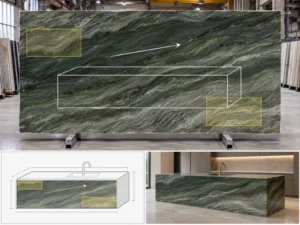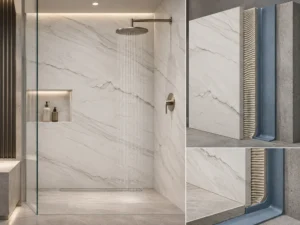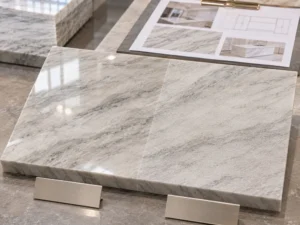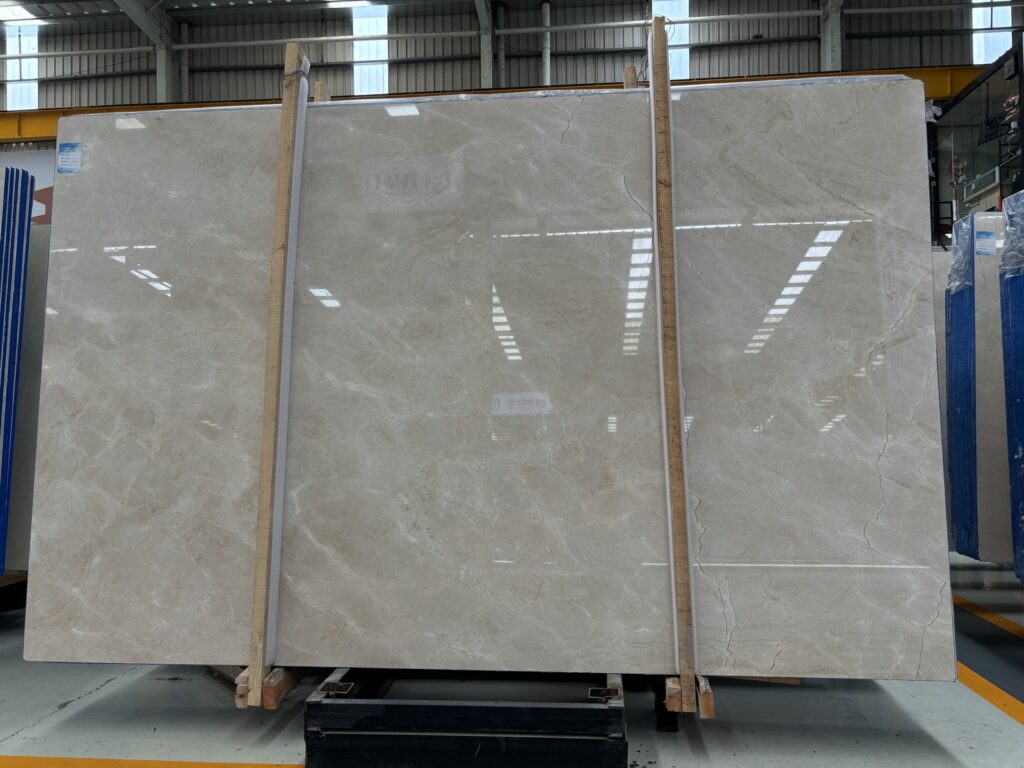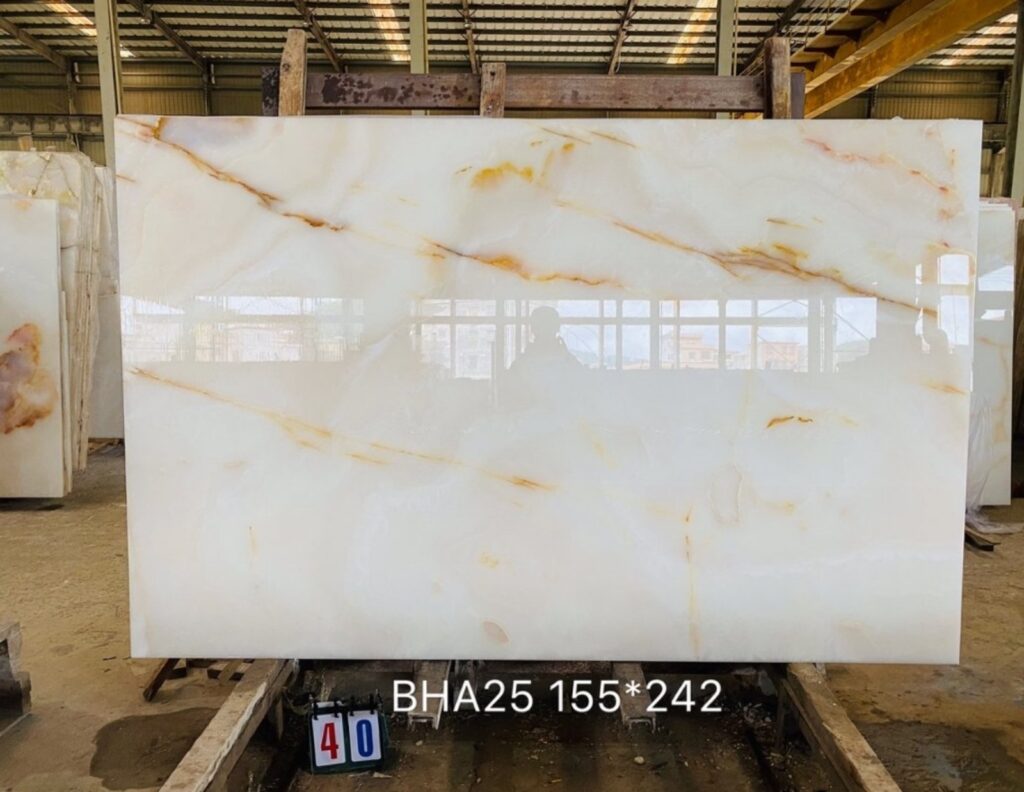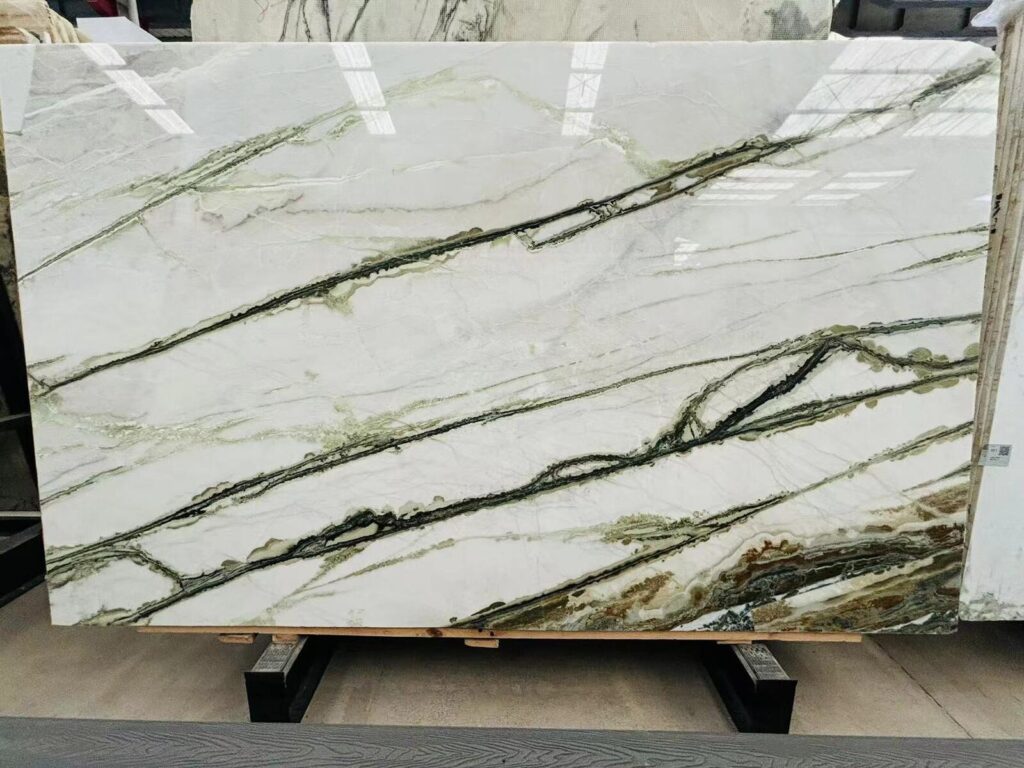


A quartzite bundle should not be approved as a complete lot simply because the first visible slab looks acceptable. If middle slabs remain hidden, the buyer should define exactly what has been inspected, request traceable evidence for the remaining sequence, and keep whole-lot approval conditional until the required visual, dimensional and fabrication checks have been completed.
Краткое резюмеWhen several quartzite slabs are stored together as a bundle, the front slab does not automatically represent every slab behind it. Natural variation, local mineral features, repairs, mesh backing, edge damage, tonal shifts and directional movement may differ through the sequence. Before approving the whole lot, identify the bundle, slab quantity and slab sequence; obtain complete slab views wherever required; define what remains unseen; and state whether the approval covers the full bundle, selected slabs only, or a conditional reservation pending final inspection.
А quartzite slab bundle is a grouped set of natural quartzite slabs stored, handled or supplied together, often from related production, but the number of slabs and their degree of visual similarity should never be assumed without reviewing the actual material.
This distinction matters for importers, fabricators, designers and contractors buying natural quartzite remotely. A supplier may send an excellent photograph of the first slab in a bundle. The photograph may be completely genuine, yet it still tells the buyer very little about a slab positioned several pieces behind it.
That does not mean hidden slabs are automatically problematic. It means the evidence available for approval is incomplete.
The purchasing decision should therefore separate three questions: Which slabs have actually been seen? Which slabs can be identified and traced? And what level of approval is justified by the evidence available today?
Natural quartzite is not manufactured as a perfectly repeated graphic. Even slabs cut from the same block can show changes in vein position, mineral concentration, crystal fields, background tone or the location of natural fissures and repaired areas.

Related slabs may look very similar overall while still containing important local differences. These differences become especially significant when the project requires large kitchen islands, waterfall ends, feature walls, reception fronts, bookmatched panels or several pieces that must visually relate to one another.
A front slab photograph can confirm useful information:
However, it cannot confirm that every hidden slab has the same usable area, the same dominant movement, the same repair distribution or the same condition along its full face.
Approval Boundary“Front slab accepted” и “entire bundle accepted” are two different decisions.
If only one or two slabs have been fully viewed, the approval record should say so. The unseen slabs should remain subject to the agreed inspection requirement rather than being silently treated as approved.
This is particularly important for remote purchasing. High-resolution photographs and video can support a professional decision, but the buyer still needs a traceable record showing which slab each image represents.
A hidden slab is simply a slab whose complete usable face cannot currently be reviewed because other slabs are positioned in front of it or because the bundle has not been opened far enough for inspection.
The term should not automatically imply concealment by the supplier.
Large stone slabs are heavy products that must be stored and moved using controlled equipment and trained personnel. In an active factory or slab yard, opening every bundle may require space, handling time and an appropriate safety procedure.
The procurement issue is therefore not whether a slab happens to be physically hidden. The issue is whether the buyer understands what remains unreviewed before granting approval.
For example, suppose a bundle contains several related slabs and the supplier sends complete photographs of Slabs 1 and 2 while the remaining slabs stay packed behind them. The buyer can reasonably review Slabs 1 and 2. The buyer cannot reasonably claim to have visually approved all remaining slabs unless further evidence is provided.
A useful bundle record should therefore connect the physical sequence with the approval evidence.
It may identify:
The exact labeling system can vary between suppliers. Consistency and traceability matter more than the appearance of the label itself.
Before a buyer writes “approved,” both sides should understand what that approval means.
Whole-bundle approval may involve visual acceptance, dimensional acceptance, fabrication suitability, quantity confirmation or a combination of these. Those decisions should not be merged into one vague message.
| Approval Area | What Should Be Reviewed | What Approval Does Not Automatically Mean |
| Material identity | Material name, bundle reference, finish and slab quantity | Every slab has identical colour or movement |
| Visual range | Complete slab faces, tonal range, directional movement and major natural features | Every area of every slab is suitable for every finished piece |
| Состояние | Visible repairs, fissures, resin, mesh, edge condition and relevant surface observations | An unseen condition has been inspected |
| Размеры | Usable dimensions where required by the project | Nominal slab size guarantees every cutting layout |
| Fabrication release | Approved slab allocation and current cutting drawings | Material approval alone authorizes cutting |
This distinction protects both buyer and supplier.
A buyer may accept the overall natural variation of the bundle while still requiring project-specific slab allocation before cutting. Conversely, a slab may be visually attractive but unsuitable for one particular large finished piece because the required usable area conflicts with a natural feature or slab geometry.
The safest commercial record states exactly which decision has been made.
The evidence required depends on the project value, visual sensitivity, number of slabs and intended fabrication.
A small vanity project does not require the same inspection package as a multi-slab kitchen island or hospitality feature wall. However, the evidence should always be sufficient for the decision being requested.

For visual approval, a complete slab photograph is more useful than several decorative close-ups.
The image should show all or nearly all of the usable face, including the main boundaries of the slab. Lighting should be reasonably consistent between slabs so that differences are not created merely by photographing one slab in direct sunlight and another under dark warehouse lighting.
Close photographs can then document specific mineral zones, repairs or areas the buyer wants to discuss.
The buyer should be able to connect each photograph with a specific physical slab.
That does not require publishing readable factory labels in marketing images. During project control, however, the supplier and buyer need a stable internal reference such as Bundle A / Slab 01, Bundle A / Slab 02 and so on.
If revised photographs are issued later, the same identity should continue to follow the slab.
For a bundle where visual continuity matters, sequential review can help the buyer understand how the material changes through the stack.
A practical sequence may show:
Slab 01 → Slab 02 → Slab 03 → Slab 04 → remaining slabs
The goal is not to create a promotional slideshow. The goal is to establish which physical slab follows which and whether the pattern or tone changes materially through the bundle.
Some quartzite slabs may have mesh reinforcement, resin treatment or other processing visible from the back. Whether the back needs to be reviewed depends on the project and the material.
When it matters to fabrication, ask for relevant back-surface photographs rather than assuming all slabs in the bundle have identical reinforcement conditions.
Evidence LadderLevel 1: One visible front slab — useful for preliminary material discussion.
Level 2: Several identified slab faces — useful for understanding the developing range.
Level 3: Identified sequential slab photographs or controlled video — stronger evidence for bundle review.
Level 4: Full slab review plus project cutting layout — appropriate when the exact usable areas matter before fabrication.
The purpose of inspection is not to reject natural variation. It is to understand it before the stone is allocated to finished work.
Natural quartzite may contain changes that are expected characteristics of geological material as well as repaired or processed areas introduced during slab production. These should be reviewed in context rather than automatically described as defects.

A slab positioned deeper in a bundle may be lighter, darker, warmer or cooler than the first slab.
For a single countertop this may be perfectly acceptable. For one continuous reception wall using several slabs, the same tonal change may need deliberate allocation.
Direction can matter more than colour.
A set of slabs may share a similar background but contain a major diagonal movement on one slab and a more horizontal movement on another. That becomes important when a project expects a visual flow across seams or waterfall returns.
This is why strongly directional stones should be reviewed as actual slabs rather than approved from a small sample.
For example, Синий ромский кварцит can show noticeable changes in dark mineral concentration, cloudy areas and dominant movement between individual slabs. The project layout should therefore use the actual selected slabs rather than assuming one photographed slab represents the entire supply.
Quartzite may contain natural fissures, crystal transitions, mineral lines or other geological features. Their significance depends on location, geometry and intended fabrication.
A feature near the edge of an unused slab area may have little project impact. The same feature positioned through a narrow bridge beside a sink cutout may require additional fabrication review.
Slab processing can include resin filling or local repair. Buyers should distinguish visible processing from geological variation and review any relevant areas against the acceptance criteria agreed for the order.
A photograph should document a significant repair rather than rely on vague descriptions such as “normal” or “not normal.” The useful question is whether the actual condition is acceptable for the intended finished piece.
Some natural stone slabs may use mesh reinforcement on the reverse side. Mesh presence alone does not establish whether a slab is suitable or unsuitable for a particular fabrication.
If the proposed project contains large cutouts, narrow sections or demanding handling conditions, the fabricator should review the actual slab and finished geometry before cutting.
Consecutive slabs can be valuable when a project requires related visual movement, but the word consecutive should not be interpreted as a guarantee of perfect matching.
Depending on how the block was cut and how the natural geology moves through it, two neighboring slabs may relate strongly or may show noticeable differences.
The buyer should therefore verify the relationship rather than approve based on terminology alone.
For projects where matching matters, place the slab images in physical sequence and review them at a comparable scale.

Look for:
If a design requires mirrored or bookmatched effects, confirm the actual slab relationship before promising the result.
Two consecutive slabs are not automatically a bookmatch pair.
The appropriate step is to review the real slabs together with the finished elevation or cutting layout.
This is where approval language becomes especially important.
There may be legitimate operational reasons why a full bundle cannot be completely opened at the first commercial stage. The buyer then has several options other than pretending the hidden slabs have already been inspected.
| Situation | Possible Buyer Decision | Recommended Record |
| Only front slabs visible | Preliminary material acceptance | Identify exactly which slabs were viewed |
| Bundle needs to be commercially reserved | Conditional reservation | Reservation subject to agreed slab inspection |
| Some slabs can be opened | Partial inspection | Record inspected and uninspected slab references separately |
| All slabs required for sensitive layout | Hold final visual approval | Release approval after complete slab evidence |
| Material accepted but layout unresolved | Approve material only | Fabrication remains on hold pending slab allocation |
There is no need to create a universal sampling percentage for every order.
A low-risk repetitive cut-to-size project and a five-slab feature wall do not require the same review depth. The buyer, supplier and fabricator should establish an inspection level appropriate to the actual risk.
The important point is that a partial review should remain clearly described as partial.
Bundle approval is only one step in the purchasing process.
Once the stone is intended for fabricated work, the next decision is how finished pieces will be positioned on the approved slabs.
This is where hidden-slab inspection becomes commercially valuable. If all required slabs have already been identified and reviewed, the fabricator can build a layout around actual vein direction, usable areas and local features.
Without that information, a design team may approve a material family but discover later that its preferred large island cannot be positioned on the available slabs in the expected way.
The cutting layout should identify the relevant finished pieces, orientation, visible edges, major openings and seam relationships.
For visually sensitive projects, compare the proposed layout with complete slab photographs before cutting.
The process should be:
Bundle Identification → Slab Review → Slab Selection → Cutting Layout → Drawing Approval → Fabrication Release
Not:
Front Slab Photo → Whole Bundle Approved → Cutting Begins
HRST STONE describes its production workflow as beginning with material selection before slab processing and cut-to-size fabrication. Its inspection and production-control service also covers stone production through dry laying and packing. For project procurement, that inspection workflow is most useful when the buyer’s required approval points are defined before fabrication starts.
Fabrication Hold PointDo not treat a commercial stone reservation as permission to cut.
If finished-piece placement depends on the actual slab movement, repairs or usable zones, keep fabrication on hold until the required slabs and cutting layout have been approved.
A useful final approval record is short enough to understand but specific enough to prevent later disagreement.
It should identify the material and bundle, what was reviewed, what was accepted and which decisions remain separate.
For example, a procurement record may state that all identified slabs in a particular bundle have been visually reviewed from complete front-face photographs and accepted for the agreed natural variation range, while final allocation for the kitchen island remains subject to cutting-layout approval.
Another project may record that only three of six offered slabs were inspected and that the remaining slabs must be photographed before final purchase approval.

These statements are more useful than the single word “approved.”
If the project is still at the purchasing stage, avoid requesting guarantees for information that has not yet been verified. Ask instead for the current stock evidence, offered quantity, slab references, condition records and commercial reservation terms.
For a project-specific quartzite inquiry, buyers can send the required material, quantity, slab dimensions, finish, drawings and delivery destination through the HRST STONE contact page. Where complete slab approval is required, state that requirement at the beginning of the enquiry rather than after cutting has already been scheduled.
One complete slab photograph can support preliminary material approval, but it does not demonstrate the appearance or condition of every slab behind it. If whole-bundle approval is required, request evidence that identifies and reviews the additional slabs to the level appropriate for the project.
No. Consecutive slabs may have related geology and movement, but natural variation can still change across the sequence. The actual slabs should be reviewed when colour balance, vein direction, bookmatching or continuity is important.
Not every project requires the same inspection method. For visually sensitive fabrication, full slab evidence may be necessary. For other orders, the buyer may agree to a defined partial inspection or conditional reservation. The approval record should make clear which slabs were actually reviewed.
Request complete front-face views of the relevant slabs under reasonably consistent lighting, stable slab identification and close photographs of any condition requiring discussion. Back-surface photographs may also be useful where reinforcement or fabrication condition is relevant.
No. Mesh backing can be used as reinforcement on some natural stone slabs. Its presence should be documented where relevant, while the fabricator evaluates the actual slab condition and finished-piece geometry rather than treating mesh alone as an automatic rejection criterion.
Yes, provided the two decisions are clearly separated. A buyer can accept the material and selected slabs while keeping fabrication on hold until the actual cutting layout, seam positions, orientation and critical usable areas are approved.
Send the quartzite name, required slab quantity, approximate dimensions, finish, project drawings, intended finished pieces and delivery destination. State whether you need preliminary stock review, complete slab photographs, consecutive slab review, project layout approval or final fabrication release.
Решение покупателяA hidden slab should not automatically be rejected, but it should not automatically be approved either.
The correct decision depends on what evidence is available and what the project requires. Identify the bundle, connect photographs to real slabs, define the inspection boundary and keep cutting separate from material reservation. When the design depends on vein continuity or large usable areas, review the actual slab sequence and proposed layout before fabrication.
Buyer Next Step: Ask the supplier to show which slabs are included in the offered bundle, which have been fully reviewed and which still require evidence before whole-lot approval.