Custos de Protótipo de Quartizito para Marcas de Móveis: Preço de Unidade Única vs Preço de Produção
Post navigation
Resumo Rápido
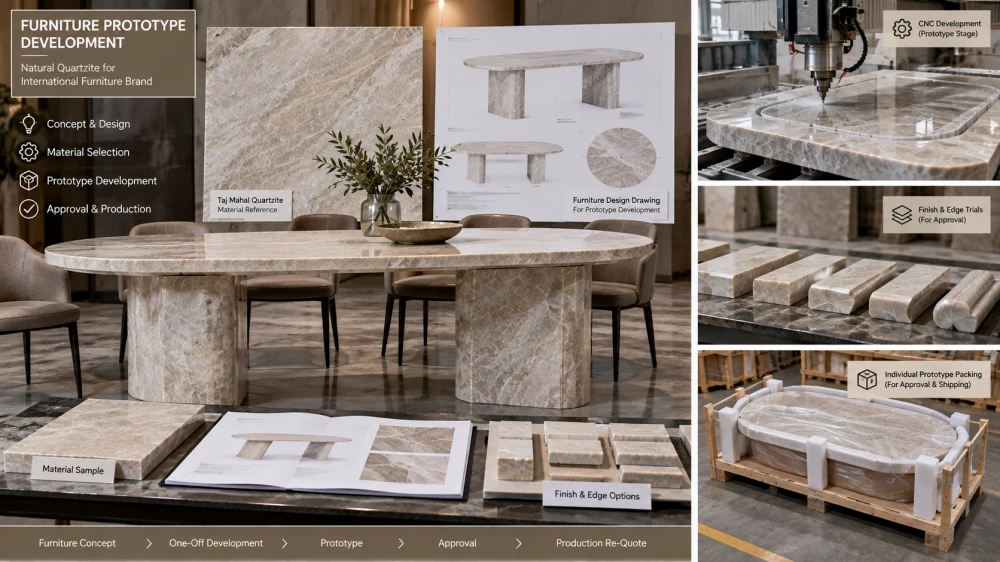
A Quartzite prototype cost should normally be evaluated separately from later production pricing. One prototype may absorb one-off work such as slab allocation, CAD development, CNC programming, finish trials, edge development, hardware or base coordination, trial assembly, photography, QC, and individual export packing. If the design is approved for repeat production, some setup work may not repeat in the same way, while material yield, natural stone variation, fabrication, QC, packing, and logistics still remain production costs.
A furniture brand sends a reference image for a Quartzite dining table.
It wants one prototype first.
If approved, the design may later become 20, 50, or 100 pieces.
The prototype quotation looks expensive compared with the expected production unit price.
Is the supplier overcharging?
Não necessariamente.
The first piece may be doing two jobs at once:
Prototype = Finished Furniture + Development Work.
That distinction is the starting point for understanding Quartzite prototype cost.
Why Prototype Cost and Production Price Should Be Separated
A prototype is not simply “one production piece.”
For a new stone-furniture design, the first piece may also be used to establish:
Represents the physical furniture piece being produced
C. Prototype-Only Logistics
Individual crate, prototype documentation, courier/air/ocean shipment or other project-specific delivery
Should not automatically be used as the logistics basis for bulk production
This structure is more useful than quoting one unexplained prototype total and asking the buyer to infer what might happen later.
One-Off Cost 1: Design and CAD Development
A furniture brand may begin with:
a rendering;
a reference photograph;
a concept sketch;
basic overall dimensions; or
an existing product that needs to be adapted to Natural Quartzite.
That is not always fabrication-ready information.
The prototype stage may require the concept to be converted into controlled furniture drawings showing:
overall dimensions;
tabletop geometry;
finished thickness;
perfil da borda;
raio dos cantos;
base footprint;
support positions;
connection locations;
removable components; and
assembly relationships.
If those drawings become the approved master specification, later production pieces can work from that established reference rather than redeveloping the concept from zero.
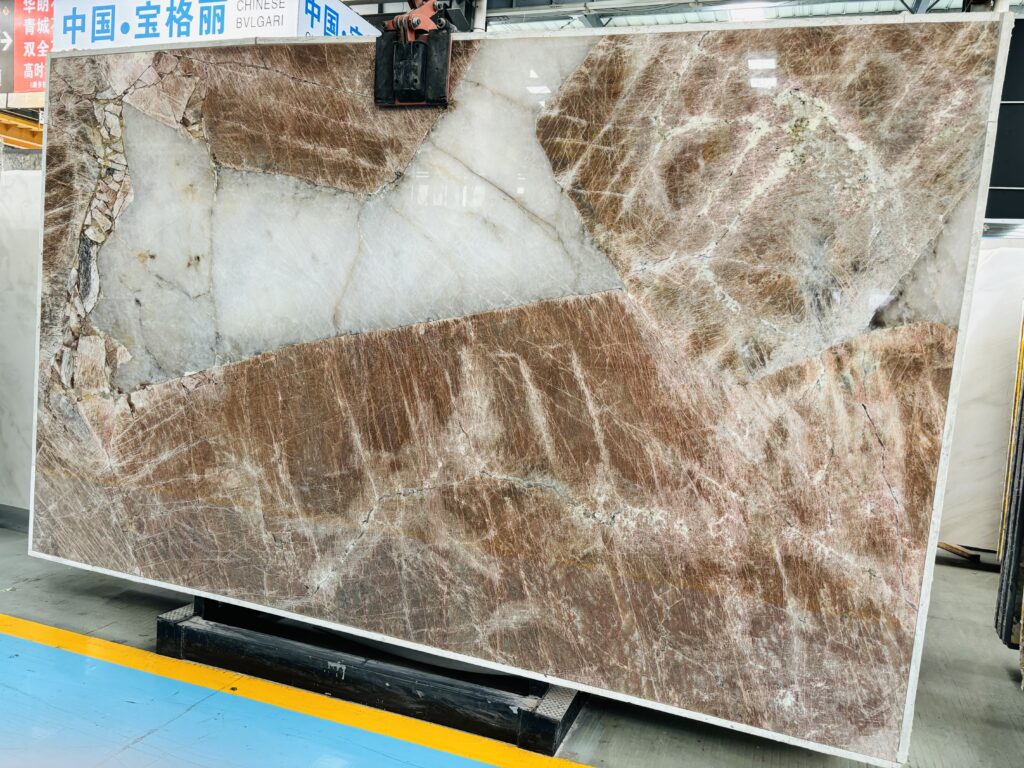
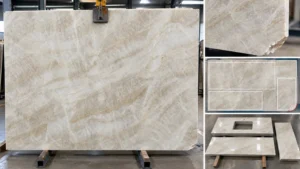
blue-roma-quartzite-prototype-tabletop-slab-yield
One-Off Cost 2: Material Allocation and Prototype Yield
Natural Quartzite creates another issue: the prototype may require more raw material than the finished furniture area suggests.
Imagine a sculptural table requiring one visually clean oval top.
The finished tabletop area is not automatically the same as the raw stone quantity required.
The supplier may need to consider:
Slab Size → Finished Shape → Natural Features → Visual Position → Cutting Margin → Other Components → Usable Yield
This is particularly important for irregular, round, oval, freeform, or strongly patterned furniture pieces.
Gross slab area and usable material area are different procurement concepts; actual cutting geometry determines how much of the selected slab can contribute to the finished product.
One-Off Cost 3: CNC and Fabrication Setup
A custom prototype may require fabrication preparation before the finished component can be produced.
Once an acceptable finish reference is established, retain it as part of the production specification.
That does not make Natural Quartzite visually uniform, but it gives later production a defined processing reference.
One-Off Cost 5: Base and Connection Development
A Quartzite furniture prototype is often more than a stone top.
The design may include:
stone pedestal components;
metal frames;
mixed-material bases;
concealed supports;
removable hardware;
recessed connection areas; or
site-assembly interfaces.
The prototype can therefore be used to test whether the physical components fit together as intended.
Where structural design or engineering is required, that responsibility should remain with the appropriately qualified project party rather than being inferred from a general prototype quotation.
One-Off Cost 6: Trial Assembly
For furniture brands, trial assembly can be one of the most valuable parts of the prototype.
Your existing Quartzite furniture content already treats trial assembly as part of a complete furniture-production workflow rather than inspecting only the polished stone surface.
The prototype should record any changes discovered during this stage so the production drawing can be updated before repeat manufacturing.
Prototype QC Is Also Creating a Production Reference
Prototype QC has a different purpose from simply checking whether one piece is acceptable to ship.
It can help define what later production should be checked against.
Prototype Review
Possible Production Reference
Dimensões finais
Approved production drawing
Surface appearance
Approved finish reference
Edge geometry
Edge profile drawing / control sample
Montagem
Approved connection and assembly method
Embalagem
Production packing concept after review
Prototype Packing Can Distort the Apparent Unit Cost
One stone furniture prototype may need its own export crate.
That can make the logistics cost per piece look disproportionately high.
The prototype may require:
surface protection;
proteção de bordas e cantos;
component separation;
internal supports;
fixação segura;
a reinforced fumigated wooden crate;
piece identification; and
packing inspection.
For later production, multiple pieces may use a different crate configuration, container loading plan, shipment mode, or destination arrangement.
Portanto:
Prototype Freight per Piece ≠ Production Freight per Piece.
Which Costs May Continue Into Production?
Separating prototype costs does not mean bulk production becomes only raw material plus cutting.
Production still has recurring costs.
Depending on the product, these may include:
Natural Quartzite material;
material allocation and usable yield;
corte;
CNC machining;
edge fabrication;
surface finishing;
base or support components;
assembly;
production QC;
component identification;
packing; and
logistics.
Existing Quartzite furniture guidance on the site likewise treats material, usable yield, fabrication, edge work, base construction, trial assembly, packing, and logistics as separate influences on a custom table quotation. :contentReference[oaicite:3]{index=3}
Do Not Promise a Production Price Before the Prototype Is Frozen
A common sourcing mistake is asking:
“Prototype is USD X. What will 100 pieces cost?”
before the prototype has even been approved.
The supplier can discuss an indicative production scenario when enough information exists, but the final production quotation should reflect the approved production specification.
Why?
Because the prototype may change:
overall dimensions;
stone selection criteria;
edge design;
base construction;
hardware;
connection method;
acabamento;
fabrication sequence;
packing method; or
production quantity.
Each change can alter the commercial scope.
Use a Prototype-to-Production Cost Bridge
Instead of asking whether the prototype price is “too high,” ask how it converts into production.
PROTOTYPE → PRODUCTION COST BRIDGE
Prototype Quotation
↓
Identify One-Off Development Costs
↓
Approve Final Prototype
↓
Freeze Production Drawing + Finish + Edge + Interfaces
↓
Confirm Production Quantity
↓
Recalculate Material / Yield / Fabrication / Packing
↓
Issue Production Quotation
Should the Prototype Fee Be Credited Against the Production Order?
This should be treated as a commercial term, not assumed as an industry rule.
Possible supplier arrangements may include:
prototype charged separately;
some identified development cost credited after a qualifying production order;
prototype retained as a fully separate development order;
certain tooling retained for later production; or
another negotiated commercial structure.
The quotation should state the actual arrangement rather than leaving the buyer to assume that a prototype charge will automatically be refunded or amortized.
Natural Quartzite Creates a Special Repeatability Question
A furniture brand may approve the prototype and say:
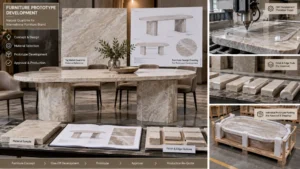
quartzite-prototype-to-production-cost-handoff
“Make every production table exactly like this one.”
Dimensional and fabrication references can be standardized much more directly than natural stone appearance.
Natural Quartzite can vary between slabs in:
background tone;
mineral movement;
crystalline structure;
vein distribution;
contrast;
natural features; and
usable areas.
Therefore the prototype should distinguish:
Repeatable Manufacturing Specification
de
Natural Material Variation.
For production orders, define how future slabs will be selected and approved rather than promising geological duplication of the prototype stone.
What Furniture Brands Should Ask for in the Prototype Quote
PROTOTYPE QUOTATION CHECK
□ Prototype purpose defined
□ Actual Natural Quartzite reference identified
□ Prototype quantity stated
□ Current drawing revision stated
□ Finished dimensions stated
□ Finish and edge scope stated
□ Base / connection scope stated
□ One-off development work identified
□ Recurring fabrication work identified
□ Trial assembly scope stated where required
□ Prototype QC / approval evidence defined
□ Prototype packing separated
□ Freight / destination basis stated
□ Prototype credit policy stated if applicable
□ Production re-quote trigger defined
□ Natural material variation addressed
Perguntas frequentes
1. Why can one Quartzite furniture prototype cost more per piece than a production order?
A primeira etapa pode incluir tanto o mobiliário físico quanto trabalhos de desenvolvimento pontuais, tais como desenvolvimento de desenhos, preparação de máquinas CNC, testes de acabamento ou de bordas, desenvolvimento de conexões, montagem experimental, controle de qualidade do protótipo e embalagem individual. Esses custos devem ser separados dos trabalhos que se repetem em cada unidade de produção.
2. Should a Quartzite prototype price be used as the unit price for 50 or 100 pieces?
Não automaticamente. O preço de produção deve ser recalculado com base na especificação de produção aprovada, na quantidade, na demanda real de materiais, no rendimento utilizável, nas operações de fabricação recorrentes, nos componentes, no controle de qualidade, na embalagem e na logística.
3. What prototype costs may not repeat in bulk production?
Dependendo do projeto, algumas etapas iniciais de desenvolvimento em CAD, programação específica para protótipos, desenvolvimento de acabamentos, testes de borda, desenvolvimento de interfaces ou o desenvolvimento inicial da embalagem podem não se repetir da mesma forma. O fornecedor deve identificar os itens específicos de cada projeto, em vez de aplicar uma fórmula universal.
4. Can a furniture brand expect production Quartzite to look identical to the prototype?
O quartzito natural apresenta variações entre as lajes. O protótipo aprovado pode estabelecer dimensões, acabamento, bordas, montagem e demais referências de fabricação, mas as peças subsequentes devem ser controladas por meio de critérios acordados de seleção de lajes e aprovação visual, em vez de uma garantia de movimentação natural idêntica.
5. Should a Quartzite furniture prototype include trial assembly?
It can be particularly useful where the design includes a custom base, multiple components, concealed connections, removable parts, or other assembly interfaces. The required trial-assembly scope should be defined for the actual furniture design.
6. Should the prototype fee be refunded after a production order?
There is no universal rule. A supplier may charge the prototype separately, credit an agreed development amount against a qualifying production order, or use another commercial arrangement. The quotation should state the actual terms.
7. When should the production quotation be finalized?
The strongest basis is after the prototype has established the production specification and the buyer has confirmed the production quantity, material criteria, drawings, finish, edges, components, QC scope, packing, and delivery basis.
Final Cost RuleDo not compare a one-piece Quartzite prototype directly with a repeat-production unit price. Separate One-Off Development + Prototype Piece + Prototype Logistics, approve the design, freeze the production specification, and then rebuild the production quotation around the confirmed quantity and recurring manufacturing scope.
For furniture brands developing Natural Quartzite tables, consoles, coffee tables, side tables, counters, or other custom stone furniture, HRST STONE can coordinate actual slab selection, CAD/shop drawings, tabletop layouts, CNC fabrication, finish and edge samples, custom stone components, trial assembly, production QC, component identification, and reinforced export packing. Send Josh the furniture drawing or concept, dimensions, quantity, preferred Quartzite, finish, edge, base concept, prototype purpose, expected production quantity, and delivery destination for a project-specific quotation.
Hi, I am the author of this article. I have been working in the field of Natural Stone for more than 15 years. If you need customized Natural Stone services, please feel free to contact me.
Fabricante e Fornecedor de Mármore, Granito, Quartzito, Ágata da China - HRST STONE
Bem-vindo à HRST STONE!
Olá, gostaria de saber mais sobre seus produtos. Você poderia compartilhar informações sobre preços, quantidade mínima de pedido, opções de personalização e amostras?