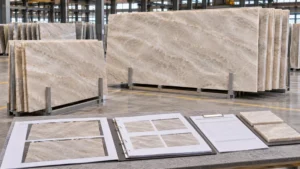
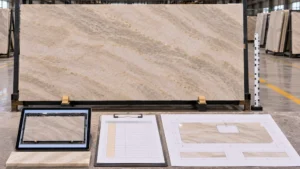
Uma mesa de jantar redonda em quartzito natural pode criar uma grande composição geológica.
Adicione um prato giratório de pedra no centro e o problema visual muda.
Agora há duas superfícies visíveis de quartzito:
o tampo de jantar fixo
e
o prato giratório.
À primeira vista, o design pode parecer simples.
Use o mesmo quartzito.
Coloque uma peça circular de pedra menor no centro.
Tente fazer coincidir as veias.
Mas um prato giratório gira.
Uma faixa mineral que se alinha lindamente com o tampo externo em uma posição pode apontar para uma direção completamente diferente após um quarto de volta.
A pedra não mudou.
A relação entre as duas composições visíveis tem.
Este é o problema central por trás de Mesas de Jantar em Quartzito com Pratos Giratórios: Combinando Duas Superfícies Visíveis.
Portanto, a pergunta correta sobre o design não é:
“As duas peças podem combinar perfeitamente?”
É:
“O tampo principal e o centro rotativo podem permanecer visualmente coordenados mesmo quando o prato giratório muda de orientação?”
O primeiro erro é tratar o prato giratório como um pequeno acessório adicionado depois que o tampo da mesa já foi projetado.
Quando feito de quartzito natural, ele é outra superfície de pedra altamente visível.
O tampo externo da mesa pode preservar:
Devido ao seu tamanho, a mesa principal pode ser percebida a vários metros de distância como um padrão completo.
A peça central é menor.
Seu padrão, portanto, é percebido em outra escala.
Uma característica geológica que parece equilibrada em todo o tampo principal pode tornar-se excessivamente dominante quando isolada dentro do disco giratório menor.
Por outro lado, uma área de laje mais discreta pode funcionar muito bem no prato giratório, pois permite que o maior tampo externo continue sendo o foco visual.
O prato giratório ainda deve ter sua própria composição coerente.
Pergunte:
O guia relacionado Escala de Padrão do Quartizito: Leitura de uma Laje à Distância de Um Ambiente O guia explica o princípio mais amplo: o padrão relevante é aquele que sobrevive dentro do contorno da peça finalizada, e não toda a geologia visível na laje original.
Tampo Principal = Uma Composição Finalizada de Quartzito. Prato Giratório = Uma Segunda Composição Finalizada de Quartzito. Aprove ambos individualmente primeiro, depois aprove como eles funcionam juntos.
“Combinar o prato giratório com a mesa” é muito vago para a fabricação.
Existem várias intenções de design possíveis.

O tampo principal e o prato giratório são posicionados dentro da mesma laje selecionada, onde as dimensões e a área utilizável permitem.
Isso pode ajudar as duas peças a compartilhar:
Eles não precisam criar uma continuação permanente da veia.
Para uma mesa grande, o conjunto completo de móveis pode exigir mais de uma laje ou usar uma peça central de outro tampo relacionado.
Nesse caso, selecione lajes com compatibilidade:
Não presuma que o nome comercial da pedra garante essa relação.
Um projeto pode intencionalmente selecionar uma posição de referência onde uma faixa mineral principal na Lazy Susan se relaciona com o tampo externo.
Isso pode criar uma apresentação forte quando a mesa é fotografada ou inicialmente arranjada.
Mas a equipe de design deve entender:
Uma vez que o centro gira, esse alinhamento muda.
A posição inicial pode, portanto, ser apenas uma referência de apresentação—não uma condição visual permanente.
Alguns projetos podem usar propositalmente uma zona de pedra mais calma ou mais dramática no centro.
Por exemplo:
Tampo Externo: amplo movimento geológico ativo.
Lazy Susan: campo central mais silencioso.
Ou o inverso.
Isso pode funcionar quando a diferença parece deliberada em vez de acidental.
| Estratégia de Correspondência | Objetivo Principal | Limitação Importante |
| Coordenação da Mesma Laje | Tom e caráter geológico compartilhados | A rotação ainda altera o alinhamento do padrão |
| Lajes Relacionadas | Coordene a cor e a intensidade do padrão | Somente o nome comercial não estabelece uma correspondência |
| Alinhamento da Posição Inicial | Crie uma composição inicial preferida | O alinhamento muda conforme o centro gira |
| Contraste Intencional | Torne o centro e a superfície externa distintos, mas relacionados | A diferença deve parecer deliberada em todas as orientações |
Este é o fato visual mais importante de todo o projeto.
O tampo principal permanece fixo.
A Lazy Susan gira.

Imagine uma faixa mineral marrom-café cruzando o tampo principal da esquerda para a direita.
Na posição inicial preferida, a Lazy Susan pode conter uma linha relacionada continuando na mesma direção.
Gire o centro noventa graus.
A linha mineral interna agora está perpendicular ao movimento externo.
Gire novamente.
A relação muda mais uma vez.
This does not mean the layout failed.
It means the project should not define success as permanent vein continuation.
During visual approval, review at least several representative orientations.
Por exemplo:
The purpose is not to create a universal angle-testing standard.
It is to confirm that the centre piece still looks intentional when it is no longer aligned with the starting composition.
The Lazy Susan may be fabricated with a defined production orientation.
But after installation, guests can rotate it freely.
Therefore, avoid placing a visually awkward feature that only works when it faces one exact direction.
If the client wants a preferred presentation, define a reference orientation on the drawing or trial-assembly record.
This can help with:
But record clearly that the Lazy Susan is a rotating component.
Pattern continuity can be reviewed at one reference position. Pattern compatibility must work throughout rotation.
The stone layout should include the entire dining-table package.
Do not select the outer tabletop first and then search the leftover slab for the Lazy Susan.

On the actual slab image or physical slab layout, show:
Main Table Outline + Lazy Susan Outline + Pattern Direction + Important Natural Features.
This allows the designer to evaluate how the two compositions relate before material is committed.
If slab yield allows, create several realistic Lazy Susan crop options.
Por exemplo:
Option A — quiet centre field.
Option B — one complete focal feature.
Option C — stronger high-contrast mineral movement.
Review each option against the same outer tabletop layout.
The final visible circular boundary depends on the approved edge profile and fabricated diameter.
If a preferred vein sits extremely close to that boundary, confirm whether it remains visually complete after edge processing.
Two large circular pieces can consume significant usable slab area.
The most visually attractive centre crop may reduce yield or conflict with another important project component.
Visual layout and commercial material utilization should therefore be reviewed together rather than sequentially.
Por exemplo:
T01 — Main Dining Tabletop
LS01 — Lazy Susan
Both IDs should remain connected to:
O Quartzite Vein Direction Symbols for Shop Drawings guide explains why visual direction should remain connected to identifiable pieces and actual slab layouts rather than relying on an isolated arrow.
Not every Lazy Susan is built into the table in the same way.
The furniture construction should be defined before the stone edge and centre relationship are approved.

In one common visual configuration, the rotating stone disc sits above the main tabletop on a concealed rotating mechanism.
The outer tabletop remains a complete stone surface below it.
This approach creates questions about:
Another design may place the rotating centre within a circular opening or recessed zone.
This is a very different fabrication condition.
The project must then review:
Do not transfer details from a raised Lazy Susan directly to an inset design.
In some concepts, the designer may hope that the centre circular area can be removed from the main tabletop and reused as the rotating piece.
Whether this is practical depends on:
Even if related stone is retained, exact seamless continuity should not be promised because the finished edges, clearance and subsequent rotation change the visual relationship.
The centre of the table contains more than a pattern relationship.
It also contains an edge relationship.
This edge may be highly visible because it sits near eye level when diners are seated.
Revisão:
If the centre is recessed into the table, the main tabletop may also contain a visible circular internal edge.
This creates two adjacent worked stone edges.
Their finish and visual relationship should be reviewed together.
A rotating component generally requires a defined relationship with the surrounding fixed surface.
The exact clearance should come from the approved furniture and hardware design.
This article does not prescribe one universal gap dimension.
From a visual perspective, review whether the gap reads as:
A cut and polished Natural Quartzite edge exposes the stone through another plane.
It may therefore read differently from the broad horizontal polished face.
Review an actual worked sample or first fabricated piece rather than assuming the circular edge will look identical to the tabletop face.
The Lazy Susan must rotate smoothly while supporting its actual stone component and normal table use.
The stone supplier should not invent the hardware specification from the word “Lazy Susan.”
The furniture designer or responsible hardware supplier should confirm the selected mechanism.
Informações relevantes podem incluir:
Different rotating mechanisms have different capacities, construction, mounting points and operating behaviour.
The current product documentation for the actual selected fitting should govern the hardware side of the design.
Confirm how the complete furniture assembly carries:
This article deliberately does not prescribe universal stone thickness, bearing capacity, pedestal size or fixing spacing.
Those decisions belong to the actual furniture design and selected hardware system.
If adjustment, replacement or fastening of the rotating mechanism may be required, the table design should account for appropriate access.
Do not approve a beautiful stone configuration that makes the hardware impossible to assemble or service.
O Mesa Quartzito Roma Azul page follows the same broader furniture principle: actual slab layout, finished dimensions, edge, base, support, fabrication and trial assembly should remain connected before production.
Even when both pieces come from one slab, they may not always appear identical.
A polished main table reflects:
The Lazy Susan may reflect the same room from a slightly different height or angle.
Its appearance can therefore shift as it rotates.
A honed finish usually creates a softer reflected-light response.
Pattern and colour still vary naturally, but reflections may be less sharply defined.
Neither finish is universally better for this furniture type.
The physical Natural Quartzite pattern rotates with the Lazy Susan.
So do the directions from which its polished surface receives and returns reflected light.
A dark-looking area seen from one position may become brighter after the disc turns.
A pendant or chandelier directly above the dining table may create a strong central highlight on the Lazy Susan.
This means a centre sample should be reviewed under representative dining-room lighting rather than only warehouse ceiling light.
Dining furniture is often viewed:
The same stone relationship may read differently from each position.
A Quartzite table with a stone Lazy Susan combines natural-stone fabrication and moving furniture hardware.
A final trial assembly is therefore highly useful.
Verifique:
Verifique:
The final visual review should occur with the rotating centre in its actual position above or within the dining table.
This reveals conditions that isolated stone pieces cannot show.
Confirm that:
If a preferred reference orientation has been approved, mark or document how that position is established during final handover.
Again, this is a presentation reference.
It does not create permanent vein continuity.
□ Actual Natural Quartzite identified.
□ Main tabletop finished shape and dimensions confirmed.
□ Lazy Susan finished diameter and construction confirmed.
□ Raised / surface-mounted / inset condition clearly defined.
□ Main tabletop and Lazy Susan templates positioned on actual slab references before cutting.
□ Matching strategy defined: same-slab, related, home-position alignment, or intentional contrast.
□ Pattern balance reviewed with the Lazy Susan in several rotational positions.
□ Finish confirmed for both stone surfaces.
□ Outer table edge approved.
□ Lazy Susan edge approved.
□ Internal circular edge reviewed where an inset system is used.
□ Gap / reveal defined by the furniture and hardware design.
□ Rotation mechanism identified from current product information.
□ Base, support and fixing interface coordinated.
□ Trial assembly completed where required.
□ Preferred home orientation recorded where applicable.
□ Final QC connects the physical stone pieces to the approved slab layout.
□ Packing protects both circular stone edges and keeps the rotating component controlled during transport.
A strong approval record might say:

“Main tabletop T01 and Lazy Susan LS01 approved from the identified Quartzite slab layout. Both pieces are coordinated for background tone, mineral character and pattern intensity. LS01 has a preferred home orientation shown on the current furniture drawing, but pattern continuation is understood to change during normal rotation.”
Isso é muito mais preciso do que:
“Match Lazy Susan veins to table.”
The complete approval sequence can be:
Furniture Design → Main Top Geometry → Lazy Susan Geometry → Actual Slab Selection → Two-Piece Layout → Matching Strategy → Edge / Gap → Rotation Hardware → Base / Support → Fabrication → Trial Assembly → Rotation Review → Final QC → Packing.
For Natural Quartzite furniture, the goal should not be artificial perfection.
The goal is a controlled relationship between two natural surfaces that remains convincing as the centre performs its real function.
Não necessariamente. As duas superfícies geralmente devem ser coordenadas de acordo com o projeto pretendido, mas como a gira‑gira gira, a continuidade exata das veios não pode permanecer fixa. A correspondência pode, em vez disso, concentrar‑se no tom de fundo, na característica geológica, na intensidade do padrão, no acabamento e no peso visual. Uma posição inicial preferida pode ser aprovada separadamente, caso o projeto deseje uma alinhamento inicial.
Using the same slab can help coordinate tone and geological character when the slab size, usable area and cutting layout allow it. It is not always necessary or possible. Related slabs can also be used when their actual appearance is reviewed together before fabrication.
Não presuma isso. A largura da ranhura de corte, os diâmetros finais, a folga necessária, o acabamento das bordas, as condições da pedra, bem como os suportes e os componentes de rotação, influenciam todos se essa abordagem é viável ou não. O fabricante e o designer de móveis responsáveis devem analisar a geometria real antes do corte.
Eles podem, se essa for a intenção de projeto e o layout da laje selecionado o permitir. No entanto, a relação muda assim que a gira‑gira é girada. Portanto, o alinhamento na posição inicial deve ser considerado como um estado de apresentação aprovado, e não como uma condição permanente de continuidade.
Os dois sistemas geram questões distintas relacionadas à fabricação e ao mobiliário; por isso, este artigo não classifica um deles como universalmente mais fácil. Um centro elevado confere ao tampo principal uma continuidade visual maior, mas introduz questões relativas à altura, à face inferior e à ocultação dos suportes. Já um centro embutido cria uma abertura circular, bordas trabalhadas adjacentes, necessidade de folga, apoio e coordenação de ferragens.
Revise a peça principal da mesa e a peça central em conjunto, incluindo a relação entre os padrões, a qualidade das bordas, o acabamento, as frestas visíveis, o funcionamento dos componentes de fixação, as folgas, o suporte, várias posições de rotação e qualquer orientação doméstica aprovada. O ensaio final deverá estabelecer a correspondência entre o móvel físico e o desenho aprovado e a disposição das chapas.
Envie ao Josh o material proposto de quartzito natural, referências de lajes quando disponíveis, desenho da mesa de jantar, forma principal da tampo e dimensões acabadas, diâmetro do prato giratório e condição prevista (elevado ou embutido), quantidade, acabamento, perfis de borda, relação de padrão preferida, desenho da base e suporte, informações sobre o hardware giratório proposto, requisito de posição inicial, se houver, destino de entrega e se é necessária montagem de teste antes do embalamento.
For custom Natural Quartzite dining tables with Lazy Susans, HRST STONE can coordinate actual slab selection, full-slab photographs, main-top and centre-disc CAD templates, two-surface pattern layouts, edge samples, visible-gap review, furniture-base coordination within the confirmed stone scope, fabrication QC, trial assembly, piece identification, protective packing, and export documentation. Send Josh the table drawing, Quartzite selection, finished dimensions, Lazy Susan design, finish, edge profiles, base information, rotating-hardware reference, quantity, pattern priorities, and destination before final fabrication release.