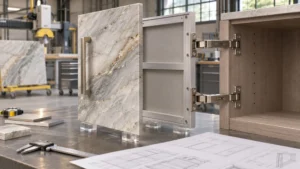

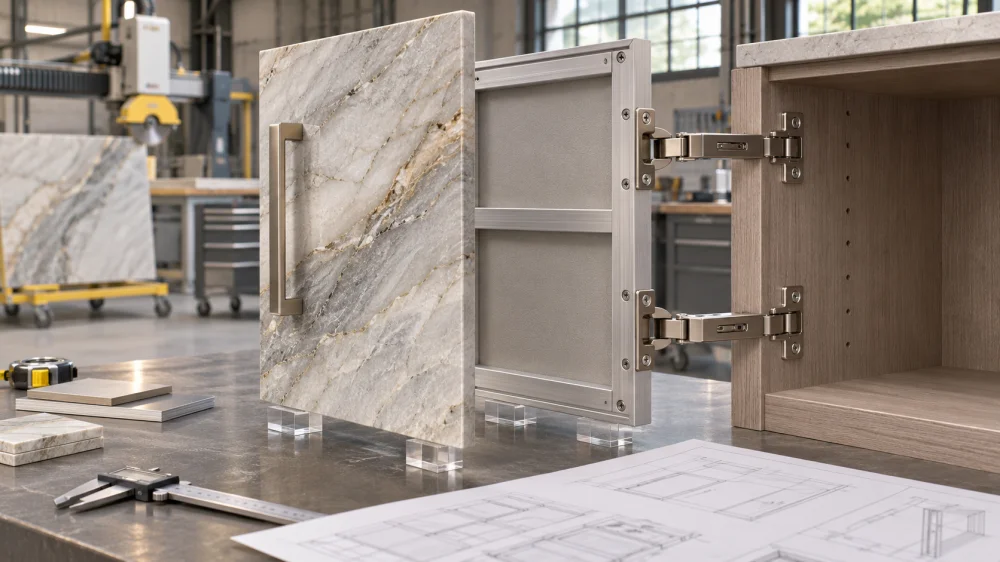
Quartzite cabinet fronts should not be cut or drilled until the cabinet maker, hardware supplier and stone fabricator have coordinated how the pulls, hinges, drawer fixings, backing panel and stone actually work together. The critical questions are not only where the handle holes appear on the elevation, but what carries the front weight, where the fastener develops its holding force, how much stone remains around an opening, and whether the selected hardware system is compatible with the proposed front construction.
A quartzite cabinet front is a furniture front in which natural quartzite forms the visible face or principal decorative panel, while the supporting structure and hardware attachment method must be designed specifically for the complete cabinet assembly.
This distinction matters because a stone front is not simply a timber cabinet door with a different surface finish.
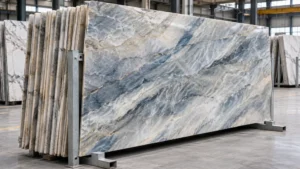
Natural quartzite is significantly different from conventional wood-based front materials in the way it is cut, drilled and supported. It may also contain veins, mineral transitions, natural fissures or repaired areas that affect where a small hole or notch should be placed.
At the same time, cabinet hardware is normally selected around defined front dimensions, weight, opening geometry and fixing positions.
The project therefore needs one coordinated drawing that connects both systems before fabrication begins.
The first question is not which pull looks best. It is how the stone front is constructed.
Two projects can show almost identical quartzite doors in a rendering while using very different structural concepts.
One may use a relatively thin quartzite facing attached to an engineered backing panel. Another may use a thin hard front with hardware specifically designed and tested for that type of panel. A third may use a framed system where the stone is visually dominant but much of the structural work is carried by metal or another supporting component.
These concepts should not be mixed after the stone has already been fabricated.
| Front Concept | Typical Hardware Question | Stone Fabrication Question |
| Quartzite bonded to structural backing | Does the hardware attach primarily to the backing structure? | Where are through-holes, recesses and visible stone edges required? |
| Thin hard front with dedicated hardware | Is the selected fixing system approved for the actual front material and thickness? | Can the required drilling pattern be produced safely in the selected slab area? |
| Stone insert within a structural frame | Which loads are carried by the frame? | What finished size, edge tolerance and retention detail does the insert require? |
| Drawer front assembly | Where do drawer-front adjusters and pull fasteners connect? | Which holes are through-stone and which belong only to the supporting assembly? |
The approved shop drawing should identify the selected construction rather than leaving the fabricator to infer it from a front elevation.
da HRST STONE móveis de pedra category illustrates the broader use of natural stone in furniture applications, but a cabinet front requires project-specific coordination of the moving hardware as well as the stone itself.
Cabinet pulls, concealed hinges, drawer systems and lift mechanisms do not share one universal drilling pattern.
Changing the hardware after fabrication may change hole centres, drilling diameter, fixing depth, edge offset or even the complete front construction.
This is particularly important when a designer specifies hardware by appearance during the early design stage but the cabinet maker later substitutes another series for availability, load capacity or adjustment requirements.
The stone drawing should therefore reference an approved hardware model or approved hardware drilling template wherever that hardware affects the quartzite.
For concealed hinges, a conventional timber-door hinge detail should not automatically be copied into stone.
Some furniture-hardware manufacturers offer dedicated systems for thin hard fronts. Those systems use their own drilling and fixing geometry rather than relying on a standard deep hinge-cup arrangement. Their existence demonstrates why the actual hardware system must be identified before fabrication, but it does not mean every quartzite slab is automatically suitable for every thin-front fitting.
If a pull, hinge, drawer connector or lift mechanism changes after approval, compare the new hardware drawing against every affected stone front before production continues.
Pull handles appear simple because many require only two visible holes. The interface becomes more complex once the complete assembly is considered.

The drawing should identify the handle centre-to-centre dimension, vertical and horizontal location, required hole diameter, fastener type, rear clearance and the material against which the fastener ultimately tightens.
If the front includes both quartzite and a structural backing panel, both components must use the same coordinated reference datum.
A hole that is correctly positioned in the quartzite but offset from the backing-panel hole can still prevent installation.
For a through-bolted pull, confirm the complete stack from the visible pull to the rear fixing.
The project team should determine whether the clamping force is intended to bear against the structural backing, a dedicated insert or another approved support detail rather than assuming the natural stone alone should receive uncontrolled point loading.
The hole should provide the clearance required by the approved hardware without creating unnecessary material removal.
Edge pulls can be more demanding because they may require a recess, notch or local reduction close to a finished stone edge.
That geometry should be shown in section.
The fabricator should review whether the proposed recess leaves an appropriate stone geometry around the feature and whether the selected slab area contains a natural condition that makes the detail less suitable.
A generic cabinet elevation showing only the handle outline is not sufficient information for this type of fabrication.
A finger-pull concept may involve the cabinet backing, metal profile or stone edge rather than a conventional handle.
The drawing must therefore show where the user’s hand actually engages the front and which component forms the gripping surface.
Do not ask the stone factory to create an edge recess based only on a rendering.
Moving fronts introduce loads that decorative wall panels do not experience.
A cabinet door repeatedly opens and closes around hinge points. A drawer front is repeatedly pulled, pushed and adjusted through its connection to the drawer system.
The hardware designer therefore needs the dimensions and weight of the complete finished front, not just the dimensions of the quartzite.
The assembled weight can include the stone, substrate, frame, pull and other attached components.
Hardware manufacturers use front weight and front geometry when selecting hinge quantities, lift mechanisms and related fittings. This is why the cabinet maker should not specify the hardware from the visual front dimensions alone.
The hinge system should define its own fixing positions, allowable front construction and required machining.
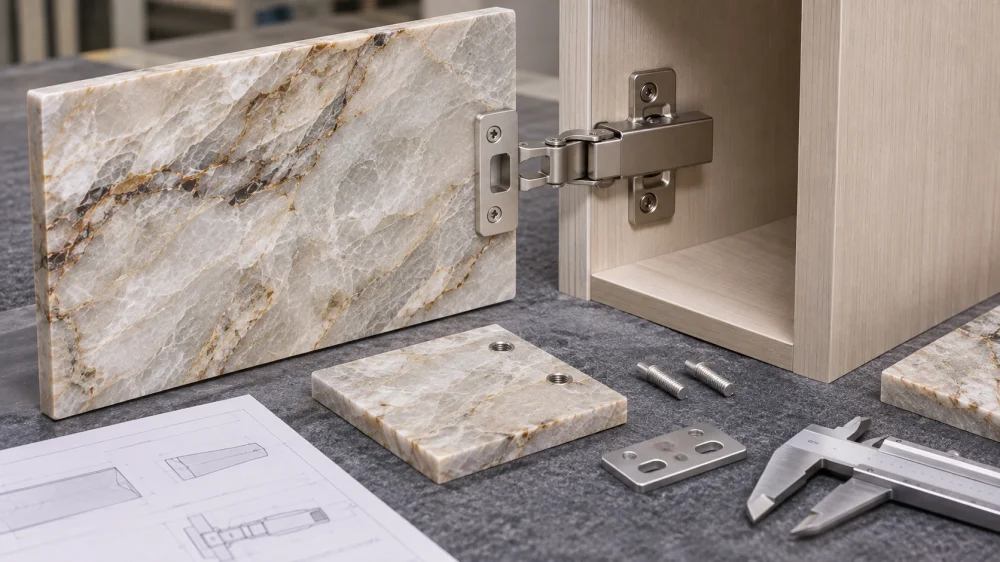
If the front uses a stone skin over a structural backing, the cabinet maker should define how the hinge connects to that backing and whether any stone recess or clearance is required.
If the proposed hardware connects to a thin hard front itself, confirm compatibility with the selected front material, actual thickness and hardware manufacturer’s instructions before the stone is drilled.
A drawer system may use adjustable front connectors positioned behind the decorative face.
The stone supplier therefore needs to know whether the quartzite requires through-holes, concealed recesses or no direct connection at all.
This information should come from the approved drawer construction drawing.
Lift systems are particularly sensitive to the finished front weight because the hardware mechanism must control the moving mass through its opening cycle.
A visually thin stone front may still be heavy once the backing and handle are included.
The selected lift mechanism should therefore be checked by the hardware or cabinet specialist using the actual completed front configuration.
A CAD drawing can position a hole accurately, but geometric accuracy alone does not establish that every location on a natural slab is equally desirable for drilling.
Before CNC machining, review the proposed hole locations together with the actual slab layout.
Particular attention should be given to holes or recesses positioned close to finished edges, corners, narrow stone bridges, natural fissures, major mineral transitions or previously repaired areas.
This does not mean every visible vein is weak or every natural feature must be avoided. It means local geometry and natural stone condition should be reviewed together.
The fabrication sequence also matters.
Cutting the finished front, machining openings and processing the edges can change how a narrow area is supported during production. The factory should establish a controlled machining sequence appropriate to the approved geometry.
The approved fabrication file must combine both references before CNC machining.
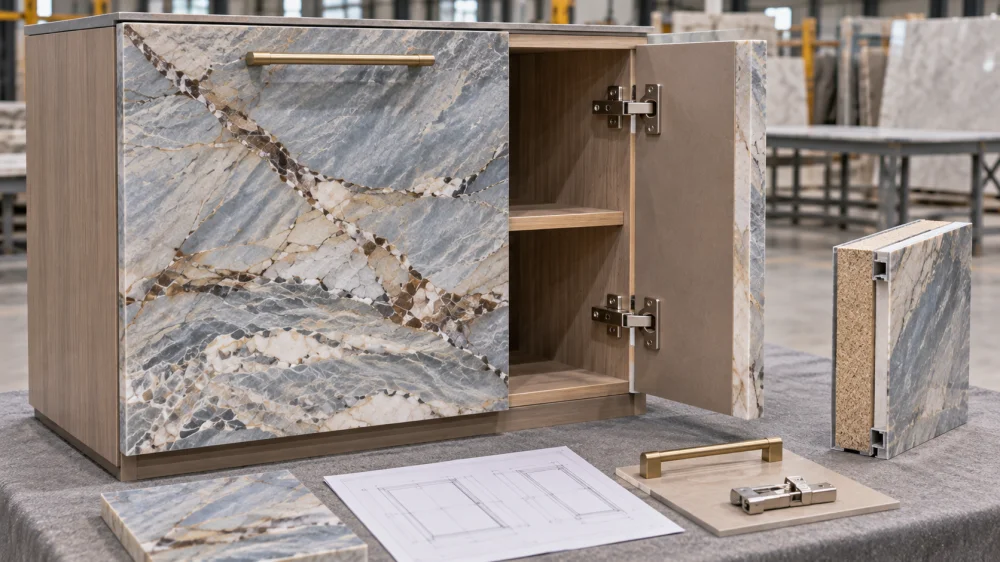
For a stone-clad cabinet front, the backing layer is not an incidental packaging component. It can be part of the functional furniture assembly.
The project team should define the backing material, thickness, finished dimensions, bond system, perimeter relationship and hardware interfaces.
The quartzite supplier should not independently select a backing construction when that decision affects hinge performance, front weight or long-term cabinet function.
Likewise, the cabinet maker should not assume that a nominal stone thickness produces an exact final assembly thickness without checking the proposed construction.
The finished assembly may need to coordinate with:
The backing and stone should also share a clear dimensional datum. If one workshop dimensions pull holes from the quartzite edge while another dimensions from an unfinished substrate edge, small discrepancies can accumulate into visible alignment problems across a cabinet elevation.
Stone fronts are usually viewed as a composition rather than as isolated panels.
Consistent gaps between neighboring doors and drawers are therefore both a furniture-function issue and a visual stone-layout issue.
The cabinet maker should establish the required gaps, overlays, inset conditions and adjustment range of the selected hardware.
The stone factory then fabricates the decorative faces to the approved finished dimensions.
Do not reduce a specified door gap in the stone drawing simply to create tighter visual continuity between veins. The opening hardware still requires the agreed movement space.
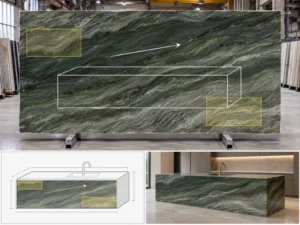
Conversely, do not optimize the quartzite pattern before the cabinet front dimensions are frozen. A later change in width or height can shift the most important vein or mineral zone out of the intended finished composition.
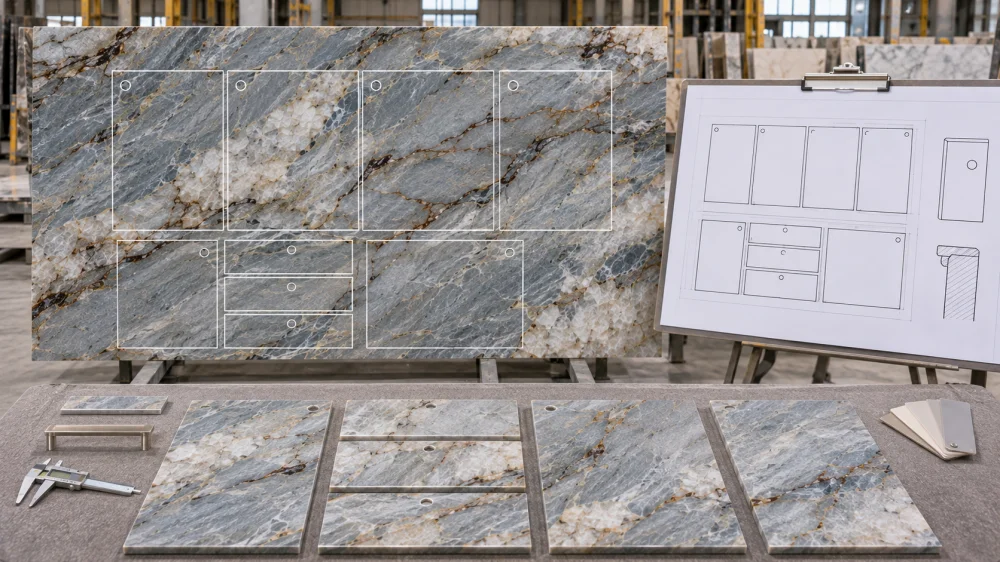
For projects using several related fronts, the slab-layout drawing can show all cabinet pieces together so the buyer can review both pattern direction and hardware-dependent geometry before cutting.
A mock-up is particularly useful when the design combines expensive quartzite, unfamiliar thin-front hardware, recessed pulls, small edge distances or a new backing construction.
The mock-up does not need to reproduce the entire kitchen.
Its purpose is to answer the uncertain interface.
For example, one test front may verify the proposed drilled fixing, backing thickness, pull installation and finished edge relationship. Another may confirm whether an edge-pull recess can be fabricated cleanly and assembled without interference.
The mock-up should use the intended geometry and the relevant hardware, not a substitute screw or approximate handle.
| Interface | Mock-Up Should Confirm | Approval Record |
| Pull through-hole | Hole size, alignment, rear fixing and visible finish | Approved hardware reference and drilling drawing |
| Edge pull recess | Machined geometry, remaining stone and hardware fit | Approved section and actual sample |
| Thin-front fixing | Hardware compatibility and controlled drilling | Hardware manufacturer’s current system reference |
| Stone plus backing | Assembly thickness, alignment and attachment sequence | Approved cabinet-front section |
Once the mock-up is accepted, record exactly what it proves. A successful handle mock-up does not automatically approve every hinge or every later stone piece.
The stone drawing should be detailed enough that production staff do not need to reconstruct the cabinet designer’s intention from emails.
Each front should have a stable piece reference linked to the cabinet schedule.
The drawing should identify finished width and height, actual stone thickness, visible faces, edge finish, pattern direction and all stone machining required for hardware.
Where the stone attaches to a backing panel, the drawing should also identify the relationship between the stone holes and the relevant backing-panel holes or inserts.
Hardware drilling information should come from the approved current hardware documents.
If different fronts use different pulls or hinge systems, do not place them under one generic machining note.
The Natural Stone Institute describes shop drawings as an important communication tool between clients, production teams and installers. That principle becomes especially important on furniture work where stone fabrication must coordinate with a separate cabinet and hardware package.
da HRST STONE inspection and production-control service covers production monitoring through later QC stages. For cabinet fronts, that control is most effective when the final hardware information has already been integrated into the approved fabrication documents.
Production release should occur only after the stone and cabinet information have converged into one buildable condition.
The material can be approved while hardware coordination remains open. Likewise, the hardware can be selected while final slab allocation is still pending.
These are separate approval stages.
Front construction: The project identifies whether the stone is backed, framed or used with an approved thin-front system.
Finished dimensions: Every door and drawer front has a controlled piece size and reference.
Metais: Pulls, hinges, drawer connectors and lift mechanisms affecting the stone are frozen.
Front weight: The cabinet or hardware specialist has reviewed the actual assembled front weight where it affects hardware selection.
Machining: Hole diameter, centres, offsets, depths, notches and recesses come from current approved drawings.
Stone layout: Drilling areas have been checked against the selected slab and finished-piece orientation.
Backing: Structural substrate and attachment responsibilities are defined.
Clearances: Front gaps, opening swing, drawer travel and neighboring components are coordinated.
Mock-up: Any new or sensitive stone-to-hardware detail has been tested where required.
Status de revisão: Cabinet, hardware and stone drawings refer to the same approved design revision.
Final QC should compare the fabricated piece against the approved stone drawing and the relevant hardware reference.

Dimension checks alone are not enough.
The inspection should review the finished face, pattern orientation, edge processing, hole positions, recess geometry and any local chipping or cracking around machined areas.
Where appropriate, a controlled hardware fit check or assembly test can confirm that the physical interface matches the drawing.
The goal is not to permanently assemble every cabinet in the stone factory. It is to detect interface errors before the fronts are packed and shipped to another workshop or project site.
For international projects, the packing plan should also protect small finished edges, corners and drilled areas from impact during handling. Piece identification should remain traceable without placing damaging adhesives directly on the finished stone face.
Buyers preparing a custom cabinet-front package can use the HRST STONE contact page to send the quartzite selection, cabinet elevations, front schedule, hardware drawings, finished sizes, quantities and destination for project-specific review.
Do not assume that a conventional timber-door hinge detail can be transferred directly to natural quartzite. The project must first establish the complete front construction and select hardware compatible with that construction. Some hardware systems are specifically designed for thin hard fronts, but their drilling and fixing requirements are system-specific.
The fixing detail should be defined by the cabinet and hardware design rather than assumed. Where the front includes a structural backing, the project may use that backing or another approved support as part of the fixing assembly. The quartzite fabricator needs the complete section before drilling.
Approve handle-hole positions only after the exact pull model, centre-to-centre dimension, finished front size and cabinet layout are confirmed. A later hardware substitution can change the required drilling pattern.
Hinge and lift-system selection can depend on the dimensions and weight of the moving front. The relevant value is the complete assembled front, which may include quartzite, backing, frame and handle rather than the stone alone.
They should not be moved independently by the stone factory. A change in hole location can affect handle alignment, hinge geometry, drawer-front adjustment or cabinet clearances. Any proposed change should be returned to the responsible cabinet or hardware designer for approval.
No. A mock-up is most useful when the interface is new, structurally sensitive or difficult to correct after fabrication, such as a thin-front fixing, recessed edge pull, unusual backing system or machining close to a critical stone feature.
Send the selected quartzite, front schedule, finished dimensions, thickness, slab-layout requirements, cabinet elevations, section details, pull and hardware references, hole or recess drawings, backing construction, quantities and delivery destination. Clearly identify which drawings are approved for production.
Do not release drilling from a rendering, an approximate handle position or a generic hinge detail. Freeze the hardware, establish what carries the front, confirm the backing and finished weight, combine the approved drilling geometry with the actual slab layout, and verify any high-risk interface before bulk production.
Buyer Next Step: Send the cabinet-front schedule and current hardware drawings together with the quartzite selection so the stone machining can be reviewed before cutting.