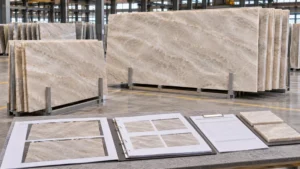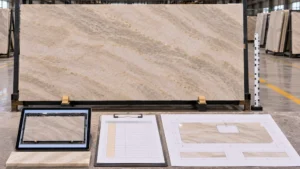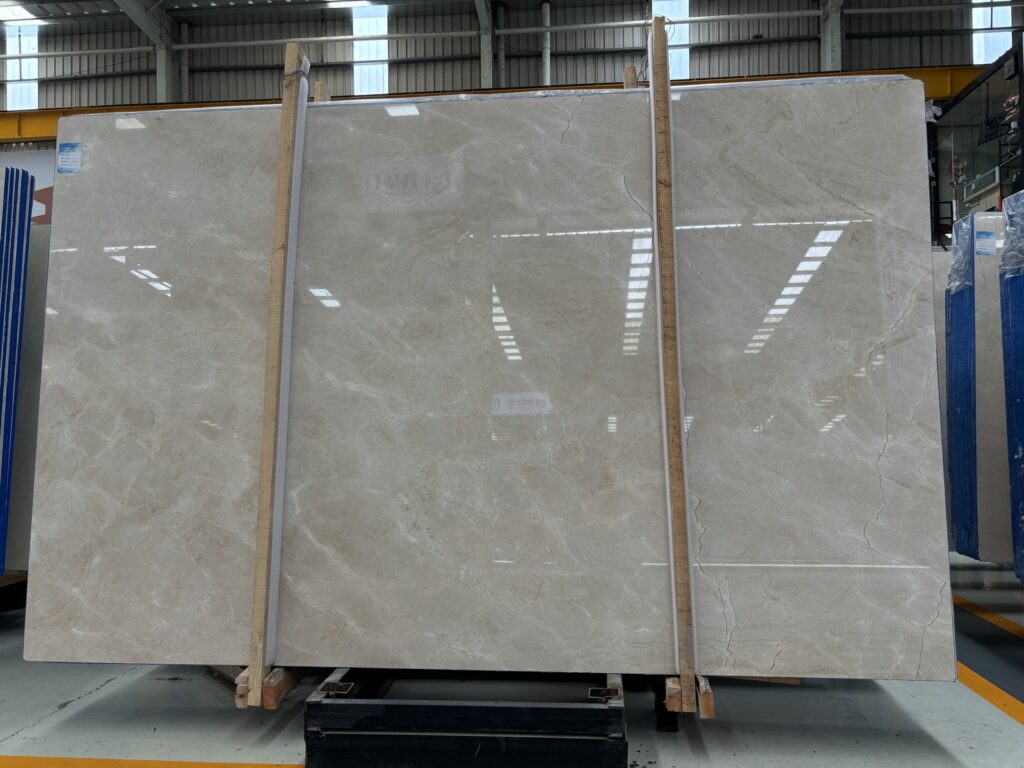

Resumo RápidoAs maquetes adesivas de quartzito devem testar toda a interface de instalação proposta antes do início da produção. Utilize o quartzito natural real ou uma peça representativa do projeto, preserve as condições relevantes do verso, aplique o adesivo candidato e os preparativos especificados para o projeto, use um substrato representativo e mantenha uma referência de controle não colada da mesma pedra, quando possível. Avalie a face da pedra antes da colagem, durante o processo de cura e secagem e após a condição final acordada de revisão. Registre mudanças mais escuras, mais claras, mais quentes, mais frias, turvas, relacionadas à borda ou ao brilho, sem automaticamente classificá-las como manchas. Registre também a cor do adesivo, a cobertura, o suporte ou resina, o substrato, o primer ou membrana, a condição de umidade, o estágio de cura, a iluminação e a orientação da amostra. Uma maquete de aparência bem-sucedida não aprova automaticamente a resistência da ligação, o suporte estrutural, a fixação mecânica, a impermeabilização ou cada laje subsequente.
Um painel de quartzito natural claro parece correto antes da instalação.
A pedra está colada a um substrato.
No dia seguinte, parte da face parece mais escura.
Uma borda parece ligeiramente mais saturada que o centro.
Uma zona rica em cristais parece mais cinza do que antes da colagem.
Vários dias depois, parte da diferença de cor torna-se mais fraca.
Outra área permanece visivelmente alterada.
O que aconteceu?
O adesivo estava muito escuro?
A umidade da instalação pode ter escurecido temporariamente a pedra?
A pedra real reagiu de forma diferente da amostra?
A diferença visível provém do adesivo, da umidade do substrato, do suporte existente, de algum tratamento já presente na pedra ou de outra condição?
Esta é a razão prática para Maquetes Adesivas de Quartzito: Testando a Descoloração Antes da Instalação.
Uma maquete não deve ser construída apenas para provar que um adesivo consegue segurar uma peça de pedra no lugar.
Para quartzitos naturais visualmente sensíveis, ela também pode responder a uma segunda pergunta:
O sistema completo de instalação proposto cria uma alteração visível inaceitável na face da pedra?
O primeiro erro é chamar toda mudança visível de mancha.
Uma maquete pode apresentar várias observações diferentes.
Uma área pode parecer mais escura que o controle não colado.
Isso pode ser uniforme em toda a amostra, concentrado perto de uma borda, visível apenas sobre certas zonas minerais ou presente como manchas irregulares.
Uma zona colada também pode parecer mais clara, leitosa, cinza ou menos profunda visualmente do que a referência original da pedra.
Isso é particularmente importante em quartzitos naturais claros, onde pequenas mudanças podem ser perceptíveis.
A pedra pode parecer:
Descreva o que é visível antes de decidir por que isso ocorreu.
Uma diferença visual pode, na verdade, estar relacionada à luz refletida e não à cor.
Pergunte separadamente:
A cor mudou?
e:
A superfície reflete a luz de forma diferente?
Algumas amostras podem mostrar uma faixa mais escura ou de outra forma diferente perto de um perímetro ou junta, enquanto o centro parece relativamente inalterado.
Registre a geometria da condição visível.
Não atribua um mecanismo apenas pela aparência.
O guia relacionado Gravação versus mancha em uma amostra de quartzito: como descrever o problema guia utiliza o mesmo princípio: primeiro registre cor, brilho, limites, textura, comportamento de visualização, condição de umidade e histórico de exposição antes de identificar a causa.
Regra de Observação
Mais escuro ≠ Automaticamente Manchado. Turvo ≠ Automaticamente Danos por Umidade. Escurecimento da Borda ≠ Automaticamente Falha do Adesivo. Primeiro registre a mudança visível, depois investigue o mecanismo.
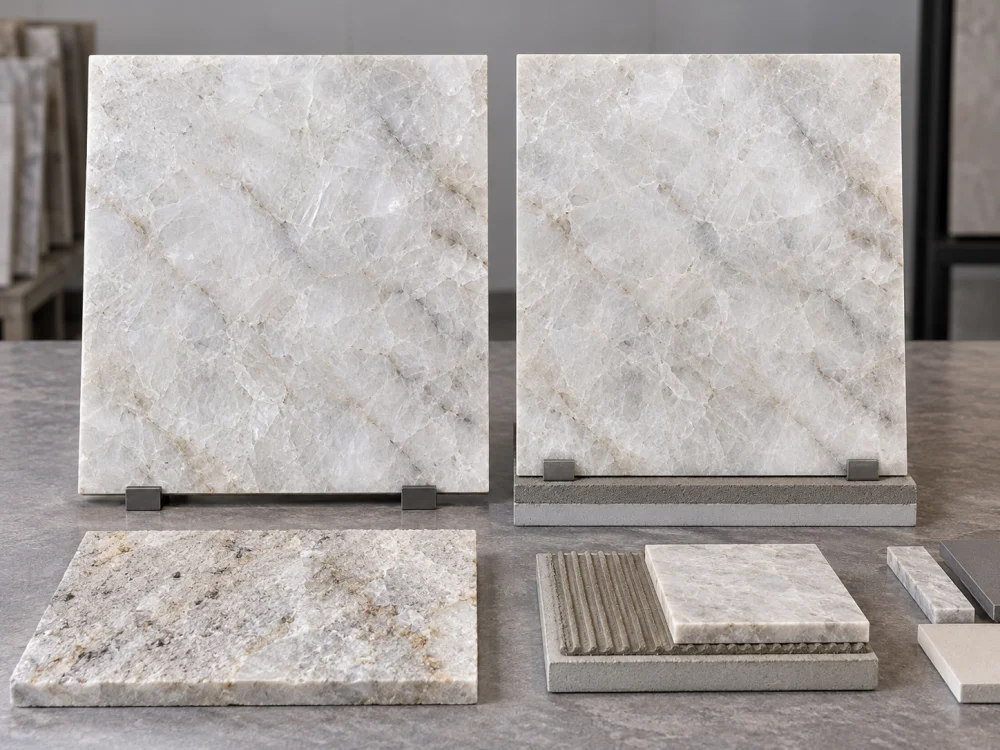
Uma maquete torna-se difícil de interpretar se não houver nada com que compará-la.
Where practical, prepare a control piece from the same Natural Quartzite selection.
The strongest comparison is often:
Unbonded Control ↔ Bonded Mock-Up
rather than:
Bonded Mock-Up ↔ Old Mobile-Phone Photograph.
Natural Quartzite varies.
Two samples from unrelated parts of a slab may already have different colour, crystal density, veining, or translucency before adhesive is applied.
For a colour-sensitive test, adjacent or otherwise representative pieces can reduce unrelated variables.
The control and test piece should use the same intended surface finish where practical.
A polished control should not silently be compared with a honed bonded sample.
If the project stone has documented:
record it.
The control is useful only when the team understands what it represents.
Take the baseline photographs before adhesive is applied.
A useful set includes:
Baseline Sequence
Identify Stone → Match Finish → Photograph Face → Photograph Back → Record Treatments → Preserve Unbonded Control → Begin Adhesive Test.
A discoloration test made with the wrong backing or wrong substrate can produce an answer to the wrong question.
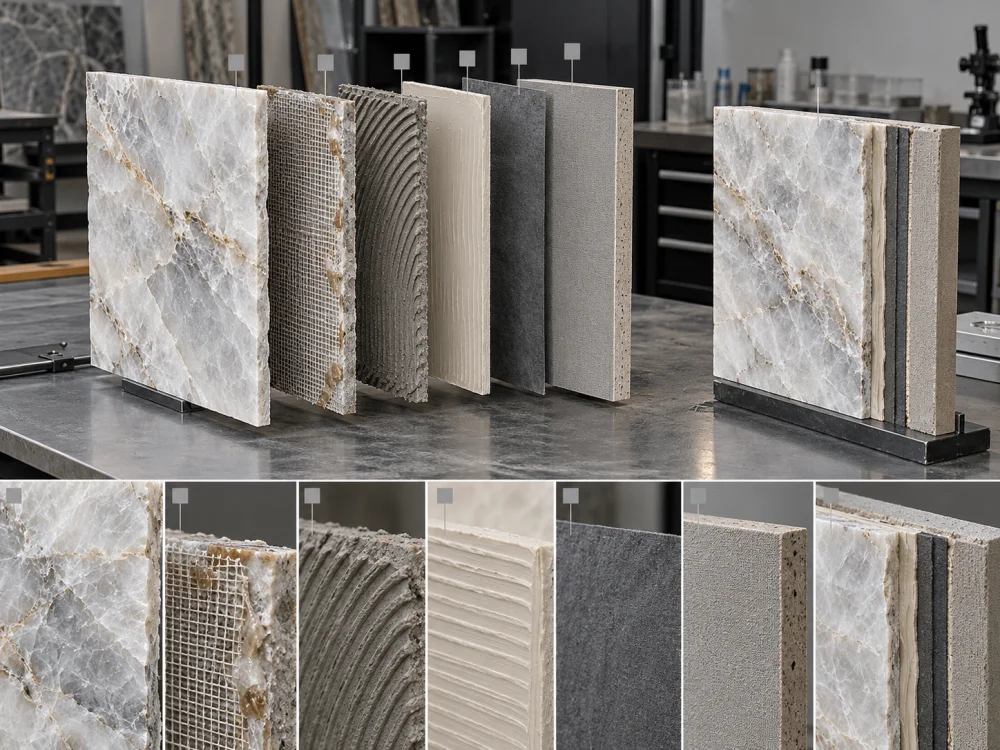
The complete installation interface matters.
The back of the Natural Quartzite may be:
If the production panel is mesh-backed, a test performed only on freshly exposed bare Quartzite does not reproduce the same interface.
O Lajes de Quartzoide Com Suporte de Malha: O Que os Instaladores Devem Saber Antes da Colagem guide explains why the actual bonding surface must be identified before the adhesive system is approved.
If the approved installation system requires a particular preparation, the mock-up should reproduce it as closely as practical.
Do not sand, grind, prime, clean, or otherwise alter the test surface in a way that production will not follow.
The other side of the bond also matters.
The test should identify the actual or representative receiving condition, such as the project-approved:
A mock-up bonded to one substrate does not automatically approve a different substrate.
If the real installation includes a primer, membrane, waterproofing layer, or another system component between adhesive and structural substrate, include it where the mock-up is intended to represent that assembly.
The bond stack may therefore be:
Quartzite → Existing Back Treatment → Prepared Surface → Adhesive → Primer / Membrane → Substrate.
A horizontal floor sample and a large vertical wall panel do not necessarily reproduce the same installation condition.
Where orientation affects application, coverage, movement, or visual review, record the intended project orientation.
Adhesive is normally hidden after installation.
That does not always mean its colour or distribution is visually irrelevant.
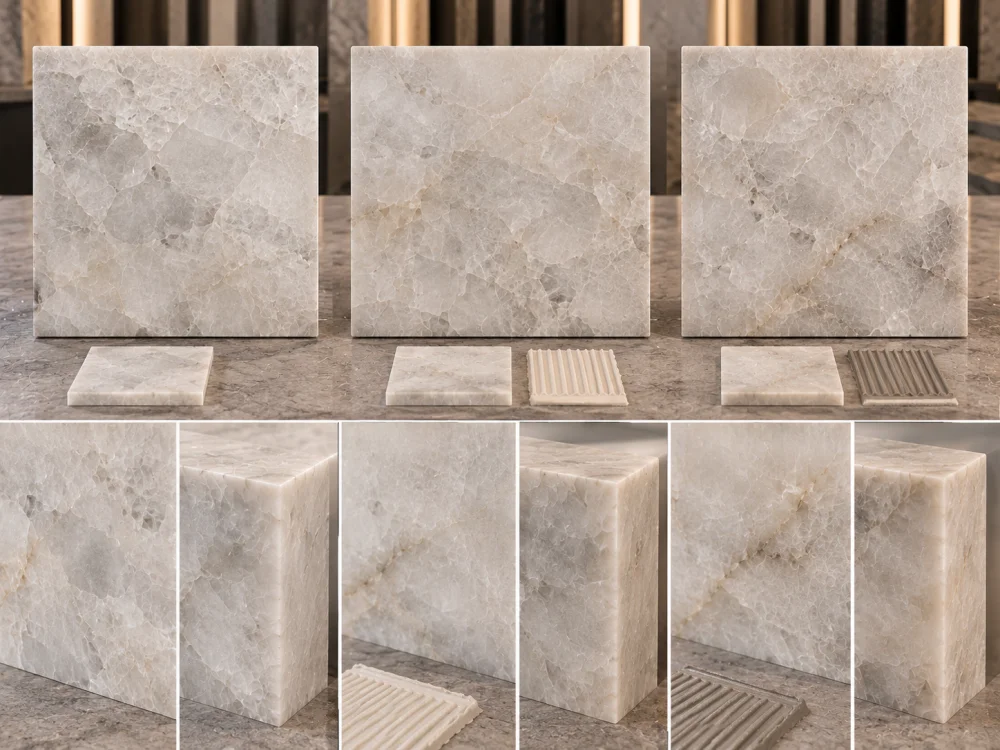
Pale Natural Quartzite can contain zones with different optical depth.
Some crystal-rich areas may visually transmit or scatter light differently from more opaque mineral fields.
Where the actual stone makes adhesive show-through or shadowing a concern, test it.
Do not assume that every Natural Quartzite is translucent.
Some installation-product manufacturers distinguish between products or colours intended for light-coloured or visually sensitive natural stone.
The responsible installer should follow the current documentation for the candidate product.
If the project is comparing more than one approved candidate system, the mock-up may be organized as:
Control → Candidate A → Candidate B.
Keep the stone, substrate, preparation, application method, and viewing conditions as consistent as practical so the adhesive system remains the principal changed variable.
A very thin smear made only for photography may not represent the production installation.
Likewise, an intentionally excessive adhesive layer may create a condition the actual installation will not use.
The mock-up should follow the proposed installation method and current product guidance for:
White adhesives or mortars are commonly considered for some light-coloured or translucent natural stones because darker material behind the stone may affect appearance.
That does not mean every Quartzite project should automatically use the same white adhesive.
The decision still depends on the actual stone, backing, substrate, environment, installation method, and current adhesive-manufacturer guidance.
O site’s Tratamentos com resina para quartzito: perguntas a fazer antes de escolher um adesivo guide explains why product choice should begin with the actual bond surface and bond purpose rather than the commercial stone name.
| Mock-Up Variable | What Must Be Recorded |
| Quartzito | Sample / slab relationship, finish and relevant mineral zone |
| Condição do suporte | Bare stone, mesh, resin, mixed condition or other prepared surface |
| Adhesive | Exact candidate product, colour and current reference |
| Aplicativo | Preparation, coverage and relevant installation method |
| System layers | Primer, membrane or other specified intermediate layer |
| Substrato | Actual or representative receiving surface |
| Ambiente | Orientation, temperature / moisture condition where relevant, and review location |
A bonded sample can change visually while moisture is present and then change again as the installation system cures.
This means one photograph taken shortly after bonding is not enough.
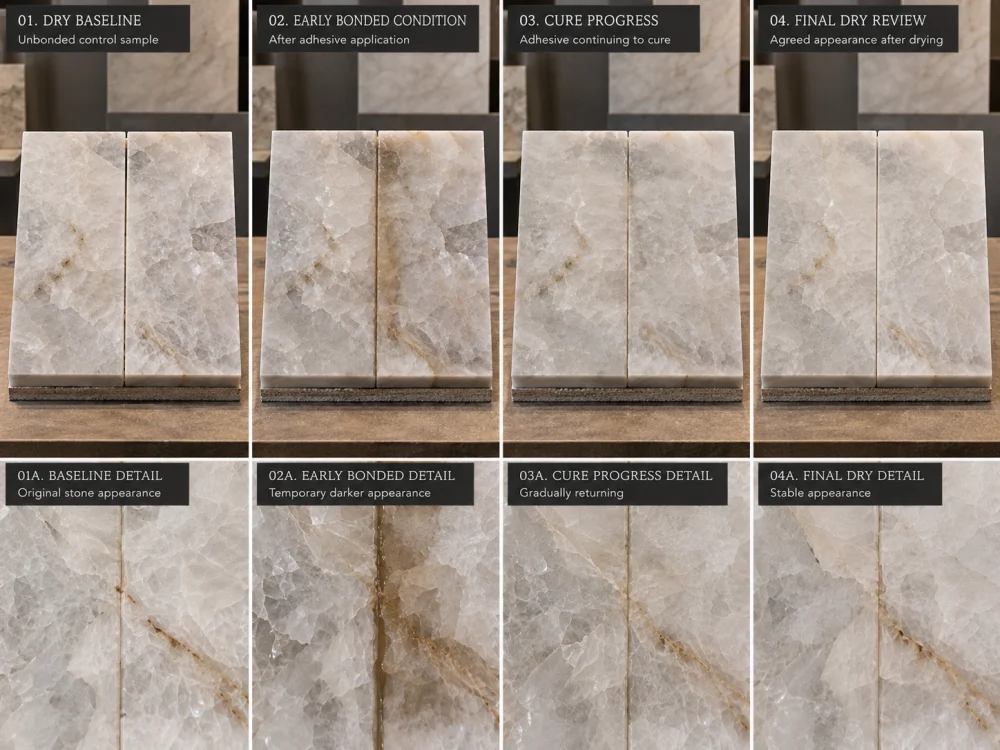
Registre:
After installation begins, the face may appear temporarily different.
If a darker or cloudy zone develops, record it.
Do not immediately classify it as permanent staining.
Continue the comparison according to the curing conditions and timing relevant to the proposed product.
Avoid inventing one universal number of hours or days for every adhesive.
At the final agreed review condition, compare:
Bonded Sample ↔ Unbonded Control.
Verifique:
A sample photographed under warm evening lighting should not be silently compared with a control photographed under cool daylight.
Use the same or clearly documented viewing conditions.
For every visual review, note:
Dry / Damp / Recently Wiped / Unknown.
Natural stone can appear darker while moisture is present.
The condition during photography matters.
Mock-Up Timeline
Dry Baseline → Bond → Early Observation → Defined Cure Stage → Agreed Dry Final Review → Compare with Control → Record Decision.
One of the main reasons to continue a mock-up through curing and drying is that the first visual change may not be the final one.
A bonded natural-stone sample can look darker while moisture is present within or behind it.
If the appearance gradually returns toward the control as the approved installation system cures and the sample dries, record that sequence.
Do not silently use only the darkest photograph as the final condition.
If a darker, lighter, cloudy, coloured, or edge-related area remains after the agreed dry review condition, record that separately.
The next step is not automatically to declare:
“The adhesive stained the Quartzite.”
The relevant parties may need to consider:
A light-coloured powdery or crystalline surface deposit is a different observation from simple darkening.
Moisture moving through installation materials can transport soluble salts under some conditions.
If a powdery deposit appears, document it rather than grouping it under the word “discoloration.”
Natural stones can contain different minerals.
Water and installation chemistry may be relevant to some stone conditions, but a brown, yellow, grey, or cloudy area does not by itself prove which mineral or chemical process is responsible.
Visual evidence should trigger the appropriate technical review rather than replace it.
One Natural Quartzite sample may contain several zones that do not respond identically.
A small colour difference may be easier to see against a light background than against a darker mineral field.
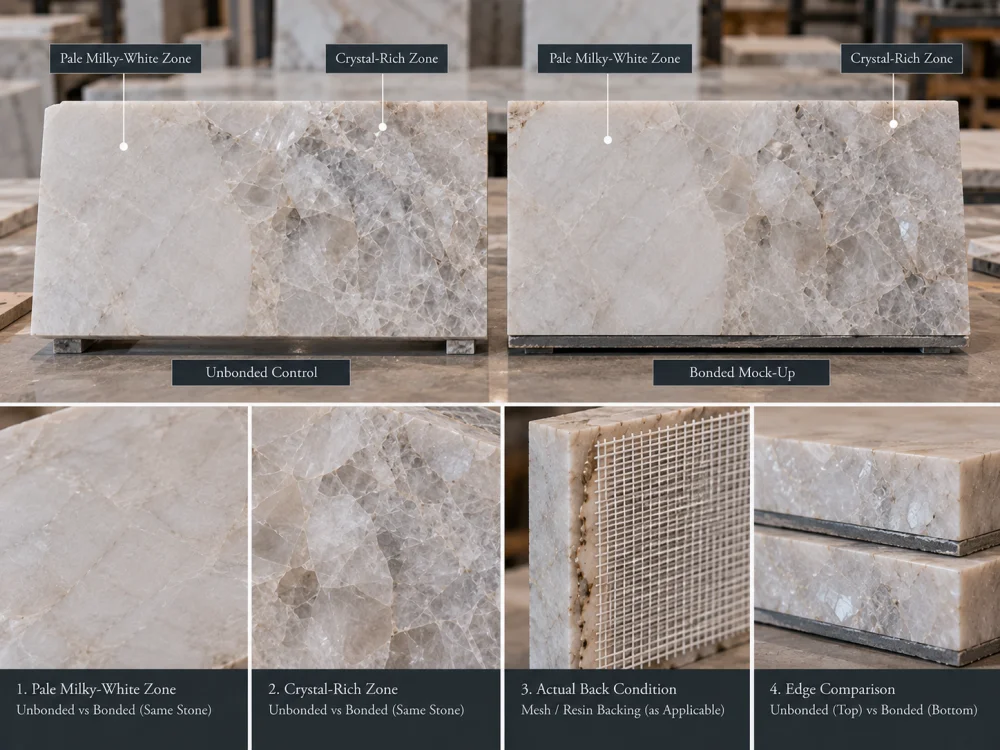
Crystal-rich or partially light-transmitting zones may show underlying colour, shadow, moisture, or interface differences differently from more opaque sections.
Do not assume that this behaviour applies to every Quartzite.
Use the actual selected material.
An existing repair or resin-treated condition introduces another material history.
If the installation adhesive will sit behind that area, include a representative repaired zone in the test when it is visually or technically important.
If the project panel contains mesh and resin, the installation adhesive may not contact Natural Quartzite directly.
That changes both compatibility review and the ability of the mock-up to represent production.
A fabricated panel may include:
If one panel contains materially different bonding surfaces, a single tiny test coupon from only one zone may not answer every installation question.
This distinction should be explicit in the approval record.
Its main purpose may be to review:
A technical bond test may evaluate other questions, depending on the approved system and project specification.
Those can include:
A mock-up can remain visually unchanged and still fail to prove that the complete wall, floor, or panel assembly has adequate technical bond performance.
Likewise, an adhesive can achieve strong attachment while creating an unacceptable visible change in a pale or visually sensitive stone.
Record which question each test answers.
Two Separate ApprovalsAprovação visual: Does the bonded Quartzite retain an acceptable appearance after the agreed cure and dry review?
Technical Installation Approval: Is the complete adhesive / backing / substrate / environment system suitable according to the responsible installation design and current product documentation?
A useful record allows the team to reconstruct exactly what was tested.
| Item a Registrar | O que Identificar |
| Quartzito | Material, sample ID, slab relationship, finish and mineral zone where relevant |
| Controle | Unbonded comparison piece or documented control area |
| Condição do suporte | Bare / mesh / resin / repaired / mixed |
| Preparação | Actual preparation used on test piece |
| Adhesive | Exact candidate product and colour |
| Substrate / system layers | Representative substrate, primer, membrane or other relevant layers |
| Aplicativo | Representative method and coverage condition |
| Review stages | Baseline, early observation, cure-stage review and final agreed dry review |
| Visual result | Colour, sheen, cloudiness, edges and comparison with control |
| Approval boundary | Exact condition approved and unresolved technical questions |
Repeat the affected review if:
The purpose is not to create endless testing.
It is to prevent one controlled mock-up from being used as proof for a physically different installation.
The safest approval sequence is:
Actual Quartzite → Baseline Control → Actual Back Condition → Intended Preparation → Candidate Adhesive → Actual System Layers → Representative Substrate → Cure / Dry Review → Visual Approval → Separate Technical Installation Approval → Release.
This sequence avoids several common mistakes:
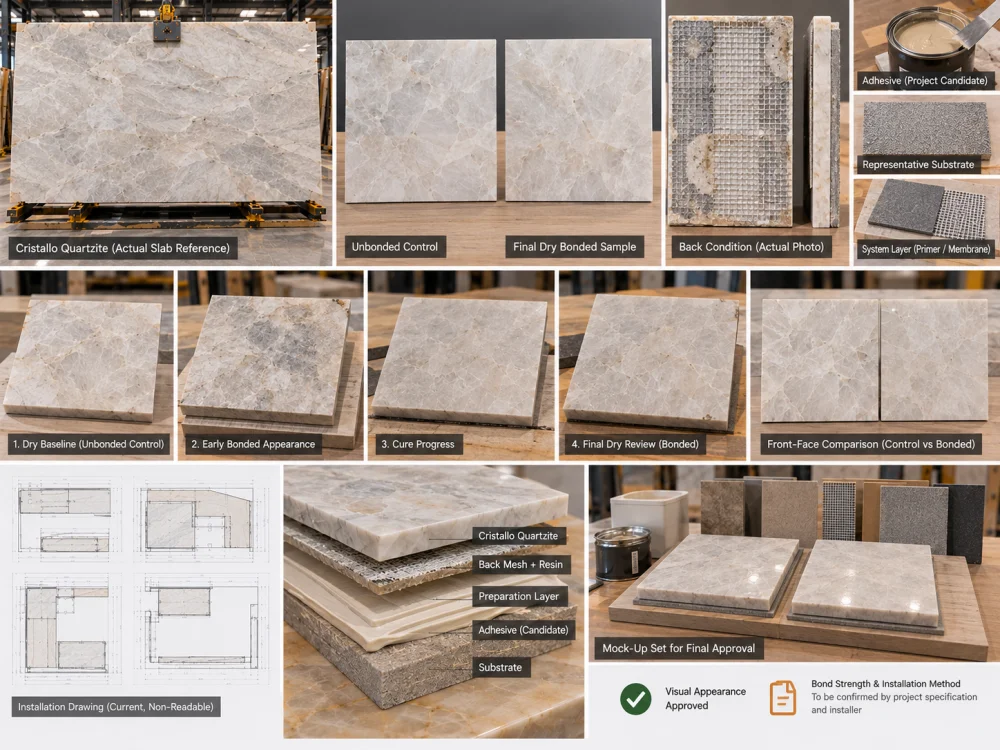
A good adhesive mock-up is therefore not just a sample glued to a board.
It is a controlled record of the real installation interface and the real visual question.
Uma mudança visível de cor pode ocorrer em determinadas condições da pedra e da instalação, mas a aparência por si só não é suficiente para identificar a causa. A cor do adesivo, a umidade durante a instalação, a umidade do substrato, o suporte ou a resina existentes, materiais solúveis, zonas minerais naturais, tratamentos de superfície e outros fatores podem necessitar de análise. Uma amostra representativa ajuda a determinar o que ocorre com o sistema realmente proposto.
Nenhuma regra universal deve ser aplicada com base apenas na cor da pedra. Alguns fabricantes de adesivos recomendam sistemas de cor branca para determinadas pedras naturais claras ou translúcidas, pois a cor subjacente pode afetar a aparência; entretanto, a escolha final do produto deve levar em conta a própria quartzita, o suporte, o substrato, o ambiente, o método de instalação e a documentação atual do fabricante.
Do not use one universal cure time for every adhesive. Record the dry baseline, early bonded condition, the manufacturer-defined curing stages relevant to the selected product, and the agreed final dry visual review. The candidate adhesive’s current technical documentation should control curing requirements.
Não automaticamente. A umidade pode, temporariamente, fazer com que a pedra natural pareça mais escura. Registre o estado e continue a revisão controlada do cura e da secagem. Se a diferença persistir após atingir o estado de secagem acordado, documente a alteração persistente e investigue mais a fundo, em vez de atribuir uma causa com base em apenas uma fotografia inicial.
A maquete deve representar a superfície de adesão real. Se os painéis de produção contiverem malha, resina, resina lixada, reforço localizado ou outra condição de suporte, um ensaio realizado apenas sobre pedra nua pode não reproduzir a interface de instalação. Confirme o preparo exigido e a compatibilidade do adesivo para o suporte real.
Não. Uma maquete visual pode auxiliar na decisão quanto à aparência, mas aspectos como suporte estrutural, resistência da aderência, fixação mecânica, adequação do substrato, impermeabilização, movimentações, cargas externas e outros requisitos de instalação podem exigir avaliação técnica ou ensaios específicos.
Envie a Josh o material de quartzito natural e a amostra ou referência da laje, o acabamento, fotografias da face frontal e posterior, o estado conhecido da malha ou da resina, o local e a orientação previstos para a instalação, informações sobre o substrato, o produto adesivo e a cor propostos, informações sobre o primer ou a membrana, quando aplicável, o método de preparação da superfície, os desenhos do projeto, as quantidades, bem como a questão visual específica que está sendo testada. Mantenha, sempre que possível, uma referência de controle identificada e registre a maquete ao longo das etapas acordadas de cura e revisão a seco.
Adhesive Mock-Up Approval SummaryA Quartzite adhesive mock-up should reproduce the real installation interface closely enough to answer the actual visual question. Keep an identified unbonded control, use the relevant stone and back condition, reproduce the proposed preparation, adhesive, system layers and substrate, and document the face before bonding, during curing, and after the agreed dry final review. Describe visible changes before diagnosing their cause. Keep visual-discoloration approval separate from bond strength, structural support, mechanical fixing, waterproofing, and other installation-system requirements. If the stone, backing, adhesive, substrate, preparation, or installation environment changes materially, repeat the affected review before extending the previous mock-up approval.
For project-based Natural Quartzite wall panels, tiles, feature walls, and other bonded stone components, HRST STONE can coordinate actual slab references, front- and back-surface photographs, visible mesh or resin records, cutting layouts, panel IDs, control samples, mock-up documentation, cured appearance records, fabrication QC, packing, and export documentation according to the confirmed stone scope. Final adhesive selection, substrate preparation, installation method, bond performance, waterproofing, structural support, and mechanical fixing should be confirmed for the actual project by the responsible installer, installation-system manufacturer, designer, engineer, or other qualified project party as applicable.