No mundo da arquitetura de alto padrão, um projeto só é tão bom quanto sua execução. Você provavelmente já viu as imagens renderizadas: fachadas paramétricas imponentes, escadarias orgânicas em mármore que parecem desafiar a gravidade e paredes com relevos intrincados que contam uma história em pedra calcária. Mas, como qualquer gerente de projeto experiente sabe, a distância entre um belo arquivo CAD e uma obra-prima de pedra finalizada está repleta de obstáculos técnicos.
Quando chega a hora de passar da tela para a pedra, a questão não é apenas “como cortamos isso?”, mas sim, “fabricação de pedra CNC vs jato de água vs 5 eixos—qual delas não vai estourar o orçamento nem comprometer o cronograma?” Escolher a tecnologia de corte de pedra errada pode levar a bordas irregulares, desperdício de material ou a uma conta que fará o cliente chorar. Este guia analisa minuciosamente os três grandes nomes do ateliê para ajudá-lo a escolher a ferramenta certa para o seu próximo projeto complexo de fabricação de pedra projeto. O Dilema do Arquiteto: 3 Pontos Comuns de Dor.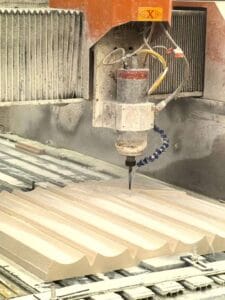
Antes de mergulharmos na mecânica, vamos reconhecer as dores de cabeça que tiram o sono dos projetistas:
O “Efeito Desaparecimento” do Detalhe:
-
Você projeta uma textura 3D delicada, mas o fabricante diz que é “impossível” ou devolve uma peça que parece ter sido esculpida com uma faca de manteiga. O Estouro do Orçamento:.
-
Selecionar uma máquina de 5 eixos para um trabalho que poderia ser realizado por uma CNC padrão, resultando em custos 3 vezes superiores ao necessário. A Falha Estrutural:.
-
Escolher um método de corte que exerce vibrações excessivas ou estresse térmico sobre a laje, fazendo com que quartzoite ou mármore caros rachem durante a etapa final de produção. Compreendendo os Concorrentes: Papéis e Definições.
Para navegar
, é preciso primeiro entender o “DNA” fundamental de cada máquina. projeto., 1. Usinagem de Pedra CNC (3 eixos e 4 eixos).
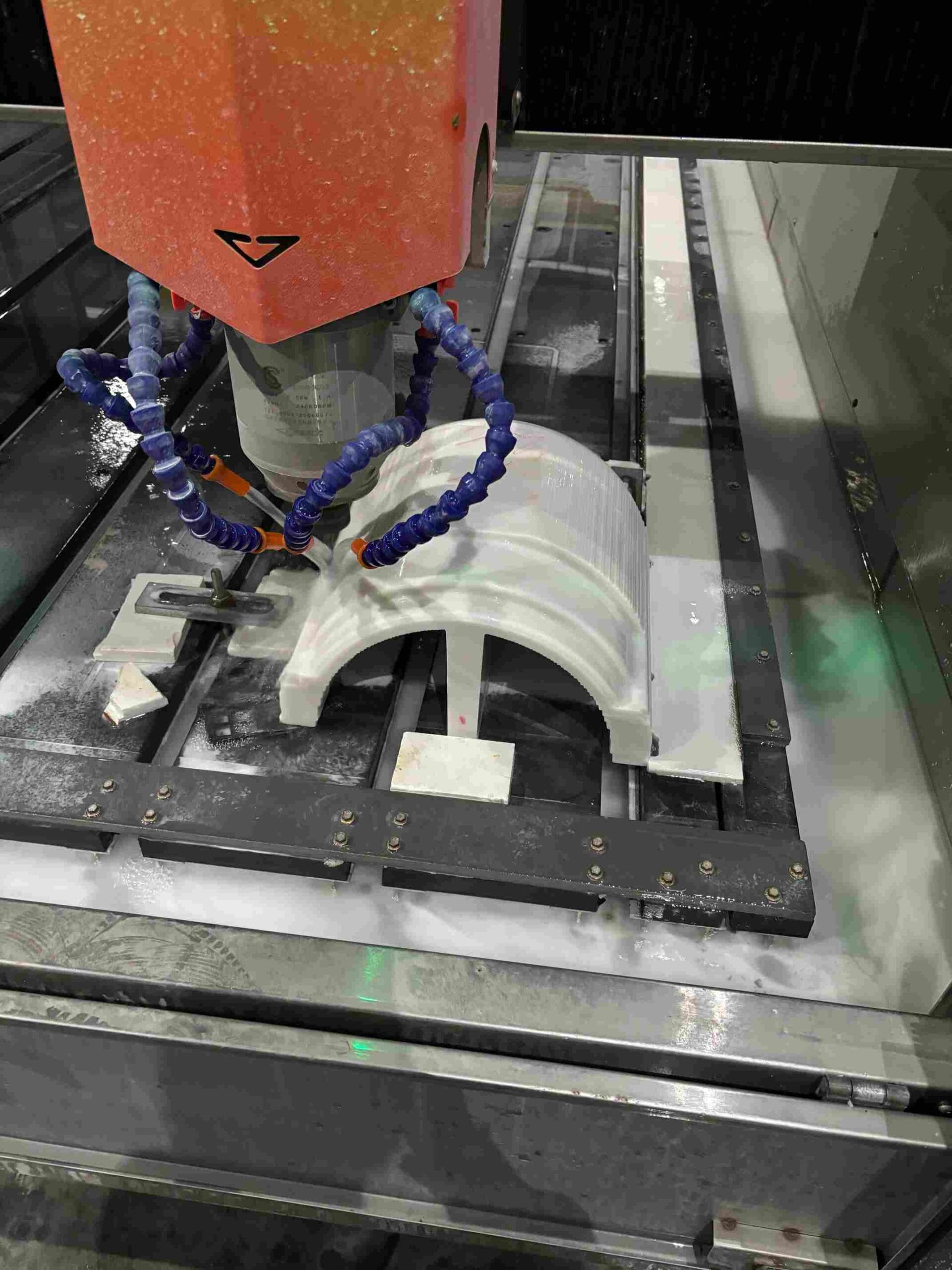
opera em um sistema de coordenadas cartesianas (
Padrão Usinagem de pedra CNC $X, Y, Z$). Pense nisso como um escultor extremamente disciplinado que se move da esquerda para a direita, da frente para trás e de cima para baixo.Melhor para:.
-
Superfícies planas, rebaixos, gravação e relevos 3D básicos. O Problema:.
-
Tem dificuldade com recortes subterrâneos ou curvas verticais acentuadas, porque a ferramenta sempre fica perpendicular à mesa. 2. Corte por Jato de Água.
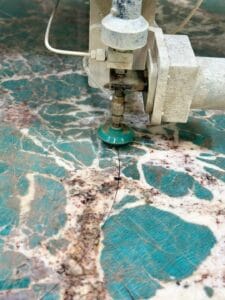 A tecnologia de jato de água utiliza um fluxo supersônico de água misturada com abrasivo de granada. É o “bisturi” da indústria.
Contornos 2D intrincados, incrustações de pedra (marquetry) e corte de lajes espessas (até 200 mm) com extrema precisão.
-
Superfícies planas, rebaixos, gravação e relevos 3D básicos. É estritamente um “cortador de atravessar”. Não pode criar profundidades, bolsões ou esculturas 3D.
-
Tem dificuldade com recortes subterrâneos ou curvas verticais acentuadas, porque a ferramenta sempre fica perpendicular à mesa. 3. Usinagem de 5 Eixos.
A máquina de 5 eixos adiciona dois eixos de rotação (
$A$$B$ e ) ao modelo padrão. A cabeça de corte pode inclinar-se e girar, permitindo abordar a pedra de qualquer ângulo. ). Pense nisso como um escultor extremamente disciplinado que se move da esquerda para a direita, da frente para trás e de cima para baixo.. Esculturas 3D verdadeiras, escadarias torcidas e designs “subcortados” onde a ferramenta precisa alcançar sob uma saliência de pedra.
-
Superfícies planas, rebaixos, gravação e relevos 3D básicos. Alta complexidade de programação e taxas horárias elevadas.
-
Tem dificuldade com recortes subterrâneos ou curvas verticais acentuadas, porque a ferramenta sempre fica perpendicular à mesa. Comparação Direta: Os Dados.
Ao decidir sobre
, use a seguinte matriz para ponderar suas prioridades. pode levar a bordas irregulares, desperdício de material ou a uma conta que fará o cliente chorar. Este guia analisa minuciosamente os três grandes nomes do ateliê para ajudá-lo a escolher a ferramenta certa para o seu próximo, Característica.
| CNC (3/4 eixos) |
Jato de Água |
Usinagem de 5 Eixos |
Dimensionalidade |
| 2,5D (Relevos) |
2D (Perfis Planos) |
3D Completo (Escultural) |
Precisão |
| Ultra-Alta |
Alto |
Tempo de Configuração |
Alto |
| Rápido |
Médio |
Lento (Codificação Complexa) |
Desperdício de Material |
| Moderado |
Mínimo (Fenda Fina) |
Melhor Para |
Mínimo (Fenda Fina) |
| Tampos de Cozinha / Painéis de Parede |
Incrustações de Piso / Medalhões |
Estátuas / Curvas Complexas |
Análise Detalhada: Qual Processo para Qual Forma? |
A “Regra de Ouro” de
The “Golden Rule” of projeto. is matching the tool’s movement to the stone’s geometry.
Scenario A: Parametric Facade Panels
If your design features a repeating geometric wave, Usinagem de pedra CNC is usually the winner. Since the panels are mostly flat with varying depths, a 3-axis CNC can batch-produce these efficiently.
Scenario B: Intricate Floor Medallions
For a hotel lobby featuring interlocking marble colors, waterjet cutting is the only logical choice. The “kerf” (the width of the cut) is less than 1mm, allowing pieces to fit together like a perfect jigsaw puzzle.
Scenario C: The Spiral Solid-Stone Staircase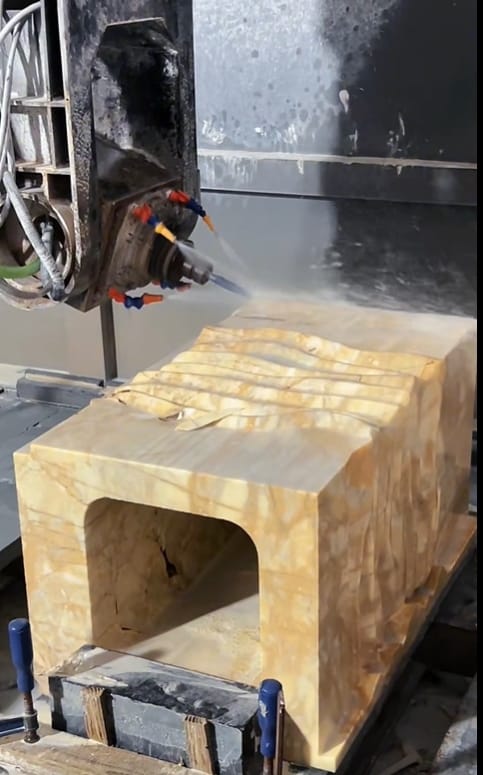
When the underside of a tread is curved and the side is twisted, you need 5-axis machining. The tool must “follow” the curve of the stone in a fluid, multi-directional motion to ensure a smooth finish.
Engineering for Success: Pro Tips for Designers
Beyond the machine choice, the success of projeto. depends on how you prepare the “Digital Twin.”
-
Mind the “Safety Thickness”: When using 5-axis paths for thin organic shapes, always leave a 2-3mm “tolerance” in the digital model. Stone is a natural product with internal stresses; if you go too thin, the vibration of the tool will shatter the piece.
-
Integrated Fixings: For heavy 3D wall claddings, use Usinagem de pedra CNC to pre-cut the pockets for undercut anchors or T-slots. This should be done in the factory, never on-site.
-
The Hybrid Approach: Most high-end projects use a combination. A waterjet might cut the rough “blank” of a statue to save time, followed by 5-axis milling for the detail, and finally, manual hand-finishing for the soul.
Market Insights & Future Trends
The stone industry is moving toward “Industry 4.0.” We are seeing an increase in Robotic Arm Machining (effectively 6-axis or 7-axis), which allows for even larger-scale projeto., such as entire monolithic columns.
Sustainability is also driving the popularity of waterjets. Because they use a “cold cutting” process, there is no thermal shock to the stone, and the water can be recycled in closed-loop systems. Furthermore, the ability of waterjets to nest parts tightly reduces material waste—a critical factor when working with $1,000-per-square-metre Calacatta Borghini.
Conclusion: Making the Right Call
There is no “best” machine—only the best machine for your specific geometry and budget.
-
Choose waterjet for flat, intricate patterns and interlocking parts.
-
Choose Usinagem de pedra CNC for traditional architectural elements, moldings, and shallow textures.
-
Choose 5-axis machining for the “impossible” shapes—the curves, the twists, and the true 3D forms.
No Quartzite Stone, we specialise in bridging the gap between ambitious design and technical reality. Whether you are sourcing lajes premium de quartzito or need advice on a custom installation, our team is here to ensure your vision is set in stone—perfectly.
Ready to bring your complex design to life? Contact our engineering team today for a technical review of your CAD drawings.
FAQ: Common Questions on Stone Technology
1. Is 5-axis machining always more expensive than CNC?
Generally, yes. The hourly rate for the machine is higher, and the “CAM” (Computer-Aided Manufacturing) programming takes significantly longer. However, for a very complex part, it might be cheaper because it can finish the piece in one setup, whereas a 3-axis CNC would require the stone to be moved and recalibrated multiple times.
2. Can waterjets cut through 100mm granite?
Yes. Modern waterjets can cut through stone up to 200mm thick, though the speed decreases as the thickness increases.
3. Which method is best for preventing cracks in fragile marble?
Waterjet is often safest for fragile materials because it exerts very little lateral force on the stone. CNC and 5-axis machining involve physical bits “pushing” against the material, which can cause vibrations.
4. What file types do I need for these machines?
For waterjet (2D), a clean .DXF or .DWG is standard. For CNC and 5-axis (3D), you will need to provide .STEP, .IGES, or .STL files.
5. Does the machine finish determine the final polish?
No. While these machines can get the stone very close to the final shape, a high-gloss polish usually requires secondary oscillating heads or manual polishing by a craftsman.
6. Can I use these technologies for sintered stone or porcelain?
Absolutely. In fact, waterjet is the preferred method for sintered stone to avoid the internal tension issues common with mechanical cutting.
References & Authority Links