Como Especificar o Brilho da Superfície para uma Maquete de Quartizito
Post navigation
Resumo Rápido
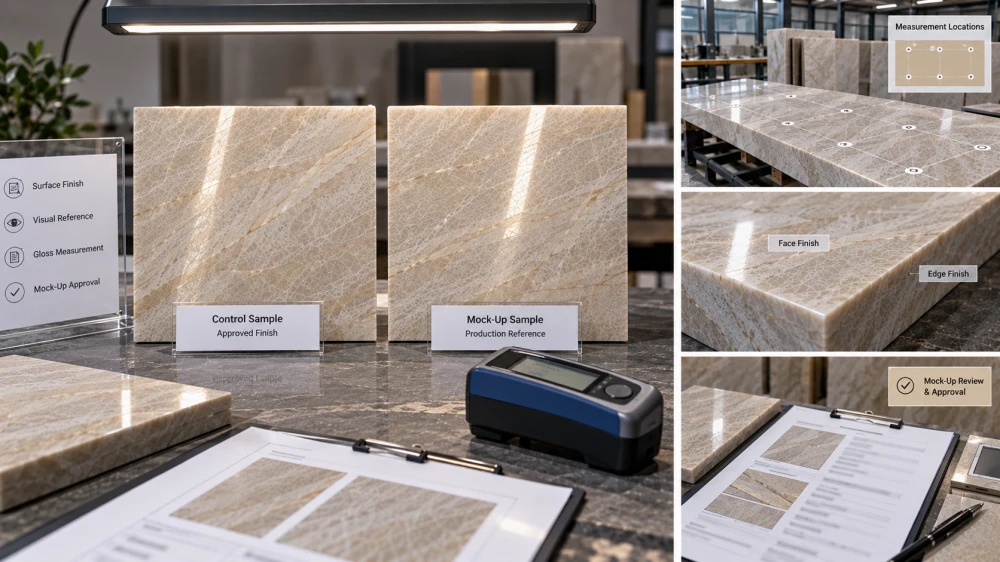
Para especificar o brilho da superfície do quartzito em uma maquete, não basta apenas escrever “polido”, “afiado”, “brilhante” ou “fosco”. Identifique a amostra de controle de quartzito natural, defina a aparência visual pretendida, indique se a aceitação será visual ou baseada em instrumentos e, caso seja necessário realizar medições de brilho, registre o método de medição, a geometria, os locais de medição, as condições da superfície e a faixa de aceitação específica do projeto. A maquete aprovada deverá então tornar-se uma referência de produção rastreável, em vez de uma simples fotografia isolada ou um único valor de brilho.
Uma especificação diz:
Quartzito Natural — acabamento afiado.
O fabricante prepara uma maquete.
O designer afirma que está muito brilhante.
A fábrica diz que já é afiado.
Quem está correto?
O problema pode não ser a qualidade do trabalho. O projeto talvez nunca tenha definido o que o brilho da superfície do quartzito deve realmente significar para esta maquete.
Uma especificação mais útil estabelece esta cadeia:
Intenção de Design → Amostra de Controle → Meta Visual de Brilho → Método de Medição, se necessário → Locais de Teste → Faixa de Aceitação → Aprovação da Maquete → Referência de Produção
Comece pela Aparência, Não pelo Número de Brilho
Antes de escolher um valor instrumental, defina o que o projeto busca alcançar visualmente.
uma aparência afiada de baixo brilho, mais contida;
uma superfície suave, com reflexão direta limitada;
um acabamento texturizado, com reflexão intencionalmente interrompida; ou
uma aparência específica ao projeto, estabelecida por uma amostra física aprovada.
Isso importa porque a questão final não é simplesmente:
“Qual foi o número indicado pelo medidor?”
É:
“O quartzito natural acabado corresponde à aparência aprovada pelo projeto?”
Polido e Afiado São Nomes de Acabamento, Não Especificações Completas de Brilho
Termos como polido e afiado são úteis, mas, por si só, não estabelecem um critério completo de aceitação do projeto.
Duas superfícies descritas com o mesmo nome de acabamento ainda podem apresentar diferenças visíveis em:
intensidade da reflexão;
uniformidade da reflexão;
profundidade da cor;
definição mineral;
textura da superfície;
direção do processamento;
áreas locais opacas ou brilhantes; e
aparência face‑a‑borda.
Por esse motivo, o nome do acabamento deve estar vinculado a uma referência de controle concreta sempre que a aparência for relevante.
Utilize uma Amostra de Controle Identificada
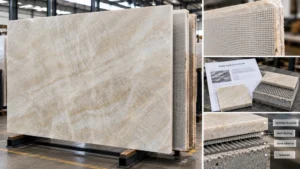
A amostra de controle confere aos termos como polido, afiado, de baixo brilho ou fosco uma referência física.
Registre:
Item de Controle
O Que Registrar
Material
Referência comercial/projeto do quartzito natural
ID da Amostra
Identificador estável da referência aprovada
Relação entre Lajes
Relação conhecida entre laje/lote/projeto, quando disponível
Terminar
Descrição aprovada do acabamento
Face Revisada
Superfície efetivamente utilizada para comparação
Data de Aprovação/Revisão
Registro atual de aprovação do projeto
Não confie em uma fotografia rotulada como “acabamento afiado aprovado” se a referência física não puder ser rastreada até o registro do projeto.
Decida Se a Aceitação É Visual, Baseada em Instrumentos ou Ambas
Nem todo projeto de quartzito necessita de leituras numéricas de brilho.
A useful specification should explicitly choose the approval route.
Controle VisualCompare the mock-up directly with the approved physical reference under controlled viewing conditions.
Instrument ControlUse a defined measurement method, geometry, locations, and project acceptance range.
Combined ControlUse numerical readings for repeatability while retaining the approved physical sample as the visual reference.
For appearance-sensitive architectural stone, the combined approach can be useful when the project team wants both a physical appearance reference and a reproducible QC record.
But the project—not a generic article—should decide whether instrument measurement is necessary.
If You Specify Gloss Units, Specify the Measurement Method Too
A requirement such as:
Gloss = 30
is incomplete by itself.
If numerical gloss is part of the acceptance requirement, the specification should identify the applicable measurement procedure and enough test information to make the reading reproducible.
Depending on the selected method and equipment, relevant information may include:
measurement standard or agreed procedure;
instrument type or approved instrument;
measurement geometry;
calibration procedure;
sample condition;
measurement locations;
number of readings;
reporting method;
acceptance range; and
responsible reviewer.
Specification Rule
Do not write a universal GU target for Natural Quartzite without defining how the reading is obtained. A gloss number only becomes useful when the project also controls the measurement method, geometry, sample condition, test locations, and acceptance rule.
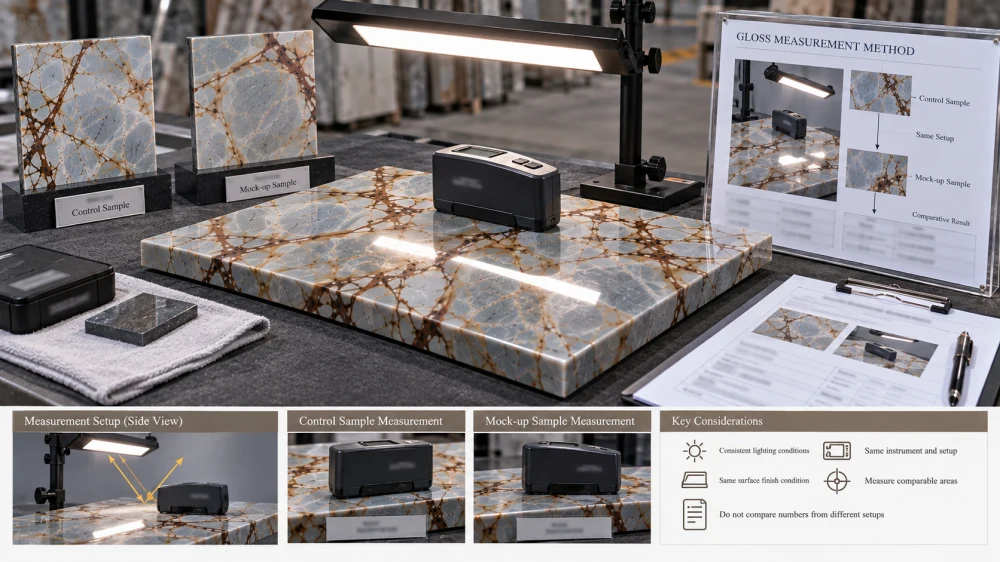
Why Measurement Geometry Matters
Gloss measurement depends on how light is directed toward the surface and how reflected light is measured.
blue-roma-quartzite-gloss-measurement-geometry
Therefore, a project should not copy a gloss number from another specification while omitting the measurement geometry used to produce it.
If the project references a specific standard, instrument procedure, or contractual measurement geometry, use that requirement consistently for:
Control Sample → Mock-Up → Production QC → Final Review
Do not switch methods midway and compare the resulting numbers as though they came from the same test condition.
Do Not Invent a Universal Gloss Range for Polished or Honed Quartzite
This is particularly important for Natural Quartzite.
A specification should not assume that every:
polished Quartzite;
honed Quartzite;
brushed Quartzite;
leathered Quartzite; or
other project finish
must fall inside one universal gloss range.
Material character, mineral distribution, finish process, surface texture, measurement method, and the intended design appearance can all matter.
The safer sequence is:
Develop Representative Finish → Review Mock-Up → Establish Project Criterion → Record Approved Reference → Control Production Against That Reference
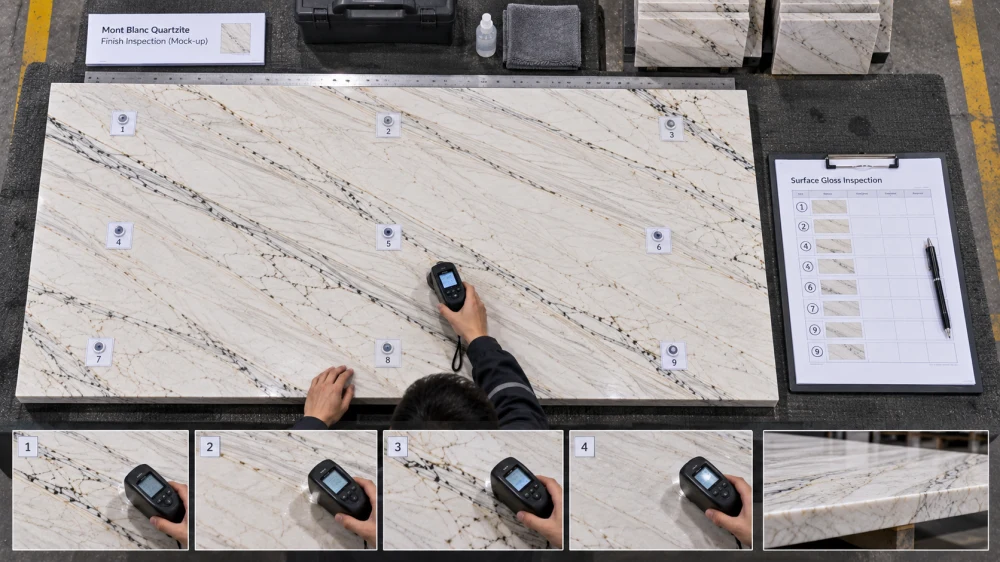
Choose Measurement Locations Before Testing
Natural Quartzite is not a visually uniform manufactured sheet.
A single reading from one convenient point may not represent the complete mock-up.
Where numerical measurement is required, define the locations before testing.
Depending on the mock-up geometry, the review might consider:
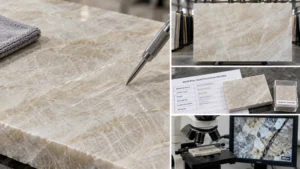
mont-blanc-quartzite-gloss-measurement-locations
central field;
additional field locations;
different visible mineral zones where relevant;
areas near but not distorted by an edge;
separately fabricated returns;
finished edges where the project requires them to match; and
other project-specific visible surfaces.
Do not move the meter around after seeing the readings until a preferred result appears.
The sampling plan should come first.
Use Multiple Readings to Understand Uniformity
If instrument readings are part of the specification, the project may need more than one reading.
The objective is not simply to find one point that falls inside the required range.
The readings should help the team understand whether the reviewed surface is reasonably consistent under the project-defined acceptance method.
The specification should state how the readings are evaluated—for example, whether the project reviews individual locations, an agreed statistical summary, variation between locations, or another defined rule.
Do not invent that rule after the mock-up has already been measured.
Keep the Stone Clean, Dry, and in a Defined Surface Condition
Surface condition can affect both visual review and instrument readings.
Before the mock-up is assessed, record whether the surface is:
clean;
dry;
free from loose polishing residue;
free from temporary protective film;
free from uncontrolled surface contamination; and
in the project-defined condition for approval.
If a sealer, enhancer, coating, treatment, or other surface product is part of the final specified system, that condition should be separately defined rather than silently introduced during the comparison.
Visual Lighting Conditions Still Matter Even When You Use a Gloss Meter
A gloss meter does not eliminate the need for visual review when appearance is part of the design intent.
The mock-up should still be viewed under a documented lighting condition.
Record relevant information such as:
general light source;
light direction;
normal viewing distance;
low-angle viewing where relevant;
sample orientation;
surrounding finishes; and
whether the review represents normal project viewing conditions.
This is especially important because a surface can produce an acceptable instrument reading while still showing localized processing bands, inconsistent reflections, or other visible differences that require discussion.
Natural Mineral Zones Can Affect the Reading
A Natural Quartzite surface can contain different mineral structures across the same piece.
One mock-up may include:
fine crystalline areas;
coarser crystalline zones;
lighter and darker minerals;
vein bands;
natural textural transitions; and
locally treated or reinforced areas where relevant.
If these zones respond differently to finishing, the measurement plan should not pretend the surface is perfectly homogeneous.
Record where readings were taken so the numbers remain connected to the actual stone.
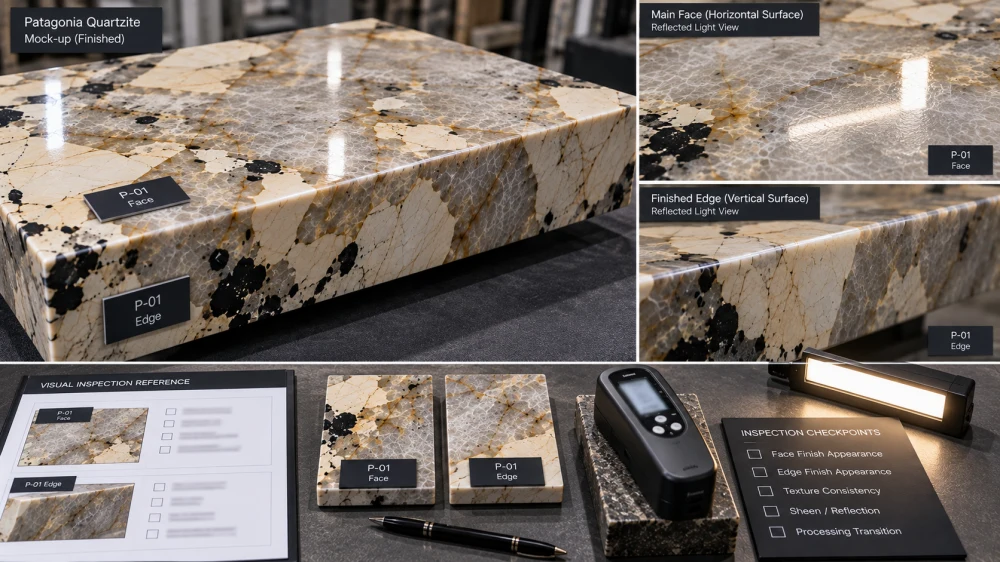
Specify Face and Edge Gloss Separately Where Needed
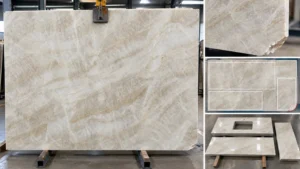
A countertop mock-up may include a broad horizontal face and a polished, honed, mitered, eased, or profiled edge.
Do not automatically assume that matching the face measurement proves the edge matches visually.
Edge finishing can involve:
patagonia-quartzite-face-edge-gloss-mock-up
different tools;
different working direction;
smaller processing areas;
different access;
profile geometry; and
different reflected-light behavior.
If the edge is a visible design element, include it in the mock-up approval separately.
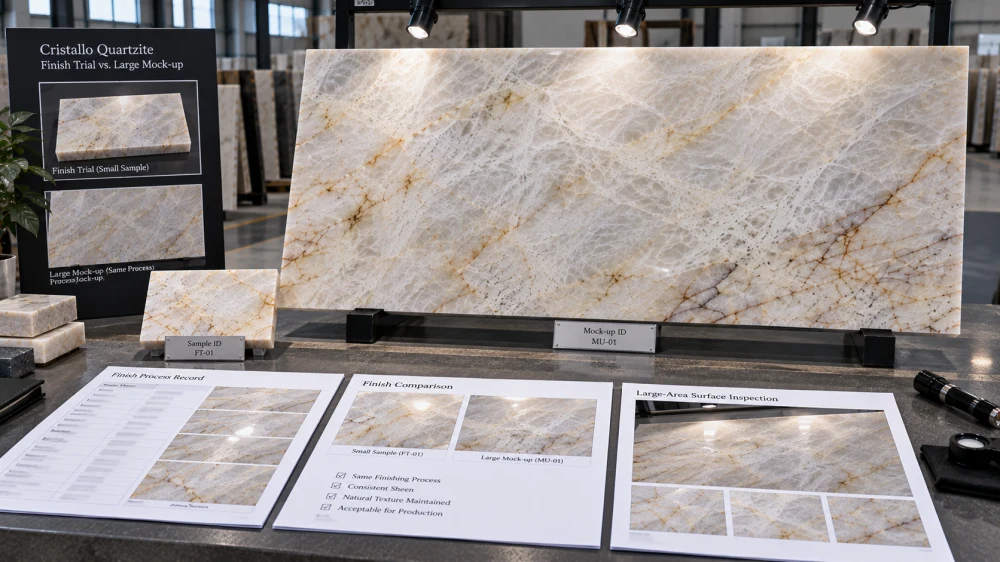
Mock-Up Size Should Represent the Decision Being Made
A very small chip may be useful for initial finish development.
It may not be enough to approve the finish of a large island, long vanity, wall panel, reception counter, or other broad architectural surface.
Build an Acceptance Range From the Project Reference
If the project requires numerical control, an agreed range is generally more meaningful than pretending every point on a Natural Quartzite surface must produce one exact number.
But the range should come from the project’s approved method and reference—not from a generic online table.
The approval record should answer:
What is being measured?
Which sample established the target?
Which measurement method applies?
Which geometry applies?
Where are readings taken?
How many readings are required?
How are the results evaluated?
What project-specific range or acceptance rule applies?
Does visual approval also apply?
Who has authority to approve?
A Useful Quartzite Surface Gloss Specification
A project specification can follow this structure:
Edge Requirement: [Separate visual / measurement requirement where applicable]
Approval Owner: [Named project role]
Production Scope Released: [Defined pieces / area / slab group]
This format intentionally leaves project-specific numerical fields open until the responsible team defines them.
That is safer than inserting an unsupported universal gloss target.
Do Not Let One Mock-Up Approve Unlimited Production
An approved mock-up should have a defined scope.
Record whether it applies to:
a named slab or slab group;
a defined project area;
a particular finish process;
specified faces;
specified edge conditions;
a particular fabrication facility or process where relevant; and
a stated production revision.
If a meaningful variable changes, decide whether another review is required.
Por exemplo:
New Slab Group → New Finish Process → Different Surface Treatment → Different Edge → Different Mock-Up Scale → Re-review as Required
Connect the Mock-Up to Production QC
A mock-up has limited value if it disappears after design approval.
The approved reference should remain available to the production and QC teams.
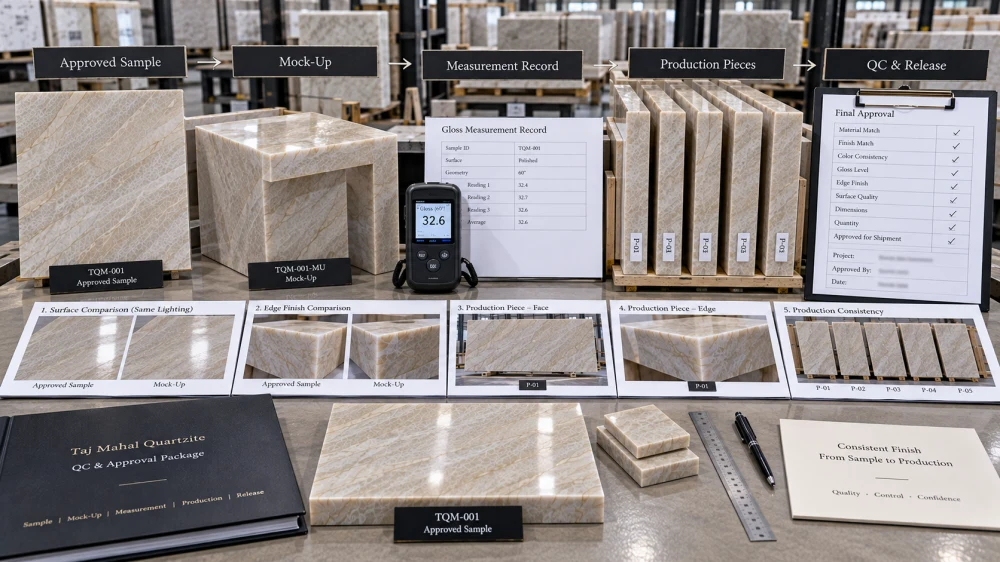
A useful control chain is:
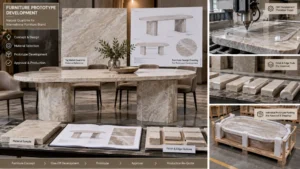
Approved Sample → Mock-Up ID → Finish Process → Measurement Record → Production Piece → QC Record → Final Approval
If the project later asks whether a finished piece matches the approved surface, the team should be able to trace the answer back to the same control reference.
What Buyers Should Confirm Before Mock-Up Approval
Question
Porque é que é importante
Which physical sample is the control reference?
Prevents approval from relying on a generic finish name
Is approval visual, numerical, or both?
Defines how the mock-up will actually be judged
What measurement method applies?
Makes numerical readings reproducible
Where are readings taken?
Prevents selective measurement after results are known
Are face and edge reviewed separately?
Different geometries can show different finish behavior
Is the mock-up large enough?
Small samples can hide large-area processing variation
What production scope does approval release?
Prevents one sample approval from becoming an unlimited guarantee
quartzite-approved-gloss-mock-up-production-qc
Perguntas frequentes
1. How should surface gloss be specified for a Quartzite mock-up?
Identifique a amostra de controle de quartzito natural, descreva o acabamento visual pretendido, defina o tamanho da maquete e as condições da superfície, e indique se a aceitação será visual, baseada em instrumentos ou ambas. Caso sejam necessárias leituras numéricas de brilho, também defina o método de medição, a geometria, os locais de medição, o número de leituras, a regra de aceitação e o responsável pela aprovação.
2. Is “honed finish” enough to specify Quartzite gloss?
Nem sempre. O acabamento aplainado indica uma direção geral de acabamento, mas duas superfícies aplainadas ainda podem apresentar diferenças em brilho, comportamento da luz refletida, textura, profundidade de cor e uniformidade do processo de fabricação. Para projetos sensíveis à aparência, associe o nome do acabamento a uma referência física aprovada e a um método de aceitação específico ao projeto.
3. What gloss unit should polished or honed Quartzite have?
There is no single universal gloss value that should automatically be applied to every polished or honed Natural Quartzite project. If a numerical requirement is needed, establish it using the project’s selected material, approved reference, measurement method, geometry, and acceptance criteria.
4. Why does measurement angle matter when checking Quartzite gloss?
As leituras de brilho dependem da geometria de medição utilizada pelo método ou instrumento selecionado. Assim, um resultado numérico deve permanecer vinculado ao seu procedimento de medição. Resultados obtidos com diferentes geometrias não devem ser considerados diretamente intercambiáveis sem justificativa técnica adequada.
5. Should a Quartzite mock-up use several gloss readings?
Se for necessária uma medição numérica, múltiplas localidades pré‑definidas podem fornecer um registro mais útil do que uma única leitura conveniente, especialmente em uma superfície naturalmente variável. O projeto deve definir as localidades de medição, o número de leituras e a regra de avaliação antes da realização dos ensaios.
6. Should Quartzite edges use the same gloss requirement as the main face?
Não presuma que eles apresentarão aparência idêntica de forma automática. A geometria das arestas e o processo de usinagem podem alterar o comportamento da luz refletida. Se as arestas acabadas forem visualmente importantes, inclua-as separadamente na revisão da maquete e defina a relação exigida com o acabamento da face aprovado.
7. Does an approved Quartzite mock-up automatically approve all production slabs?
Não. O registro de aprovação deve definir qual material, grupo de lajes, processo de acabamento, superfícies, peças ou área do projeto ele abrange. Uma mudança significativa no material ou no processo pode exigir uma nova revisão.
Final Gloss-Specification RuleDo not specify Quartzite surface gloss with one adjective or one unexplained number. Keep the control chain complete: Design Intent → Control Sample → Visual Finish → Measurement Method if Required → Geometry → Test Locations → Acceptance Rule → Mock-Up Approval → Production QC.
For project-based Natural Quartzite fabrication, HRST STONE can coordinate actual stone references, finish trials, mock-up samples, fabrication drawings, finish comparison photographs, production QC records, piece identification, packing, and export documentation for the confirmed scope. Send Josh the material name, approved or proposed finish reference, drawings, dimensions, quantities, visible surfaces, mock-up requirement, measurement specification if applicable, and delivery destination before bulk production release.
Hi, I am the author of this article. I have been working in the field of Natural Stone for more than 15 years. If you need customized Natural Stone services, please feel free to contact me.
Fabricante e Fornecedor de Mármore, Granito, Quartzito, Ágata da China - HRST STONE
Bem-vindo à HRST STONE!
Olá, gostaria de saber mais sobre seus produtos. Você poderia compartilhar informações sobre preços, quantidade mínima de pedido, opções de personalização e amostras?