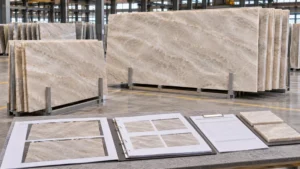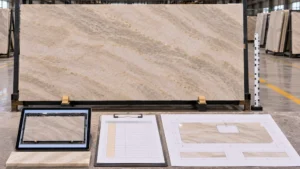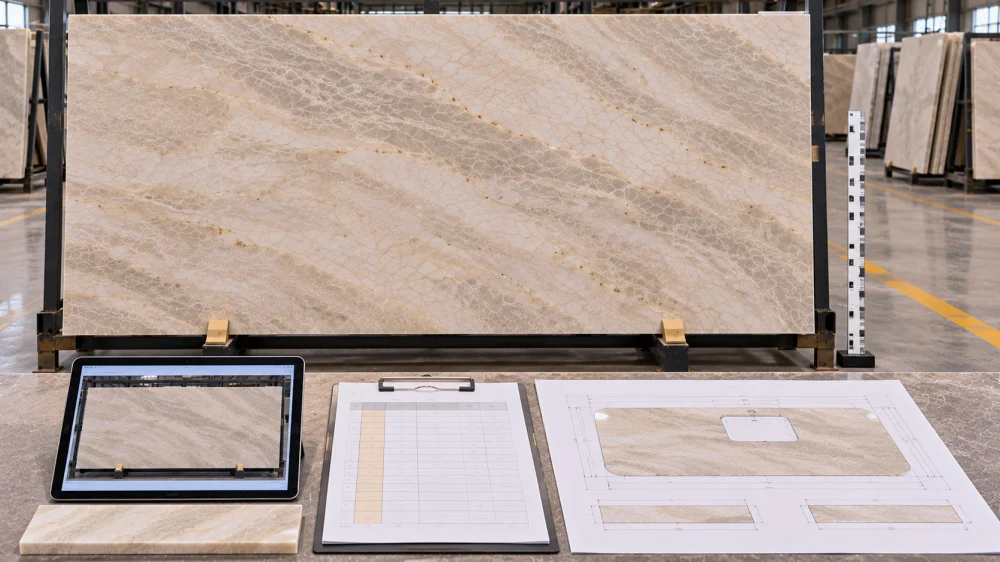
Quartzite slab photos with rulers are useful when buyers need visual scale, but the ruler should not quietly turn a perspective photograph into a dimensional inspection record. A scale reference can help show whether a vein, crystal zone, repair or colour transition is locally small or visually dominant. Exact slab dimensions, cutout sizes, edge locations and fabrication measurements should still come from identified measurements, current drawings, templates, CAD data or other controlled project records.
빠른 요약A ruler in a Quartzite slab photograph is best treated as a visual scale reference. It can help a remote buyer understand the approximate scale of veins, crystalline areas, repairs or other observed features when the ruler and stone are photographed in a controlled relationship. It should not be used to derive fabrication dimensions from an angled image. For exact size decisions, request the actual slab dimensions, identified measurement photographs, current shop drawings or approved cutting information separately.
ㅏ scale-reference slab photograph is an image in which a known-size ruler, scale, measuring stick or other controlled reference is placed beside or on the same plane as the stone to help viewers understand relative physical scale.
Its primary purpose is orientation.
It answers questions such as:
Is that dark mineral zone a few centimetres wide or a major feature crossing a large part of the slab?
It should not automatically answer:
What is the exact usable slab width at that position?
Those are different levels of evidence.
A full-slab photograph compresses a large physical object into a small screen.
That creates an obvious scale problem.
A Blue Roma Quartzite slab photographed from several metres away may contain a dark mineral band that looks narrow on a phone screen. Without another physical reference, the buyer may not know whether that feature is approximately the width of a finger, a countertop cutout or a substantial portion of the slab.
A ruler or scale reference can reduce that ambiguity.
It can help communicate:
This is especially useful when full-slab photographs are followed by detail images.
현재 Quartzite slab condition-map guide uses a similar two-level evidence structure: the full slab establishes location, while the detail photograph explains the observed condition.
Photo-Scale RuleA ruler can help answer “How large does this feature appear relative to the slab?”
It should not automatically answer “What exact fabrication dimension should we use?”
A physical measurement is made directly between defined points using an appropriate measuring method.
A photograph is a projection of three-dimensional reality onto a two-dimensional image.
Camera position, lens perspective, distance and the relationship between the ruler and stone can all change how lengths appear within that image.
If the ruler is closer to the camera than the slab face, it can appear proportionally larger.
If it sits farther back, it can appear smaller.
If the photograph is taken from an angle, one part of the slab can appear compressed relative to another.
This is why the photograph should be treated as scale context rather than a substitute for dimensional QC.
| Evidence Type | Useful For | Should Not Be Used Alone For |
| Full-Slab Photo | Movement, tone, overall slab context | Exact dimensions |
| Photo with Ruler | Relative physical scale and feature context | Fabrication measurement from image pixels |
| Measurement Photo | Documenting where a direct measurement was taken | Replacing the actual recorded measurement value or QC basis |
| Shop Drawing / CAD | Current fabrication geometry | Proving actual stone appearance |
| 절단 레이아웃 | Finished-piece position on actual slab | Replacing field or production measurements |
For the most useful visual comparison, keep the reference scale as close as practical to the same plane as the stone area being documented.

For a vertical slab, this may mean placing the ruler directly against the slab face or immediately beside it in approximately the same plane.
For a horizontal inspection sample, place the scale on the same inspection surface.
Avoid holding the ruler toward the camera while the stone sits farther behind.
That may create an exaggerated visual relationship.
Also avoid positioning the scale at a dramatically different angle from the slab.
The scale should support the photograph rather than create another perspective problem.
When the photograph documents one local condition, place the scale near that condition without covering it.
예를 들어:
Full Slab → Condition C-04 → Detail Photograph + Nearby Scale Reference
This makes the close-up easier to interpret later.
A ruler placed at the opposite side of a large perspective photograph provides much weaker local scale information.
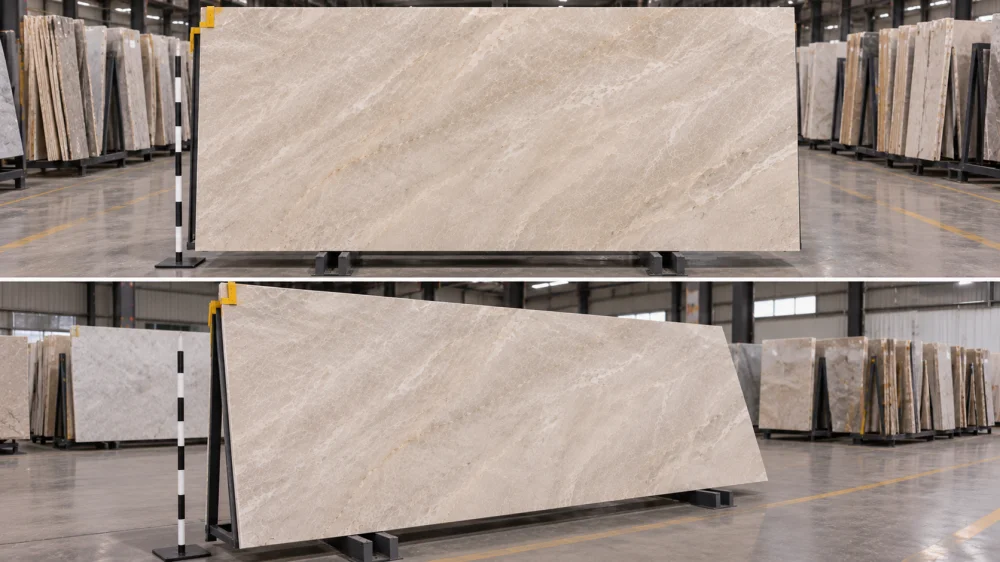
The most useful full-slab documentation photograph is generally taken as straight-on as practical.
A strongly angled warehouse photograph may still be useful for showing slab identity or general appearance, but it creates more perspective distortion.
The near side appears larger.
The far side appears smaller.
Vertical and horizontal relationships may converge.
This matters when someone later attempts to judge the width of a mineral zone or compare the ruler with another part of the slab.
For documentation intended to communicate scale, try to keep the camera approximately perpendicular to the slab face where practical.
Do not crop away the slab boundaries merely to make the image visually dramatic.
현재 규암 판재 쇼룸 선택 가이드 similarly recommends complete, straight-on slab photographs where practical, linked to identifiable board references rather than isolated decorative close-ups.
Perspective WarningIf the image is obviously angled, use the ruler only as rough visual context.
Do not scale an island, sink opening, slab width or other fabrication dimension from that photograph.
One photograph rarely needs to answer every question.
A better remote-review package uses several images with different jobs.
A controlled sequence can be:
Photo 1 — Full Slab + Board Reference
Shows the complete stone and identifies the physical slab.
Photo 2 — Straight-On Full Slab
Shows overall movement and tone with minimal perspective distortion where practical.
Photo 3 — Full Slab with Scale Reference
Adds physical scale context without blocking important stone features.
Photo 4 — Detail Feature + Nearby Scale
Shows one specific mineral zone, repair, fissure-like feature or colour transition.
Photo 5 — Actual Slab Dimensions
Provides the supplier’s identified dimensional record separately from the visual photograph.
Photo 6 — Cutting Layout Where Required
Connects the selected slab to the finished project geometry.
This sequence separates visual evidence from technical measurement instead of forcing one image to perform both tasks.
This is where scale-reference photographs are most useful for natural stone.
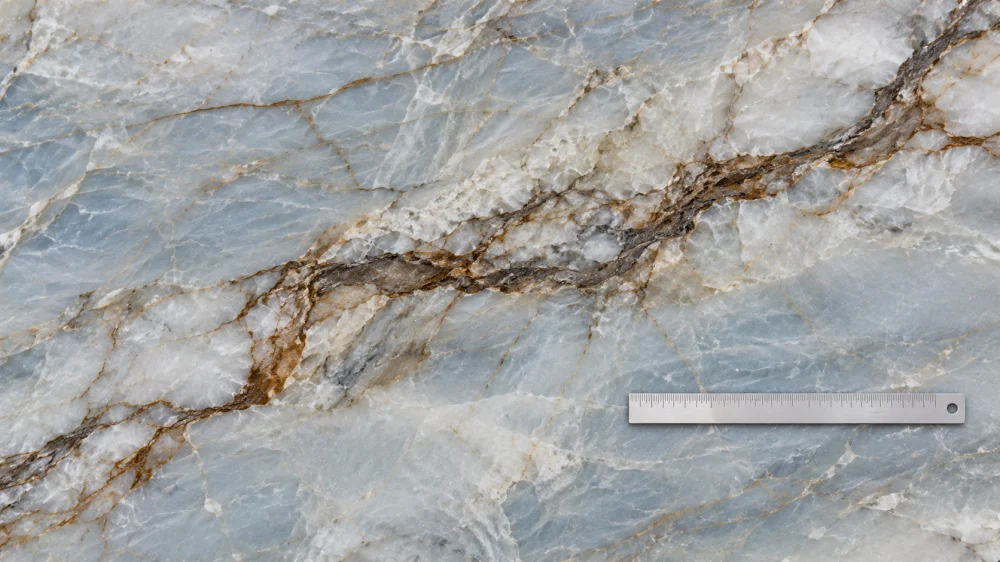
Terms such as fine vein, broad movement, large crystal 또는 small dark inclusion are relative.
Without scale, two people can interpret those descriptions very differently.
A scale reference makes the language more grounded.
For example, a buyer reviewing Patagonia Quartzite may want to know whether a black mineral fragment is a small local accent or a major zone that could dominate a vanity front.
A close-up alone may make the fragment look enormous.
A full slab alone may make it look insignificant.
A detail photograph with a nearby scale reference can place it between those two extremes.
The ruler should not automatically convert every natural feature into a pass/fail dimension.
For example, a photograph may show that a visible linear feature is approximately small relative to the overall slab.
That does not establish a universal rule stating that features below a particular width are acceptable and larger ones are defective.
The project still needs to consider:
These should remain clearly separate.
A scale photograph explains the physical size relationship visible in an image.
Dimensional QC checks whether a slab or fabricated piece meets a defined dimensional requirement.
| 질문 | Scale-Reference Photo | Dimensional QC |
| How broad is this visual feature? | Useful context | May measure if project requires it |
| What is the exact slab length? | Not controlling evidence | Direct measurement required |
| Will the island fit this slab? | Useful visual preview | Use actual slab size + approved layout |
| Is a sink opening correctly positioned? | Cannot establish final geometry | Use current drawing / measurement basis |
| Where is a visible condition located? | Very useful | Add measurement only when required |
This distinction is consistent with the site’s guide to briefing a Quartzite fabricator with annotated photos: photographs are useful for identifying context, priorities and observed conditions, but they should not replace verified dimensions or the current fabrication drawing.
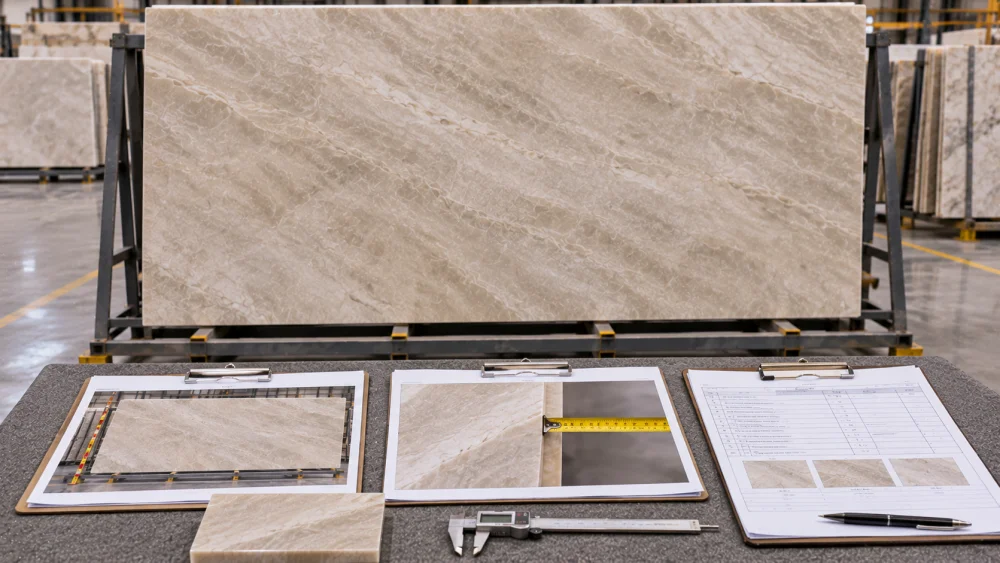
Not safely as a normal procurement workflow.
A known scale visible in the frame may make image-based measurement appear simple.
In reality, reliable measurement from photographs requires control of image geometry, scale position, camera relationship and uncertainty.
That moves the task toward photogrammetry rather than ordinary slab photography.
For routine stone purchasing, it is normally simpler and more reliable to request the required measurement directly from the supplier or fabricator.
For example, if the buyer needs the distance between a visible condition and the slab edge, request:
Board ID + Defined Measurement Points + Direct Measurement + Supporting Photograph
Do not estimate the distance by measuring pixels on a WhatsApp screenshot.
A strong remote approval package should preserve actual dimensions independently of the scale-reference photograph.
The slab record can contain:
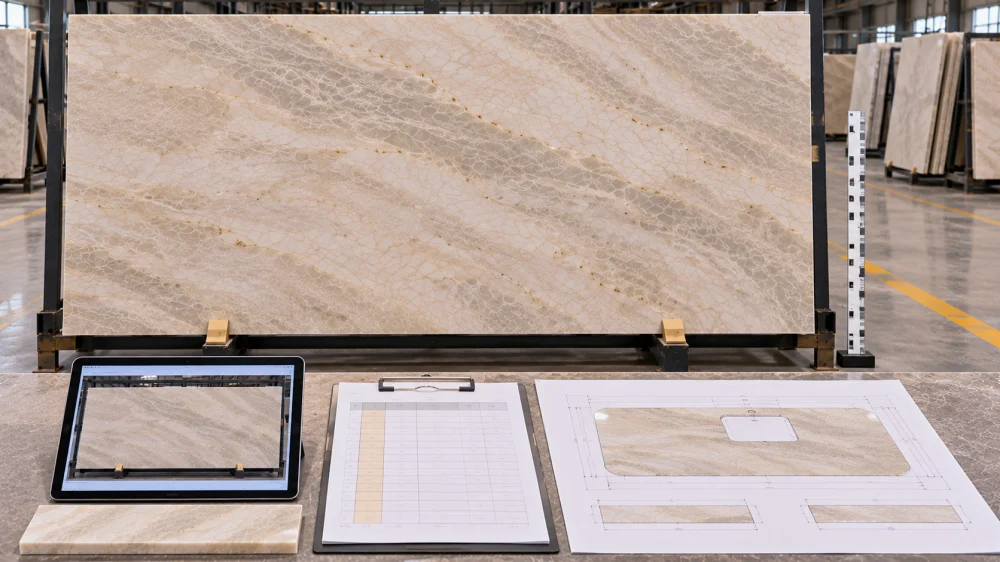
If the slab is irregular, one overall length and width may not fully describe every usable boundary.
The cutting-layout stage should therefore work from the actual slab outline or other approved fabrication basis rather than assuming the slab is a perfect rectangle because the photograph looks rectangular.
A useful request should explain why the scale is needed.
예를 들어:
Remote Slab Photo RequestPlease photograph each selected Quartzite slab straight-on where practical and include the complete board boundaries and board reference.
For the marked mineral zones, please provide one wider context image and one closer image with a ruler or scale reference positioned near the observed feature and approximately on the same plane.
The ruler is for visual scale only. Please provide the actual slab dimensions separately and use the current drawing or cutting layout for any fabrication decision.
This makes the purpose of the ruler explicit and prevents another project party from later treating the photograph as a measured drawing.
Not every slab photograph needs a scale.
For overall material approval, the ruler can become visual clutter and cover important stone features.
A useful photo package can therefore contain both:
clean slab photographs without a ruler
그리고
specific documentation photographs with a scale reference.
Use clean images for overall visual selection.
Use scaled images when the physical size of a particular feature is part of the discussion.
This avoids turning every material photograph into a measurement scene.
Do not use an ordinary perspective slab photograph as the final dimensional basis. Camera angle, scale position and image geometry can change apparent proportions. Request the actual measured slab dimensions or another controlled dimensional record instead.
A ruler can provide relative physical scale. It helps a remote reviewer understand whether a vein, crystal zone, repair or other visible feature is locally small or visually large without relying only on a cropped image.
Place it close to the feature being documented and approximately on the same plane as the stone wherever practical. Avoid holding the ruler significantly closer to the camera than the slab, because that can distort the apparent size relationship.
No. Keep clean full-slab photographs for overall movement and material review. Add separate scale-reference images when a particular feature needs physical-size context.
No. It can help the buyer understand visual scale, but final fit should use actual slab dimensions and the current project cutting layout. Large islands, waterfalls and other slab-sensitive pieces should be reviewed against the identified physical slab.
No. Annotated photographs can identify the feature or area being discussed, but current drawings, verified measurements, templates, CAD information or another approved fabrication basis should control irreversible dimensions.
Request the current material and board IDs, complete slab photographs, a straight-on view where practical, targeted detail photographs with a nearby scale reference, actual slab dimensions provided separately, and the current cutting layout when project-specific fit or feature placement must be reviewed.
Photo Review DecisionA ruler improves a Quartzite photograph when it helps the reviewer understand physical scale.
Do not make the photograph carry more authority than it has. Use the image to show context and relative feature size; use direct measurements, current drawings and cutting layouts to control actual geometry.
Buyer Next Step: When requesting remote slab photographs, specify which images are for visual scale and which dimensions must be measured and reported separately.