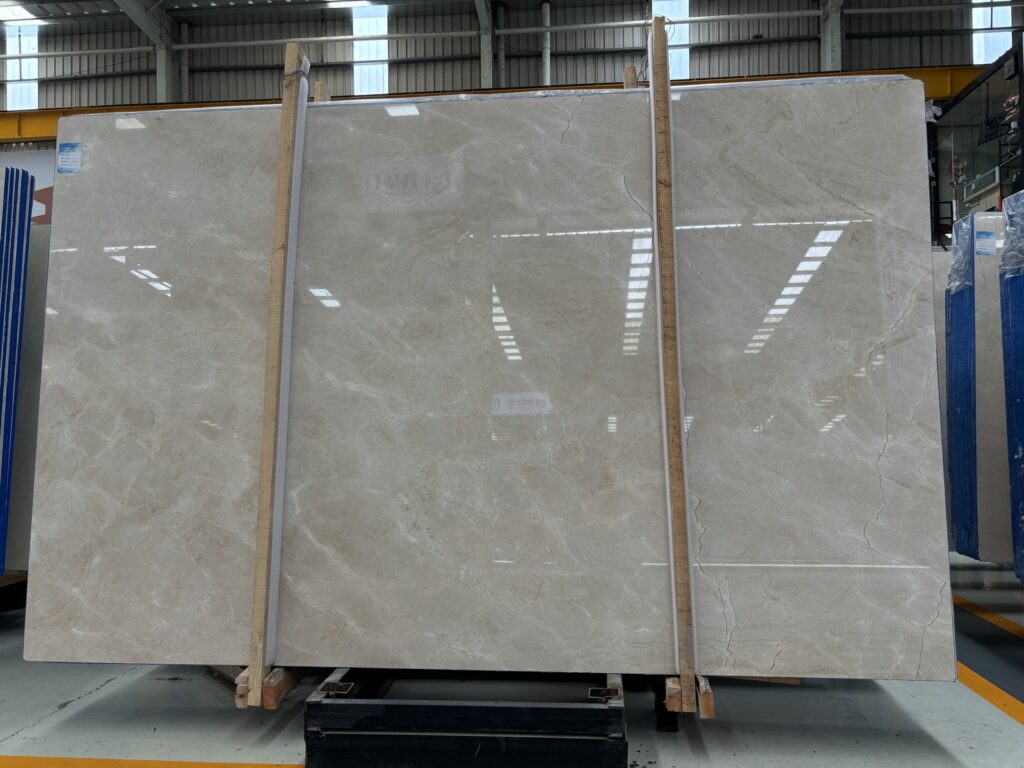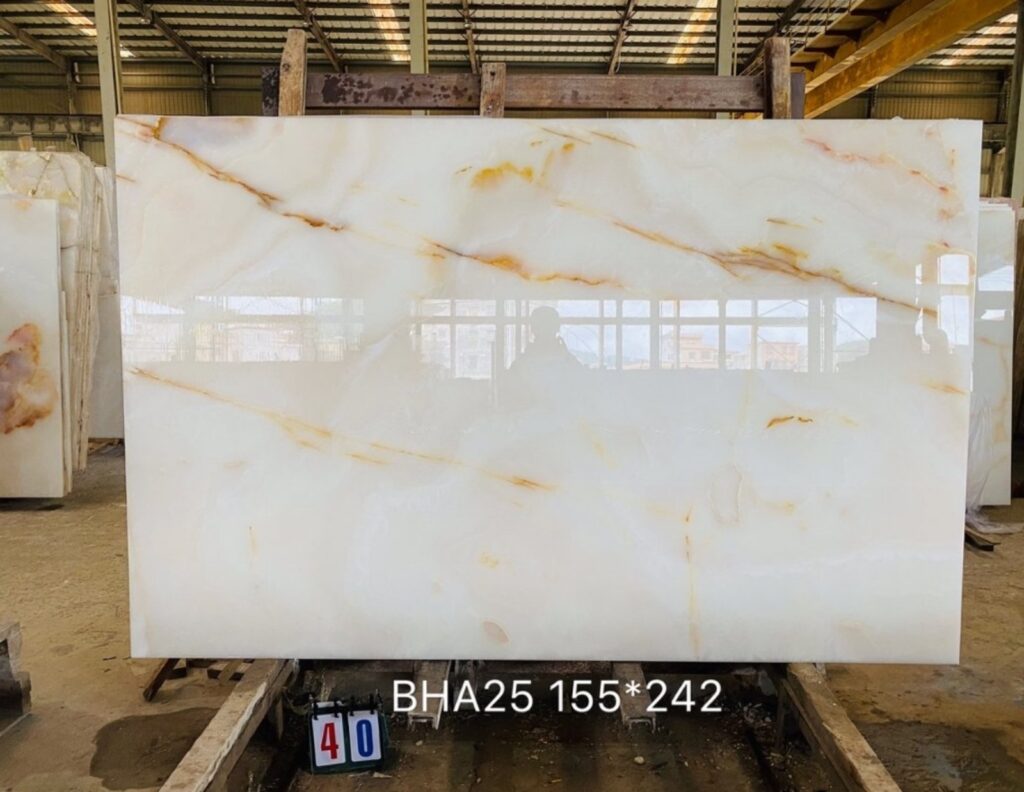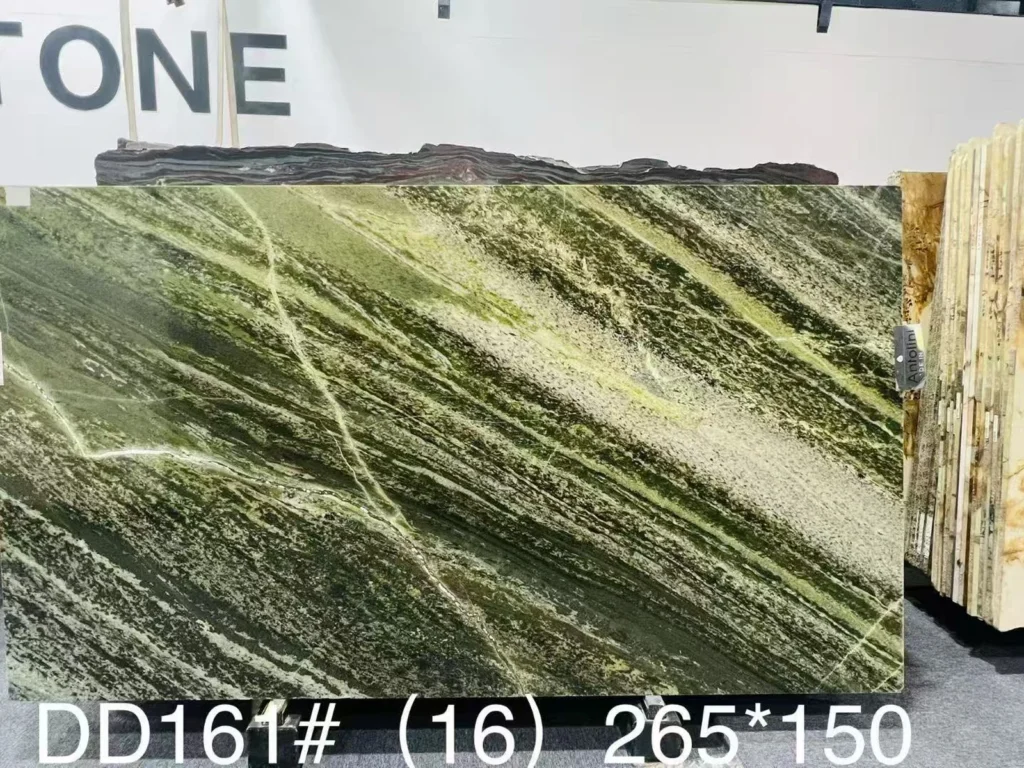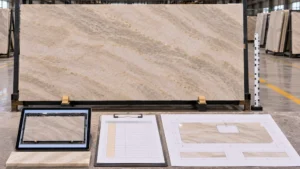
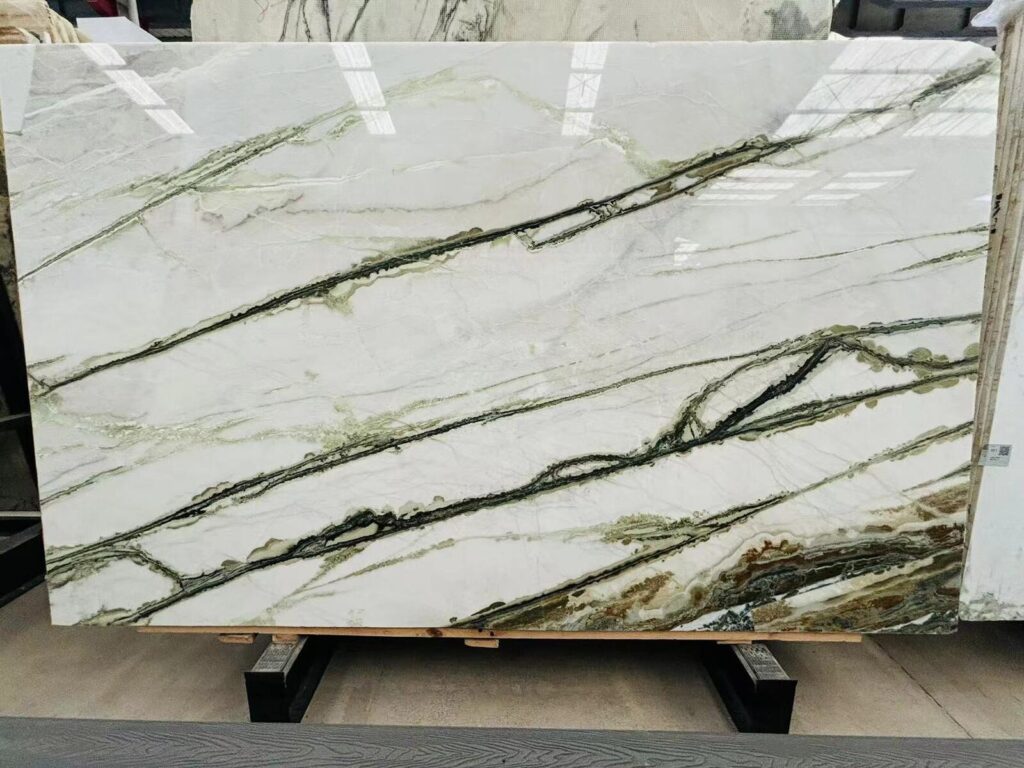
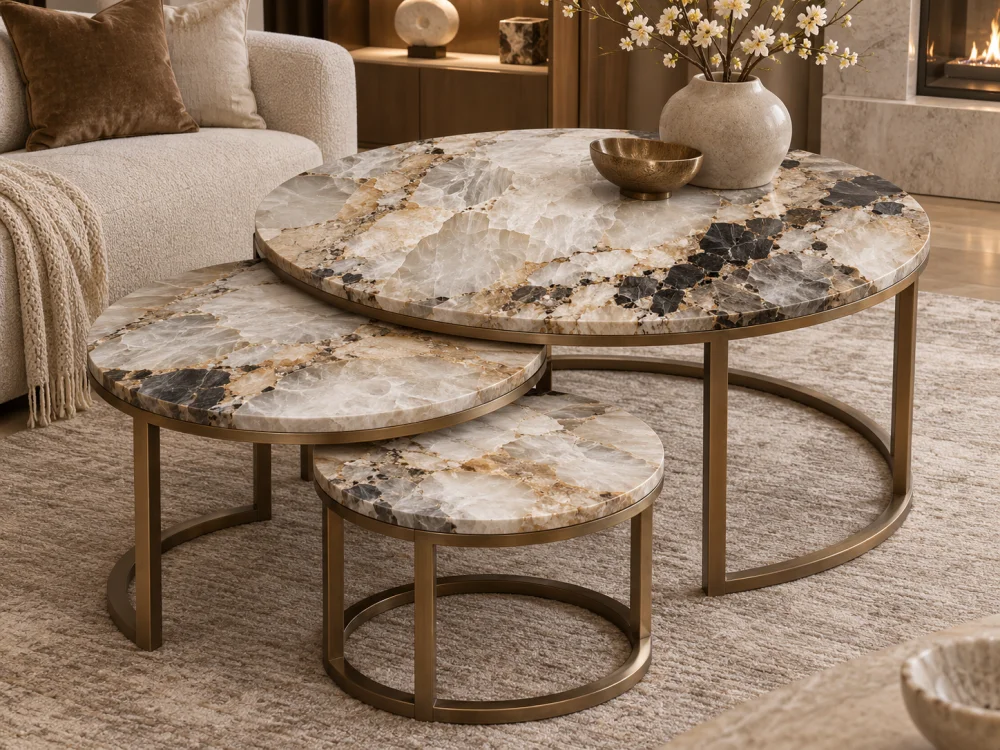
천연 석영암 판재에는 하나의 특별한 지질학적 영역이 포함되어 있습니다.
크고 정교한 결정 구조, 뚜렷한 광물학적 변화, 또는 즉시 시선을 사로잡는 독특한 어두운 특징이 존재합니다.
프로젝트에는 세 개의 레이어드 테이블이 필요합니다.
그 판재의 어느 부분을 어떤 테이블에 배치해야 할까요?
가장 큰 것?
가장 높은 것?
세트를 겹쳐 놓았을 때 맨 위에 놓이는 테이블?
가장 작은 테이블, 왜냐하면 이 테이블은 자주 꺼내어 독립적으로 사용될 것이기 때문인가요?
아니면 그 특징을 전체 세트에 걸쳐 나누어야 할까요?
이것이 바로 석영암 레이어드 테이블: 주요 패턴을 어느 표면에 배치할지 결정하기.
레이어드 테이블은 세 개의 독립된 사이드 테이블과 다릅니다.
이들은 단순히 하나의 일반적인 시각적 상태만을 갖는 것이 아닙니다.
겹쳐 놓았을 때 표면들이 서로 겹치며 일부 영역은 시야에서 사라집니다.
분리되었을 때 각 상판은 고유한 완전한 천연 석영암 구성이 됩니다.
세트 구성 + 개별 테이블 구성.
1. 개별 석재 상판이 아닌 가구 세트부터 시작하십시오.
겹쳐 놓은 상태.

가구의 기하학적 형태에 따라:.
가장 큰 상판이 거의 완전히 드러난 채로 남을 수 있고;
부분적으로 겹쳐 놓은 상태.
주택 소유주나 호텔 투숙객이 일부 테이블을 반쯤 꺼내놓고 나머지는 그룹으로 유지할 수 있습니다.
이렇게 하면 이전에 숨겨졌던 영역이 드러나면서 매우 다른 석재 구성이 만들어질 수 있습니다.
분리된 상태.
레이어드 구성 내에서는 작은 포인트로 훌륭하게 보였던 크롭이 독립적으로 볼 때는 미완성처럼 느껴질 수 있습니다.
일반적인 사용 상태를 정의하십시오.
상태 A — 완전히 겹쳐 놓음
상태 B — 부분적으로 겹쳐 놓음
상태 C — 완전히 분리됨
정확한 상태 수는 다양할 수 있습니다.
중요한 점은 석영암을 단 한 장의 가구 사진만으로 평가하는 것을 멈추는 것입니다.
세트 계획 규칙.
2. 이 특정 판재에 대해 “주요 패턴”이 무엇을 의미하는지 정의하십시오.
“이는 가장 강렬한 시각적 중요성을 지닌 판재 영역에 대한 프로젝트 디자인 설명입니다.
그것은 하나의 커다란 광물학적 특징일 수 있습니다.
For an expressive Natural Quartzite, the main pattern may be:
The most desirable part of the slab is not always the most dramatic.
For a restrained furniture design, the main visual value may come from a particularly calm and balanced area.
A feature that occupies only a small part of the complete slab can dominate a small table.
Likewise, one broad mineral structure may work beautifully on the largest table but become confusing when cropped into a much smaller top.
그만큼 석영암 패턴 스케일: 실내 거리에서 판재 읽기 guide explains why the complete slab and the finished-piece crop should be reviewed separately.
For each proposed tabletop, compare:
Do not ask only “Where is the most dramatic part of the slab?” Ask “Which finished tabletop should carry the strongest visual event, and will that event still look complete when that table is used by itself?”
There is no universal rule that the largest nesting table must receive the main pattern.
Several controlled strategies can work.

The largest top receives the strongest geological composition.
The smaller tables use quieter but related slab areas.
This can work when the largest table remains the primary visual surface both nested and separated.
The relationship becomes:
Main Table = Focal Pattern
Secondary Tables = Supporting Pattern
Some furniture geometries leave a smaller upper table very visible while much of the larger lower table is covered.
In that arrangement, the most exposed surface may deserve the stronger pattern.
The decision is based on visibility rather than physical area alone.
The designer may know that one table will frequently be moved beside a sofa or chair and used as an independent side table.
That piece can intentionally receive the most distinctive slab crop.
The other pieces remain quieter when nested around it.
The set may use several related parts of one geological movement.
예를 들어:
The pieces do not need to create a literal continuous image when moved together.
They can simply share enough geological language to feel intentionally related.
Another approach avoids one dominant hero completely.
Each tabletop receives a different but equally controlled composition.
The set remains coordinated through:
| Pattern Strategy | Best Question to Ask | Main Risk to Review |
| Largest Table Leads | Is the largest top visually dominant in normal use? | Main pattern may be partly hidden when nested |
| Most Exposed Surface Leads | Which top remains most visible in the nested arrangement? | That top may become less important when separated |
| Independent Hero | Which table is most often used independently? | Grouped set must still look balanced |
| Progressive Sequence | Can related geological zones connect the set? | Do not promise permanent vein continuity as tables move |
| Balanced Independent Tops | Can every top work alone without one overpowering the group? | Set may lack a clear focal hierarchy if that was intended |
A slab layout becomes much more useful when it knows which parts of each tabletop will actually remain visible.
Using the current furniture drawing, identify where smaller or taller tables overlap other stone surfaces.
For each tabletop, divide the finished top conceptually into:
Always Visible
Sometimes Visible
Normally Hidden When Nested
If one exceptional slab feature will sit almost completely beneath another tabletop in the normal nested arrangement, ask whether that is the best use of the material.
It may still be appropriate if the table is regularly separated.
But that decision should be intentional.
A smaller table pulled halfway out can expose a narrow crescent, rectangle, or irregular zone of its surface.
Make sure the visible section does not accidentally contain only a disconnected fragment of a stronger pattern.
Do not evaluate only from directly overhead.
Nesting furniture is normally read from an oblique room angle.
From that viewpoint:
Pattern allocation should therefore use both top-view layout and normal room-view review.
This is the most important production rule for the article.
Do not approve Table A, cut it, and then try to fit Tables B and C into whatever stone remains.

The slab layout should show:
T01 → Large Table
T02 → Medium Table
T03 → Small Table
or the project’s equivalent controlled piece IDs.
Place every finished outline on the selected Natural Quartzite before irreversible cutting.
A perfect crop for T01 may consume the only slab area that allows T02 and T03 to form a coherent set.
The correct layout should balance:
If the tables are:
use those actual outlines rather than bounding rectangles.
A circle and rectangle with similar net area can require very different parts of the slab.
The complete slab may make a crop appear more coherent because the eye sees geological information outside the finished piece.
Temporarily hide that surrounding stone.
Then ask:
Does T01 work by itself?
Does T02 work by itself?
Does T03 work by itself?
Do they still work as one set?
그만큼 천연 석영암의 사용 가능 면적 vs 총 슬래브 면적 principle becomes especially important for multi-piece furniture.
The slab may contain enough square metres mathematically while still failing to provide three acceptable finished crops in the required shapes and pattern hierarchy.
Approve T01 + T02 + T03 as one cutting-layout decision. The strongest first tabletop is not a successful layout if it leaves the remaining tables with poor crops or no usable stone.
A natural feature does not have the same visual effect on every tabletop size.
The largest surface can usually preserve more geological context.
It may contain:
The medium surface may work best with:
The smallest top needs especially careful crop review.
A large dark fragment can become the entire composition.
A broad feature may be reduced to one unexplained edge fragment.
A quieter area may therefore become more successful at this scale.
But this is not a universal rule that small tables require quiet stone.
A compact top can intentionally carry one strong focal feature if that crop appears complete.
The project is selecting real Natural Quartzite.
A smaller table does not receive a proportionally reduced version of the same slab pattern.
It receives a smaller physical crop from the real geology.
This is why actual templates matter.
Nesting tables are movable furniture.
Their relationship is less fixed than a kitchen island and waterfall end.
A grouped arrangement may allow two mineral features to relate beautifully.
Move one table beside a chair and that relationship disappears.
This is normal.
Set-wide coordination should therefore rely more on:
than on one fragile alignment that works only in a single staged position.
If the designer wants the set presented in one preferred arrangement, document it.
This can support:
But it should remain a reference arrangement rather than a promise of permanent stone continuity.
If the Quartzite has strong directional movement, each tabletop can have an approved orientation.
예를 들어:
T01 Direction → Long Axis
T02 Direction → Related Long Axis
T03 Direction → Project-Specific Orientation
The tables can then be rearranged while each individual top still retains an intentional composition.
The slab layout is only the visible top-surface decision.
The furniture still has to physically nest.
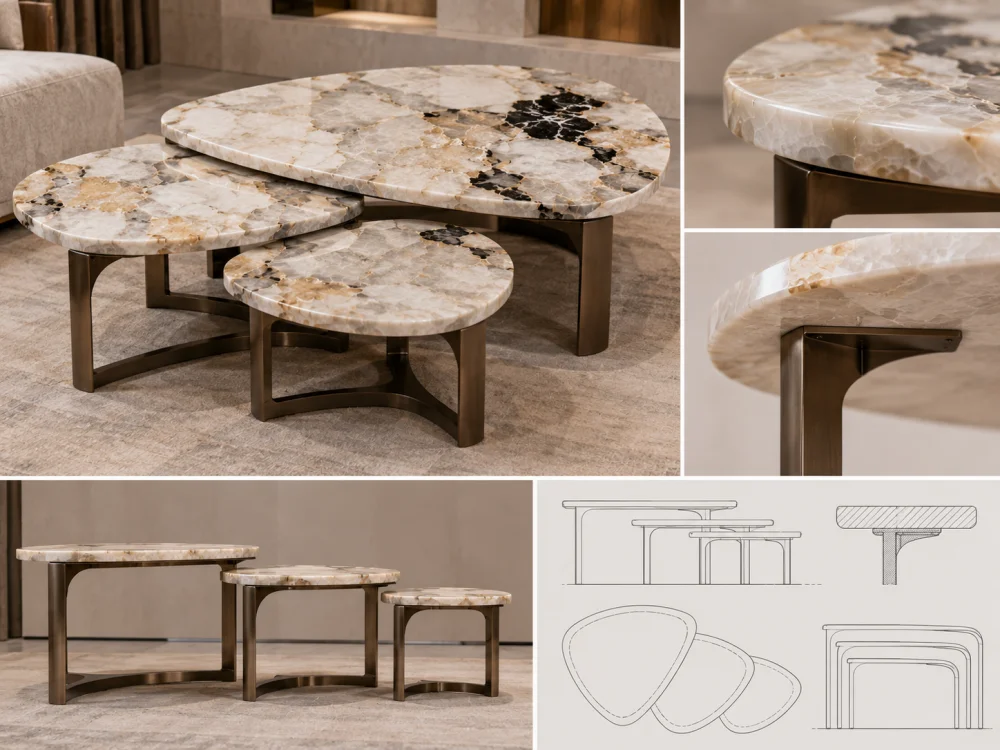
The actual Natural Quartzite thickness and any built-up edge treatment influence:
Do not change the apparent stone thickness late in the project without checking the complete nesting geometry.
Nesting tables are frequently touched and viewed closely.
검토:
Confirm the actual furniture-base geometry before cutting.
The responsible furniture designer and fabricator should coordinate:
This article does not prescribe universal nesting clearance, support spacing or stone thickness.
If the furniture system needs:
connect those operations to the current base drawing and approved stone layout.
그만큼 블루 로마 규암 테이블 page follows the same furniture principle: slab selection, top geometry, edge, base, support and fabrication QC should remain coordinated rather than being approved independently.
Nesting tables can be a useful application for retained Natural Quartzite remnants.
Several smaller surfaces may fit into material that cannot accommodate a large countertop.
But this should not become:
“Use whatever offcuts are available.”
확인 사항:
If three tops are required, place all three finished outlines on the current remnant before approving any one of them.
관련된 잔재로 제작한 소형 가구 상판에서의 천연 석영암 대 화강암 guide makes this set-planning principle explicit: one attractive first furniture top should not consume the only usable area required for the remaining pieces.
A remnant may be physically present while still being:
Physical existence, usability and commercial availability are separate questions.
If useful stone remains after the nesting-table set is fabricated, update the remaining piece identity, dimensions, photograph and status rather than leaving the previous record unchanged.
The final inspection should not show three stone tops separately and call the set approved.
확인 사항:
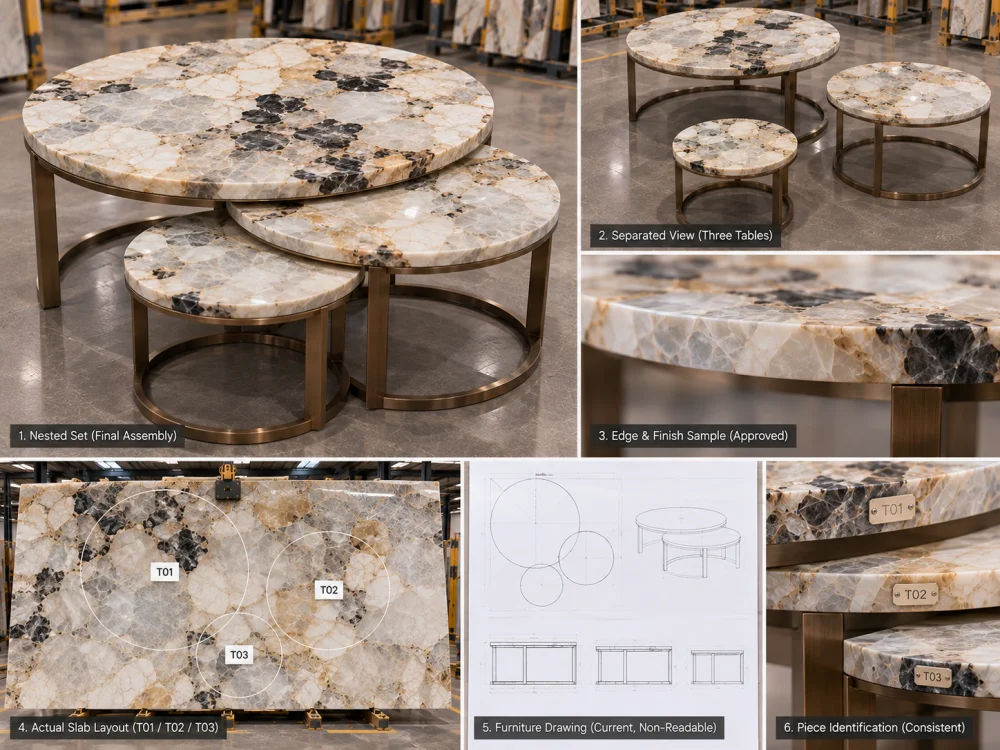
검토:
Check whether surfaces that become newly visible still read intentionally.
Each top should also be photographed and inspected as a complete individual composition.
예를 들어:
T01 — Large Table
T02 — Medium Table
T03 — Small Table
The top, base and packing reference should remain connected so the correct components can be reassembled after shipment.
Packing should respond to:
Do not allow the nesting function itself to cause stone-to-stone impact during transport.
□ Exact Natural Quartzite identified.
□ Actual slab or remnant reference confirmed.
□ Complete nesting-table set drawing confirmed.
□ Large, medium and small tabletop finished shapes confirmed.
□ Fully nested arrangement reviewed.
□ Partially nested arrangement reviewed where relevant.
□ Fully separated condition reviewed.
□ Main-pattern strategy defined.
□ Most-visible surfaces identified in each furniture state.
□ All tabletop templates positioned on the actual stone before the first cut.
□ Each tabletop crop reviewed individually.
□ Complete set reviewed together.
□ Pattern scale reviewed for each different tabletop size.
□ Directional orientation recorded where relevant.
□ Permanent vein continuity is not promised for movable pieces.
□ Surface finish confirmed.
□ Edge profile confirmed.
□ Stone thickness and furniture height coordinated.
□ Base geometry and support reviewed.
□ Nesting clearance confirmed by the responsible furniture design team.
□ Any underside machining or fixing details confirmed before stone machining.
□ Trial assembly completed where required.
□ T01 / T02 / T03 or equivalent piece IDs maintained through QC.
□ Packing keeps the complete set traceable and protects finished stone surfaces and edges.
No. The largest top may be the correct focal surface when it remains visually dominant, but another table may be more exposed when nested or more frequently used independently. Decide the pattern hierarchy from the furniture’s real nested and separated states rather than from surface area alone.
이들은 서로 연관된 패턴 방향이나 지질학적 특성을 가질 수 있지만, 영구적인 광맥 연속성은 일반적으로 이동식 가구의 승인 기준으로 적합하지 않습니다. 테이블들이 분리되고 재배치될 때마다 그 관계는 변화합니다. 조화로운 배경 톤, 패턴 강도, 대비, 마감 및 전체적인 시각적 무게감은 종종 공간 전체에 걸쳐 더 안정적인 통제 요소가 됩니다.
네, 시각적으로 조화로운 맞춤 세트의 경우 가능합니다. 최초의 되돌릴 수 없는 절단을 하기 전에 필요한 모든 완성된 상판 형태를 함께 배치해 보세요. 이렇게 하면 프로젝트 전체에서 메인 패턴 위치, 보조 컷, 사용 가능한 슬래브 영역, 방향 및 제작 공간을 균형 있게 조정할 수 있습니다.
네, 완성된 작물이 의도된 구성을 완전히 갖추고 있다면 그렇습니다. 작은 테이블이라고 해서 반드시 차분한 돌을 사용해야 하는 것은 아닙니다. 다만 크기가 큰 고대비 요소 하나가 작은 표면을 지배할 수 있으므로, 해당 요소가 시각적으로 축소될 것이라고 단정하기보다는 실제 테이블 상판의 윤곽을 먼저 검토하는 것이 좋습니다.
가능성이 있습니다. 현재 남아 있는 재료의 가공 가능 여부, 사용 가능한 형상, 마감 상태, 두께, 기존 컷아웃이나 불규칙한 가장자리, 패턴 위치 및 시장 공급 가능성 등을 확인하십시오. 최초 제품 승인 전에 실제 재료 위에 전체 네스팅 테이블 세트를 겹쳐서 확인해야 합니다.
중첩은 테이블 높이, 석재 두께, 베이스 형상, 다리 또는 프레임의 위치, 지지대, 고정 방식 및 여유 공간 간의 관계에 따라 달라집니다. 베이스를 나중에 변경하면 이전에 승인된 석재 형상이나 하부 가공이 부적합해질 수 있습니다. 되돌릴 수 없는 제작에 들어가기 전에 양쪽을 반드시 조율하십시오.
조쉬에게 제안된 천연 석영암 재료, 판재 또는 잔재 참고 자료(가능한 경우), 테이블 수, 마감된 상판 형태 및 치수, 네스팅 배치, 개별 테이블 높이, 마감 처리, 모서리 프로파일, 선호하는 패턴 계층 구조, 가구 베이스 도면, 확정된 범위 내의 고정 방식 또는 하부 가공 정보, 수량, 주요 공간 참조 사항 및 납품 목적지를 전달하십시오. 판재 레이아웃을 승인하기에 앞서, 해당 세트가 하나의 메인 패턴을 사용할지, 점진적인 지질학적 순서를 따를지, 아니면 균형 잡힌 개별 구성으로 할지 여부를 명시해 주시기 바랍니다.
For custom Natural Quartzite nesting tables, coffee-table sets, side tables and coordinated furniture collections, HRST STONE can coordinate full-slab or remnant photographs, tabletop CAD templates, set-wide pattern allocation, actual-slab cutting layouts, edge samples, base-interface review within the confirmed stone scope, fabrication QC, trial assembly, piece identification, protective packing and export documentation. Send Josh the material, slab or remnant reference, complete furniture-set drawings, tabletop dimensions and shapes, finish, edge design, nesting arrangement, base information, pattern priorities, quantity and destination before final cutting approval.