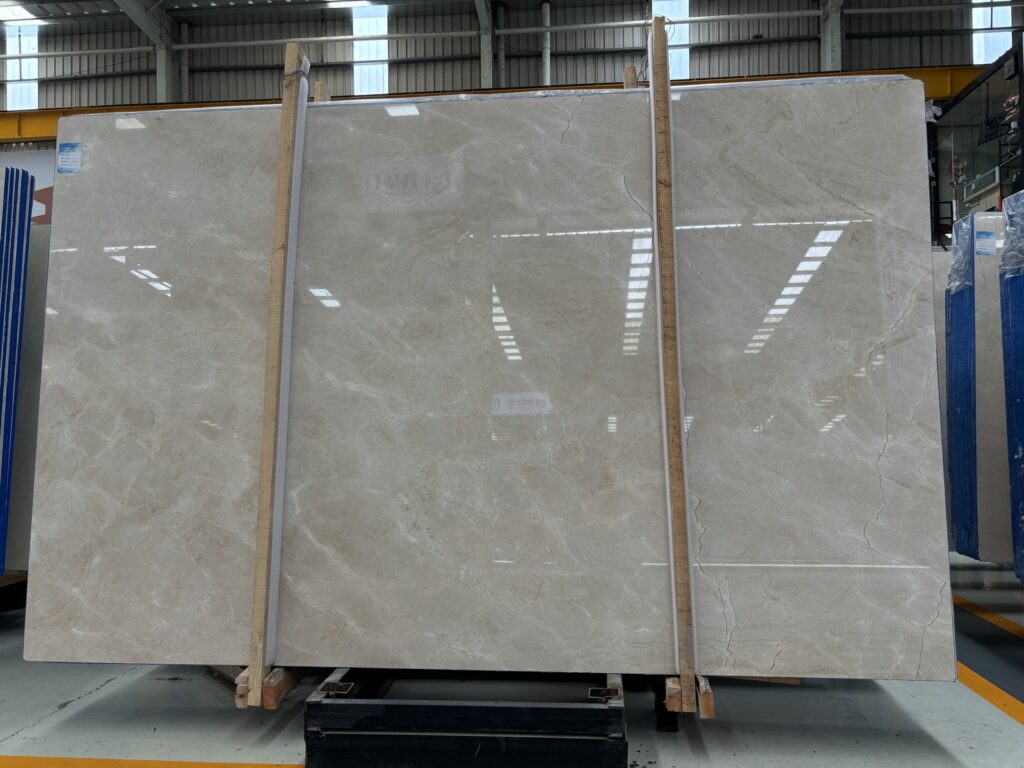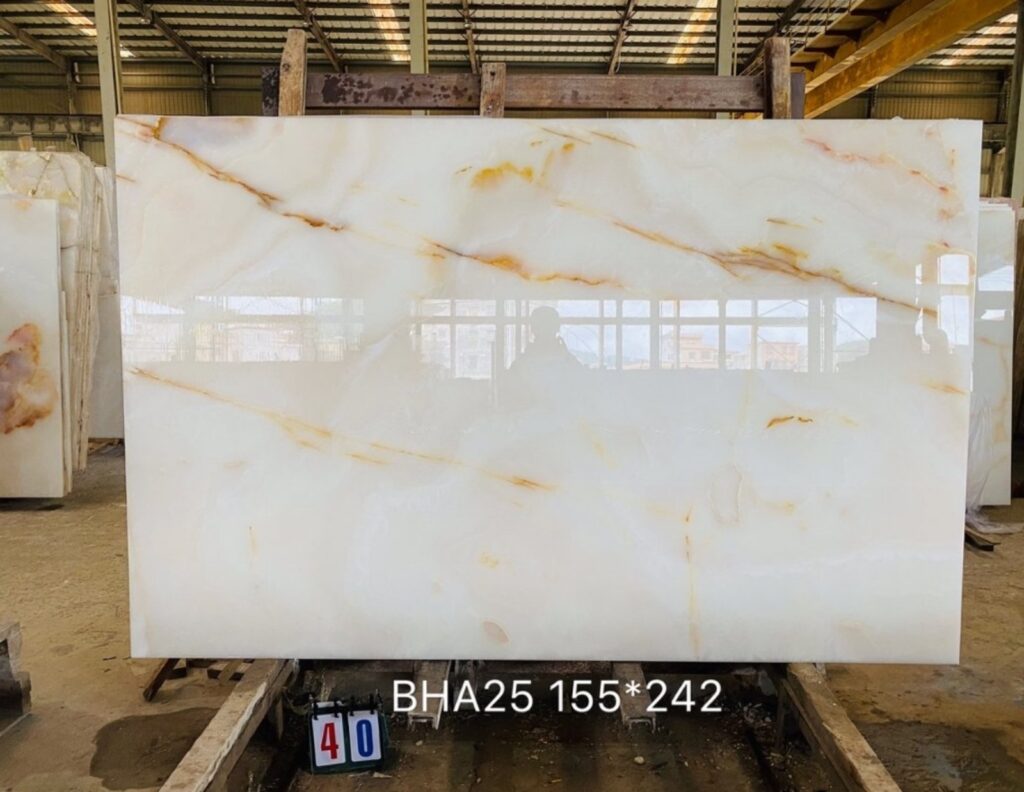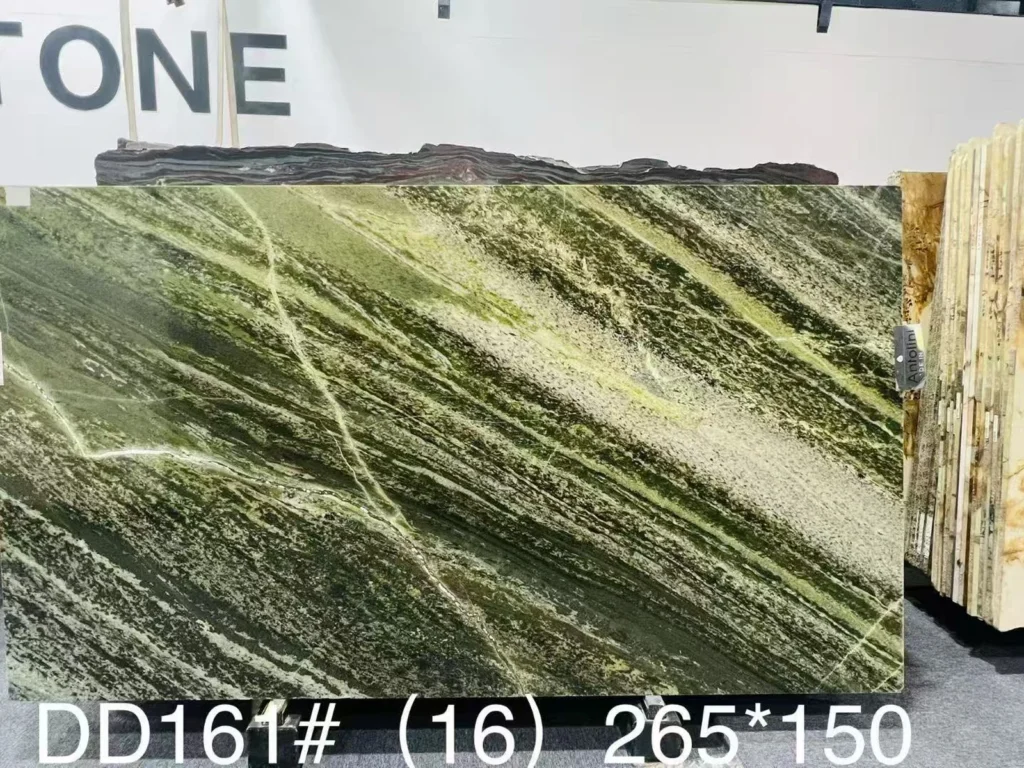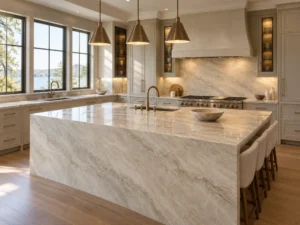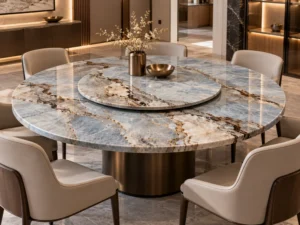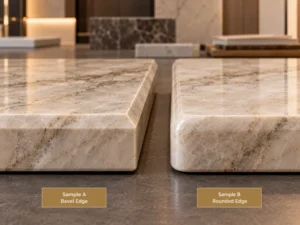
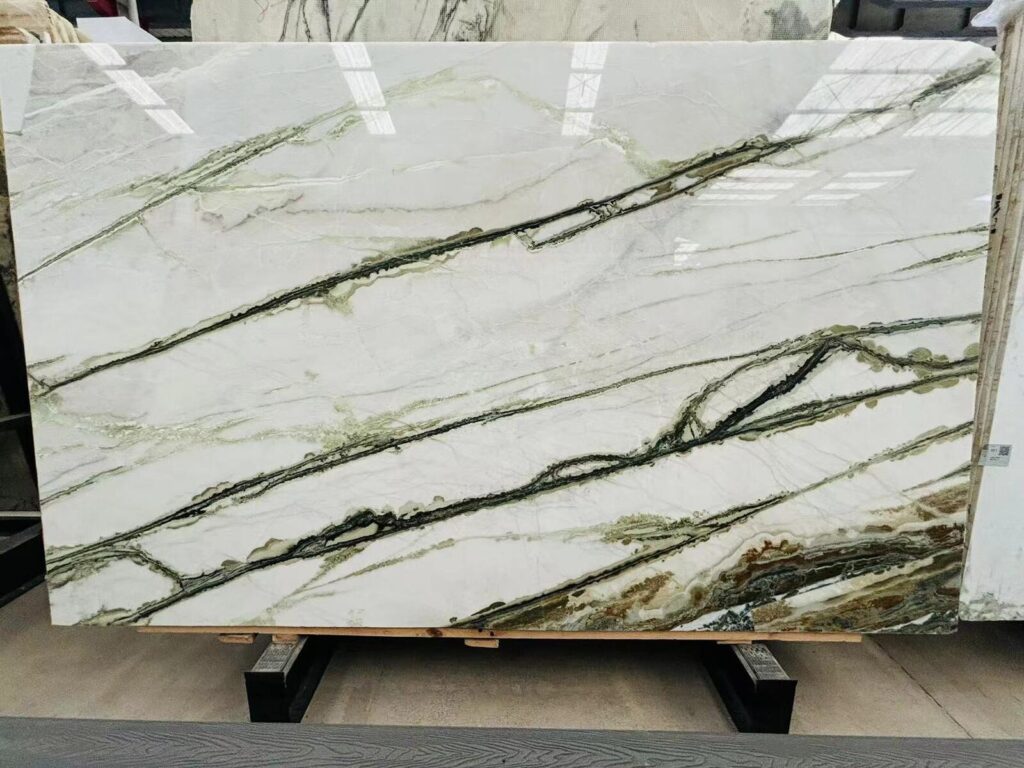
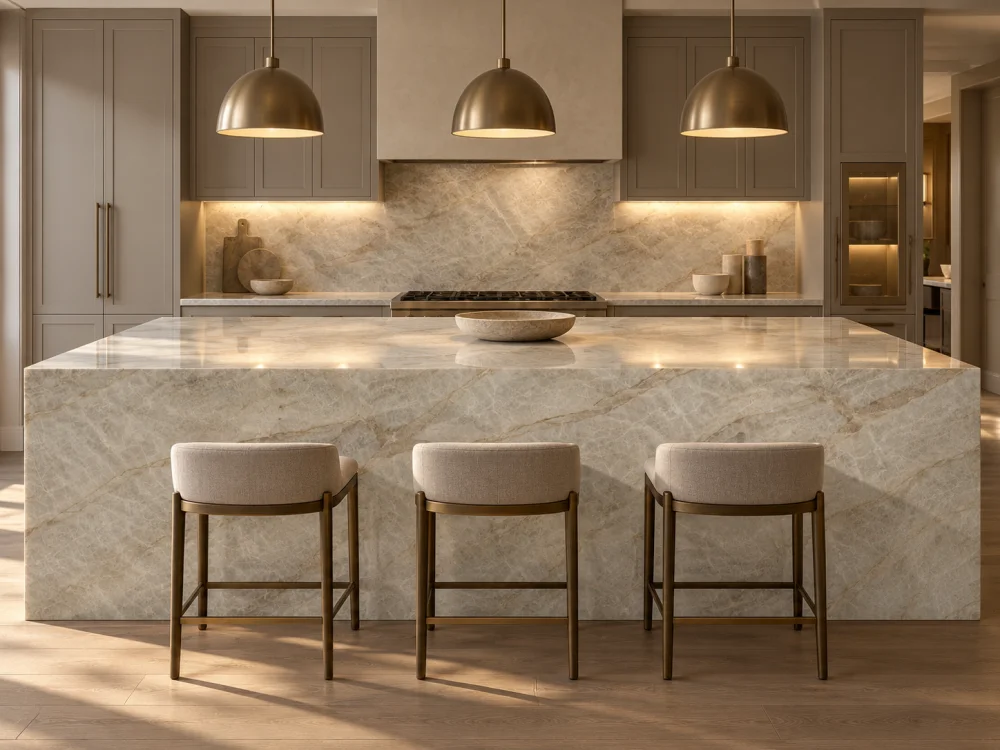
A large Natural Quartzite island may look calm and evenly balanced in daylight.
Then the pendant lights are switched on.
A pale mineral field becomes noticeably brighter.
One darker vein appears stronger beneath a nearby shadow.
A polished area reflects the pendant itself.
Another section of the island looks almost flat because two overlapping light zones reduce the contrast that was obvious earlier in the day.
The stone has not changed.
The lighting relationship has.
This is the central issue behind 펜던트 조명 아래의 석영암 아일랜드: 표면에 드리워지는 그림자 확인.
A pendant is not simply a decorative object hanging above a countertop. Depending on its shade, light source, optics, location, height, output, and relationship with other lighting, it can create several visual effects across the same stone surface.
For a statement island, those effects deserve review before the project assumes that a rendering or one showroom photograph predicts the finished result.
One of the easiest mistakes is to describe every visible light-related change on the countertop as a “shadow.”
Three different effects may be present.
This is the light reaching the Quartzite surface.
A pendant may produce a concentrated bright area directly below the fixture, a wider softer zone, or a more diffuse contribution depending on the actual luminaire.
Where several pendants are used, their illuminated areas may overlap.
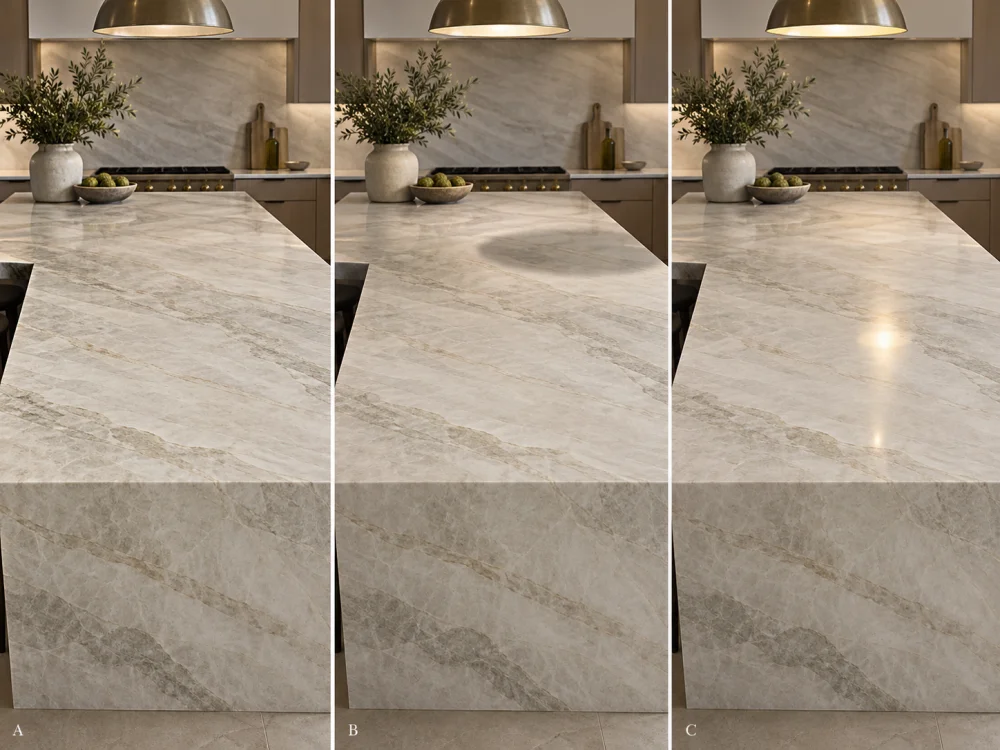
A polished Natural Quartzite surface can reflect:
A bright oval or dark pendant-shaped form on the stone may therefore be a reflection rather than an intrinsic part of the slab.
A shadow occurs when an object interrupts part of the light reaching the surface.
The pendant fixture itself can contribute to shadow patterns depending on its construction.
People, taps, bowls, flowers, appliances, shelves, and other objects can also cast temporary shadows across the island.
If a dark area moves when the viewer changes position, reflection may be involved.
If it changes when an object is moved but the viewer remains still, shadow may be involved.
If it remains fixed under several lighting and viewing conditions, it is more likely to be part of the stone itself.
Stone Pattern + Illumination + Reflection + Shadow = What the Viewer Sees. Diagnose these components separately before describing a dark or bright area as a material condition.
A long kitchen island is not one uniform lighting zone.
A pendant centered over the left side, middle, or seating end can make different parts of the natural slab visually dominant.
Use the current kitchen reflected ceiling plan, island plan, and countertop drawing together.
Identify:
Now compare that arrangement with the proposed Quartzite slab crop.
If a major dark or warm mineral band passes through a strongly illuminated area, it may become a stronger focal point.
This can be desirable when the design intends the stone to dominate the kitchen.
But it should be deliberate.
The opposite can occur.
A shadow edge may cross the same vein and temporarily reduce its visual continuity.
From another viewing position or when another lighting layer is switched on, the vein may become much more obvious again.
This is why slab layout should not be redesigned from one pendant-light photograph alone.
General lighting references may provide starting ranges for pendant positioning, but the appropriate arrangement depends on the actual fixture, optics, ceiling, island dimensions, sight lines, task requirements, and design intent.
The stone supplier should not invent a universal hanging height simply to control how the Quartzite looks.
The relevant lighting designer, architect, interior designer, electrical designer, or fixture supplier should control the lighting specification.
The Quartzite review should evaluate the visual result produced by that project-specific design.
Large islands commonly use two, three, or more pendant fixtures.
This creates another layer of visual complexity.
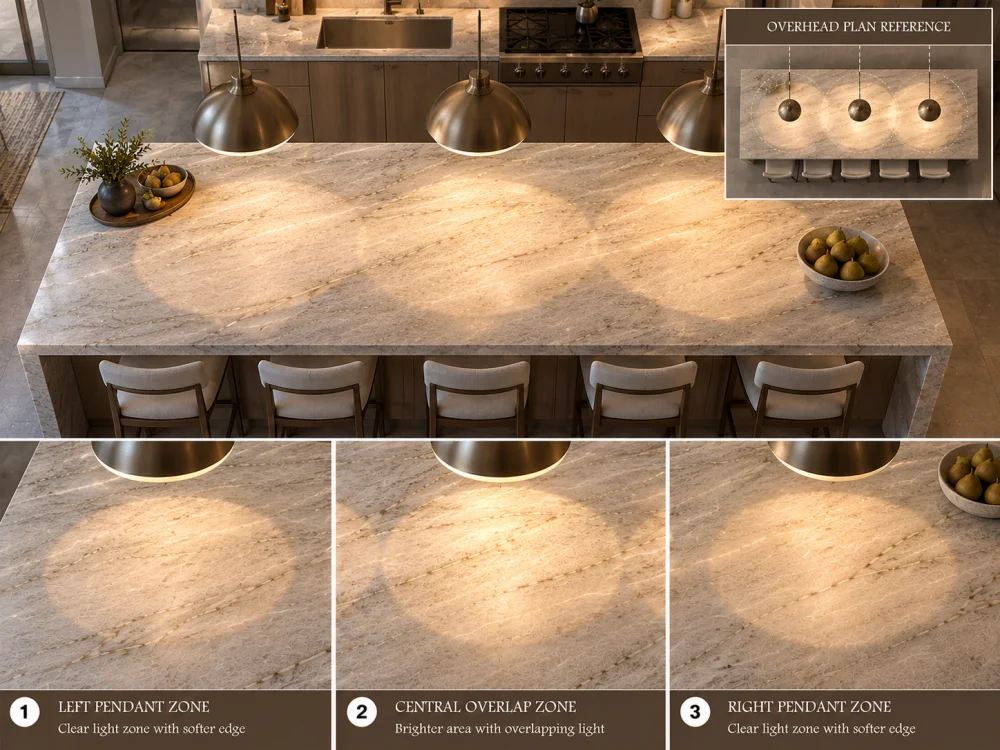
If the illuminated areas overlap, the center of the island may appear brighter than either end.
This can change perceived stone contrast.
A low-contrast Quartzite may look more uniform through the brightest zone while its movement becomes stronger toward less illuminated areas.
Depending on fixture construction and surrounding light, one pendant’s shadow effect can overlap another fixture’s illumination.
The resulting pattern may not resemble the simple circular pool shown in a concept rendering.
A clear glass globe, solid metal shade, open-frame pendant, translucent shade, linear suspension, and multi-light cluster do not interact with the countertop in the same way.
The project should therefore evaluate the actual or sufficiently representative fixture rather than using the generic term “pendant light.”
Pendants are rarely the only lights operating in a kitchen.
Recessed ceiling fixtures, under-cabinet lighting, daylight, wall lighting, and adjacent room illumination can reduce or change pendant-generated shadow contrast.
A test performed with every other light switched off may therefore exaggerate a condition that will rarely occur in the finished kitchen.
Conversely, if the pendants are the dominant evening island lighting, that low-ambient-light condition may deserve separate approval.
| Lighting Condition | What to Review on the Quartzite | Risk of Misreading |
| Daylight, pendants off | Natural slab colour, broad movement and room reflections | Assuming this predicts the evening appearance |
| Daylight + pendants | How decorative light interacts with stronger ambient illumination | Ignoring competing daylight |
| Evening + general lighting | Combined reflections, brightness balance and pattern visibility | Blaming one fixture for the complete room effect |
| Pendants dominant | Strongest pendant-related light pools, shadows and reflections | Treating this as the only normal viewing condition |
Surface finish changes the way light is reflected from Natural Quartzite.
This can substantially change the island’s nighttime appearance.
A polished surface produces stronger specular reflection.

Depending on viewing angle, a pendant may appear as a distinct highlight or visible reflected object.
The polish can also increase perceived colour depth and make mineral movement appear more defined.
On a large island, these reflections can move across the stone as the viewer walks through the room.
A honed or lower-sheen finish generally produces a softer reflected-light response.
The pendant may still influence brightness and colour perception, but its reflected image is usually less mirror-like than on a highly polished face.
This does not automatically make honed Quartzite the better choice beneath pendants.
The finish should match the overall design intent.
Finish and shadow are different concepts.
Changing from polished to honed may reduce sharp reflections, but an object can still interrupt light and create a shadow on the surface.
Do not choose a honed finish solely to solve a shadow issue without identifying the actual cause.
그만큼 주방 조리대용 광택 처리된 석영암 vs 연마 처리된 석영암 guide explains in more detail how finish changes colour depth, pattern contrast, and reflectivity.
Polished vs Honed is not simply “more light vs less light.” Compare the same Quartzite under the intended pendant arrangement and judge reflection, shadow, colour depth, and pattern visibility separately.
Natural Quartzite already contains light and dark structures.
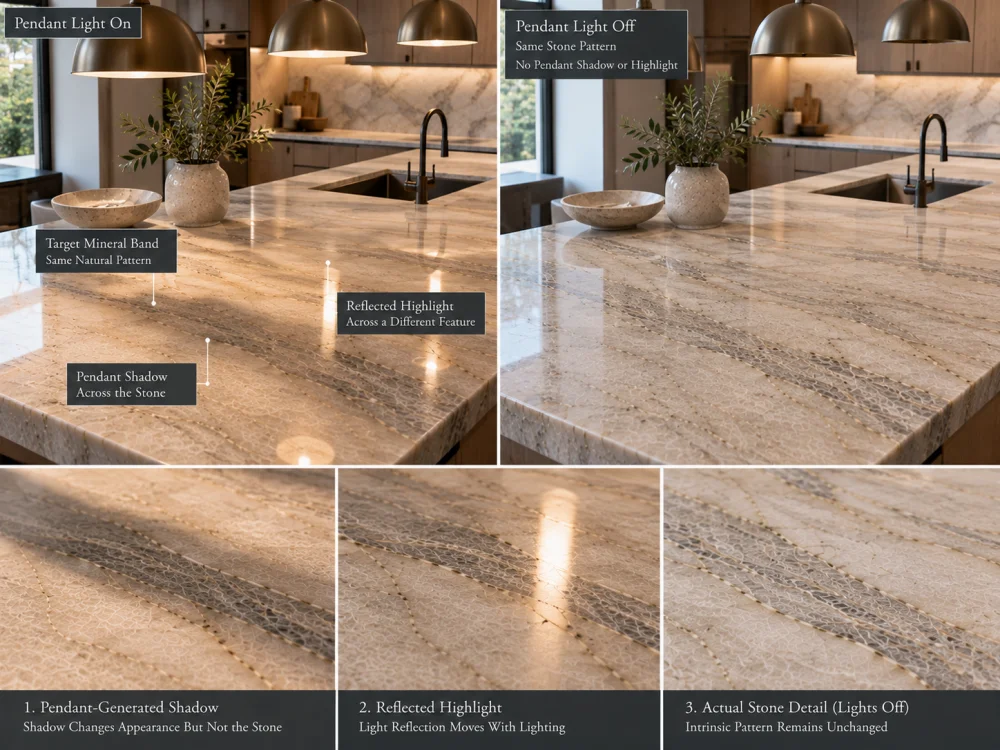
When artificial shadows are added, the eye may temporarily combine the two.
Imagine a dark taupe mineral band passing diagonally across an island.
A pendant shadow falls in a similar direction and begins close to the mineral line.
From one viewpoint, the shadow may appear to make the vein larger or darker than it really is.
When the light is switched off, the apparent extension disappears.
Strong reflected highlights can create the opposite effect.
A natural vein may seem to disappear where the pendant reflection crosses it.
The geological movement has not stopped; it is temporarily masked by reflected light.
Some Natural Quartzites contain areas with greater crystalline visual depth or partial translucency.
These zones may appear brighter or more layered beneath a pendant than quieter opaque regions.
Do not turn that observation into a universal statement that every Quartzite transmits light or reacts identically.
Review the actual slab.
A directional slab can create very different island compositions depending on how it is rotated.
But pendant shadows should not become the sole reason to change a slab orientation that otherwise works architecturally.
First determine whether the lighting effect is:
Then decide whether the stone layout genuinely needs adjustment.
그만큼 수직과 수평으로 본 석영암 판재: 왜 전시 방식이 달라지는가 guide explains the same underlying principle: the stone can remain unchanged while orientation, reflected light, and viewer position substantially change the visual impression.
A pendant-light study made directly beneath the fixture is incomplete.
Most people experience an island from several viewpoints.
From the working side, the viewer may stand relatively close to the countertop and see the stone at an oblique angle.
Pendant reflections can become strong from this position.
Someone seated at the island sees the surface from a lower angle.
The fixture may appear higher in the reflection, while shadow and highlight relationships across the stone can change.
In an open-plan home, the island may first be seen from a living or dining space.
From this distance, broad light-and-dark zones can matter more than small local reflections.
If the island has a waterfall end or a highly directional pattern, the end approach may reveal the relationship between the illuminated top and the darker vertical face.
This can be visually important even though the pendant illuminates mainly the horizontal worktop.
For remote review, take photographs from identified positions rather than sending a collection of unrelated close-ups.
A useful sequence can include:
Keep the relevant lights and camera exposure as consistent as practical.
There is rarely one “correct” lighting condition for a kitchen island.
The island may be used during bright daylight, cloudy daylight, early evening, and nighttime.
The project does not need to simulate every possible hour of the year.
It does need to identify the lighting conditions that meaningfully change the visual decision.
This is useful for understanding the Natural Quartzite primarily through daylight and ambient room reflection.
검토:
This is often the most representative evening condition.
검토:
Use this condition only when it reflects a realistic way the kitchen will be experienced.
It can reveal the strongest pendant-related shadows and highlights.
This is useful as a stress-test for the visual design but should not automatically replace normal-use approval.
A team may approve the stone in daylight and later find that the pendant arrangement needs adjustment.
That does not necessarily mean the Quartzite selection was wrong.
Likewise, approving a dramatic evening lighting photograph should not automatically mean that the daytime stone composition has been approved.
현장의 크리스탈로 석회암(조명 꺼짐 상태): 왜 주간 승인이 중요한가 guide deals with a different lighting system, but the approval principle is relevant: different lighting states can answer different visual questions and should not automatically be collapsed into one approval.
Actual Slab → Intended Island Crop → Project Finish → Pendant Position → Normal Ambient Lighting → Daylight Review → Evening Review → Main Viewing Directions → Defined Approval.
The Quartzite supplier controls the confirmed stone scope.
The lighting designer, architect, interior designer, electrician, fixture supplier, or other responsible project party controls the relevant lighting scope.
A useful review keeps those responsibilities connected without confusing them.
| 결정 | Primary Review |
| Quartzite material | Actual slab, natural variation, finish and project suitability |
| Island crop | Slab allocation, pattern direction and main visible zones |
| Pendant specification | Project lighting design and selected fixture information |
| Pendant location / height | Project-specific lighting, sight-line and task requirements |
| Stone / light interaction | Physical or project-relevant visual review under intended conditions |
| Final record | What stone condition and which lighting state were actually reviewed |
If an undesirable dark area appears on the island, first determine whether it belongs to the stone, the lighting, reflection, or temporary shadow.

If a strong pendant reflection appears only from one viewing position, decide whether that position matters to the real project before changing the slab.
If the lighting design changes significantly after stone approval, repeat the relevant visual review.
If the selected Quartzite slab or surface finish changes, repeat the lighting-sensitive comparison where necessary.
The final goal is not a countertop with no shadows and no reflections.
That would be unrealistic in a real illuminated room.
The goal is an island whose natural stone composition and lighting effects remain intentional under the conditions that matter to the finished kitchen.
The darker area may come from shadow, lower illumination, reflection of a darker surrounding surface, or the natural Quartzite itself. Compare the same location with the pendant lights off, from another viewing angle, and under normal ambient lighting before deciding that the stone colour has changed.
Yes. Focused illumination, shadow contrast, and reflection can make some natural mineral features appear more prominent. A dark vein near a shadow boundary may look stronger, while a bright reflection may temporarily reduce the visibility of another vein.
Neither finish is universally better. Polished Quartzite generally produces stronger reflections and greater visual depth, while honed Quartzite produces a softer, lower-sheen response. Shadow can occur on either finish. Compare the intended finish under the actual lighting concept before deciding.
Do not use a Quartzite-specific universal height. General lighting guides provide starting ranges, but the appropriate position depends on fixture dimensions, light distribution, ceiling height, island geometry, task requirements, sight lines, and the overall lighting design. The responsible project lighting or design team should confirm the final arrangement.
Where the island is visually critical, it is useful to understand the planned fixture locations and major lighting conditions before final stone-layout approval. However, lighting approval and stone fabrication approval remain separate decisions. Use the available lighting design to identify whether any part of the slab layout needs a project-specific visual review.
Not by itself. Photographs can be affected by exposure, white balance, reflections, viewing position, and temporary shadows. Compare complete-piece views, closer details, different lighting states, and the physical material before classifying a questioned area.
Send Josh the Natural Quartzite material name, current slab references where available, island dimensions, proposed cutting layout, surface finish, edge details, sink or cooktop locations, kitchen plan, pendant locations, relevant fixture information, important viewing directions, daylight photographs or lighting context where available, quantities, and delivery destination. Identify whether the concern is slab pattern, reflection, shadow, brightness distribution, or the overall evening appearance.
For project-based Natural Quartzite islands, HRST STONE can coordinate available full-slab photographs, slab references, cutting layouts, vein-direction review, island piece identification, surface finishes, edge details, fabrication QC, and project-specific visual records according to the confirmed stone scope. Send Josh the island drawings, dimensions, selected Quartzite, finish, quantities, lighting context, important viewing directions, and delivery destination for review.