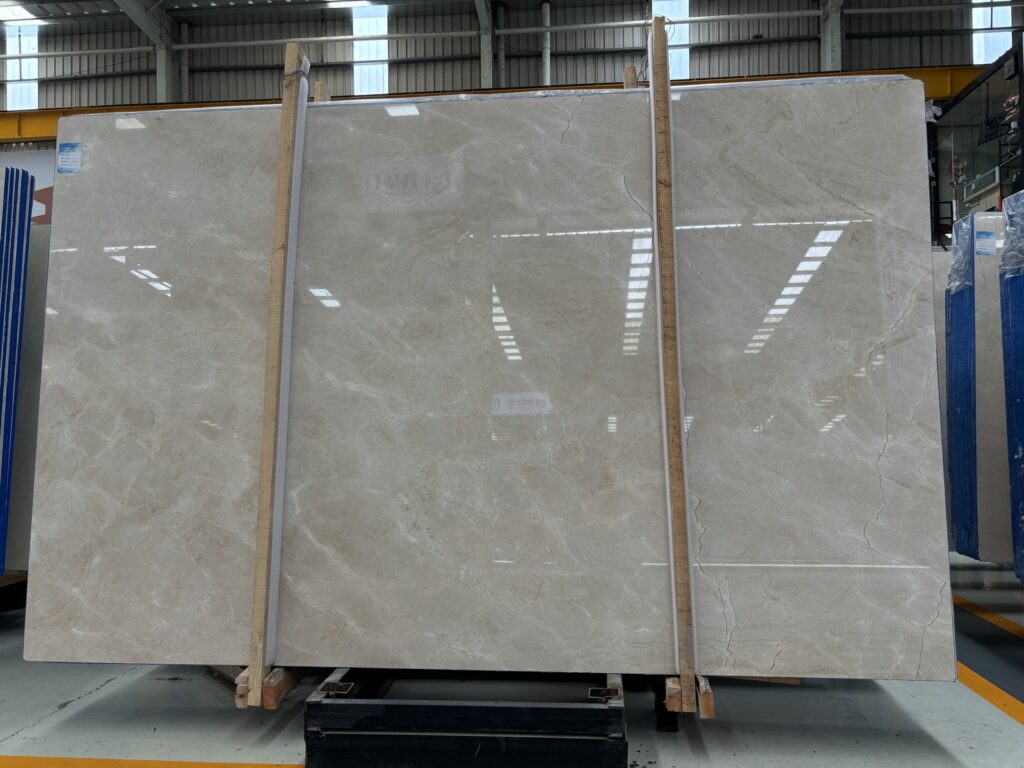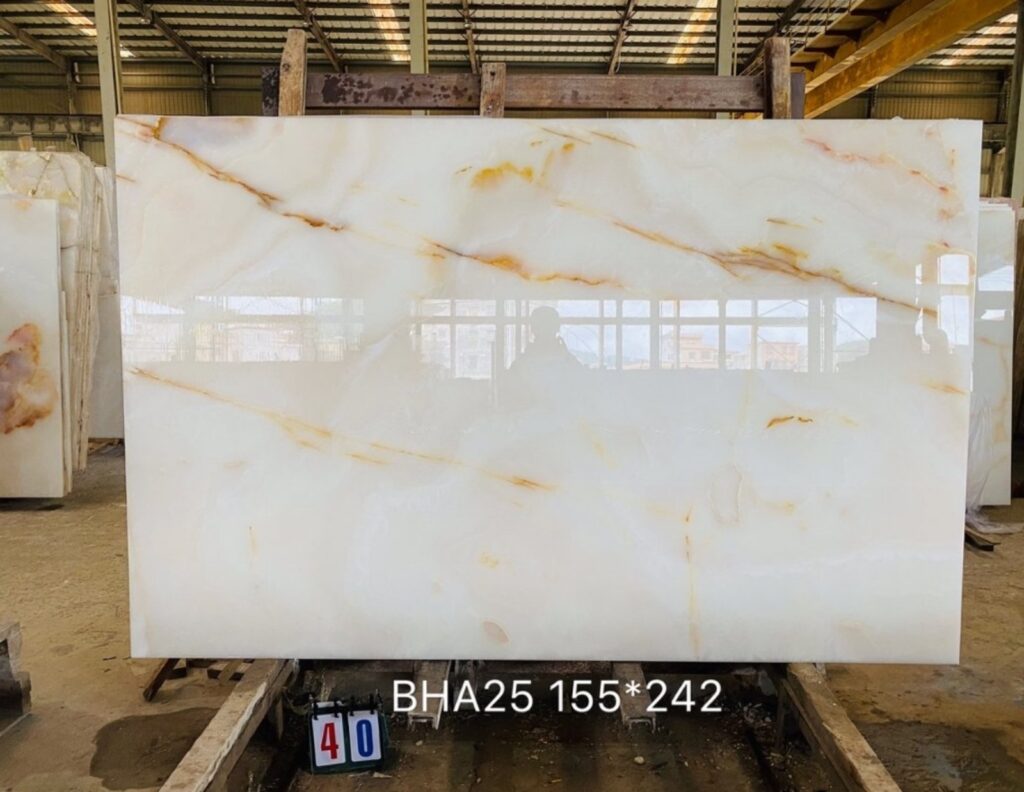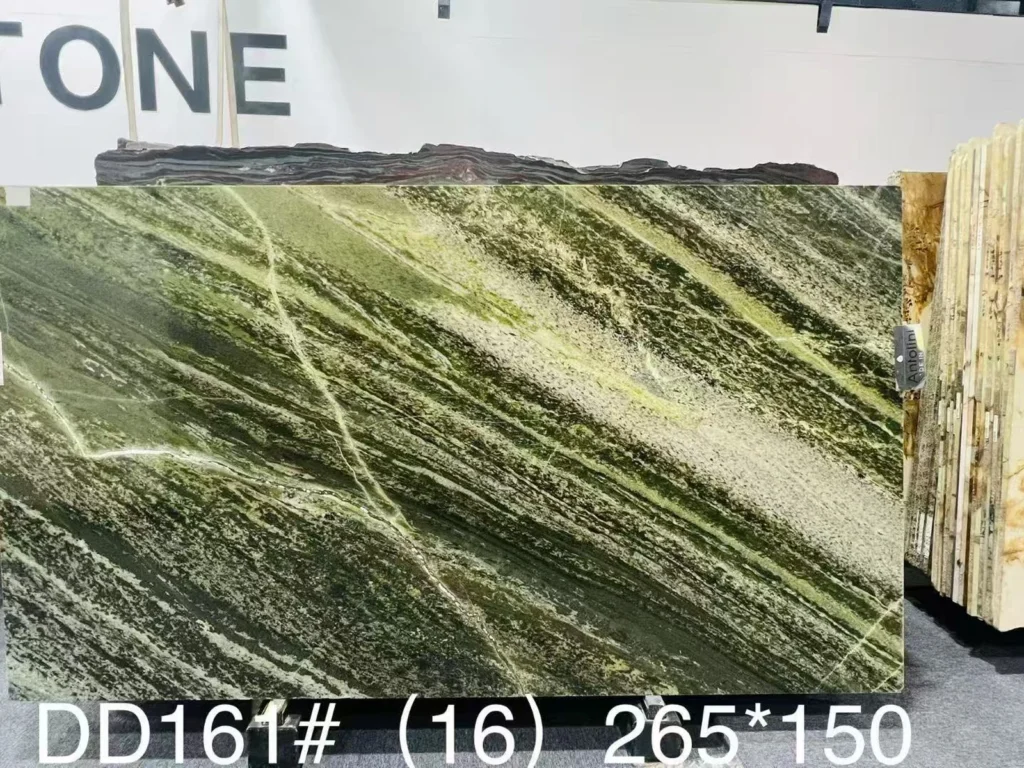
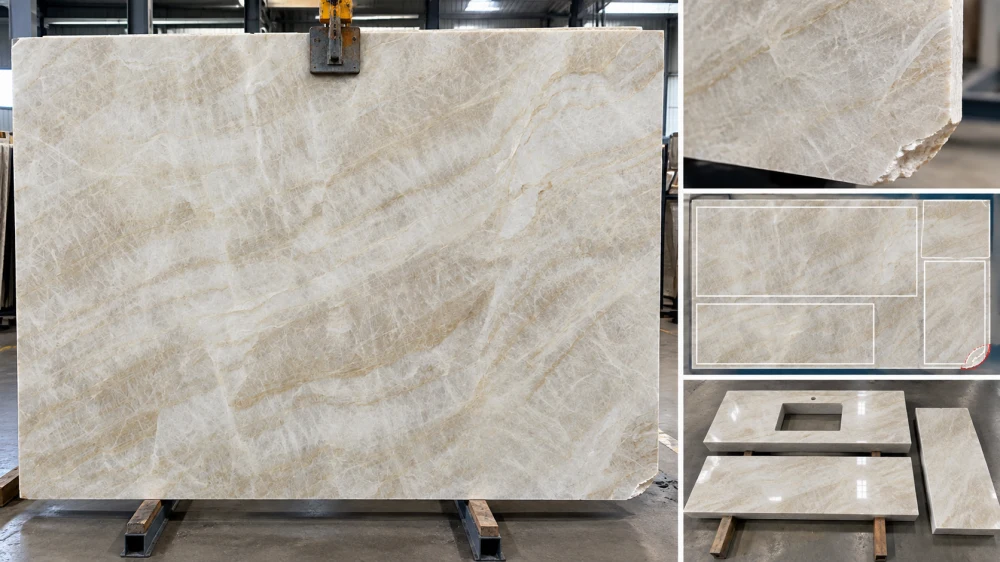
Quartzite edge damage reduces usable yield only when the affected zone interferes with the material required for the approved finished-piece layout. A chipped corner outside all planned components may have little or no effect, while damage extending into a long island, visible finished edge, waterfall, seam zone, or other required piece can force additional trimming, repositioning, a new seam, or another slab. Evaluate the actual slab condition against the cutting plan before deciding how much usable material has been lost.
A buyer receives photographs of a Natural Quartzite slab before cutting and notices a chipped edge or broken corner.
즉시 제기되는 질문은 대개 다음과 같습니다:
“How much usable area have we lost?”
That question cannot be answered reliably from the chip alone.
A 100 mm damaged area at one corner does not automatically mean that the entire slab must be reduced by 100 mm on both dimensions. Conversely, a relatively small edge condition can matter significantly if it falls directly inside the only workable position for a large island, waterfall panel, long vanity, or another critical finished component.
The correct approach is to connect quartzite edge damage to the actual cutting layout.
Gross slab dimensions describe the physical envelope of the slab.
Usable yield describes how much of that particular slab can actually satisfy the project cutting plan.
The difference may be influenced by:
This is why a slab should not be judged only by multiplying its overall length by its overall width.
Damage outside all planned pieces
May have little or no effect on project yield.
Damage inside an area already intended for trimming
May be absorbed without changing the finished-piece layout.
Damage intersects a planned piece but the piece can move
May require layout optimization rather than another slab.
Damage enters a critical piece that cannot move
May reduce usable yield and require a seam, redesign, or additional material.
Damage reaches a required visible finished edge
Requires specific visual and fabrication review even if the gross piece still fits.
Before deciding whether quartzite edge damage affects the order, create a simple condition record for the actual slab.
기록 사항:
The condition should be identifiable on the complete slab image. A close-up alone can make a small edge chip appear much more important than it is in relation to the whole board.
Damage sits beyond every required finished piece. Yield may remain unchanged.
The affected material would already have been removed during squaring or fabrication.
One or more pieces can be repositioned while maintaining the required project result.
Damage enters a required component or visible edge and the layout cannot simply move away.
This is the simplest situation.
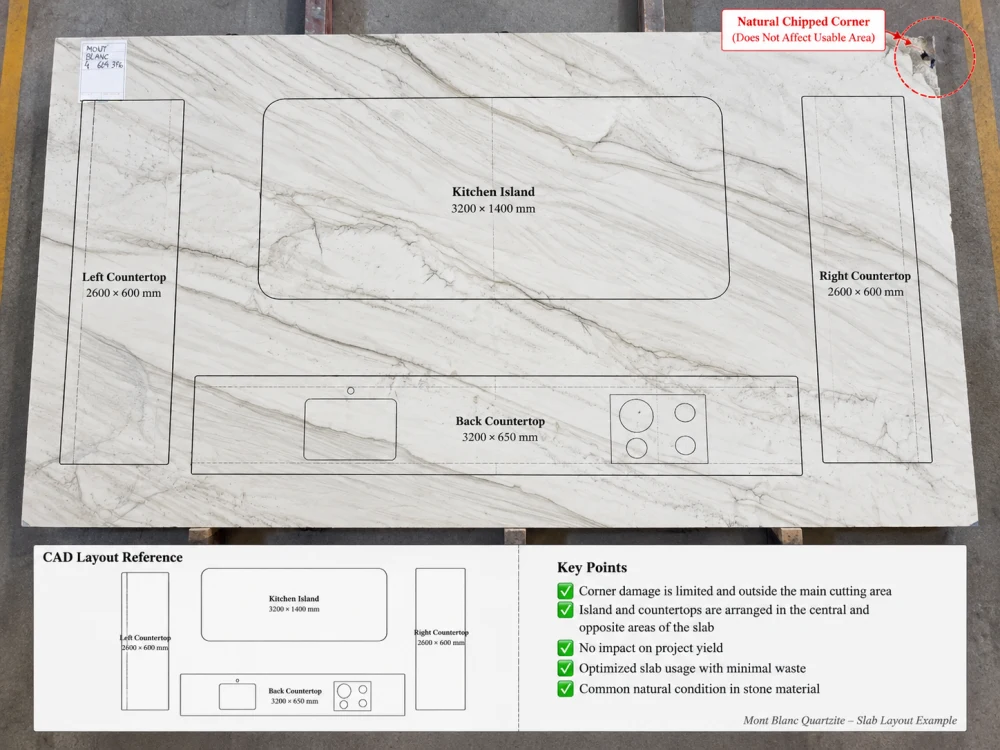
Suppose the slab has an irregular chipped corner, but the cutting plan places:
If none of those components requires the damaged area, the chip may not reduce project yield at all.
The gross slab remains visually damaged at its perimeter, but the project-usable area may be unchanged.
Natural stone slabs do not always have perfectly straight production-ready edges.
A cutting plan may already assume that part of the perimeter will be removed before finished components are produced.
If an edge chip lies completely inside material that was already going to be trimmed away, it may not create an additional yield loss.
Do not create a universal “standard trimming allowance” for every Quartzite slab. The required trimming depends on the actual slab edge, cutting method, finished-piece geometry, fabrication process, and project requirements.
Sometimes the damage enters the first proposed position of a component but does not make the slab unusable.
The fabricator may be able to reposition the pieces.
However, moving a piece should trigger another question:
What else changes when the piece moves?
확인 사항:
Solving an edge conflict should not accidentally create a worse visual or fabrication problem elsewhere.
바로 여기에서 quartzite edge damage can genuinely reduce usable yield.
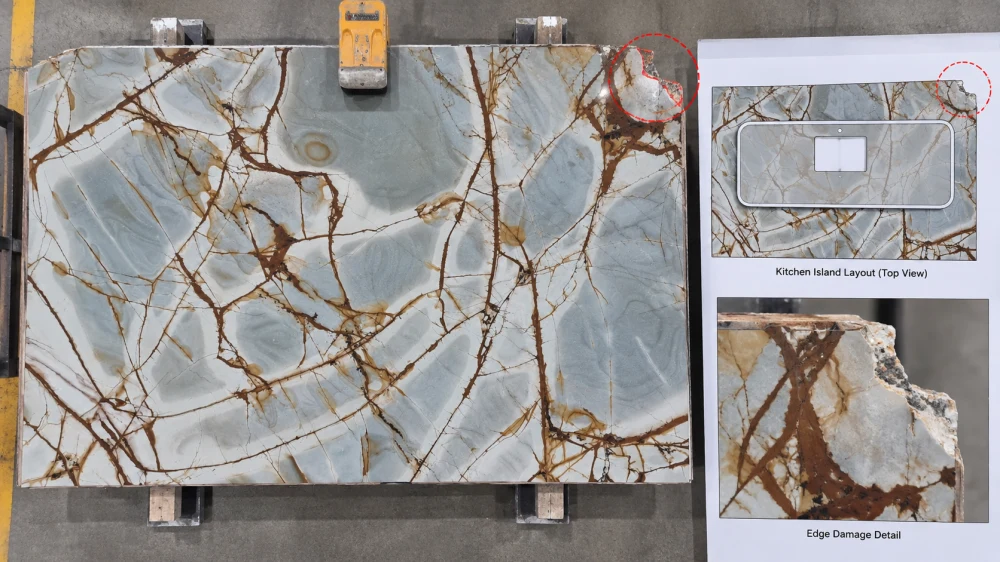
For example, the project requires a long one-piece island and only one position on the selected slab provides enough usable length.
If the damaged edge extends into that required envelope, possible consequences may include:
The correct solution depends on the actual slab and project. The edge condition itself does not determine which option should be selected.
Yield is not only about whether a rectangle physically fits.
Suppose a countertop piece fits inside the slab dimensions, but the affected area becomes part of an exposed finished edge.
The project must then consider:

A piece can therefore “fit” geometrically while still requiring visual review.
This is an important procurement distinction.
If a small damaged corner forces a 3,000 mm-long finished component to move to another slab, the commercial effect may be much larger than the physical area of the chip.
Conversely, a visibly larger edge condition may have almost no project effect if that entire perimeter lies outside all required components.
Physical damage area and project yield loss are not the same measurement. Yield loss should be evaluated through the cutting plan.
The most useful review is visual.
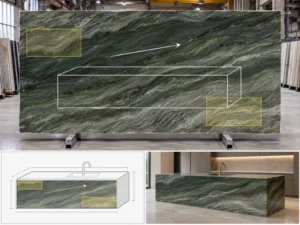
Place the proposed finished-piece outlines over the actual slab image and show the edge condition in the same record.
This allows the buyer and fabricator to see:
Actual Slab → Edge Condition → Piece Envelope → Trim Zone → Cutouts → Visible Edges → Remaining Material
현장의 석영암 슬래브 예약 가이드 similarly recommends checking actual slabs against the project cut list rather than relying on gross dimensions alone. It specifically identifies edge trimming, orientation, natural features, openings, waterfall returns, and cutting layout as factors that can change usable yield.
When several slabs from the same bundle are available, a condition report without a board number can quickly become ambiguous.
The yield review should connect:
Board Number → Full-Slab Photo → Edge Condition → Cutting Plan → Finished Pieces
If the cutting layout is revised, retain the same slab identity so the buyer knows which physical board is being reassessed.
For projects where several slabs feed multiple finished components, the 석영암 절단 계획 안내서 explains how board numbers and finished-piece IDs can maintain this traceability through fabrication.
A damaged perimeter can become more significant when the planned component also contains a large opening.
For example, moving an island away from an edge chip may shift the sink cutout closer to:
This is why layout optimization should consider the whole finished component rather than only avoiding the damaged perimeter.
그만큼 파타고니아 브라운 쿼츠라이트 주방 아일랜드 page likewise treats usable slab yield as a combination of visual selection, fissures, repairs, cutout position, waterfall matching, edge requirements, spare material, and other risk areas rather than gross slab area alone.
Do not make repair the first question.
First determine whether the affected material is even needed.
If the edge condition changes the cutting plan, record both versions.
| 검토 항목 | Original Layout | Revised Layout |
| Slab / Board | Same identified slab | Same or replacement slab |
| Main Piece Position | Original position | Moved if required |
| Edge Condition | Conflicts / no conflict | Excluded, trimmed, or still relevant |
| Secondary Pieces | Original allocation | Reallocated where necessary |
| Additional Material | Original assumption | Confirm after revised layout |
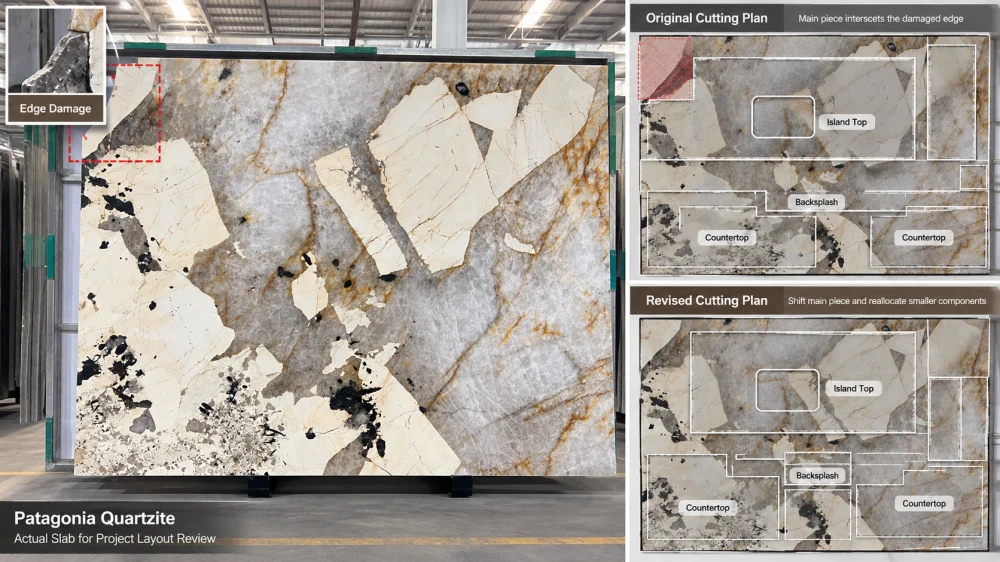
The practical answer is:
When avoiding, trimming, or accommodating the affected edge prevents the approved finished-piece set from being produced from the slab in the intended layout.
This may happen when:
It may have no meaningful effect when:
The decision still needs to be tied to the actual slab and current cutting plan rather than assumed from these examples.
Before cutting a slab with a recorded edge condition, confirm:
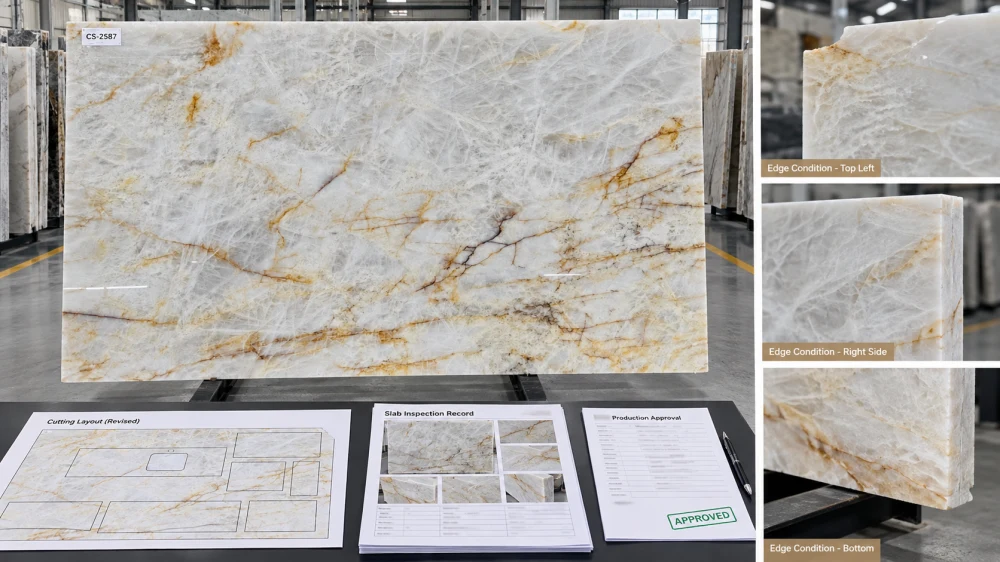
□ Correct slab / board number identified
□ Full-slab photograph retained
□ Edge condition shown in context
□ Current slab dimensions confirmed
□ Latest cutting-plan revision used
□ Finished pieces overlaid on actual slab
□ Visible edges checked
□ Cutouts and seams reviewed
□ Original vs revised yield recorded if layout changed
□ Additional material requirement confirmed if applicable
□ Buyer / designated reviewer approval recorded
아니요. 칩이 발생한 가장자리는 요구되는 모든 완성 부재의 외부에 위치할 수도 있고, 이미 제거될 예정인 재료 내부에 있을 수도 있습니다. 그 영향은 실제 판재와 절단 계획을 기준으로 평가해야 합니다.
실제 슬래브의 치수와 상태를 완성된 부재 배치도와 함께 검토하십시오. 영향을 받는 구역이 부재의 위치, 이음새, 시각적 관계, 절단부 또는 필요한 슬래브 수에 변화를 초래하는지 판단하십시오. 물리적인 칩 면적만으로 수율 손실을 산정해서는 안 됩니다.
가능할 수 있습니다. 답변은 손상된 부위의 위치, 사용 가능한 슬래브 치수, 아일랜드의 크기, 컷아웃 여부, 시각적 우선순위, 가장자리 처리 요구사항, 그리고 승인된 배치를 유지한 채 아일랜드를 해당 영역에서 벗어나도록 배치할 수 있는지 여부에 따라 달라집니다.
아니요. 먼저 해당 부위가 절단 계획상 필요한 부분인지 여부를 확인하십시오. 손상된 재료가 제거되거나 모든 완성된 부품의 외부에 위치하는 경우에는 보수가 적합하지 않을 수 있습니다. 완성된 부품 내에 남아 있는 재료에 대한 보수는 실제 공사 사항을 기준으로 검토해야 합니다.
때로는 가능합니다. 부품의 재배치를 통해 엣지 조건을 피할 수 있지만, 수정된 레이아웃에서도 정맥 방향, 시각적 우선순위, 이음선, 컷아웃, 워터폴 관계 및 기타 부품을 위한 남은 공간 등을 반드시 확인해야 합니다.
모서리 상태 및 기타 배치 요구사항을 고려한 후, 승인된 완성 부재 세트가 선택된 자재의 사용 가능한 면적 내에 더 이상 수용되지 않을 경우, 추가 판재가 필요할 수 있습니다. 이는 모서리 사진만으로 판단하기보다는 수정된 절단 계획을 통해 확인하시기 바랍니다.
재료명, 슬래브 또는 보드 번호, 전체 슬래브 사진, 영향을 받은 가장자리의 클로즈업 이미지, 슬래브 치수, 현재 도면, 완성된 부품의 규격, 컷아웃, 노출된 가장자리에 대한 요구사항, 배치 우선순위 및 현재 절단 계획의 개정 사항을 제출해 주시기 바랍니다.
For project-based Natural Quartzite fabrication, HRST STONE can coordinate actual slab photographs, board identification, CAD cutting layouts, finished-piece positioning, visual review, fabrication QC, and export packing around the approved project scope. Send Josh the slab reference, condition photographs, drawings, required piece sizes, finish, cutouts, edge requirements, and destination when an edge condition needs to be reviewed before cutting.
© HRST STONE / XIAMEN HRST STONE CO., LTD. 모든 권리 보유.