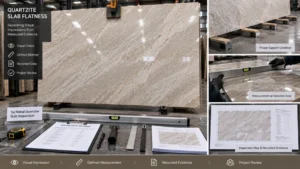
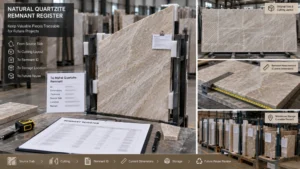
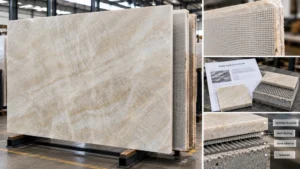
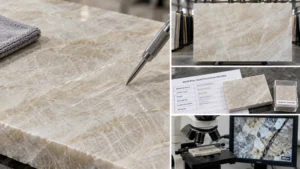
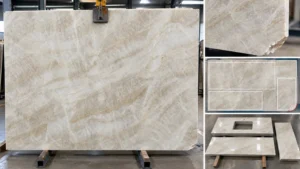
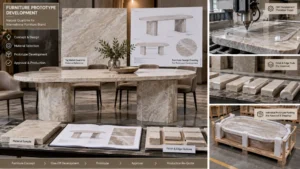
Taj Mahal Quartzite thickness and edge details should be decided as one coordinated package. Confirm the visible edge, support condition, seam approach, cutout strategy, and approved slabs before fabrication begins.
Best Thickness and Edge Details for Taj Mahal Quartzite in Kitchen And Bathroom Projects is a buyer-focused guide from HRST STONE for importers, fabricators, designers, architects, contractors, and project procurement teams. The main goal is to turn a material idea into an approval-ready natural quartzite scope without making unsupported assumptions about inventory, price, origin, testing, lead time, or final visual outcome.
How to evaluate Taj Mahal quartzite thickness for kitchen and bathroom projects
Use the project brief, full-slab review, current drawings, and a documented approval process as the foundation. Taj Mahal Quartzite should be discussed against the intended application, not as a generic commodity. The sections below set out the practical questions that should be resolved before the purchase order and fabrication release.
A Taj Mahal quartzite waterfall island shows how slab movement, visible edges, returns, and surrounding finishes must be reviewed together.
의사결정 지점
확인해야 할 사항
왜 중요한가
Visible edge
Decide whether Taj Mahal Quartzite needs a straight, eased, mitred, laminated, or custom-built-up edge.
The edge changes the visual mass and can influence fabrication planning.
Support condition
Share cabinet, wall, frame, and substrate information with the fabricator.
Thickness alone does not determine suitability; the complete support condition matters.
Cutouts and joints
Mark sink, hob, outlet, fixture, and seam positions on current drawings.
Openings and joints should respect the approved slab layout and fabrication sequence.
Lot approval
Approve full slabs and proposed layouts before cutting starts.
Natural variation makes lot-level review essential for visual continuity.
Treat thickness as a system decision
Taj Mahal Quartzite thickness should not be selected as an isolated number. It works together with the piece dimensions, intended visual mass, edge detail, support condition, openings, joints, and handling route. For kitchen and bathroom projects, begin with drawings that show finished sizes and the underlying structure. Then ask the fabricator to assess a workable approach for the actual slabs. This avoids trying to apply a generic detail to a project with different spans, returns, or installation conditions.
Bathroom vanity projects require the stone thickness, visible edge, backsplash, plumbing cutouts, and installation interfaces to be coordinated as one package.
Start with the actual slab
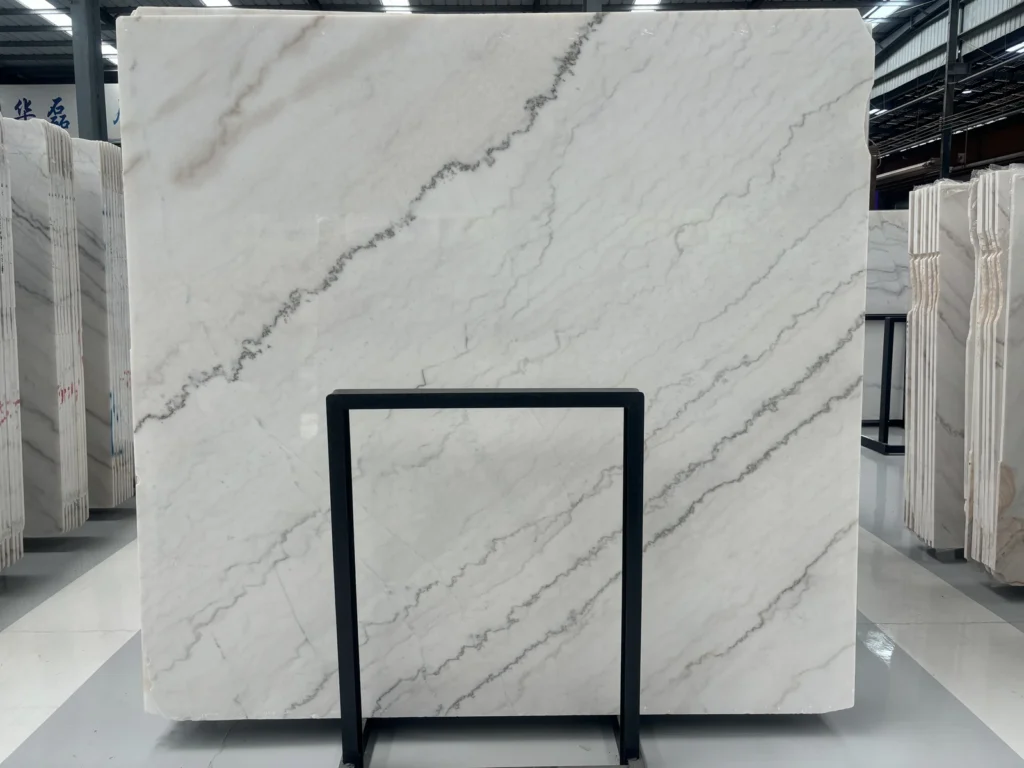
Natural quartzite varies from slab to slab, so thickness and edge decisions should be checked against the selected material. Full-slab photographs and a layout discussion can show where movement, color shifts, crystalline areas, or other natural features fall within the proposed pieces. A small sample is useful for a preliminary direction, but it cannot establish the final face or piece yield. Approve the actual slabs before the cutting plan is released.
Full-slab selection allows the project team to review natural movement, color balance, usable areas, and continuity before layout approval.
천연 쿼츠라이트와 엔지니어드 쿼츠를 구분하세요
Taj Mahal Quartzite is discussed here as natural quartzite, not engineered quartz. Engineered quartz is a manufactured composite and should not be treated as the same material in selection or detailing conversations. Natural quartzite needs a lot-level review because its pattern and characteristics are not factory-repeated. This distinction helps project teams communicate clearly when drawings, material schedules, and approvals refer to different surface categories.
Choose the visible edge deliberately
An edge is both a visual and fabrication decision. A simple eased profile may keep attention on the stone face, while a mitred or built-up approach may create a stronger visual mass. The appropriate option depends on the approved slab, finished detail, junctions, support, and fabricator method. State the intended edge in the drawing package rather than leaving it as a late workshop choice. That helps the design team review scale and helps the fabricator plan the sequence.
설계 검토 시 제기해야 할 질문들
어떤 표면이 가장 가까이 관찰되는지, 어떤 단면이 연속성을 요구하는지, 이음새가 어디까지 허용 가능한지, 그리고 어떤 주변 재료가 의도된 대비를 형성하는지 물어보세요. 이러한 답변들은 재료 논의에 실질적인 틀을 제공하며, 모든 당사자가 실제 판재를 일관되게 평가할 수 있도록 돕습니다.
Coordinate cutouts, seams, and returns
Cutouts, seams, drainboard details, outlets, returns, and concealed supports can change how a thickness strategy performs in practice. Mark them on current drawings and coordinate them with the visible faces of the selected slabs. A project can look different after a seam moves or a return consumes a preferred area of the slab. Reviewing these conditions before cutting is more reliable than trying to solve them after pieces are fabricated.
Slab layout planning coordinates finished pieces, grain direction, cutouts, seams, returns, and preferred visual areas before fabrication begins.A polished eased edge keeps the profile visually restrained while allowing the natural Taj Mahal quartzite surface to remain the primary focus.
Read support conditions from the project
Support planning is project-specific. Cabinet construction, wall framing, substrate condition, fixing method, spans, and installation access all need to be understood by the responsible technical parties. A thicker-looking edge does not by itself define the correct support solution. Share the available project information early so the stone scope can be coordinated with the contractor, fabricator, and designer rather than treated as a standalone finish selection.
Plan for handling and installation
Large or shaped quartzite pieces require a handling plan that respects their finished size, routes, and installation sequence. Consider access openings, lift paths, staging, and whether pieces will be installed before or after adjacent finishes. These questions can influence how a layout is divided and how an edge or return is formed. They should be discussed before the final piece schedule is issued, especially for prominent islands, wall panels, and custom furniture elements.
Use surface finish with intent
The specified surface should be part of the same review. A polished, honed, leathered, or other requested finish may change the way natural movement is perceived under project lighting. Confirm the required appearance through an approved sample and the actual slabs where possible. A finish should not be assumed to eliminate natural variation, conceal every feature, or substitute for a clear slab-selection process.
소싱 검토를 개선하는 정보 제공
재료명, 치수, 수량, 도면, 원하는 표면 처리, 마감 기대치, 모서리 디자인 아이디어 및 배송 목적지를 반드시 포함해 주시기 바랍니다. 문의 내용에 여러 공간이 포함되어 있다면 각 공간을 명확히 구분해 주시기 바랍니다. 이렇게 하면 공급업체가 광범위한 상업적 설명을 확정된 프로젝트 사양으로 오해하지 않고, 정확한 후속 질문을 던질 수 있습니다.
Make layout approval concrete
A useful layout approval package identifies the selected slabs, finished piece dimensions, face orientation, seams, edges, cutouts, and any bookmatched or continuous areas. It should align with the latest drawings. If the project changes, revisit the affected layout instead of relying on an earlier image. This is particularly valuable for international procurement, where designers, importers, fabricators, and site teams may be reviewing the same material from different locations.
Keep commercial expectations specific
Do not infer inventory, price, production timing, test data, or suitability from a thickness discussion. Those points depend
Hi, I am the author of this article. I have been working in the field of Natural Stone for more than 15 years. If you need customized Natural Stone services, please feel free to contact me.