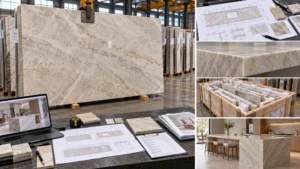
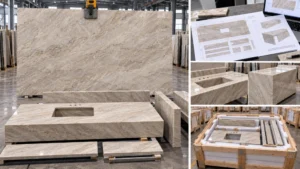
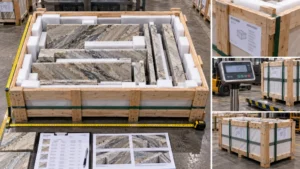
A useful Quartzite RFQ should tell the supplier exactly what is being priced. Before asking for a number, send the Natural Quartzite reference, current drawings, finished dimensions, quantities, thickness, finish, cutouts, edges, visual priorities, required supply scope, packing or logistics request, and delivery destination. Clearly mark anything that is still provisional. Better project inputs do not guarantee the lowest quotation, but they make different quotations much easier to compare on the same basis.
あ Quartzite RFQ template should do more than ask, “How much is this stone?”
For Natural Quartzite projects, price depends on what the supplier is actually being asked to provide. A slab-only enquiry, a fabricated kitchen package, a hotel vanity programme, and a multi-piece feature wall may use the same stone name but require very different quantities, layouts, processing, QC, packing, and logistics.
The purpose of the RFQ is therefore to convert a design idea into a reviewable quotation basis.
A strong RFQ should allow the supplier to understand:
What material? → What pieces? → What fabrication? → What visual priorities? → What delivery scope?
Before Asking for a Price: Check RFQ Readiness
Not every enquiry needs to be 100% finalized before pricing begins.
But the buyer should know which project inputs are confirmed and which are still assumptions.
RFQ Status
Typical Condition
How to Use the Price
Concept
Material direction and approximate scope only
Early budgeting
Developing
Dimensions and quantities available, some details open
Provisional quotation
Quotation Ready
Current drawings, piece scope and fabrication details substantially defined
Like-for-like supplier comparison
If important information is still unknown, do not invent it just to obtain a firm-looking total. Mark it as provisional and ask the supplier to identify the assumption used.
quartzite-rfq-template-before-asking-price
This is especially important when the final slabs, cutting layout, cutouts, edge details, packing or freight basis are still developing. Our guide to Quartzite provisional allowances explains why early pricing should remain traceable to the assumptions on which it was prepared.
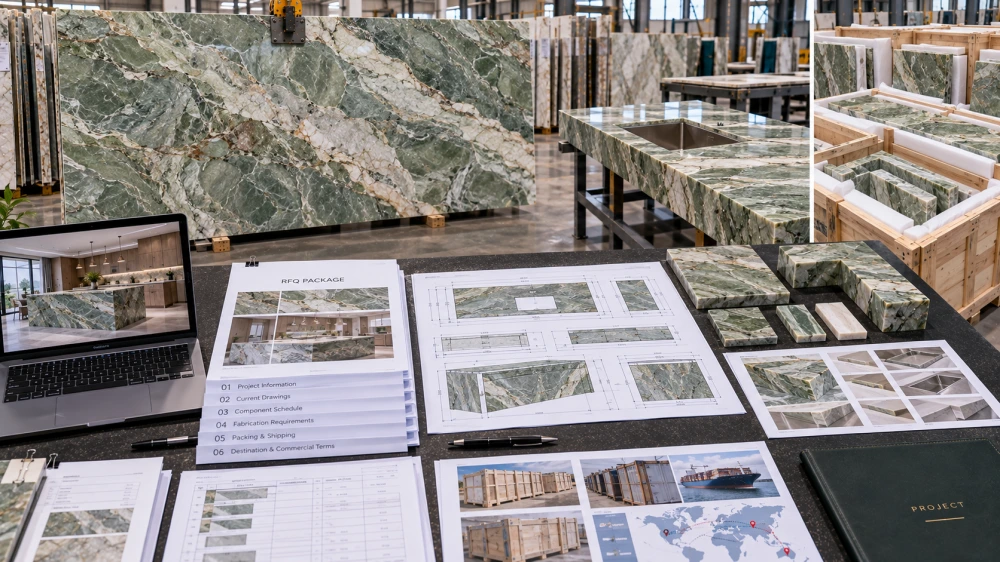
The 8-Part Quartzite RFQ Input Pack
A practical RFQ can be organized into eight information blocks.
01
素材参照
Natural Quartzite name, actual slab reference where available, visual grade or selection preference.
02
Application & Supply Form
Slabs, countertops, islands, vanities, wall panels, flooring, stairs, furniture or another defined scope.
03
Dimensions & Quantities
Finished dimensions, units, quantities, room or zone references and piece schedule.
04
Thickness & Surface Finish
Required project thickness and polished, honed, leathered or other specified finish.
Movement direction, feature areas, matching requirements, visible faces, seam priorities and slab-selection preferences.
07
Packing & Commercial Scope
Packing request, preferred quotation term, documentation needs and any specific QC requirements.
08
納品先
Destination port or delivery location so logistics can be discussed on the correct basis.
1. Identify the Natural Quartzite Clearly
Start the RFQ with the actual requested material.
Useful information may include:
Natural Quartzite trade name;
current slab reference or slab numbers where already selected;
reference photographs;
preferred visual range;
acceptable natural variation; and
any project sample already reviewed.
If actual slabs have not yet been selected, say so.
A supplier can then distinguish between:
Material Direction と Actual Slab Allocation.
This matters because the final project price can change when actual slab dimensions, usable areas and layout requirements become known.
2. Tell the Supplier What You Want to Buy
Do not send a stone name without defining the requested supply form.
例えば:
full slabs only;
サイズカット済みの部材;;
fabricated kitchen countertops;
waterfall island package;
vanity tops;
wall panels;
flooring pieces;
stair components; or
custom stone furniture.
The supply form changes the quotation substantially because it determines who is responsible for cutting layout, fabrication, QC and packing.
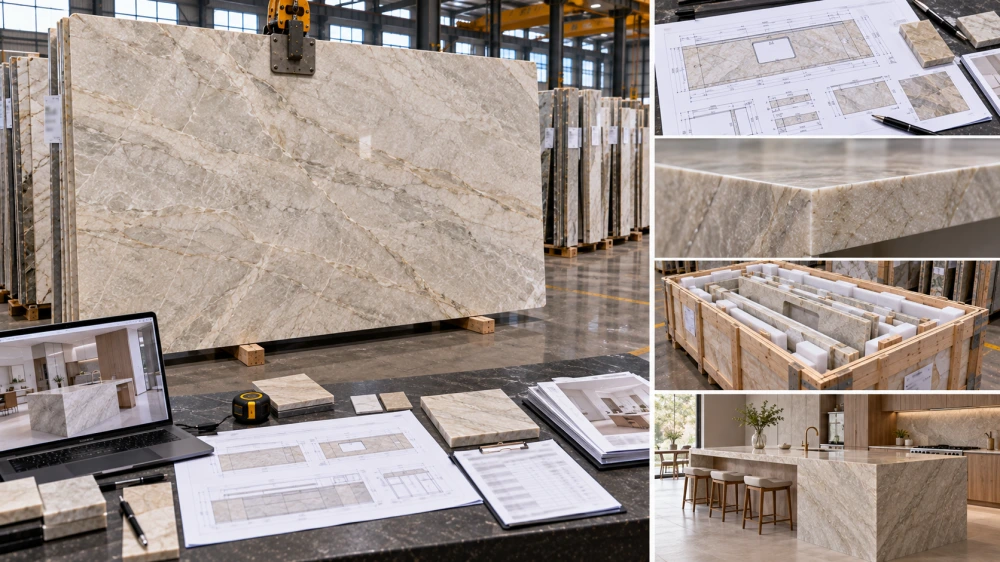
3. Attach the Latest Drawing, Not the Easiest Drawing to Find
The RFQ should identify the current drawing revision and issue date.
mont-blanc-quartzite-rfq-drawings-piece-schedule
Where relevant, include:
plans;
elevations;
sections;
countertop drawings;
wall elevations;
stair schedules;
detail drawings; and
piece schedules.
Attachment Stack
RFQ Brief
+ Current Drawing Revision
+ Finished-Piece Schedule
+ Material / Slab Reference
+ Finish Reference
+ Appliance / Sink Information where applicable
+ Destination & Commercial Request
A supplier should not have to combine dimensions from one drawing, edge details from an older PDF, and sink information from an unrelated message to reconstruct the quotation scope.
4. Give Finished Dimensions, Not Only Total Square Meters
Total area alone does not explain fabrication geometry.
For example, 12 m² of Natural Quartzite could represent:
several simple floor tiles;
one oversized island plus waterfalls;
multiple vanity tops;
long wall panels; or
a kitchen containing sinks, cooktops and backsplashes.
Those projects can require very different numbers of slabs even if their finished net area is similar.
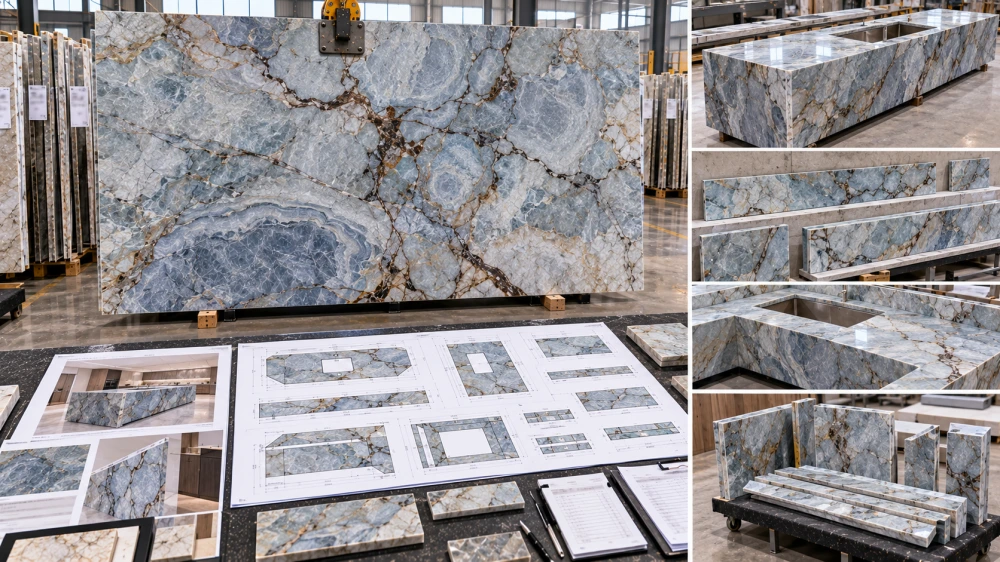
blue-roma-quartzite-rfq-finished-piece-dimensions
For cut-to-size work, send finished component dimensions and quantities wherever practical.
This also helps distinguish finished project area から 実際の板材消費量. Our usable area vs gross slab area guide explains why natural edges, layout priorities, cutouts and visual selection can reduce the amount of a slab available for a specific cutting plan.
5. State Thickness and Finish Explicitly
Thickness and finish should be written into the RFQ rather than inferred from website images or previous conversations.
For Natural Quartzite, the project may request:
polished;
honed;
leathered;
brushed; or
another project-specific finish.
If a finish sample has already been accepted, include its reference.
A phrase such as “same finish as the photo” is weaker than an identified project finish because screens, lighting and camera processing can alter appearance.
6. Make Every Cutout and Edge Visible in the RFQ
Fabrication details are among the most common reasons two apparently similar Quartzite quotations differ.
The RFQ should identify items such as:
patagonia-quartzite-rfq-cutouts-edge
undermount sink cutouts;
cooktop cutouts;
蛇口用穴;;
drain or accessory holes;
drainer grooves;
polished straight edges;
beveled or shaped edges;
45-degree miters;
waterfall panels;
積層エッジ;;
backsplash returns; and
special-shaped components.
If the exact sink, cooktop or edge profile is not yet confirmed, flag the item as pending rather than allowing it to disappear from the pricing discussion.
7. Explain What Matters Visually
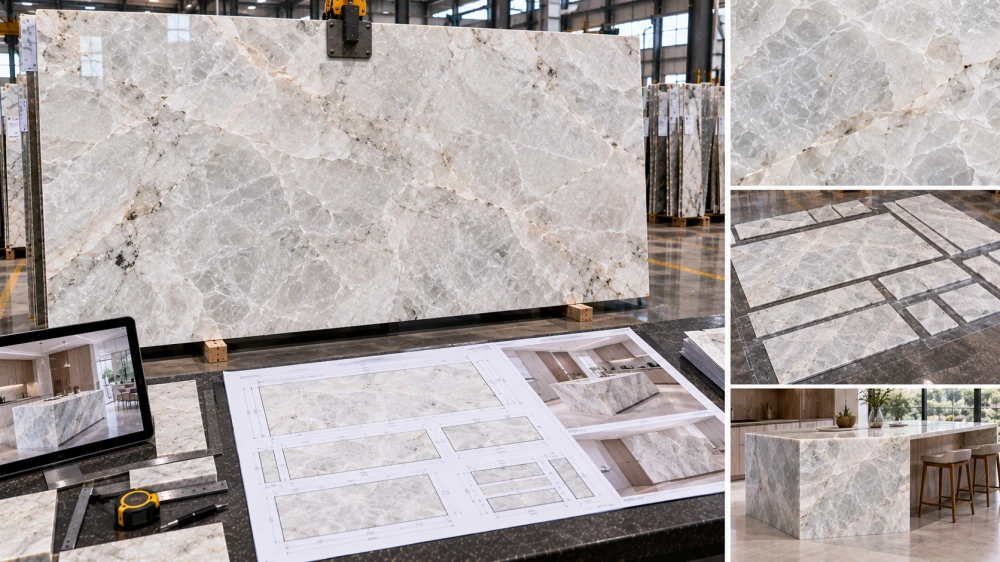
Natural Quartzite is not a uniform manufactured sheet, so visual priorities can affect slab selection and cutting yield.
cristallo-quartzite-rfq-visual-layout-priorities
The supplier should know when the buyer cares about:
strong vein or mineral movement;
a quieter island center;
waterfall continuity;
bookmatch or mirrored relationships;
directional movement;
matching several connected pieces;
avoiding a visually dominant fissure in a focal area; or
grouping several slabs with compatible tone.
These are not small aesthetic notes. They can change how the slabs are allocated and therefore change usable yield.
Visual Brief vs Fabrication Instruction
VISUAL BRIEFPrefer calm cream area on island center.
Keep stronger movement on waterfall.
Review actual slab layout before cutting.
FABRICATION INPUTIsland finished dimensions.
Waterfall orientation.
Approved seams, cutouts and edge geometry.
Both are important, but they answer different questions. A good RFQ keeps them connected without treating design preference as a technical fabrication dimension.
8. State the Delivery Destination Before Asking for Freight
If the buyer wants anything beyond material or FOB pricing, the destination needs to be clear.
Depending on the requested trade term, useful information can include:
destination port;
city and country;
complete delivery address where appropriate;
commercial term requested;
known access restrictions; and
whether the request is for port delivery or broader delivery scope.
Packing, cargo volume, gross weight and shipment timing may not yet be final when the first RFQ is sent. Keep those logistics figures separate from the confirmed stone and fabrication scope when they are still provisional.
What Information Can Stay Open?
An RFQ does not have to pretend that every project decision is complete.
A better approach is to show the missing information visibly.
Open Item
RFQ Treatment
Actual slabs not yet selected
Quote on stated provisional material basis
Sink model pending
Identify sink cutout as provisional
Edge profile undecided
State assumed edge basis separately
Final drawing pending
Mark quote as preliminary and identify drawing revision used
Final crate volume unknown
Keep freight or packing estimate provisional
Ask the Supplier to Return the Quote in the Same Structure
Sending a complete RFQ is only half of the process.
Ask the supplier to show enough structure in the response that you can understand what the price covers.
A useful response can separate:
材料
加工
梱包
運賃
除外事項
Open Items
This helps prevent a low headline number from being mistaken for a more complete project scope.
For kitchen projects in particular, our Quartzite countertop cost guide recommends comparing the same material, fabrication and installation layers rather than using one total without understanding the scope behind it.
Copyable Quartzite RFQ Template
Project / RFQ Reference:
[Project name or enquiry reference]
Natural Quartzite:
[Material name / slab reference if available]
Quotation Term Requested:
[EXW / FOB / CFR / CIF / DDP / Other agreed basis]
目的地:
[Port / City / Delivery Location]
Open Items:
[List anything not yet confirmed]
Please Confirm:
Material basis, included fabrication, exclusions, packing basis, freight basis where applicable, quotation validity, and any information required before the scope can be finalized.
A Photo-Only RFQ Is Usually Not Enough
A kitchen rendering or inspiration image can help the supplier understand the desired design direction.
But an image alone usually does not define:
finished dimensions;
piece count;
actual slab selection;
thickness;
cutout geometry;
edge profile;
waterfall construction;
packing scope; or
delivery terms.
Use inspiration images as supporting visual information, not as substitutes for project data.
RFQ Revision Rule
Once quotations are being compared, changes need to remain visible.
RFQ-01 → Initial pricing package
RFQ-02 → Revised sink + new island size
RFQ-03 → Final edge profile + confirmed destination
A revised RFQ should identify what changed instead of forcing the supplier to compare several conversations manually.
Before You Compare Two Quartzite Prices
Confirm that both suppliers responded to the same:
quartzite-complete-rfq-supplier-quotation-review
Natural Quartzite reference;
drawing revision;
finished dimensions;
quantity;
thickness;
finish;
cutout scope;
edge and miter scope;
visual layout requirement;
packing requirement;
trade term; and
destination.
If those inputs differ, the totals may describe two different projects even though both quotations use the same material name.
よくある質問
1. What should a Quartzite RFQ include?
A Quartzite RFQ should include the Natural Quartzite reference, requested supply form, current drawings, finished dimensions, quantities, thickness, surface finish, fabrication details, visual priorities, packing or commercial requirements, destination, and any open items.
2. Can I ask for a Quartzite price before the final slabs are selected?
Yes. The supplier can provide preliminary or provisional pricing when the basis is clearly stated. The price may need review after actual slabs, usable yield, fabrication details, packing, or other project inputs are confirmed.
3. Do I need shop drawings before requesting a Quartzite quotation?
Not always. Early budgeting can begin from preliminary drawings and dimensions, but a detailed cut-to-size or fabrication quotation becomes more reliable when current piece geometry, cutouts, edges, and other fabrication information are available.
4. Is total square meterage enough for a Quartzite RFQ?
Usually not for fabricated work. Finished piece sizes, geometry and quantity help the supplier evaluate slab consumption, cutting layout and fabrication complexity more accurately than net square meterage alone.
5. Should sink cutouts and edge profiles be included in the RFQ?
Yes. Identify every known sink or cooktop cutout, faucet hole, edge profile, miter, waterfall and special fabrication detail. If a detail is not yet final, mark it as provisional.
6. Should I include the delivery destination in the first RFQ?
Yes, especially if you want packing, freight or a delivered commercial term reviewed. At minimum, provide the destination port or relevant delivery location so the logistics discussion uses the correct project basis.
7. What should I send HRST STONE to receive a project quotation?
Send the Natural Quartzite name, latest drawings, finished dimensions, quantities, thickness, surface finish, cutout and edge requirements, visual priorities, desired supply scope, packing or trade-term request, and delivery destination. Clearly identify any item that is still awaiting confirmation.
Final RFQ RuleBefore asking for a Quartzite price, make sure the supplier can identify what material is being priced, what finished scope is required, which drawing revision applies, what fabrication is included, what remains provisional, and where the order needs to go. The more clearly those inputs are separated, the easier it becomes to compare quotations without confusing a lower scope with a lower price.
HRST STONE can review Natural Quartzite enquiries for slab supply, cut-to-size components, countertops, islands, vanities, wall panels, stairs and other custom stone work. Send Josh the current RFQ package with material references, drawings, dimensions, quantities, finish, fabrication details, visual priorities and destination so the quotation can be structured around the actual project scope.
Hi, I am the author of this article. I have been working in the field of Natural Stone for more than 15 years. If you need customized Natural Stone services, please feel free to contact me.