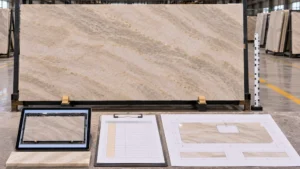
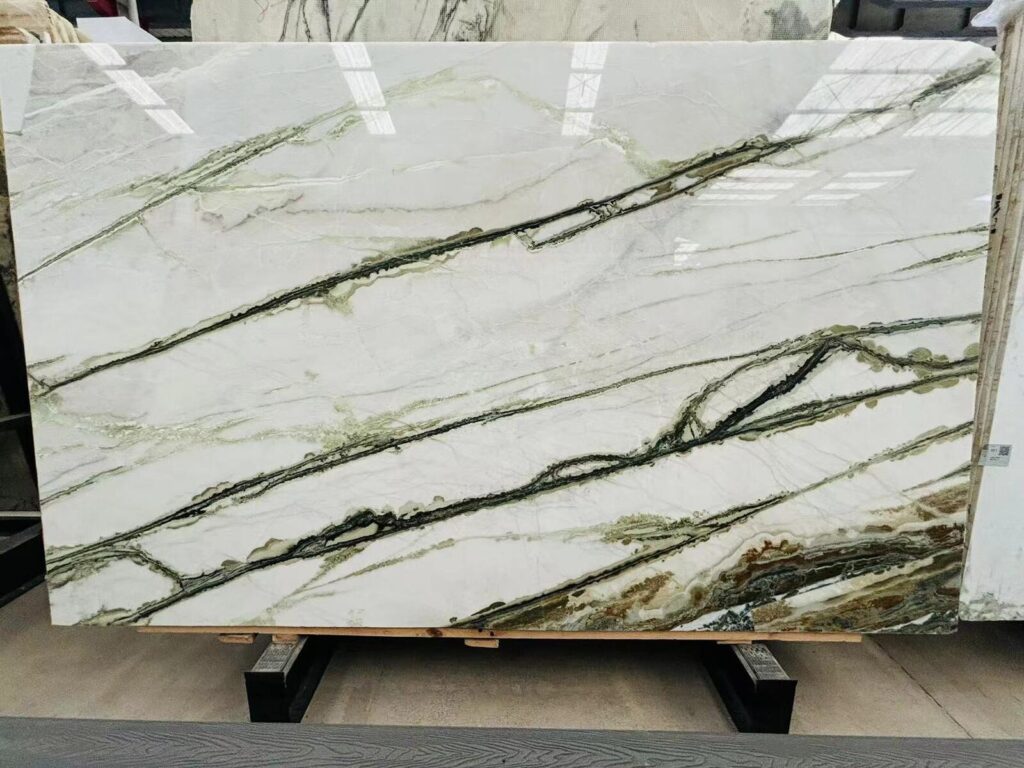

丸型の天然クォーツァイト製ダイニングテーブルは、一つの大きな地質学的構成を作り出すことができます。.
中央に石製のラジオスーサンを追加すると、視覚的な問題が変化します。.
これで見えるクォーツァイト表面は2つになります:
固定されたダイニング天板
と
回転するラジオスーサン。.
最初は、デザインが単純に思えるかもしれません。.
同じクォーツァイトを使用します。.
中央に小さな円形の石材部材を配置します。.
脈理を合わせるように努めます。.
しかしラジオスーサンは回転します。.
ある位置では外側の天板と見事に一致する鉱物帯も、四分の一回転した後には全く異なる方向を指していることがあります。.
石材そのものは変わっていません。.
このように、2つの見える構成間には相互関係があります。.
これが、背後にある核心的な問題です。 ラジオスーサン付きクォーツァイト製ダイニングテーブル:2つの見える表面をマッチングさせる.
したがって正しい設計上の問いは次の通りです:
“「2つの部分は完璧に一致できるか?」”
正しくは以下のとおりです:
“「メインの天板と回転する中心部は、ラジオスーサンが向きを変えても視覚的に調和し続けられるか?」”
最初の誤りは、ラジオスーサンをダイニング天板のデザインが完了した後に追加される小さなアクセサリーのように扱うことでした。.
天然クォーツァイトから作られる場合、それはもう一つの非常に目立つ石材表面となります。.
外側のダイニング天板は次のような特徴を保つ可能性があります:
そのサイズゆえに、メインテーブルは数メートル離れた場所からでも一つの完全なパターンとして読み取ることができます。.
中心部の部材はより小さいです。.
そのためそのパターンは別のスケールで読み取られます。.
メイン天板全体でバランスが取れていると感じられる地質的特徴も、小さな回転ディスク内に孤立すると過度に支配的になってしまうことがあります。.
逆に、静かなスラブエリアはラジオスーサン上で非常にうまく機能します。なぜなら、より大きな外側の天板が視覚的な焦点であり続けることができるからです。.
ラジオスーサンには依然として独自の整合性のある構成が必要です。.
問う:
関連する クォーツァイトの模様スケール:室内距離での板材の読み取り ガイドラインはより広範な原則を説明しています:関連するパターンとは、元のスラブ上に見えるすべての地質ではなく、完成品の輪郭内に残存するパターンのことです。.
メイン天板=一つの完成したクォーツァイト構成。ラジオスーサン=第二の完成したクォーツァイト構成。まず両者を個別に承認し、その後両者がどのように連携するかを承認してください。.
“「ラジオスーサンをテーブルに合わせる」という表現は製作には曖昧すぎます。.
考えられる設計意図はいくつかあります。.

メイン天板とラジオスーサンは、寸法と有効面積が許す限り、同一の選定スラブ内に配置されます。.
これにより、2つの部材が共有できるものが生じます:
恒久的な脈の連続性を確保する必要はありません。.
大型テーブルの場合、家具一式には複数のスラブが必要となるか、別の関連板材から中央部材を使用することがあります。.
その際は、互換性のあるスラブを選択してください:
商業用石材名がこの関係性を保証するものではないと認識してください。.
プロジェクトでは、ラージーサスーン上の主要な鉱物帯が外側の天板に対応する特定の基準位置を意図的に選択することがあります。.
これにより、写真撮影時や初期配置時に強い印象を与えることができます。.
ただし、デザインチームは以下の点を理解しておく必要があります:
センターが回転すると、その整合性は変化します。.
したがって、ホームポジションはあくまでプレゼンテーション上の参考であり、恒久的な視覚的条件ではありません。.
一部のデザインでは、意図的にセンター部分に穏やかまたは劇的な石のゾーンを設けることがあります。.
例えば:
外側天板: 活発な地質活動が広範に見られる領域。.
ラージーサスーン: より静かな中央部のフィールド。.
あるいはその逆。.
この違いが偶然ではなく意図的であるように見える場合、効果的に機能します。.
| マッチング戦略 | 主な目標 | 重要な制約 |
| 同一スラブの調整 | 共通の色調と地質的特徴 | 回転によってパターンの整合性は依然として変化する |
| 関連スラブ | 色とパターンの強度を調整する | 商標名だけでは一致が成立しない |
| ホームポジションの整合 | 一つの好ましい初期構成を作成する | センターの回転に伴い整合性は変化する |
| 意図的なコントラスト | センターと外側表面を明確に区別しつつ関連付ける | すべての向きにおいて、その違いが意図的であるように見えるべきである |
これはプロジェクト全体で最も重要な視覚的事実です。.
メイン天板は固定されたままです。.
ラージーサスーンが回転します。.

メイン天板を左から右へ横切るコーヒー色の鉱物帯を想像してください。.
好ましいホームポジションでは、ラージーサスーン内に同じ方向へ続く関連するラインが含まれているかもしれません。.
センターを九十度回転させます。.
内側の鉱物ラインは今や外側の動きに対して垂直になっています。.
さらに回転させます。.
関係性は再び変化します。.
これはレイアウトが失敗したことを意味するわけではありません。.
プロジェクトにおいて、成功を恒久的なベインの連続性として定義すべきではないということです。.
目視承認時には、少なくともいくつかの代表的な向きを確認してください。.
例えば:
目的は、普遍的な角度試験基準を作ることではありません。.
開始時の構成からずれた状態でも、センターピースが依然として意図的に見えることを確認することです。.
ラージ・スーザンは、製造時に特定の向きが決められている場合があります。.
しかし設置後は、ゲストが自由に回転させることができます。.
したがって、正確に一つの方向に向かないと機能しないような、見た目に不自然な特徴は配置しないようにしてください。.
クライアントが希望するプレゼンテーションがある場合は、図面または仮組み記録上に参照となる向きを明示してください。.
これにより以下が容易になります:
ただし、ラージ・スーザンが回転部品であることを明確に記録してください。.
パターンの連続性は、一つの参照位置で確認できます。パターンの互換性は、回転全体にわたって確保しなければなりません。.
石材レイアウトには、ダイニングテーブルパッケージ全体を含める必要があります。.
まず外側の天板を選定し、残りのスラブからラージ・スーザンを探すようなやり方は避けてください。.

実際のスラブ画像または物理的なスラブレイアウト上で、次を表示します:
メインテーブルの輪郭+ラージ・スーザンの輪郭+パターンの方向+重要な自然特徴。.
これにより、デザイナーは材料投入前に二つの構成がどのように関連しているかを評価できます。.
スラブ歩留まりが許す限り、現実的なラージ・スーザンのクロップオプションをいくつか作成してください。.
例えば:
オプションA — 静かなセンターフィールド。.
オプションB — 完全なフォーカルフィーチャー一つ。.
オプションC — より強い高コントラストの鉱物ムーブメント。.
各オプションを同じ外側天板レイアウトと照らし合わせて検討してください。.
最終的に見える円形の境界線は、承認済みのエッジプロファイルと製作された直径に依存します。.
もし好ましいベインがその境界線に極めて近い位置にある場合、エッジ処理後に視覚的に完全な状態を保つかどうかを確認してください。.
二つの大きな円形ピースは、利用可能なスラブ面積を大きく消費する可能性があります。.
最も視覚的に魅力的なセンターカットは、歩留まりを低下させたり、他の重要なプロジェクトコンポーネントと競合したりする恐れがあります。.
したがって、ビジュアルレイアウトと商業的な材料利用率は、順番ではなく同時にレビューされるべきです。.
例えば:
T01 — メインダイニングテーブル天板
LS01 — レイジースーザン
両方のIDは以下に引き続き接続されている必要があります:
の Quartzite Vein Direction Symbols for Shop Drawings ガイドでは、視覚的な方向性を孤立した矢印に頼るのではなく、識別可能な部材や実際のスラブ配置に結び付けておくべき理由が説明されています。
すべてのレイジースーザンが同じ方法でテーブルに組み込まれるわけではありません。
石材のエッジとセンターの関係が承認される前に、家具の構造を確定しておく必要があります。

一般的な視覚的構成の一つでは、回転する石材ディスクが隠された回転機構の上にメインテーブル天板の上方に設置されます。
その下の外側のテーブル天板は完全な石材面として残ります。
このアプローチにより、以下の点に関する疑問が生じます:
別の設計では、回転センターを円形の開口部または凹状の領域内に配置することもあります。
これは非常に異なる製作条件です。
プロジェクトは次を検討しなければなりません:
突き出し型レイジースーザンの詳細をそのまま埋め込み型デザインに移行してはいけません。
一部のコンセプトでは、デザイナーがセンターの円形エリアをメインテーブル天板から取り外し、回転部品として再利用できることを期待することがあります。
これが実用的かどうかは、次の要因に依存します:
たとえ関連する石材が保持されていても、仕上げエッジ、クリアランス、その後の回転によって視覚的関係が変化するため、正確なシームレスな連続性は保証できません。
テーブルのセンターにはパターン上の関係以上のものがあります。
そこにはエッジの関係も含まれています。
このエッジは、食事をする人が座った際に目の高さ近くに位置するため、非常に目立つ場合があります。
レビュー:
If the centre is recessed into the table, the main tabletop may also contain a visible circular internal edge.
This creates two adjacent worked stone edges.
Their finish and visual relationship should be reviewed together.
A rotating component generally requires a defined relationship with the surrounding fixed surface.
The exact clearance should come from the approved furniture and hardware design.
This article does not prescribe one universal gap dimension.
From a visual perspective, review whether the gap reads as:
A cut and polished Natural Quartzite edge exposes the stone through another plane.
It may therefore read differently from the broad horizontal polished face.
Review an actual worked sample or first fabricated piece rather than assuming the circular edge will look identical to the tabletop face.
The Lazy Susan must rotate smoothly while supporting its actual stone component and normal table use.
The stone supplier should not invent the hardware specification from the word “Lazy Susan.”
The furniture designer or responsible hardware supplier should confirm the selected mechanism.
関連情報には以下が含まれる場合があります:
Different rotating mechanisms have different capacities, construction, mounting points and operating behaviour.
The current product documentation for the actual selected fitting should govern the hardware side of the design.
Confirm how the complete furniture assembly carries:
This article deliberately does not prescribe universal stone thickness, bearing capacity, pedestal size or fixing spacing.
Those decisions belong to the actual furniture design and selected hardware system.
If adjustment, replacement or fastening of the rotating mechanism may be required, the table design should account for appropriate access.
Do not approve a beautiful stone configuration that makes the hardware impossible to assemble or service.
の ブルーローマクォーツァイトテーブル page follows the same broader furniture principle: actual slab layout, finished dimensions, edge, base, support, fabrication and trial assembly should remain connected before production.
Even when both pieces come from one slab, they may not always appear identical.
A polished main table reflects:
The Lazy Susan may reflect the same room from a slightly different height or angle.
Its appearance can therefore shift as it rotates.
A honed finish usually creates a softer reflected-light response.
Pattern and colour still vary naturally, but reflections may be less sharply defined.
Neither finish is universally better for this furniture type.
The physical Natural Quartzite pattern rotates with the Lazy Susan.
So do the directions from which its polished surface receives and returns reflected light.
A dark-looking area seen from one position may become brighter after the disc turns.
A pendant or chandelier directly above the dining table may create a strong central highlight on the Lazy Susan.
This means a centre sample should be reviewed under representative dining-room lighting rather than only warehouse ceiling light.
Dining furniture is often viewed:
The same stone relationship may read differently from each position.
A Quartzite table with a stone Lazy Susan combines natural-stone fabrication and moving furniture hardware.
A final trial assembly is therefore highly useful.
確認事項:
確認事項:
The final visual review should occur with the rotating centre in its actual position above or within the dining table.
This reveals conditions that isolated stone pieces cannot show.
Confirm that:
If a preferred reference orientation has been approved, mark or document how that position is established during final handover.
Again, this is a presentation reference.
It does not create permanent vein continuity.
□ 実際の天然クォーツァイトが特定されている。.
□ Main tabletop finished shape and dimensions confirmed.
□ Lazy Susan finished diameter and construction confirmed.
□ Raised / surface-mounted / inset condition clearly defined.
□ Main tabletop and Lazy Susan templates positioned on actual slab references before cutting.
□ Matching strategy defined: same-slab, related, home-position alignment, or intentional contrast.
□ Pattern balance reviewed with the Lazy Susan in several rotational positions.
□ Finish confirmed for both stone surfaces.
□ Outer table edge approved.
□ Lazy Susan edge approved.
□ Internal circular edge reviewed where an inset system is used.
□ Gap / reveal defined by the furniture and hardware design.
□ Rotation mechanism identified from current product information.
□ Base, support and fixing interface coordinated.
□ Trial assembly completed where required.
□ Preferred home orientation recorded where applicable.
□ Final QC connects the physical stone pieces to the approved slab layout.
□ Packing protects both circular stone edges and keeps the rotating component controlled during transport.
A strong approval record might say:

“Main tabletop T01 and Lazy Susan LS01 approved from the identified Quartzite slab layout. Both pieces are coordinated for background tone, mineral character and pattern intensity. LS01 has a preferred home orientation shown on the current furniture drawing, but pattern continuation is understood to change during normal rotation.”
これは、次のような記述よりもはるかに正確です:
“Match Lazy Susan veins to table.”
The complete approval sequence can be:
Furniture Design → Main Top Geometry → Lazy Susan Geometry → Actual Slab Selection → Two-Piece Layout → Matching Strategy → Edge / Gap → Rotation Hardware → Base / Support → Fabrication → Trial Assembly → Rotation Review → Final QC → Packing.
For Natural Quartzite furniture, the goal should not be artificial perfection.
The goal is a controlled relationship between two natural surfaces that remains convincing as the centre performs its real function.
必ずしもそうではありません。通常、目的とするプロジェクトに応じて両面を調整する必要がありますが、ラジアス・スーザンは回転するため、正確な木目や模様の連続性を固定することはできません。代わりに、背景の色調、地質的な特徴、模様の濃淡、仕上げの質感、視覚的重量感などを基準に合わせることが一般的です。なお、プロジェクトによっては、開始時の基準となる位置を別途設定することも可能です。.
スラブのサイズ、有効使用面積および切断配置が許す場合には、同一のスラブを用いることで、色調や地質的特徴の統一を図ることができます。ただし、必ずしも必要であるとは限りませんし、実現できない場合もあります。また、製造前に各スラブの実際の外観を総合的に検討したうえで、関連するスラブを組み合わせて使用することも可能です。.
そう決めつけてはいけません。切断時のキルフ、仕上げ後の直径、必要なクリアランス、エッジの仕上げ状態、石材の状態、支持具や回転用金具など、さまざまな要素がこの手法の実用性に影響を及ぼします。適切な加工業者および家具デザイナーは、実際に加工する前に具体的な形状を十分に検討すべきです。.
設計意図がそれに合致し、選択されたスラブ配置がそれをサポートしている場合、それらは可能です。ただし、レイジースーザンが回転すると、その関係性は直ちに変化します。したがって、ホームポジションでの位置合わせは、恒久的な連続性の条件というよりも、承認済みの一つの表示状態として扱うべきです。.
両システムはそれぞれ異なる製作上の課題や家具設計上の問題を生じるため、本稿ではいずれか一方が普遍的により容易であると評価することは行わない。浮き上がった中央部はメインの天板を視覚的に連続性高く見せる一方で、高さや下面、支持構造の隠蔽といった課題をもたらす。一方、埋め込み式の中央部は円形の開口部や隣接する加工された端部、クリアランス、支持構造および金具の整合性といった要素を新たに考慮しなければならない。.
メインの天板とセンターピースを一緒に確認し、模様の対応関係、エッジの品質、仕上げ、見える隙間、金具の動作、クリアランス、支持状態、複数の回転位置、および承認済みの設置方向について点検してください。最終的な試験では、実際の家具を承認済みの図面およびスラブ配置に照らして照合する必要があります。.
ジョシュに、提案した天然クォーツァイト素材、入手可能な場合のスラブ参照資料、ダイニングテーブルの図面、天板の主要形状および仕上げ後の寸法、レイジースーザンの直径と意図する浮き出しまたは埋め込み状態、数量、仕上げ、エッジプロファイル、希望する模様の配置関係、ベースおよびサポートの図面、提案された回転用金具の情報、ホームポジションの要件(ある場合)、納品先、および梱包前の試験組み立ての必要有無を送付してください。.
For custom Natural Quartzite dining tables with Lazy Susans, HRST STONE can coordinate actual slab selection, full-slab photographs, main-top and centre-disc CAD templates, two-surface pattern layouts, edge samples, visible-gap review, furniture-base coordination within the confirmed stone scope, fabrication QC, trial assembly, piece identification, protective packing, and export documentation. Send Josh the table drawing, Quartzite selection, finished dimensions, Lazy Susan design, finish, edge profiles, base information, rotating-hardware reference, quantity, pattern priorities, and destination before final fabrication release.