簡単なまとめQuartzite Bevels vs Rounded Edges should be compared on actual worked samples made from the same Natural Quartzite, with the same stone thickness and intended surface finish wherever practical. A bevel introduces a separate flat facet between the countertop face and vertical edge, creating a defined highlight and shadow line. A rounded profile replaces that sharp transition with curvature, so reflected light moves continuously across the edge and the stone can appear softer or visually different in thickness. Neither profile is universally better. Review the actual profile geometry, face-to-edge colour, natural mineral features, sheen, external corners, underside transition, touch, cleaning, lighting, and finished application before approving fabrication. Terms such as “bevel” and “rounded” are not precise enough on their own; the drawing and physical sample should define the edge that production must reproduce.
A Quartzite countertop is approved.
The slab looks right.
The colour is right.
The finish is right.
Then one final design question remains:
Should the exposed edge be beveled or rounded?
On a CAD section, the difference can look small.
One profile uses a flat angled facet.
The other uses a curve.
But once the profiles are fabricated into Natural Quartzite, the difference becomes much more than geometry.
The bevel creates additional visible planes.
The rounded edge bends reflected light continuously.
The same mineral feature can look different as it crosses from the broad top onto either profile.
The edge can appear visually thinner, heavier, sharper, softer, brighter, darker, or more sculptural depending on the stone, profile, finish, lighting, and viewing angle.
This is the real issue behind Quartzite Bevels vs Rounded Edges: Comparing the Actual Sample.
The useful question is not:
“Which edge profile is better?”
正しくは以下のとおりです:
“Which actual worked profile produces the intended appearance and touch in this specific Quartzite and this specific finished component?”
Edge-profile names can create false confidence.
Two people may both request a “rounded edge” while imagining noticeably different geometries.

A bevel removes the sharp transition between two surfaces and replaces it with a flat secondary facet.
The finished edge therefore contains several visual planes:
Top Face → Bevel Facet → Vertical Edge Face
The bevel geometry should be defined on the current drawing.
Relevant information can include:
Do not assume every bevel uses the same dimensions.
“Rounded” is a broad description rather than one exact profile.
Depending on the project, it may refer to:
The production drawing should show the intended geometry.
If the visual difference matters, approve a physical sample.
“Beveled edge” and “rounded edge” are useful design descriptions.
They are not complete manufacturing instructions.
A controlled fabrication record should connect:
Profile Name → Section Drawing → Actual Stone Thickness → Surface Finish → Visible Faces → Corner Detail → Approved Sample.
Edge Definition Rule
Do not approve “bevel” or “rounded” as words alone. Approve the actual section geometry and the physical edge result that production is expected to reproduce.
The physical stone thickness can remain unchanged while the edge makes the countertop appear visually different.
A bevel divides the edge transition into clearly readable planes.
Depending on its geometry and lighting, the facet may:
A relatively restrained bevel can make a countertop feel precise and linear.
A more visually pronounced bevel can become an obvious part of the design.
A curved profile does not create one distinct flat facet.
Instead, the surface turns continuously from horizontal toward vertical.
This can make the transition appear softer.
But “softer” does not automatically mean visually lighter.
A large curved profile may also make the stone edge feel substantial and sculptural.
Do not look only at the upper few millimeters of the sample.
レビュー:
The related クォーツァイト製キッチンカウンタートップに最適な厚みとエッジの仕上げ guide explains the broader relationship between slab thickness, edge profile, visual weight, support, and fabrication approval.
| Review Area | Bevel | Rounded Profile |
| 幾何学 | Distinct flat secondary facet | Continuous curved transition |
| Visual line | More defined transition lines | Softer continuous outline |
| Reflection | Facet can create a distinct highlight or shadow | Highlight moves across the curved surface |
| Pattern reading | Stone feature is divided across several planes | Stone feature follows a changing curved viewing plane |
| Approval control | Facet width, angle, finish and corner continuity | Radius/profile shape, finish and corner continuity |
Edge geometry changes how light reaches the stone.
This is one reason CAD drawings cannot fully predict the finished appearance.
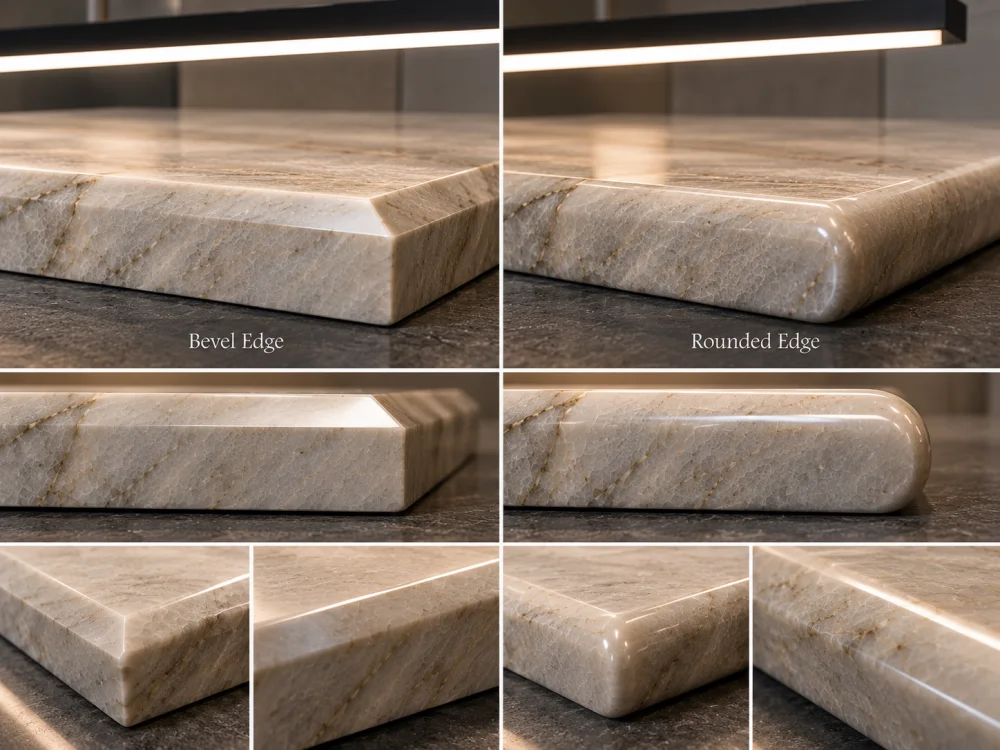
On polished Quartzite, the bevel facet may catch a separate reflection from the top and vertical face.
From one angle, it may appear bright.
Move slightly and it may become darker.
The bevel can therefore create a deliberate line of contrast along a long island or countertop.
A curved edge presents many slightly different surface angles.
As the viewer moves, the reflected highlight can travel across that curve.
This may create a smoother transition than the bevel, but it can also make local mineral structure more visible from particular angles.
A polished edge creates stronger reflected highlights.
A honed edge generally produces a softer reflected response.
The comparison should therefore use the actual intended finish.
Do not approve a polished bevel against a honed rounded sample unless the finish difference is intentionally part of the decision.
Compare both samples from:
The same profile can look substantially different depending on where the observer stands.
の クォーツァイトスラブの直立と平置きの比較:なぜ見え方が変わるのか guide explains the broader principle: the Natural Quartzite may remain unchanged while viewing plane, reflected surroundings, light direction, and observer position change the visual reading.
Lighting Comparison
Same Quartzite + Same Finish + Different Edge Geometry = Different Reflection. Compare bevel and rounded samples under the same light before deciding that one profile makes the stone inherently lighter or darker.
Natural Quartzite contains three-dimensional geological structure.
A profiled edge exposes that structure from different directions.

Imagine a grey mineral band reaching the front edge of the countertop.
On a bevel, the band can appear across:
Top Face → Flat Bevel Facet → Vertical Front Edge.
The three surfaces may reflect light differently, making one geological feature appear visually segmented even though it remains physically continuous.
On a curved edge, the mineral feature crosses a continuously changing surface angle.
Its apparent width, contrast, and direction may therefore change as it wraps around the profile.
From some viewpoints, part of the vein may become visually compressed or emphasized by reflection.
A crystalline zone can react differently from a quieter mineral field when the edge is shaped and polished.
Do not assume that a profile sample made only from the quietest area of the slab proves how a strong mineral transition will look.
High-contrast dark lines can become particularly important on a shaped edge because a small amount of stone may dominate the narrow visible profile.
Where the project has prominent edge visibility, overlay the countertop outline and edge position on the actual slab.
The broad polished countertop face and the shaped edge are not two different materials.
They are different views through the same three-dimensional Natural Quartzite.
That means face-to-edge colour and mineral appearance may not be identical.
の Natural Quartzite vs Engineered Quartz for an Undermount-Sink Detail guide explains the same principle for visible sink edges: the fabricated Natural Quartzite edge exposes the geological material through its thickness and should be reviewed as a worked surface rather than inferred only from the top face.
Profile shape and finishing quality are two different decisions.
A project can prefer the geometry of one sample but prefer the polish quality of another.
Do not combine these observations into one vague comment such as:
“The rounded edge looks better.”
Compare whether the profile has the intended relationship with the countertop face.
Look for:
Curved and beveled profiles may require different shaping and finishing sequences.
The final approved sample should represent the finished fabrication condition rather than an intermediate machining stage.
A profiled surface may appear lighter or darker because of:
Do not diagnose every edge colour difference as a polishing defect.
If an exposed edge looks lighter than the broad slab face, do not automatically assume that a colour-enhancing treatment is the correct solution.
First identify whether the difference comes from finish, reflection, stone structure, an existing slab treatment, or another factor.
Any treatment should be evaluated on the actual stone and according to the relevant product guidance.
A straight edge sample answers only part of the profile question.
If the finished countertop contains exposed outside corners, the sample should address those corners too.

A bevel creates defined transition lines.
At an outside corner, those lines must resolve around the geometry.
Review whether:
A rounded front profile meeting a rounded plan corner can create a more complex three-dimensional surface than a straight section suggests.
The light moves across both the edge radius and the plan-view corner.
This can make corner finishing especially visible.
If the project contains highly visible corners, use either:
Approval should reflect the geometry that will actually exist.
Beveled and rounded profiles are used on many types of Natural Quartzite components.
The preferred profile can depend on where the edge is located and how people interact with it.
A long island edge is visually prominent.
A bevel can create a continuous architectural shadow or highlight line.
A rounded profile can create a softer continuous transition.
Review both from the room approach and seating side.
Perimeter edges may be visually interrupted by appliances, corners, sinks, and cabinetry.
The profile may therefore read less continuously than on an island.
A vanity edge is typically viewed from relatively close range.
Touch, edge finishing, mineral detail, and the relationship to basin geometry can become important.
On tables, consoles, side tables, and bedside furniture, the edge can become one of the defining furniture details.
A rounded profile may reinforce a softer furniture geometry, while a bevel can emphasize a more architectural character.
These are design tendencies rather than universal rules.
Edge geometry around an undermount sink is a separate condition from the exposed outside countertop edge.
Do not automatically transfer the same profile to both locations without confirming the drawing.
Impact behavior depends on:
A procurement article should not claim that rounded Quartzite edges cannot chip or that beveled edges are inherently fragile.
The appropriate profile should be reviewed for the actual component.
Edge profiles are touched frequently.
This is especially true at:
A drawing cannot reproduce tactile perception.
Run a hand across the transition between:
Top Face → Profile → Vertical Edge.
Check whether the transition matches the intended design character.
The underside or lower profile may be visible or reachable depending on the component.
A beautifully finished top transition with an unresolved lower edge can still feel incomplete.
Both bevels and rounded profiles can be maintained when properly fabricated and finished.
Do not invent a universal statement that one profile is maintenance-free or always easier to clean.
Instead, test the physical sample using the approved care method and look for:
These observations assess fabrication quality rather than declaring one geometry universally superior.
A useful comparison controls unrelated variables.
Where practical, both samples should come from the same stone selection and visually comparable mineral zones.
If the bevel sample uses one stone thickness and the rounded sample another, apparent thickness cannot be attributed only to profile geometry.
Compare polished with polished or honed with honed unless finish itself is also being tested.
The sample should be long enough to show:
A tiny profile chip may show the section but not the finished visual effect.
Place the samples side by side and compare them under the same:
| レビュー項目 | Bevel Sample | Rounded Sample |
| Apparent thickness | 観察結果を記録する; | 観察結果を記録する; |
| Highlight / shadow | Record facet behavior | Record curved reflection |
| Face-to-edge colour | Record relationship | Record relationship |
| Mineral / vein reading | Record across facet | Record across curvature |
| Sheen / polish | Accept / adjust / review | Accept / adjust / review |
| Touch | Record transition | Record transition |
| Outside corner | Review line continuity | Review compound curvature |
Controlled Edge Comparison
Same Quartzite → Same Thickness → Same Finish → Same Lighting → Bevel Sample vs Rounded Sample → Straight Section → Corner → Touch → Reflected-Light Review → Defined Approval.
The physical sample has value only if production can be compared back to it.
Identify the sample with enough project information to prevent confusion with another profile.
The record may include:
A short sample may look consistent while a long countertop reveals profile variation.
Final QC should review the complete visible edge, not only one selected close-up.
If the production edge crosses several natural Quartzite zones, compare how the profile behaves across those changes.
Do not expect every mineral area to look artificially identical.

Photograph important outside corners where the profile changes direction.
Include:
A previous edge approval should be reconsidered if:
□ Actual Natural Quartzite identified.
□ Stone thickness confirmed for the compared samples.
□ Surface finish identical or intentionally different and recorded.
□ Bevel section geometry shown on current drawing.
□ Rounded profile geometry shown on current drawing.
□ Face-to-edge colour relationship reviewed.
□ Sheen and reflected-light behavior compared.
□ Natural veins / mineral zones reviewed across both profiles.
□ Outside corner condition included where relevant.
□ Lower / underside transition reviewed where visible or touchable.
□ Samples reviewed clean and dry under the same lighting.
□ Touch and normal cleaning interaction checked.
□ Approved physical sample retained or documented.
□ Production pieces linked to the approved profile revision.
□ Re-review trigger defined if stone, finish, thickness, or profile changes.
Neither profile is universally better. A bevel creates a distinct secondary plane and more defined transition lines, while a rounded profile creates continuous curvature and a moving reflected highlight. The better choice depends on the actual Quartzite, thickness, finish, component, design intent, touch preference, lighting, and approved worked sample.
The term is too broad to define fabrication by itself. It may refer to a small pencil round, a larger radius, partial bullnose, full bullnose, or another custom curved profile. The project drawing and physical sample should define the intended section geometry.
It can alter perceived thickness because the bevel divides the front edge into separate visual planes and may create a highlight or shadow line. The actual effect depends on bevel geometry, stone thickness, finish, lighting, mineral pattern, and viewing angle. Compare the physical sample rather than assuming the result from the section drawing alone.
A rounded profile presents the stone through a continuously changing surface angle. As a mineral band wraps around the curve, reflected light and viewing direction change, so its apparent width, colour depth, and contrast may look different from the broad flat countertop face.
Where the design intends one continuous finish relationship, the worked edge should be reviewed against the approved top finish. Profile geometry can still make sheen and colour appear different because the surface angle changes. Approve the actual edge rather than relying only on the finish name.
Do not apply a universal claim. Impact response depends on the actual stone, profile geometry, thickness, mineral structure, fabrication quality, support, use, and impact location. The responsible fabricator should review the proposed edge for the actual component rather than promising that one profile is chip-proof.
Send Josh the proposed Natural Quartzite material, current slab references where available, countertop or furniture drawings, finished dimensions, stone thickness, quantity, intended surface finish, the bevel section under consideration, the rounded profile under consideration, visible corners, sink or other openings where relevant, important viewing directions, lighting context, and delivery destination. Identify whether physical worked samples are required before production release.
Edge Profile Approval SummaryA bevel-versus-rounded-edge decision should be based on the actual worked Quartzite rather than a CAD section or edge-profile name alone. Define both geometries on the drawing, fabricate representative samples from the same stone and thickness where practical, use the intended finish, and compare apparent thickness, reflected light, face-to-edge colour, natural mineral movement, touch, underside transition, and external corners. Keep profile geometry separate from polishing quality when reviewing the samples. Once a profile is approved, connect the retained sample or documented reference to the current shop drawing and final production QC. If the profile geometry, stone thickness, finish, material zone, or prominent corner condition changes, repeat the affected review before extending the previous approval.
For project-based Natural Quartzite countertops, islands, vanity tops, bar tops, and custom furniture, HRST STONE can coordinate actual slab references, edge-profile drawings, worked edge samples, bevel and rounded-profile mock-ups, face-to-edge colour review, corner samples, CAD/shop drawings, fabrication QC photographs, piece identification, packing, and export documentation according to the confirmed stone scope. Send Josh the material, drawings, thickness, dimensions, quantity, finish, proposed edge sections, visible corners, and delivery destination before final fabrication release.