
If you find yourself reaching for a thicker woollen scarf or eyeing a bubbling pot of stew with newfound intensity around the 7th of December, you have likely encountered the atmospheric shift of Major Snow. Known as Dàxuě (大雪) in Mandarin, this is the 21st of the 24 Solar Terms in the traditional Chinese lunar calendar. While its name might conjure images of a sudden, dramatic blizzard, Major Snow is more about the arrival of deep winter—a period where the mercury drops, the ground hardens, and the world prepares for a season of “storage” and internal reflection.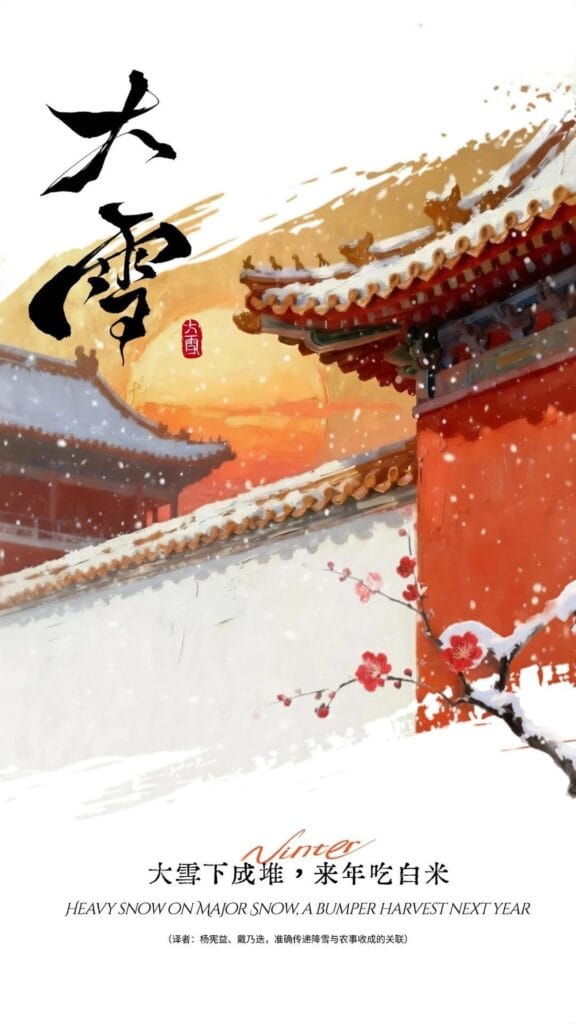
The Astronomical Precision of the Solar Terms
To understand Major Snow, one must first appreciate the sophistication of the Chinese calendar. Unlike the Gregorian calendar, which is purely solar, the traditional Chinese system incorporates 24 “nodes” that track the sun’s movement along the ecliptic. Major Snow officially begins when the sun reaches a celestial longitude of $255^\circ$.
In the British climate, this roughly aligns with the damp, chilly start of December when the days reach their shortest span and the “darker half” of the year truly takes hold. For the ancient Chinese, this wasn’t just a change in weather; it was a shift in the balance of Yin と Yang. During this period, Yin energy reaches its peak, demanding that humans slow down, conserve their energy, and mirror the dormancy of the natural world.
The Agricultural Significance: A Blanket for the Earth
Historically, the 24 Solar Terms served as a vital survival manual for farmers. There is an old proverb often cited during this time: “A timely snow promises a good harvest” (Ruìxuě zhào fēngnián). While heavy snow in the city might mean a nightmare for the morning commute, for the agricultural heartlands of China, it is a blessing.
The logic is scientifically sound. First, the snow acts as a thermal insulator. Because snow contains a high volume of trapped air, it functions like a duvet for the soil, maintaining a temperature that prevents the roots of winter wheat from freezing. Secondly, as the snow melts in the early spring, it provides a slow-release irrigation system rich in nitrogen. Finally, the extreme cold associated with Major Snow serves as a natural pesticide, killing off the larvae and eggs of insects buried in the topsoil. Thus, a harsh Major Snow period is often celebrated as a harbinger of a prosperous, pest-free spring.
Cultural Traditions: Preserving Meat and Embracing the Ice
As the landscape transforms, so do the daily habits of millions. The customs of Major Snow are a fascinating blend of practical survival and seasonal joy.
1. The Art of the “Winter Forest”
In South China, particularly in the provinces of Jiangsu and Zhejiang, the arrival of Major Snow is the traditional signal to begin the “winter cure.” Walk through the streets of old Nanjing or Hangzhou during this time, and you will see balconies and courtyards transformed into what locals call “meat forests.”
Pork bellies, whole ducks, and coils of wind-dried sausages are marinated in soy sauce, ginger, and star anise, then hung out to cure in the cold, dry wind. The low humidity and consistent chill of the Major Snow period provide the perfect conditions to preserve these meats without them spoiling. By the time the Lunar New Year arrives, these delicacies will be the centrepiece of the reunion dinner.
2. The Frozen Playground
While the south gets busy in the kitchen, Northern China turns its attention to the ice. There is a traditional saying: “Minor Snow freezes the earth, Major Snow freezes the river.” In cities like Beijing and Harbin, the local waterways become thick enough to support human weight.
Ice-skating, ice-bumpering, and traditional sleighing become the primary outdoor activities. This isn’t a modern development; ice sports have been part of the cultural fabric since the Qing Dynasty, when the “Ice Diversion” was a formal military exercise. Today, it is a more casual affair, where families brave the biting wind to slide across the frozen Kunming Lake at the Summer Palace.
3. Appreciating the Wintersweet
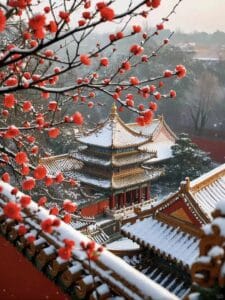
Nature is not entirely devoid of colour during this period. The Wintersweet (Chimonanthus praecox), or Lamei, begins to bloom during Major Snow. Unlike the cherry blossoms of spring, the Wintersweet features waxy, pale yellow petals that thrive in sub-zero temperatures. Its fragrance is intoxicatingly sweet and heavy, often the only scent in the crisp winter air. In Chinese literature, the flower is a symbol of resilience and moral integrity—standing tall when all other plants have withered.
The Major Snow Diet: Warming from the Inside Out
In the philosophy of Traditional Chinese Medicine (TCM), the human body is a microcosm of the universe. When the external world is cold, we must bolster our internal “fire.”
The King of Winter Foods: Lamb
Lamb is considered the ultimate “warming” meat. During Major Snow, lamb hot pot and mutton stew become dietary staples. It is believed to nourish the kidneys and boost blood circulation, helping the body resist the “pathogenic cold.” In many households, lamb is stewed with white radishes. The radish, known as “poor man’s ginseng,” is “cool” in nature and helps balance the “heat” of the lamb, ensuring that one’s internal energy remains harmonious.
Porridges and Black Foods
TCM dictates that winter is the season of the Kidneys, and the colour associated with the kidneys is black. Therefore, eating black-coloured foods during Major Snow is highly recommended. Black beans, black sesame, black rice, and wood ear mushrooms are frequently consumed to fortify the body’s essence (Jing). A warm bowl of “Eight Treasure Porridge” (Laba Zhou) is a common breakfast choice, providing slow-release energy to combat the winter fatigue.
Wellness and Rituals: The TCM Guide to Deep Winter
Staying healthy during Major Snow requires more than just a heavy coat; it requires a lifestyle adjustment.
Protect the Three Points: TCM practitioners emphasize protecting the “Three Points” of the body: the head, the back, and the feet. The back is the location of the Du meridian, the “sea of Yang.” If the back gets cold, the body’s entire immune system is compromised.
The Wisdom of “Early to Bed”: の Huangdi Neijing (The Yellow Emperor’s Classic of Medicine) advises that in winter, one should go to sleep early and wake up only after the sun has risen. This preserves the body’s Yang energy. In our modern, high-intensity world, Major Snow serves as a reminder that productivity doesn’t always have to be frantic; there is value in the quiet conservation of strength.
The Evening Foot Soak: One of the most beloved winter rituals in China is the Pao Jiao (foot soak). Before bed, soaking the feet in hot water (sometimes infused with ginger or mugwort) helps draw the blood flow away from an overworked brain and down to the extremities. This not only keeps the feet warm but is said to improve sleep quality significantly during the long nights of Major Snow.
Frequently Asked Questions (FAQ)
1. Is Major Snow the coldest period of the year?
Not quite. While Major Snow marks a significant drop in temperature, the “dead of winter” is usually reserved for the two following solar terms: Xiaohan (Minor Cold) and Dahan (Major Cold) in January.
2. Why do people eat oranges during this time?
In many regions, Major Snow coincides with the harvest of citrus fruits. Beyond being seasonal, TCM suggests that citrus can help “moisten” the lungs, which often become dry due to indoor heating and the lack of humidity in the winter air.
3. Does it actually snow every year during this term?
The term Major Snow describes a seasonal trend rather than a specific weather event. In Northern China, snow is very likely, but in the South, the term simply indicates a period of cold rain and frost.
4. Can I practice Tai Chi during Major Snow?
Yes, but with caution. TCM suggests avoiding heavy sweating in the winter, as sweating “opens the pores” and allows cold Qi to enter. Gentle, meditative exercises like Tai Chi or Qi Gong are perfect for the Major Snow period.
5. What is the symbolic meaning of this period?
It represents “storage” and “accumulation.” Just as plants store energy in their roots, humans are encouraged to use this time for study, meditation, and preparing for the renewal of spring.