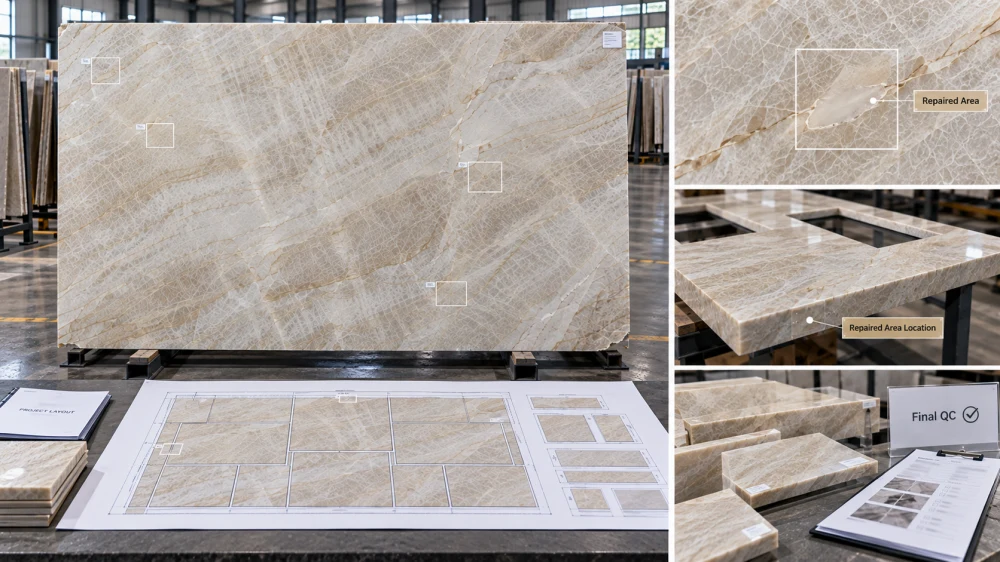
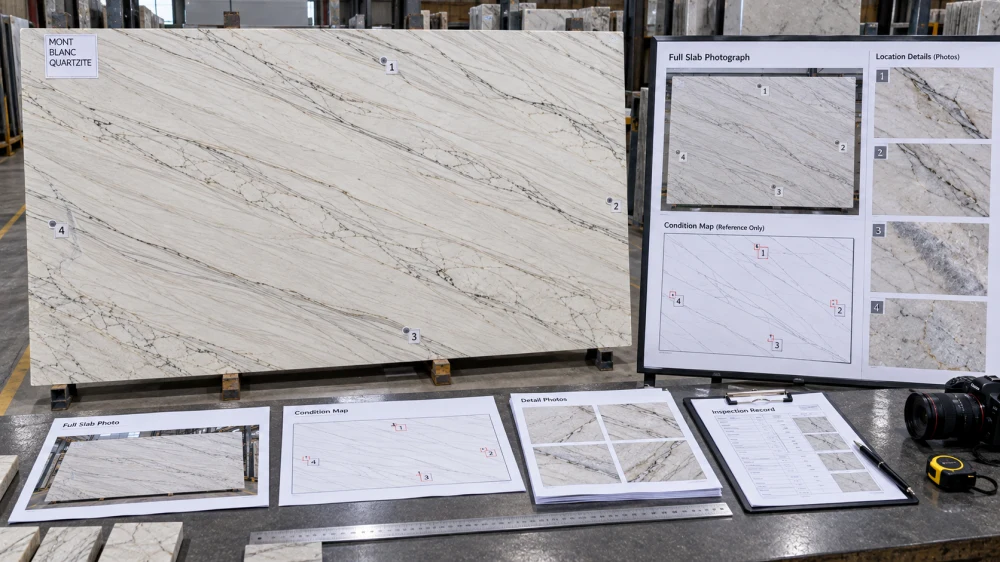
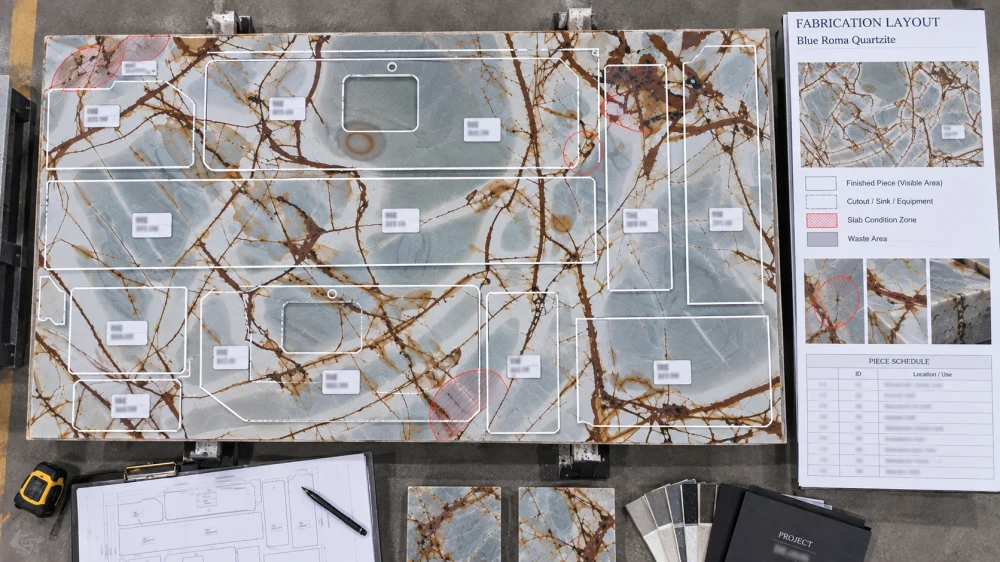
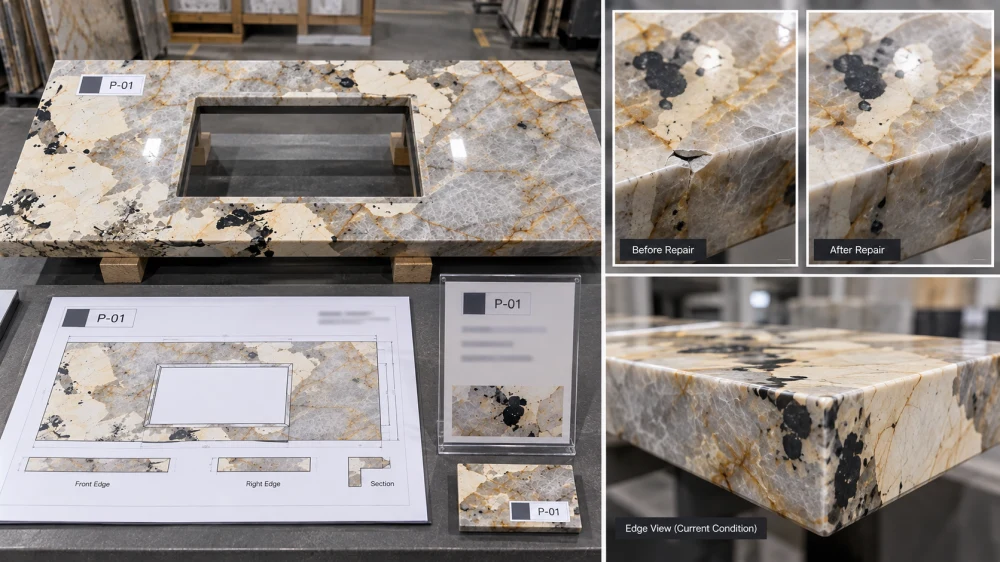
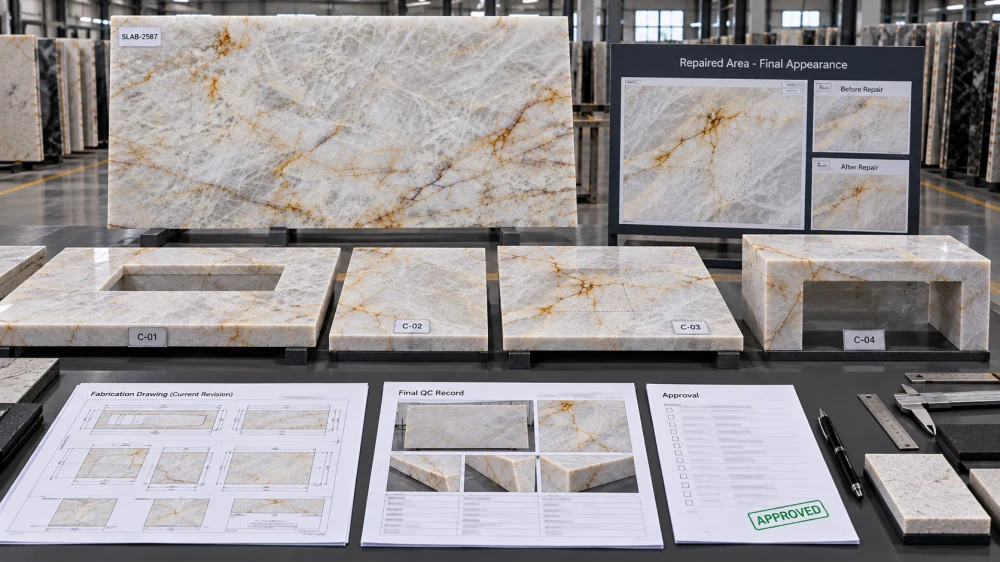
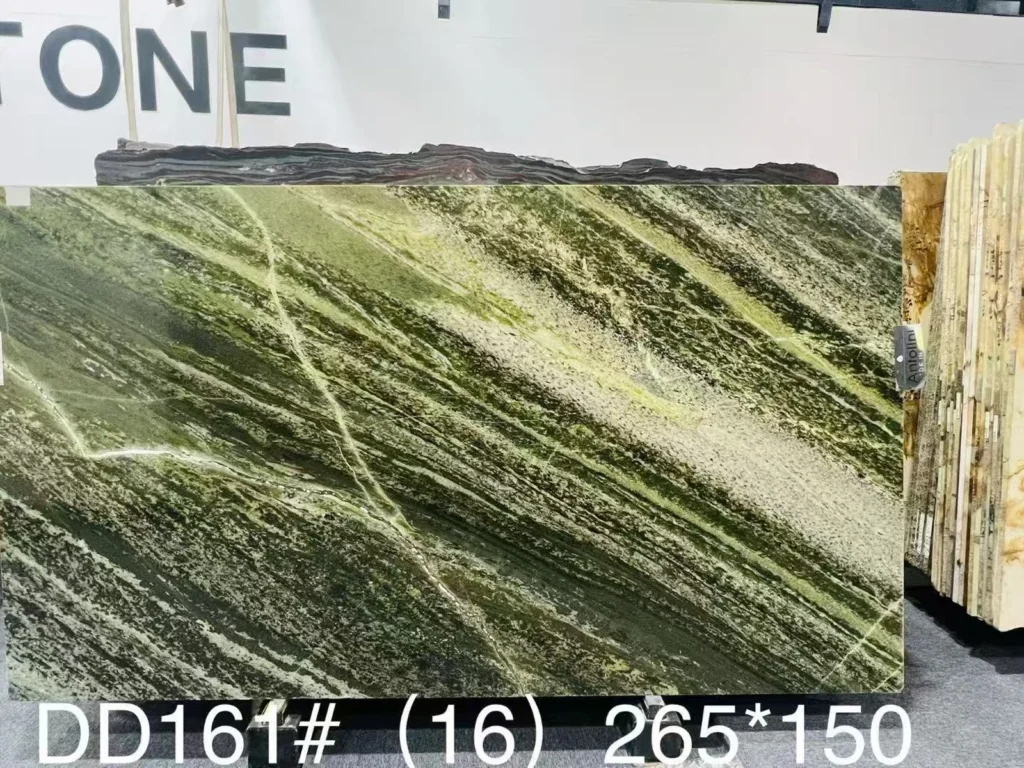
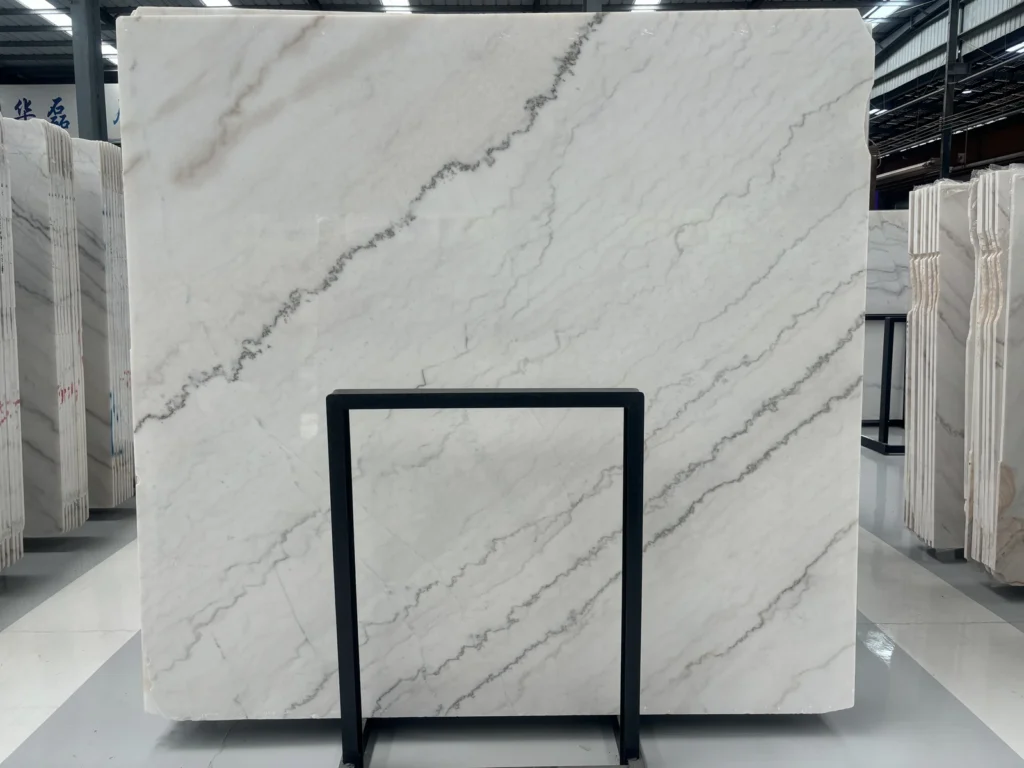
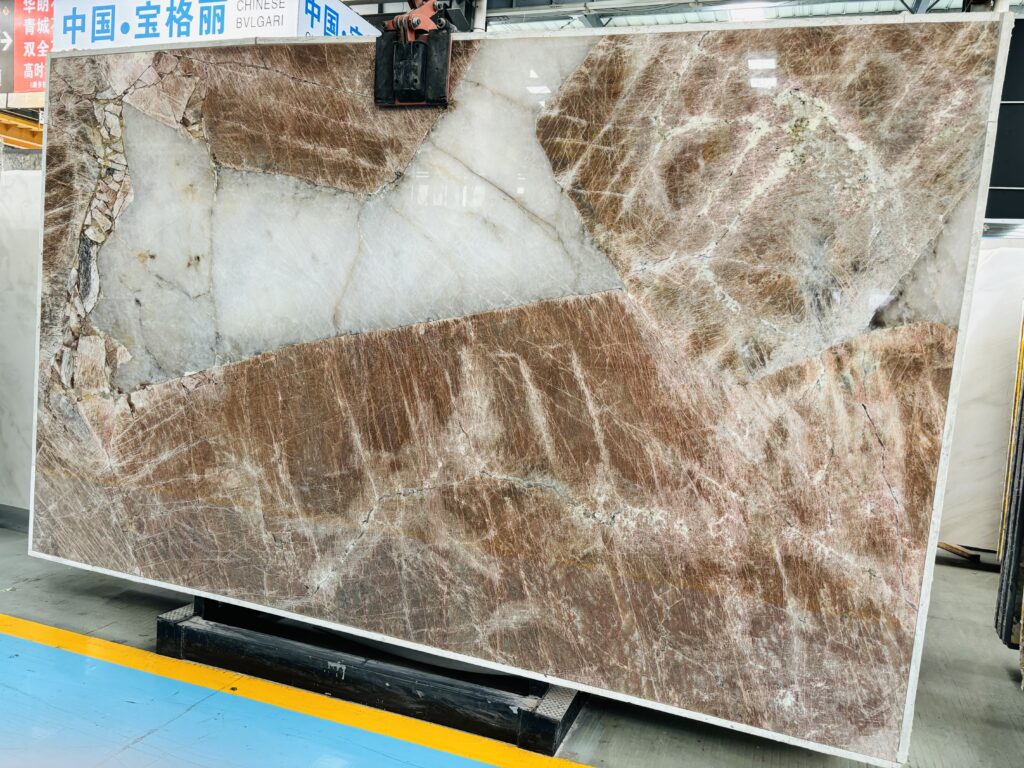
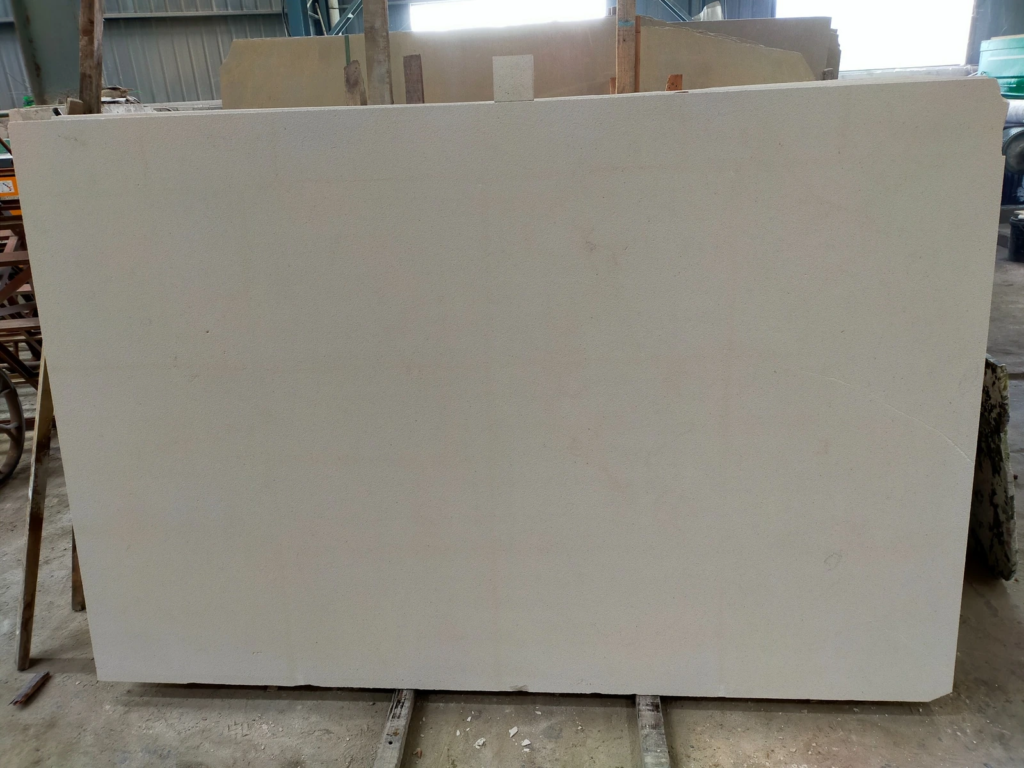
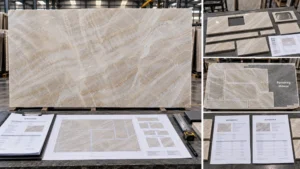
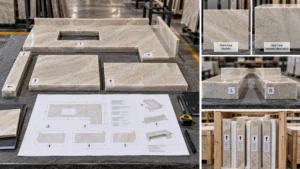
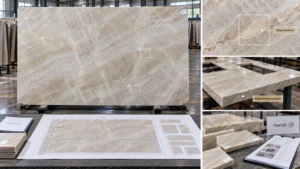
Acceptable repairs in Natural Quartzite should be defined against the actual slab, observed condition, finished-piece location, visible area, fabrication layout, repair evidence, and agreed approval route. Do not assume that every fissure requires repair, every repaired area is unacceptable, or one generic repair grade applies to every project. A stronger order record distinguishes natural features, existing repairs, proposed repairs, and fabrication reinforcement, then shows where each relevant condition will appear in the finished work before cutting is released.
A buyer reviews a Natural Quartzite slab and notices a filled line, a resin-treated area, a reinforced zone, or another visible condition.
The immediate question is often:
“Is this repair acceptable?”
But that question needs more context.
The same observed condition may have very different project significance depending on whether it falls:
天然珪岩注文における許容可能な修復
outside the cutting area;
inside a hidden return;
across the center of a statement island;
next to a sink or cooktop opening;
through a narrow finished component;
along a visible polished edge; or
inside another fabrication-sensitive area.
For a project order, repair acceptance should therefore connect the actual stone condition with the actual finished-piece layout.
First Separate Four Different Conditions
Before deciding what is acceptable, make sure the project team is discussing the same type of condition.
Natural Feature
A visible characteristic of the actual natural stone that has not automatically been established as a repair or defect.
Existing Repair
A repaired, filled or treated condition already present on the supplied slab or component.
Proposed Repair
An action being considered for a specific identified condition before fabrication, QC or handover.
Fabrication Reinforcement
Reinforcement associated with fabrication or handling that should be recorded separately from visual repair acceptance.
These categories can overlap in a real project, but they should not be casually treated as interchangeable.
Do Not Treat Every Fissure as a Defect
Natural Quartzite can contain geological lines, mineral transitions, crystalline zones, fissure-like features, filled areas and other natural variation.
A photograph alone may not establish what a particular line represents technically.
The project record should therefore begin with an observation:
“A visible linear condition is present in this identified location.”
Then add the available evidence.
Avoid jumping immediately to unsupported conclusions such as:
“the slab is cracked”;
“this is structural damage”;
“this is only a harmless fissure”;
“it will definitely break during fabrication”; or
“resin makes it completely safe.”
Where a technical conclusion matters, it should come from the appropriate project-specific review rather than terminology guessed from a photograph.
Use the Actual Slab Number
Repair acceptance should not be attached only to a commercial material name.
Actual Slab → Condition Location → Proposed Cutting Position → Finished Piece → Visible Area
私たちの クォーツァイト切断計画ガイド explains why actual slab numbers and finished-piece IDs should remain linked throughout layout, fabrication, QC and packing.
Visible Location Changes the Acceptance Question
A useful repair specification should identify visual priority instead of simply saying:
“No repairs allowed.”
Depending on the design, the buyer may care differently about:
main horizontal viewing surfaces;
statement island faces;
waterfall ends;
large wall-panel centers;
visible polished edges;
backsplashes;
返品条件;;
undersides;
concealed edges; and
areas removed by cutouts.
Visual Acceptance Rule
Define the visible priority of the finished component before deciding whether an observed or repaired condition is acceptable in that location.
Repair Acceptance Should Be Location-Specific
所在地
Review Focus
Possible Decision
Outside usable layout
Does it affect required cutting clearance or usable yield?
Record / avoid in finished piece where feasible
Primary visible surface
Appearance, agreed visual expectation and fabrication relevance
Buyer review before cutting
Visible finished edge
How the condition appears after edge fabrication
Edge-specific review
Near large cutout
Remaining geometry and fabrication implications
Fabrication review / possible layout change
Concealed zone
Whether the condition has another fabrication or technical significance
Record according to project requirement
Do Not Define Acceptance Only by Repair Size
A rule such as “repairs under X mm are acceptable” may look precise, but size alone may not capture the real project concern.
Two repaired areas of similar dimensions can have very different significance if one is:
inside a waste area;
across the center of a feature panel;
next to a cutout;
at a narrow bridge;
inside a miter;
along a visible edge; or
at a seam between visually related pieces.
If the project genuinely uses a dimensional repair limit, record the actual specification.
Do not invent one universal limit for all Natural Quartzite.
Separate Existing Repairs From New Factory Repairs
A slab may already contain filled or reinforced areas when selected.
A different issue arises when fabrication creates the need for additional work.
Keep those histories separate.
REPAIR HISTORY
Stage 1 — Slab Selection: Existing observed condition recorded
Stage 2 — Layout: Condition connected to proposed finished pieces
Stage 3 — Fabrication: Any new repair / reinforcement requirement recorded separately
Stage 4 — Final QC: Finished appearance and relevant condition reviewed
Stage 5 — Release: Approved status linked to the actual finished piece
This avoids a later argument about whether a condition existed before cutting or appeared during fabrication.
Define What Evidence Is Required After a Proposed Repair
If a repair is proposed, the project can define what evidence is needed before acceptance.
Depending on the project, that may include:
identified before photograph;
identified after photograph;
close view under neutral lighting;
wider view showing the complete piece;
back-side photograph where relevant;
edge view where relevant;
piece ID;
drawing reference;
repair location on the piece;
finish condition;
video where useful; and
other project-required technical evidence.
A close-up alone is often insufficient because it may not show where the repair sits in the finished component.
Use Before-and-After Repair Records
For visually sensitive projects, a simple before-and-after record can make remote approval much clearer.
Record
目的
Before — wide view
Shows location within slab or piece
Before — close view
Documents the observed condition
After — close view
Shows the repaired area after approved work
After — finished-piece view
Shows the repair in its final visual context
Piece / drawing reference
Keeps evidence traceable to production
patagonia-quartzite-repair-before-after-qc
Repairs Can Affect Usable Slab Yield
A repair discussion can become a yield discussion when the buyer decides that certain observed areas should not appear in specified finished components.
For example, avoiding several zones may:
reduce the usable cutting envelope;
move a large island piece;
change waterfall matching;
require a seam to move;
reduce spare material;
require another slab; or
change the proposed piece allocation.
This is why gross slab area and usable area are not the same thing. The site’s Natural Quartzite usable-area guide explains why actual layout constraints, visual priorities and slab-specific conditions need to be reviewed before relying on gross square-meter area.
Avoid “Zero Repair” Language Unless the Scope Really Defines It
“No repairs anywhere” sounds clear, but it can become ambiguous unless the order defines what counts as a repair and what stage of production the rule covers.
例えば:
Does it include an existing filled natural feature?
Does it include mesh or back reinforcement?
Does it include a fabrication reinforcement that is not visible after installation?
Does it apply to raw slabs or only finished visible faces?
Does it include factory resin treatment?
Does it apply to areas removed during cutting?
If the project requires a strict exclusion, define it precisely against the actual supply and finished-piece scope.
Do Not Hide a Repair Decision Inside a Generic Slab Approval
“Slab approved” may mean the buyer likes the overall colour and movement.
cristallo-quartzite-repair-final-piece-qc
It should not automatically be interpreted as acceptance of every observed condition in every possible finished-piece location.
Likewise:
“Repair approved”
should identify which repair, on which slab or piece, in which location, based on which evidence.
BETTER APPROVAL RECORD
Material / Board: identified
Condition ID: identified
Finished Piece ID: identified where applicable
Drawing / Layout Revision: current
Evidence Reviewed: identified
Decision: accept / revise layout / further review / other agreed action
Approved By / Date: recorded
Carry Repair References Into Fabrication QC
Once cutting begins, the original slab is divided into components.
A repair or observed condition that mattered during slab approval should not become anonymous after fabrication.
Where relevant, maintain:
Board Number → Condition ID → Cutting Position → Piece ID → Final QC
This is especially useful for:
large kitchen islands;
waterfall ends;
feature-wall panels;
reception counters;
long vanity tops;
fireplace components; and
other visually sensitive custom pieces.
What Should Final QC Check?
Final QC should return to the approved repair scope rather than inventing a new acceptance rule at the end of production.
Depending on the project, review:
correct piece ID;
correct drawing revision;
finish;
visible faces;
visible edges;
identified repair location;
appearance after fabrication;
before-and-after evidence where required;
relationship to seams or adjacent pieces; and
any open technical or buyer-review items.
For visually sensitive stone, QC should show the complete component as well as relevant details rather than relying only on extreme close-up photographs.
Repair Acceptance Gate Before Cutting
Before releasing Natural Quartzite with identified repair-sensitive conditions, confirm:
madeirus-quartzite-repair-cutout-edge-review
□ Exact slab / board identified
□ Relevant observed conditions mapped
□ Natural feature / existing repair / proposed repair distinguished where known
□ Current cutting layout reviewed
□ Finished-piece IDs identified
□ Primary visible areas identified
□ Conditions near cutouts, edges, miters or narrow zones reviewed
□ Areas to avoid or feature documented where required
□ Proposed repairs separated from existing conditions
□ Required repair evidence defined
□ Yield impact checked if areas are excluded
□ Approval authority identified
□ Current approval status recorded
What to Send HRST for a Repair-Sensitive Quartzite Order
For a project where visible repairs or slab conditions matter, send:
天然石英岩材料の名称;;
current slab references if already selected;
full-slab photographs;
current drawings;
仕上げ後の寸法;;
部材の数量;;
表面仕上げ;;
visible-edge requirements;
切り欠き加工;;
waterfall or miter requirements;
main visual priority areas;
any project-specific repair restrictions;
required approval evidence; and
delivery destination.
HRST STONE can then coordinate the actual slab references, cutting layout, piece IDs, fabrication review, QC photographs and packing records around the confirmed project scope.
よくある質問
1. Are repairs normal in Natural Quartzite slabs?
Natural Quartzite can contain natural features, filled areas, resin treatment, reinforcement or repaired conditions, but these terms should not be treated as interchangeable. Buyers should review the actual slab and identify the specific condition, location and finished-piece context rather than assuming one blanket rule applies to every material.
2. Does a repaired area mean a Quartzite slab should be rejected?
Not automatically. The project should first identify the actual condition, its location, the intended finished piece, visibility, fabrication relevance, available evidence and agreed acceptance criteria. A repaired area should not be accepted or rejected solely because the word “repair” appears in the discussion.
3. Should every fissure in Natural Quartzite be repaired?
Not automatically. A visible line should first be documented accurately. Whether it is a natural feature, existing filled condition, repair-sensitive area or another condition requiring action depends on the actual material and appropriate project-specific review.
4. How should acceptable Quartzite repairs be defined in a purchase order?
Define the relevant slab or piece references, visible areas, condition categories where appropriate, any areas to avoid, required evidence, cutting-layout relationship, approval authority and final QC expectations. Avoid relying only on vague terms such as “premium,” “minor repair,” or “A-grade repair.”
5. Can an acceptable repair reduce usable slab yield?
The repair itself does not automatically reduce yield, but a buyer decision to exclude a particular repaired or observed zone from specified finished pieces can reduce the usable cutting area. The impact should be checked against the actual cutting layout before the slab quantity is finalized.
6. Should repaired areas appear on the Quartzite cutting plan?
For conditions that affect visual approval, usable area or fabrication decisions, linking the condition location to the actual slab layout can make the approval much clearer. The project can then see which finished piece, edge, cutout or waste area is affected.
7. What photographs should be provided for a Quartzite repair?
For a repair requiring buyer review, useful evidence can include an identified wide view, close view, finished-piece view, edge or back view where relevant, and before-and-after photographs when new repair work is performed. Each image should remain traceable to the slab or finished-piece reference.
Final Repair-Acceptance RuleDo not define acceptable Natural Quartzite repairs with one vague grade or one close-up photograph. Keep the decision chain visible: Actual Slab → Condition ID → Cutting Position → Finished Piece → Visibility → Repair Evidence → Buyer Review → Fabrication QC.
For repair-sensitive Natural Quartzite orders, HRST STONE can coordinate actual slab photographs, board references, CAD/shop drawings, cutting layouts, piece numbering, condition photographs, before-and-after fabrication evidence, dry-lay review where appropriate, final QC and reinforced export packing around the approved project scope. Send Josh the material, current drawings, dimensions, quantity, finish, visible areas, cutouts, edge requirements, repair restrictions and delivery destination before the final cutting release.
Hi, I am the author of this article. I have been working in the field of Natural Stone for more than 15 years. If you need customized Natural Stone services, please feel free to contact me.