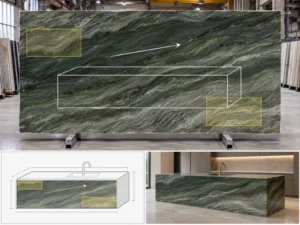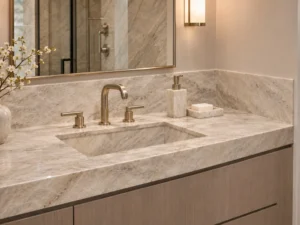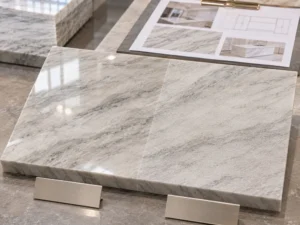


संक्षिप्त सारांशA matching Natural Quartzite offcut can be an excellent source for a vanity side splash when it comes from the same identified slab or related slab group, has enough current usable geometry, carries the intended finish, and produces a visually compatible crop beside the vanity top. However, “same slab” does not automatically mean “best finished piece.” The side splash is vertical while the vanity top is horizontal, so pattern direction, reflections, edge exposure, and the apparent scale of the stone can change. Before the vanity top is cut, reserve likely side-splash areas where practical. Review the finished side-splash template on the actual slab or retained offcut, confirm wall and backsplash interfaces, identify exposed edges, and decide whether the goal is local vein continuity, general colour coordination, or simply a quiet supporting piece. If the offcut is retained for later use, keep its source slab, current dimensions, finish, photograph, storage status, and remnant identity traceable.
A Natural Quartzite vanity top has already been laid out on the slab.
The sink opening is positioned.
The faucet holes are coordinated.
The main stone pattern looks balanced.
Then the bathroom drawing adds a side splash against the wall.
The first instinct is:
“Use the leftover piece from the vanity slab so it matches.”
Sometimes that is exactly the right decision.
Sometimes it is not.
The remaining Quartzite may be large enough in gross area but not in usable shape.
The offcut may contain a pattern that becomes too dominant when turned vertically.
A strong vein may run in the wrong direction.
The useful strip may already have an irregular cutout or damaged edge.
Or the most attractive remaining area may be more valuable as a future replacement piece than as a narrow side splash.
This is the practical question behind Quartzite Vanity Side Splashes: When a Matching Offcut Makes Sense.
The project should not ask only:
“Is this offcut from the same stone?”
It should ask:
“Can this identified offcut become the finished side splash we actually want beside this vanity?”
The first correction is simple.
A matching offcut is not another material category.
It is a remaining physical piece of Natural Quartzite.
This is the strongest source relationship.
The offcut came from the same identified slab as the vanity top.
This can help coordinate:
The side splash may come from another board in the same project slab group.
This can still produce a good result when the boards have been reviewed together.
Do not call it the same slab if it is not.
An offcut labelled only:
“Taj Mahal Quartzite”
or:
“Mont Blanc Quartzite”
does not prove that it came from the vanity slab or even from the same visually related slab group.
If its origin is unknown, record that limitation.
Natural Quartzite can vary between physical slabs carrying the same commercial name.
When the side splash directly touches or sits immediately beside the vanity top, local visual compatibility can matter more than it would for stone installed in another room.
Source Rule
Same Material Name ≠ Same Slab. Same Slab ≠ Automatically Best Side-Splash Crop. Preserve source identity, then review the actual finished piece.
“Make the side splash match” can mean several different things.
For a quiet vanity design, the project may want the side splash to feel visually calm and close in general colour to the vanity top.
Exact vein continuation may not matter.
The project may want both pieces to share:
In some designs, the vanity top and side splash are intended to read as a more continuous composition.
This requires much more deliberate slab layout.
The team needs to know:
Sometimes the strongest design is not the closest vein match.
The vanity top may already contain the main geological feature.
A quieter side splash can support the composition without competing with it.
Write the actual target.
उदाहरण के लिए:
Goal: same slab, similar cream background, low-contrast movement, no need for exact vein continuation.
Or:
Goal: side splash to continue the main directional movement from the rear corner of the vanity top.
| Matching Goal | क्या समीक्षा करना है |
| General Colour Match | Background tone, finish and local mineral colour |
| Pattern Coordination | Movement scale, contrast and geological character |
| Directional Continuity | Exact crop position, rotation, joint and finished orientation |
| Quiet Supporting Piece | Low visual competition with the main vanity top |
If the side splash is visually important, do not wait until the vanity top has already consumed the preferred slab area.
Where practical, the cutting layout should show:
Vanity Top + Rear Backsplash + Side Splash + Other Required Pieces.
This allows the project to decide which slab areas have the highest visual priority.
For many projects, the horizontal vanity top remains the primary visible stone surface.
Its pattern placement should not be sacrificed blindly just to create a small side-splash match.
A very narrow offcut may technically fit but place:
Reserve candidate areas during the main layout if those issues matter.
A vanity installed between two side walls may require both left and right side splashes.
Do not cut one excellent piece first and then discover the remaining offcut cannot produce a compatible second piece.
A controlled layout can identify:
V-01 — Vanity Top
SS-L — Left Side Splash
SS-R — Right Side Splash
before irreversible cutting begins.
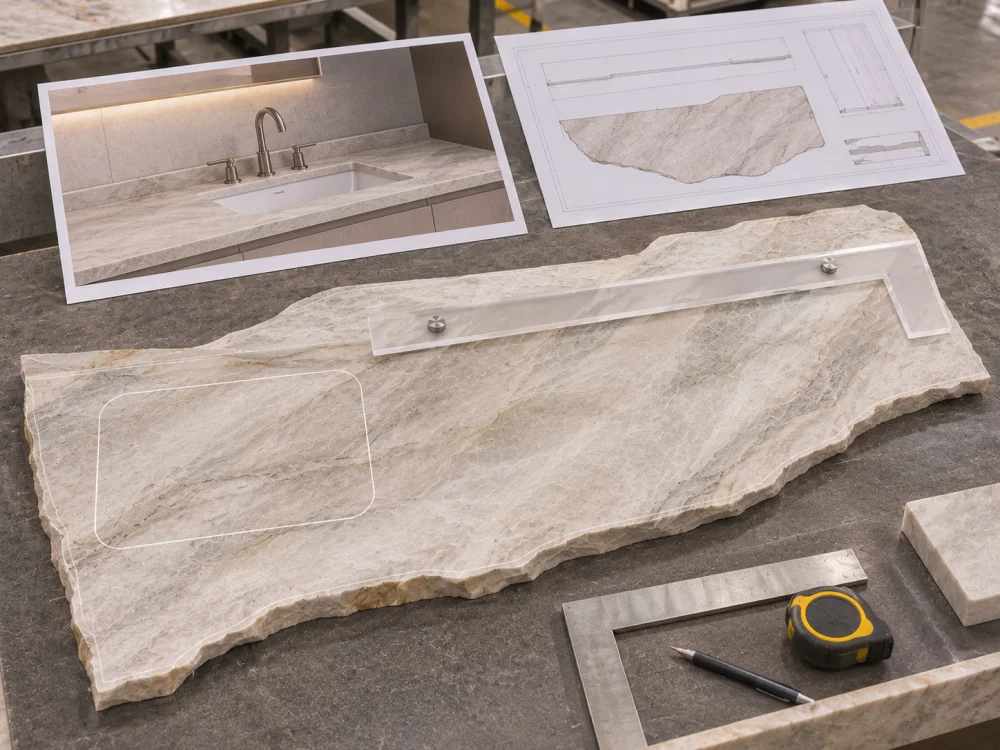
Once the main vanity component has been cut, the remaining stone becomes a new physical object.
Its current geometry matters.
संबंधित स्थानों को रिकॉर्ड करें:
An offcut that fits inside a nominal rectangular envelope may still not accept the finished side-splash template.
The Natural Quartzite Usable Area vs Gross Slab Area principle applies here as well: physical area, usable cutting area and finished-piece area are different quantities.
The fabricator may need room for:
Do not place the theoretical finished side-splash outline directly against an unusable raw offcut edge without fabrication review.
A retained section from around a basin opening may sometimes be suitable for a narrow side splash.
Its usefulness depends on the real remaining geometry, pattern, finish, edge condition and required finished dimensions.
Do not treat every sink-cutout remnant as reusable merely because it is physically present.
Offcut Fit Rule
Current Offcut Shape → Finished Side-Splash Template → Fabrication Allowance → Pattern Review → Usable or Not. Do not calculate from gross area alone.
A side splash changes the stone from a horizontal plane to a vertical plane.
The material is the same.
The visual reading may not be.

A mineral band running along the vanity top may need to be rotated to fit the side splash.
After rotation, the same feature can become:
A polished horizontal vanity can reflect:
A vertical side splash receives and reflects light from another direction.
The two pieces may therefore appear slightly different even when they come from the same physical slab.
A broad soft feature on a large vanity top may become almost the entire composition of a narrow side splash.
Review the actual finished crop, not only the surrounding slab context.
When reviewing candidate offcuts, show the side splash as it will actually be installed.
Do not approve it only while the offcut is lying in its original slab orientation.
The side splash usually interacts with more than the vanity top.
If the vanity also has a rear splash, define:

Confirm:
A mirror may:
Include this geometry in the elevation before final fabrication where it affects appearance.
Site walls may not match early design assumptions perfectly.
The exact field-measurement or templating method belongs to the responsible fabricator and project team.
The important point is that a side splash cut from a valuable matching offcut should use the current finished geometry rather than an outdated conceptual dimension.
A side splash can provide a designed transition at the vanity/wall interface.
It should not become an improvised solution for an unreviewed substrate, waterproofing, movement, or dimensional problem.
A narrow side splash may expose more finished edge proportionally than the vanity top.
If the side splash terminates below a mirror or wall finish, the top edge may remain visible.
समीक्षा:
The front termination is often seen directly from the bathroom entrance.
A strong feature ending abruptly at this point can become more noticeable than it appeared on the raw offcut.
A Natural Quartzite cut edge exposes another plane through the material.
It may appear visually different from the broad face.
This is normal material geometry, not automatic evidence that the offcut failed to match.
If the vanity top is polished, honed, leathered, or otherwise processed, confirm whether the side splash uses the same surface condition.
Do not assume an old remnant carries the current required finish merely because it came from the correct source slab.
Not every usable same-slab offcut should automatically become the side splash.
Some retained stone may have higher future value.
An original same-slab remnant can be valuable if a vanity component later needs:
A larger offcut may fit:
better than a narrow splash strip.
The opposite is also true.
There is little value in storing every small irregular fragment indefinitely.
Decide whether the remaining piece has a realistic future use.
The side splash may be the most logical use when:
संबंधित छोटे फर्नीचर के टॉप के लिए प्राकृतिक क्वार्ट्जाइट बनाम ग्रेनाइट: अवशेषों से काटा गया guide applies the same principle: a remnant is valuable because of what finished geometry it can become, not merely because leftover stone exists.
A matching offcut is only useful in the future if the project still knows what it is.
Where retention is justified, connect:
Material → Source Board → Vanity Project → Remnant ID.
Do not keep only the dimensions of the rectangular area from which the vanity was cut.
Record the remaining physical piece as it exists now.
If the retained stone is polished on one face, honed, raw, partially finished, or contains worked edges, record the current condition.
A current photograph helps a future team understand:
The offcut can be:
Physical presence does not automatically mean commercial availability.
If part of the offcut later becomes a side splash, update the remaining remnant geometry rather than continuing to show the old dimensions.
Before fabrication is complete, review the two pieces together.

Confirm:
Confirm:
A factory dry review or controlled digital layout can show:
Vanity Top → Rear Splash → Side Splash → Wall Relationship.
The project does not need artificial perfect vein matching.
It needs the intended relationship to look deliberate.
उदाहरण के लिए:
V-01 — Vanity Top
BS-01 — Rear Backsplash
SS-01 — Side Splash
Where source traceability matters, keep those IDs connected to the actual slab or retained remnant.
Using the same slab can be a strong option because it preserves the closest source relationship for colour, finish and geological character. It is not automatically required or automatically best. The offcut still needs sufficient usable geometry, an appropriate finished pattern, correct orientation, required edges and a suitable relationship with the vanity top and wall.
No. The top and side splash are viewed on different planes, so reflections, pattern direction and apparent scale can change. Different local areas within one Natural Quartzite slab can also contain noticeably different mineral features. Same-slab sourcing improves traceability but does not remove the need to review the actual finished crop.
Only if that is the defined design intention and the actual slab layout supports it. Many projects need only coordinated colour and pattern character rather than exact continuation. When directional continuity is desired, reserve and review the side-splash crop before the vanity slab is irreversibly cut.
Potentially. Check the current physical geometry, thickness, finish, pattern position, irregular edges, openings and fabrication allowance. A piece may appear large enough by gross dimensions while still failing to fit the finished side-splash template after trimming and edge finishing.
That depends on project priorities. A larger same-slab remnant may have future replacement or furniture value, while a side splash directly adjacent to the vanity may benefit strongly from the same-source stone. Compare the current side-splash need with realistic future uses rather than automatically using or storing every remnant.
Record a stable remnant ID, Natural Quartzite material name, source slab or board where known, current dimensions and shape, thickness, finish, visible face, photograph, storage location, current status and any later recut history. If the original slab source is genuinely unknown, record that rather than guessing.
Send Josh the Natural Quartzite material, current slab or remnant reference, vanity drawing, finished vanity and side-splash dimensions, sink and faucet information, rear-backsplash design, quantity, finish, exposed-edge requirements, wall and mirror relationships where relevant, preferred pattern-matching strategy, project destination and any retained-offcut information. Identify whether the priority is same-slab colour coordination, directional vein continuity, efficient remnant use, or future spare-material retention.
Vanity Side-Splash Approval SummaryA matching Quartzite offcut is most useful when its physical source and current geometry are known and the finished side-splash crop supports the vanity design. Start by defining what “match” means: general colour coordination, similar pattern character, directional continuity, or a quiet supporting surface. Reserve likely splash zones before cutting the vanity top when that visual relationship matters, then recheck the actual offcut after fabrication rather than relying on its former slab envelope. Review the side splash in its vertical installed orientation, coordinate it with the rear backsplash, wall, mirror and visible edges, and decide deliberately whether the offcut should be consumed now or retained for future use. Same-slab origin is valuable evidence; it is not a substitute for finished-piece approval.
For custom Natural Quartzite vanity tops, backsplashes and side splashes, HRST STONE can coordinate full-slab photographs, board references, vanity CAD layouts, sink and faucet openings, side-splash templates, actual-slab or remnant allocation, pattern orientation, edge finishing, piece identification, remnant records, fabrication QC and export packing within the confirmed stone scope. Send Josh the material, slab or offcut reference, vanity drawing, finished dimensions, quantity, finish, matching priority and destination before final cutting release.