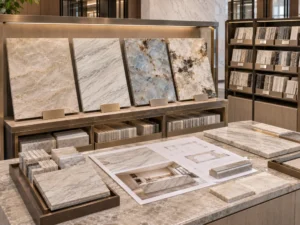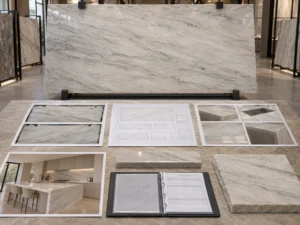

संक्षिप्त सारांशQuartzite Project Completion Records should preserve enough information to reconstruct what physical Natural Quartzite was selected, how it was fabricated, where each important piece was installed, what finish and edge details were used, and whether any useful original stone remains. Keep the commercial material name, exact board or slab numbers where known, full-slab photographs, final approved cutting layout, piece IDs, final drawings, finish, thickness, visible edges, fabrication and QC photographs, installed-location photographs, packing references, and any retained remnant or spare-piece records. A completion archive improves future replacement and extension decisions, but it does not guarantee an exact match: Natural Quartzite varies between slabs, original material may no longer exist, and an installed surface may change visually through use, maintenance, refinishing, lighting, or age. Future matching should begin with the historical evidence, then compare any retained original stone and current candidate slabs under a new project-specific approval.
A Natural Quartzite kitchen is completed.
The island looks correct.
The perimeter countertops are installed.
The client approves the room.
The project is packed away digitally and everyone moves to the next job.
Three years later, one waterfall end is damaged.
Or the client wants a matching bar in the adjoining room.
Or a vanity from the original project needs to be replaced.
The first question is:
“What Quartzite did we use?”
The answer comes back:
“Taj Mahal.”
That is useful.
But it is not enough.
Which slabs?
What did those slabs actually look like?
Which part of the slab became the damaged piece?
Was the finish polished or honed?
What was the actual thickness?
Was the visible edge mitred or solid?
Which direction did the natural movement run?
Is an original remnant still stored somewhere?
Has that remnant already been recut?
Do the old photographs show the original installed appearance or only a warm-lit phone image?
This is the purpose of Quartzite Project Completion Records: What to Keep for Future Matching.
A completion archive should make the original project reconstructable enough that a future team does not need to start from memory.
The material name is the beginning of the record.
It should not be the end.
Record the Natural Quartzite name used for the project.
उदाहरण के लिए:
This helps future teams search supplier and project history.
Where exact physical slabs were identified, preserve their board numbers.
This is much more valuable than recording only:
“3 slabs of Taj Mahal.”
A stronger record is:
Material → Board 01 / Board 02 / Board 03 → Project.
Natural Quartzite sold under the same commercial name can still vary in:
Keep enough commercial reference information to reconnect the physical stone to the original transaction where appropriate.
This may include:
The purpose is traceability, not to turn the future matching file into a pricing promise.
If the original slab is gone and a future supplier finds a visually related slab, give the new stone its own current identity.
Do not call it the original physical board merely because it looks similar.
Identity Rule
Material Name identifies the stone family. Board Number identifies the original physical slab. A future candidate requires its own current identity.
Once a slab has been cut, the original complete geological composition no longer exists as one physical surface.
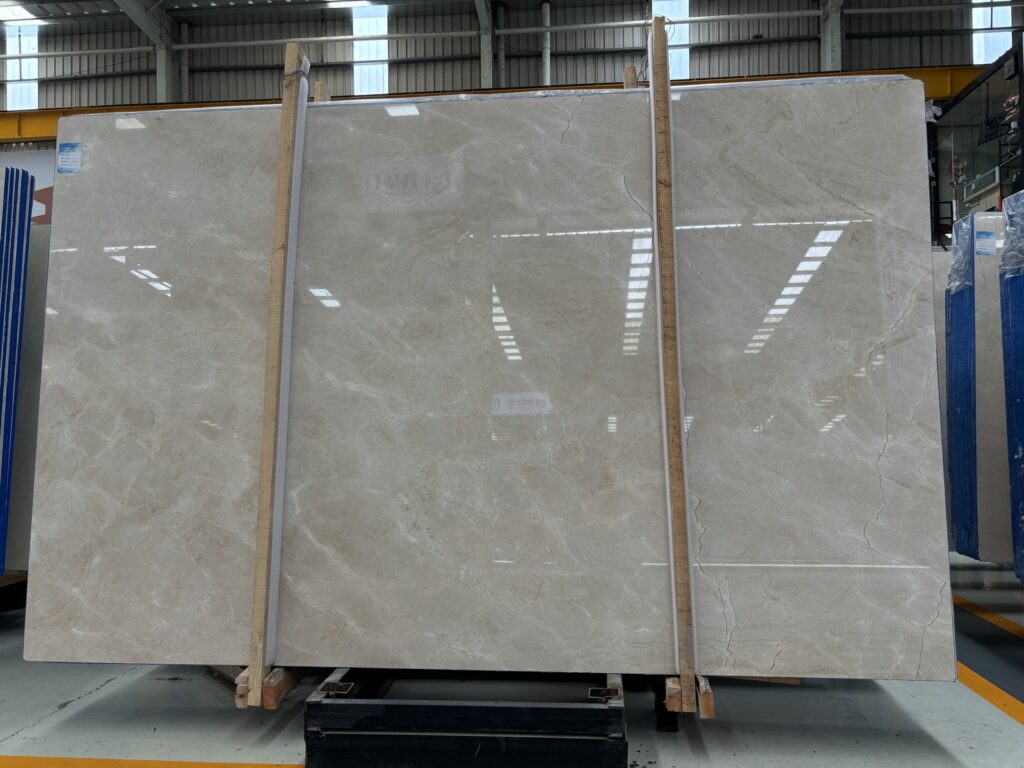
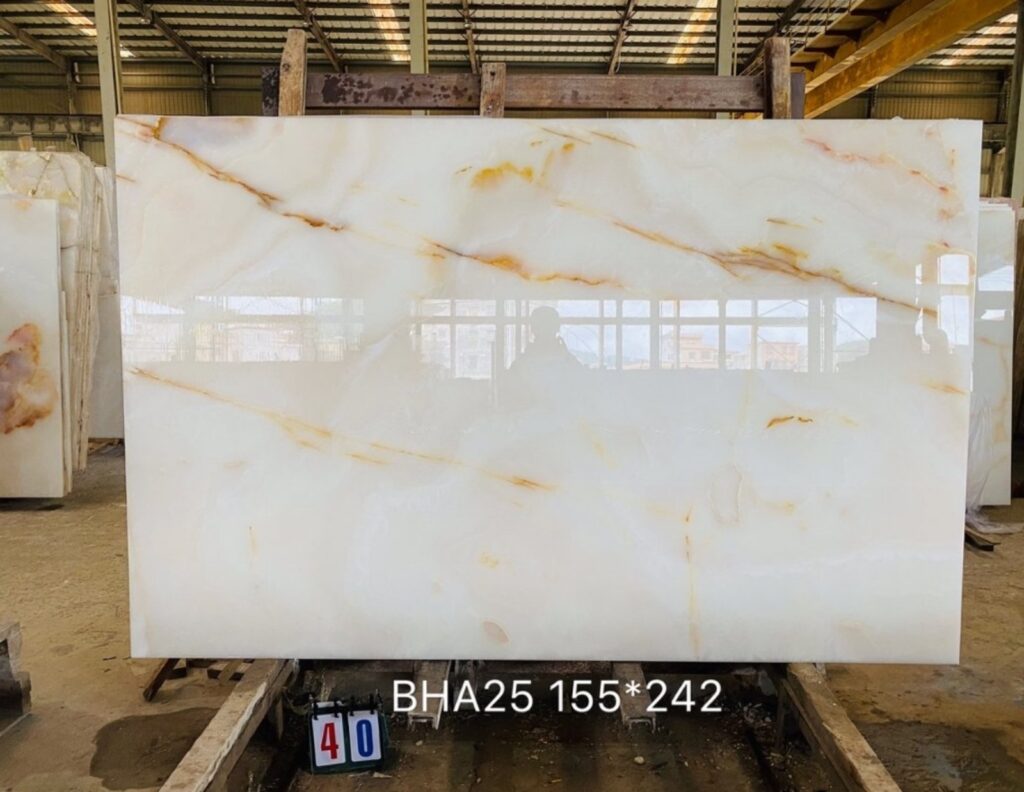
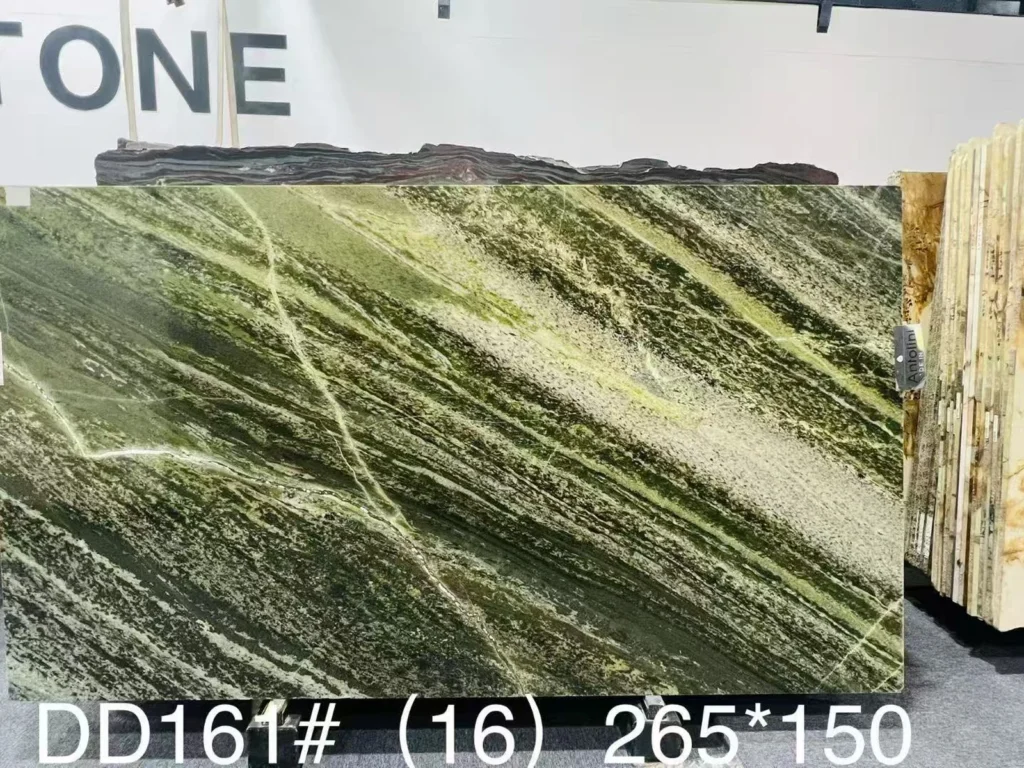
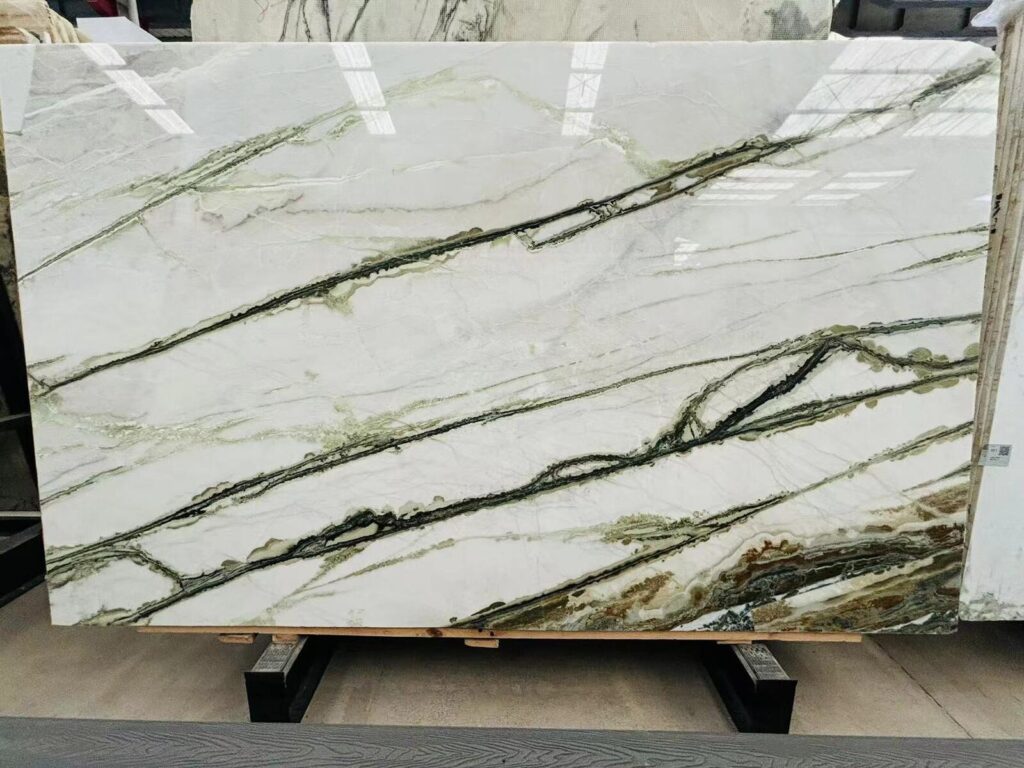
Full-slab photographs become important historical evidence.

Where practical, preserve photographs showing:
For multi-slab projects, include at least one controlled group view where useful.
This helps a future reviewer understand:
A close-up of an attractive vein has limited value if nobody knows which slab it came from.
Use a relationship such as:
Board TM-042 → Full Slab Photograph → Detail A → Detail B.
A future matching archive should prioritize project evidence over highly processed promotional imagery.
When possible, preserve:
This does not make photography colour-perfect.
It simply creates stronger evidence than memory or an isolated website image.
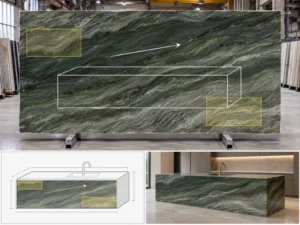
Knowing which slabs were purchased still does not tell a future team which slab became which finished component.
The final cutting layout should preserve that connection.
The record should identify the layout revision actually used for fabrication.
Do not save only an early proposal if the final pattern placement changed.
A useful chain is:
Board Number → Cutting Position → Piece ID → Installed Location.
उदाहरण के लिए:
TM-042 → Island Crop → I-01 → Kitchen Island Main Top
TM-043 → Waterfall Crop → I-02 → Island Left Waterfall
Where pattern direction matters, preserve:
The Quartzite Cutting Plans: Show the Slab Number for Every Finished Piece workflow explains why piece identification should continue through fabrication, QC, packing and installation rather than disappear after cutting.

The future matching package should include the drawing revision that describes the completed work.
Depending on the project, this may include:
Earlier revisions may still have project-record value.
But the future matching archive should make the final fabrication basis easy to identify.
| Completion Record | Why It Helps Future Matching |
| सामग्री का नाम | Identifies the original commercial stone family |
| Board numbers | Identifies the original physical slabs |
| पूर्ण स्लैब की तस्वीरें | Preserves original tone, movement and slab-to-slab relationship |
| Final cutting layout | Shows which slab area became each component |
| पीस आईडीज़ | Connects finished work to drawing, QC, packing and location |
| Final drawings | Preserves geometry, edges, seams and openings |
A visually similar future slab can still produce an obviously different replacement if the fabrication information is missing.
Record the actual project thickness where known.
Also distinguish physical slab thickness from a visually built-up edge where relevant.
Record whether the installed work was:
Do not describe finish only with an old photograph.
Record visible edges such as:
Where appearance matters, keep an edge drawing or representative worked sample reference.
A future replacement may have the correct top colour but still look wrong if the visual edge depth, joint position or return construction differs from the existing work.
Where project records confirm relevant treatments, preserve them.
Examples might include:
Do not invent treatment history if it was never recorded.
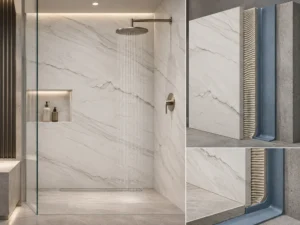
For furniture, waterfall ends, shelves, wall panels and other components, a future replacement may need information about surfaces that are not obvious in an installed front photograph.
Fabrication-Match Rule
Future matching is not only Stone A vs Stone B. It can also require Finish A vs Finish B, Thickness A vs Thickness B, Edge A vs Edge B, and the same installed orientation.
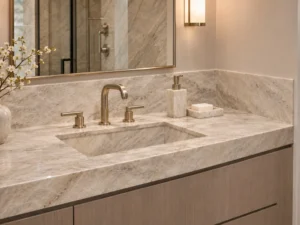
The installed room becomes one of the strongest future visual references.
However, a random set of phone photographs is difficult to interpret years later.
Keep at least one image showing the complete installation in context.
This helps a future reviewer understand:
Photograph important pieces individually.
Examples:

Include closer photographs of:
A photograph without lighting context can be misleading.
Where colour matching may matter later, distinguish useful conditions such as:
You do not need to create a laboratory colour record for every project.
But recording the general viewing condition is better than assuming two photographs taken under different lights represent a physical stone difference.
A close-up called:
“IMG_8472.jpg”
has limited future value.
A controlled archive should make it possible to understand that the image represents:
Kitchen → Island → Left Waterfall → Piece I-02 → Daylight View.
Factory QC records can become valuable completion evidence because they often show the finished components before installation obscures some edges or surfaces.
Useful QC evidence can show:
For multi-piece wall, floor, reception, fireplace, vanity or other visually sequenced installations, retain the final approved dry-lay record where one existed.
This can help a future matching request understand what variation was originally accepted across the complete set.
The packing list may help reconnect:
Piece ID → Crate → Project Area.
This becomes useful if the original installed-location information is incomplete.
For complex export projects, crate photographs or crate allocation records may help reconstruct which pieces shipped together.
They are supporting evidence.
They do not replace the final drawing or cutting layout.
Hundreds of unidentified factory images are not automatically a good archive.
The useful record is the one that allows another person to answer:
What is this image, which piece does it show, what slab did that piece come from, and where was it installed?
Digital records help.
Retained original stone can be even more valuable.
But only if its identity survives.
A remnant is a useful raw or partially processed piece remaining after fabrication.
Where its future value justifies retention, record:
The क्वार्ट्ज़ाइट रेमनेंट रजिस्टर: उपयोगी टुकड़ों को ट्रैकेबल कैसे रखें guide explains why the remnant ID should be created while its relationship to the source slab is still known.

A spare finished component is different from a raw remnant.
It may already have:
Do not reduce it to an anonymous offcut record.
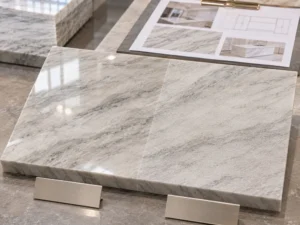
For some high-value projects, retaining one small representative sample may help preserve:
This does not replace full-slab identity.
It can supplement the completion archive.
A remnant can exist while being:
इसलिए:
Recorded ≠ Available
और
Available ≠ Suitable for the Future Piece.
If a remnant changes physically, do not leave the old dimensions and photograph as though nothing happened.
Preserve enough history to show:
Source Slab → Original Remnant → Recut → New Fabricated Piece → Remaining Remnant.
A future project team should not need to search years of email chains to reconstruct the original job.
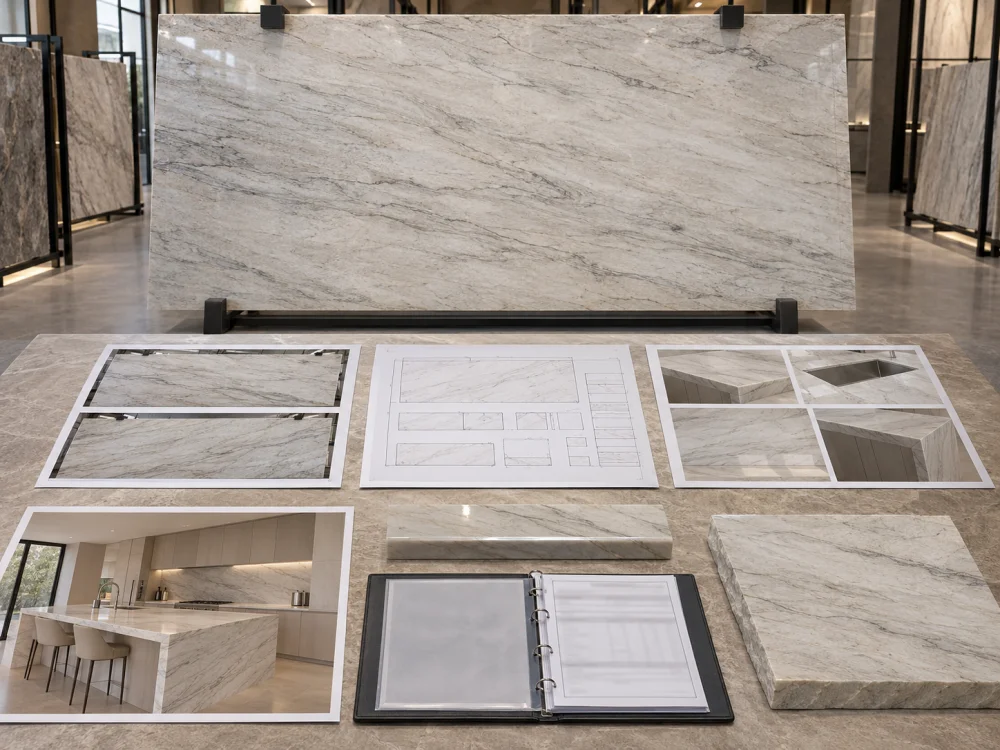
Create one logical completion package.
Include:
Include:
Include:
Include:
Include:
Include:
| Archive Layer | Future Question It Helps Answer |
| सामग्री की पहचान | What physical Quartzite was originally selected? |
| Full-Slab Evidence | What did the original slabs look like before cutting? |
| Final Layout | Which slab area became the component needing attention? |
| Fabrication Record | What thickness, finish, edge and geometry must be related? |
| Installed Photographs | What does the existing installation look like today or at completion? |
| Remnant / Spare Record | Does any original physical stone remain available for review? |
Good project records should shorten the future investigation.
They should not create false certainty.
Define exactly what needs to match.
Is the new piece:
The required visual relationship can be different in each case.
Search:
The Quartzite Replacement Orders Without the Original Slab Number guide explains why these historical sources should be searched before abandoning traceability and relying only on visual reconstruction.
Ask whether there is:
A remnant stored for years should be physically reconciled with the record.
Confirm:
If the original material is unavailable or unsuitable, review current candidate Natural Quartzite under their own current slab numbers.
Compare:

The completion record shows the original condition.
The current installed surface may now show:
The project should decide whether the new work is intended to coordinate with:
the original archived reference
या
the present installed appearance.
Do not attach a new slab to an old identity.
उपयोग:
Current Candidate Slab → New Approved Photograph → New Cutting Layout → New Piece ID → New QC → New Installed Location.
Future Matching Rule
Historic records explain the original project. Retained physical stone provides the strongest direct material evidence when available. Current candidate slabs still require their own identity, layout and approval before cutting.
Do not wait until a replacement is needed to discover which records were never saved.
□ Natural Quartzite commercial name recorded.
□ Exact original board / slab numbers recorded where known.
□ Supplier and project order references preserved where relevant.
□ Complete full-slab photographs archived.
□ Related slab group photographs retained where useful.
□ Final approved cutting layout retained.
□ Source slab linked to finished-piece IDs.
□ Final drawing revision identified.
□ Finished dimensions recorded.
□ Surface finish recorded.
□ Stone thickness recorded.
□ Visible edge profiles recorded.
□ Mitres / built-up edges documented where relevant.
□ Major cutouts and seams recorded.
□ Orientation / visible faces recorded where relevant.
□ Confirmed treatments or backing conditions preserved where relevant.
□ Final fabrication / QC photographs retained.
□ Dry-lay records retained where relevant.
□ Packing list and piece-to-crate relationship retained where useful.
□ Installed room overview photographs archived.
□ Important installed components photographed individually.
□ Representative close-ups retained.
□ Lighting condition identified where colour interpretation may matter.
□ Useful remnants given stable IDs.
□ Remnants linked back to source slabs where known.
□ Current remnant dimensions and photographs recorded.
□ Remnant storage location recorded.
□ Spare finished pieces distinguished from raw remnants.
□ Physical finish or edge sample retained when justified.
□ Archive contains a clear final project-completion index.
□ Retention responsibility assigned according to project, company, contractual and applicable legal requirements.
□ Future replacement work will receive a new candidate-slab identity and approval rather than reusing the original slab number.
The objective is not to preserve every email forever.
The objective is to preserve the evidence that allows another person to reconstruct the material decision.
A strong Quartzite completion record should let a future reviewer answer:
What stone was used?
Which physical slabs?
Which slab area became this piece?
How was it finished?
Where was it installed?
What did it look like at completion?
Does any original material still exist?
And what must now be newly approved?
Keep the material name, exact board or slab numbers where known, full-slab photographs, final approved cutting layout, finished-piece IDs, final drawings, surface finish, thickness, visible edge details, important seams and openings, fabrication and QC evidence, installed photographs, packing references where useful, and records for any retained remnants or spare finished pieces. The exact archive can vary with project complexity.
No. The original slab number provides strong traceability to the physical stone originally used, but that slab may have been fully consumed or may no longer be available. New Natural Quartzite slabs can vary even under the same commercial name. Future candidates require their own current slab identity and visual approval.
A useful remnant can be valuable for future replacement, sampling, furniture, or comparison when its identity, dimensions, finish, condition, storage location and source slab relationship are preserved. Not every scrap needs to be retained. The project should decide which pieces have enough future value to justify controlled storage.
No. Installed photographs are valuable visual evidence, but lighting, camera processing, maintenance, reflections and viewing angle can affect how the stone appears. Stronger future matching uses photographs together with board numbers, full-slab evidence, final layouts, finish information, physical remnants where available and the current installed surface.
This article does not prescribe one universal retention period. Retention should follow the relevant contract, company records policy, warranty or service obligations, applicable legal requirements and the expected business value of future matching or replacement support. High-value slab-specific records may remain useful long after fabrication is completed.
Use the strongest available historical evidence to define the original material, then review current candidate slabs under their own current board numbers. Compare the new candidates with the existing installation, archived slab photographs, finish information and any retained original sample or remnant. Do not describe a visually similar new slab as though it were the original physical board.
Send Josh the original material name, board numbers if available, full-slab photographs, final project drawings, cutting layouts, piece IDs, installed photographs, finish, thickness, edge details, replacement or extension location, current dimensions, any retained remnant or sample information, and delivery destination. If some records are missing, identify what is known and what remains unverified so current candidate slabs can be reviewed against the strongest available evidence.
Project Completion TakeawayA Quartzite project should not close with only an invoice and several installation photographs. Preserve the physical slab identity, complete slab evidence, final layout, finished-piece traceability, fabrication details, installed appearance and any useful retained original stone as one connected archive. The goal is not to promise that Natural Quartzite can be reproduced exactly years later. The goal is to make the original project reconstructable enough that a future replacement or extension begins with evidence instead of guesswork. When new stone is required, use the historical record to define the comparison, then give every current candidate slab and replacement piece its own new traceability chain.
For completed Natural Quartzite kitchens, vanities, wall panels, furniture, hospitality projects and other slab-specific work, HRST STONE can coordinate board-number records, full-slab photographs, cutting layouts, finished-piece IDs, fabrication QC, remnant registers, packing references and future replacement reviews within the confirmed stone scope. For a future matching request, send Josh every surviving project reference you have—including old slab photographs, drawings, board numbers, installed images, finish and edge information, and retained-remnant records—so current material can be reviewed against the strongest available original evidence.