क्वार्ट्ज़ाइट मॉक-अप के लिए सतह की चमक कैसे निर्दिष्ट करें
Post navigation
संक्षिप्त सारांश
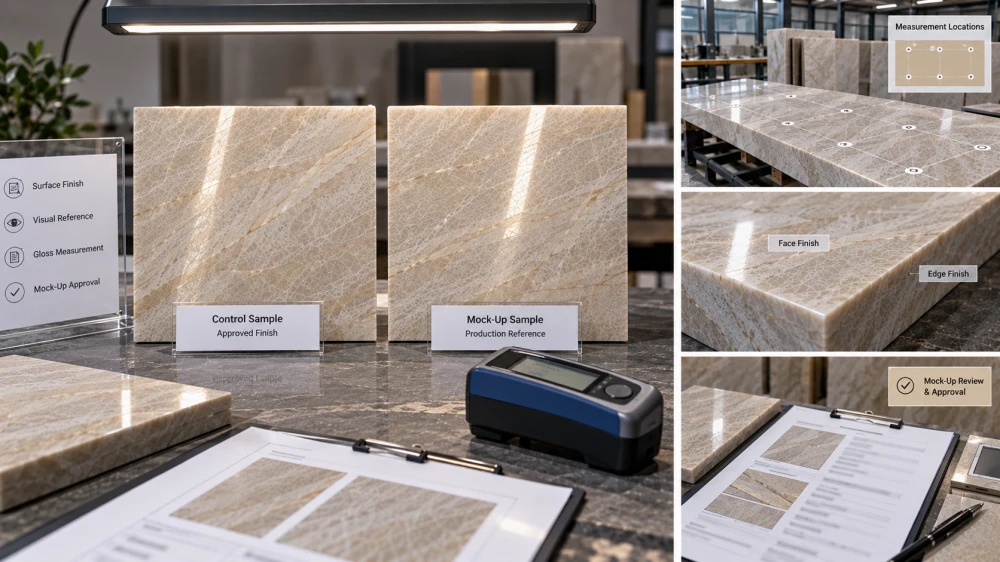
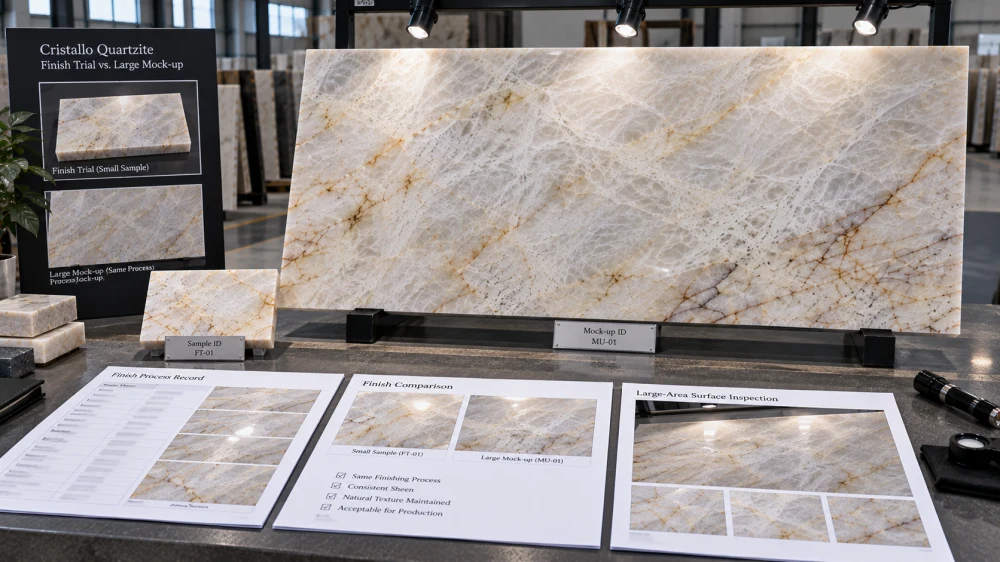
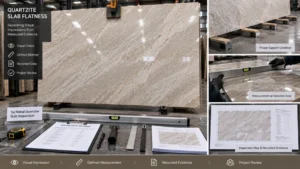
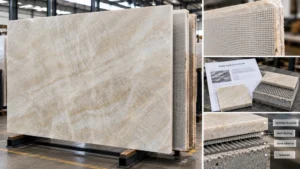
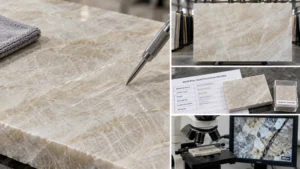
मॉक-अप के लिए क्वार्ट्ज़ाइट सतह की चमक को निर्दिष्ट करने के लिए, केवल पॉलिश्ड, होन्ड, शाइनी या मैट लिखने से अधिक कुछ करें। प्राकृतिक क्वार्ट्ज़ाइट के नियंत्रण नमूने की पहचान करें, इच्छित दृश्य दिखावे को परिभाषित करें, बताएं कि स्वीकृति दृश्य आधारित है या उपकरण आधारित है, और—यदि चमक के माप की आवश्यकता है—मापन की विधि, ज्यामिति, स्थानों, सतह की स्थिति तथा परियोजना विशिष्ट स्वीकृति सीमा को दर्ज करें। इसके बाद, अनुमोदित मॉक-अप को एक अलग-थलग फोटो या चमक के नंबर के बजाय, ट्रेस करने योग्य उत्पादन संदर्भ में बदल देना चाहिए।.
एक विनिर्देश कहता है:
प्राकृतिक क्वार्ट्ज़ाइट — होन्ड फिनिश।.
फैब्रिकेटर एक मॉक-अप तैयार करता है।.
डिज़ाइनर कहता है कि यह बहुत चमकीला है।.
फैक्ट्री कहती है कि यह पहले से ही होन्ड है।.
कौन सही है?
समस्या शायद कारीगरी की नहीं है। परियोजना ने शायद कभी यह भी परिभाषित नहीं किया है कि इस मॉक-अप के लिए क्वार्ट्ज़ाइट सतह की चमक वास्तव में क्या अर्थ रखती है।.
एक अधिक उपयोगी विनिर्देश इस प्रकार की श्रृंखला बनाता है:
डिज़ाइन इंटेंट → कंट्रोल सैम्पल → दृश्य चमक लक्ष्य → आवश्यकता होने पर मापन विधि → परीक्षण स्थान → स्वीकृति सीमा → मॉक-अप अनुमोदन → उत्पादन संदर्भ
चमक के नंबर से नहीं, बल्कि दिखावे से शुरू करें
किसी उपकरण के मान का चयन करने से पहले, परियोजना द्वारा दृश्य रूप से क्या प्राप्त करने का प्रयास किया जा रहा है, उसे परिभाषित करें।.
उदाहरण के लिए, डिज़ाइन इंटेंट यह कह सकता है:
क्वार्ट्ज़ाइट-सतह-चमक-मॉक-अप-निर्दिष्टता
एक अत्यधिक प्रतिबिंबी पॉलिश्ड दिखावा;
एक संयमित कम चमक वाला होन्ड दिखावा;
एक नरम सतह जिसमें सीधे प्रतिबिंब की सीमित मात्रा हो;
एक बनावटी फिनिश जिसमें जानबूझकर टूटे हुए प्रतिबिंब हों; या
एक परियोजना विशिष्ट दिखावा जो एक अनुमोदित भौतिक नमूने द्वारा स्थापित किया गया हो।.
यह महत्वपूर्ण है क्योंकि अंतिम प्रश्न केवल यह नहीं है:
“मीटर ने कौन सा नंबर दिखाया?”
यह है:
“क्या तैयार प्राकृतिक क्वार्ट्ज़ाइट परियोजना द्वारा अनुमोदित दिखावे के अनुरूप है?”
पॉलिश्ड और होन्ड फिनिश के नाम हैं, पूर्ण चमक विनिर्देश नहीं हैं
पॉलिश्ड और होन्ड जैसे शब्द उपयोगी हैं, लेकिन वे अकेले किसी परियोजना के स्वीकृति मानदंड को पूरी तरह से निर्धारित नहीं करते हैं।.
एक ही फिनिश नाम का उपयोग करते हुए वर्णित दो सतहें भी दृश्य रूप से अलग-अलग हो सकती हैं:
प्रतिबिंब की ताकत;
प्रतिबिंब की एकरूपता;
रंग की गहराई;
खनिज की परिभाषा;
सतह की बनावट;
प्रसंस्करण की दिशा;
स्थानीय नीरस या चमकीले क्षेत्र; और
चेहरे से किनारे तक का दिखावा।.
इस कारण से, जहाँ भी दिखावा महत्वपूर्ण हो, फिनिश के नाम को वास्तविक नियंत्रण संदर्भ से जोड़ा जाना चाहिए।.
एक पहचानी गई कंट्रोल सैम्पल का उपयोग करें
कंट्रोल सैम्पल उन शब्दों जैसे पॉलिश्ड, होन्ड, कम चमक या मैट को एक भौतिक संदर्भ प्रदान करता है।.
दर्ज करें:
कंट्रोल आइटम
क्या दर्ज करना है
सामग्री
प्राकृतिक क्वार्ट्ज़ाइट व्यापार / परियोजना संदर्भ
नमूना आईडी
अनुमोदित संदर्भ के लिए स्थिर पहचानकर्ता
स्लैब संबंध
जहाँ उपलब्ध हो, ज्ञात स्लैब / लॉट / परियोजना संबंध
खत्म करना
अनुमोदित फिनिश विवरण
समीक्षित चेहरा
तुलना के लिए वास्तव में उपयोग की गई सतह
अनुमोदन तिथि / संशोधन
वर्तमान परियोजना अनुमोदन रिकॉर्ड
अगर भौतिक संदर्भ को परियोजना रिकॉर्ड तक ट्रेस नहीं किया जा सकता है, तो “अनुमोदित होन्ड फिनिश” लेबल वाली फोटो पर भरोसा न करें।.
निर्णय लें कि स्वीकृति दृश्यमान है, उपकरण आधारित है, या दोनों है
हर क्वार्ट्ज़ाइट परियोजना को संख्यात्मक चमक मापने की आवश्यकता नहीं होती है।.
एक उपयोगी विनिर्देश में स्वीकृति मार्ग का स्पष्ट रूप से चयन किया जाना चाहिए।.
दृश्य नियंत्रणनियंत्रित देखने की स्थितियों में मॉक-अप की तुलना स्वीकृत भौतिक संदर्भ से सीधे करें।.
उपकरण नियंत्रणएक निर्धारित मापन पद्धति, ज्यामिति, स्थानों और परियोजना स्वीकृति सीमा का उपयोग करें।.
संयुक्त नियंत्रणपुनरावृत्ति के लिए संख्यात्मक मापन का उपयोग करें, जबकि स्वीकृत भौतिक नमूने को दृश्य संदर्भ के रूप में बनाए रखें।.
रूप के प्रति संवेदनशील वास्तुकला पत्थर के लिए, जब परियोजना टीम एक भौतिक रूप संदर्भ और एक पुनरावृत्तियुक्त QC रिकॉर्ड दोनों चाहती है, तो संयुक्त दृष्टिकोण उपयोगी हो सकता है।.
लेकिन परियोजना—कोई सामान्य लेख नहीं—फैसला करे कि उपकरण द्वारा मापन आवश्यक है या नहीं।.
यदि आप चमक के इकाइयों को निर्दिष्ट करते हैं, तो मापन पद्धति को भी निर्दिष्ट करें
ऐसी आवश्यकता जैसे कि:
चमक = 30
अकेले यह अपूर्ण है।.
यदि संख्यात्मक चमक स्वीकृति आवश्यकता का हिस्सा है, तो विनिर्देश में लागू मापन प्रक्रिया और पढ़ने को पुनरावृत्ति योग्य बनाने के लिए पर्याप्त परीक्षण जानकारी की पहचान करनी चाहिए।.
चयनित पद्धति और उपकरण के आधार पर, संबंधित जानकारी में शामिल हो सकते हैं:
मापन मानक या सहमत प्रक्रिया;
उपकरण का प्रकार या स्वीकृत उपकरण;
मापन ज्यामिति;
कैलिब्रेशन प्रक्रिया;
नमूने की स्थिति;
मापन स्थान;
पढ़ने की संख्या;
रिपोर्टिंग पद्धति;
स्वीकृति सीमा; और
जिम्मेदार समीक्षक।.
विनिर्देश नियम
नेचुरल क्वार्ट्ज़ाइट के लिए एक सार्वभौमिक GU लक्ष्य न लिखें, बिना यह निर्धारित किए कि पढ़ना कैसे प्राप्त किया जाता है। एक चमक संख्या तभी उपयोगी होती है, जब परियोजना मापन पद्धति, ज्यामिति, नमूने की स्थिति, परीक्षण स्थानों और स्वीकृति नियम को भी नियंत्रित करती है।.
मापन ज्यामिति क्यों महत्वपूर्ण है
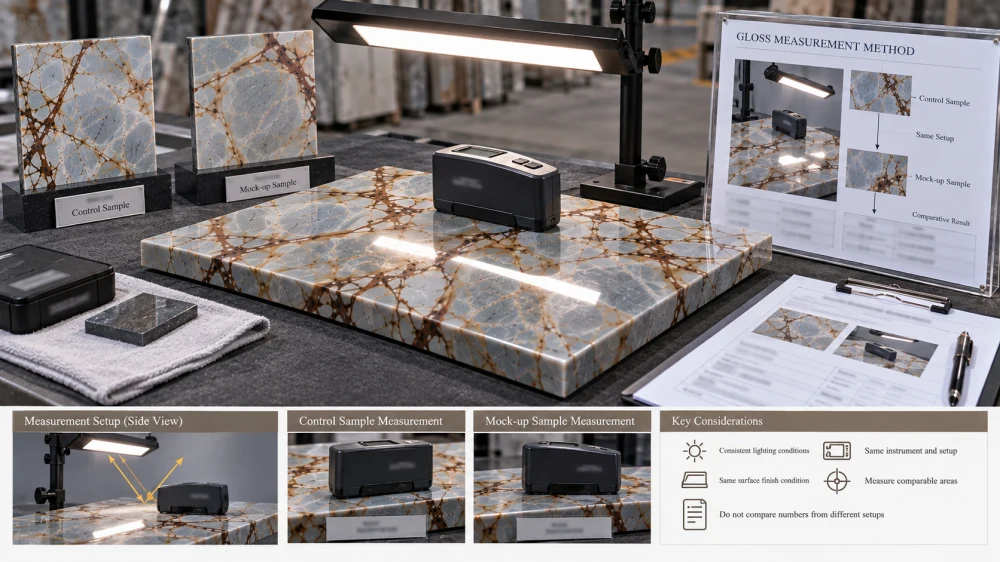
चमक मापन प्रक्रिया इस बात पर निर्भर करती है कि प्रकाश को सतह की ओर कैसे निर्देशित किया जाता है और परावर्तित प्रकाश को कैसे मापा जाता है।.
नीला-रोमा-क्वार्ट्ज़ाइट-चमक-मापन-ज्यामिति
इसलिए, एक परियोजना किसी अन्य विनिर्देश से चमक संख्या कॉपी न करे, जबकि उसे पैदा करने वाली मापन ज्यामिति को छोड़ दे।.
यदि परियोजना किसी विशिष्ट मानक, उपकरण प्रक्रिया या अनुबंधित मापन ज्यामिति का संदर्भ लेती है, तो उस आवश्यकता का लगातार उपयोग करें:
नियंत्रण नमूना → मॉक-अप → उत्पादन QC → अंतिम समीक्षा
बीच में पद्धति बदलकर और उत्पन्न संख्याओं की तुलना ऐसे करें, मानो वे एक ही परीक्षण स्थिति से आए हों।.
चमकदार या चिकनी क्वार्ट्ज़ाइट के लिए एक सार्वभौमिक चमक सीमा न बनाएं
यह विशेष रूप से नेचुरल क्वार्ट्ज़ाइट के लिए महत्वपूर्ण है।.
एक विनिर्देश यह अनुमान न लगाए कि हर:
चमकदार क्वार्ट्ज़ाइट;
चिकनी क्वार्ट्ज़ाइट;
ब्रश किया हुआ क्वार्ट्ज़ाइट;
चमड़े जैसा क्वार्ट्ज़ाइट; या
अन्य परियोजना फिनिश
एक ही सार्वभौमिक चमक सीमा के अंदर आना चाहिए।.
सामग्री का चरित्र, खनिज का वितरण, फिनिश प्रक्रिया, सतह की बनावट, मापन पद्धति और इरादा डिजाइन का रूप सभी मायने रख सकते हैं।.
सबसे सुरक्षित क्रम है:
प्रतिनिधि फिनिश विकसित करें → मॉक-अप की समीक्षा → परियोजना मानक स्थापित करें → स्वीकृत संदर्भ दर्ज करें → उस संदर्भ के अनुसार उत्पादन को नियंत्रित करें
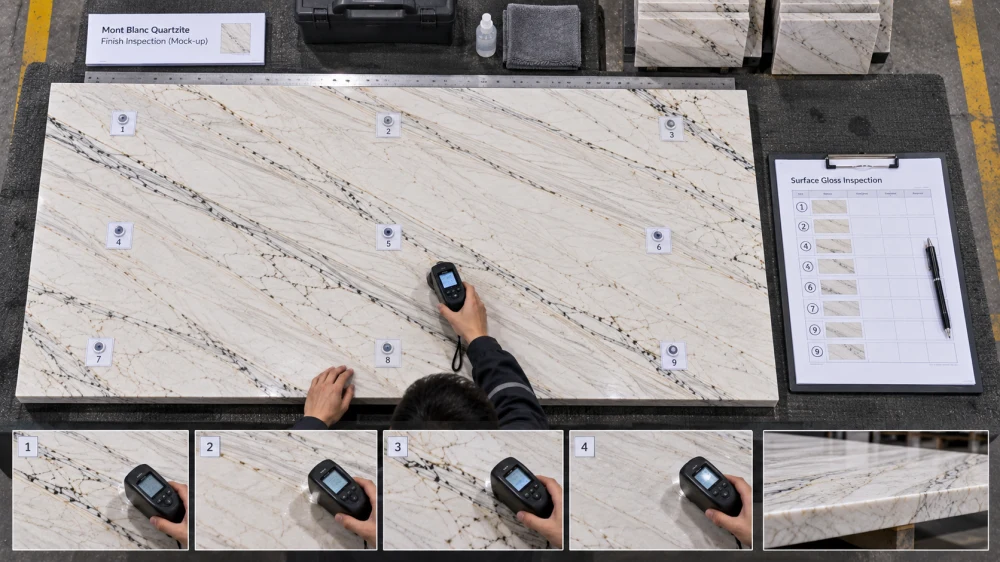
परीक्षण से पहले मापन स्थानों का चयन करें
नेचुरल क्वार्ट्ज़ाइट एक दृश्य रूप से एकसमान निर्मित चादर नहीं है।.
एक ही सुविधाजनक बिंदु से एक अकेली पढ़ने का नतीजा पूरे मॉक-अप का प्रतिनिधित्व नहीं कर सकता है।.
Where numerical measurement is required, define the locations before testing.
Depending on the mock-up geometry, the review might consider:
mont-blanc-quartzite-gloss-measurement-locations
central field;
additional field locations;
different visible mineral zones where relevant;
areas near but not distorted by an edge;
separately fabricated returns;
finished edges where the project requires them to match; and
other project-specific visible surfaces.
Do not move the meter around after seeing the readings until a preferred result appears.
The sampling plan should come first.
Use Multiple Readings to Understand Uniformity
If instrument readings are part of the specification, the project may need more than one reading.
The objective is not simply to find one point that falls inside the required range.
The readings should help the team understand whether the reviewed surface is reasonably consistent under the project-defined acceptance method.
The specification should state how the readings are evaluated—for example, whether the project reviews individual locations, an agreed statistical summary, variation between locations, or another defined rule.
Do not invent that rule after the mock-up has already been measured.
Keep the Stone Clean, Dry, and in a Defined Surface Condition
Surface condition can affect both visual review and instrument readings.
Before the mock-up is assessed, record whether the surface is:
clean;
dry;
free from loose polishing residue;
free from temporary protective film;
free from uncontrolled surface contamination; and
in the project-defined condition for approval.
If a sealer, enhancer, coating, treatment, or other surface product is part of the final specified system, that condition should be separately defined rather than silently introduced during the comparison.
Visual Lighting Conditions Still Matter Even When You Use a Gloss Meter
A gloss meter does not eliminate the need for visual review when appearance is part of the design intent.
The mock-up should still be viewed under a documented lighting condition.
Record relevant information such as:
general light source;
light direction;
normal viewing distance;
low-angle viewing where relevant;
sample orientation;
surrounding finishes; and
whether the review represents normal project viewing conditions.
This is especially important because a surface can produce an acceptable instrument reading while still showing localized processing bands, inconsistent reflections, or other visible differences that require discussion.
Natural Mineral Zones Can Affect the Reading
A Natural Quartzite surface can contain different mineral structures across the same piece.
One mock-up may include:
fine crystalline areas;
coarser crystalline zones;
lighter and darker minerals;
vein bands;
natural textural transitions; and
locally treated or reinforced areas where relevant.
If these zones respond differently to finishing, the measurement plan should not pretend the surface is perfectly homogeneous.
Record where readings were taken so the numbers remain connected to the actual stone.
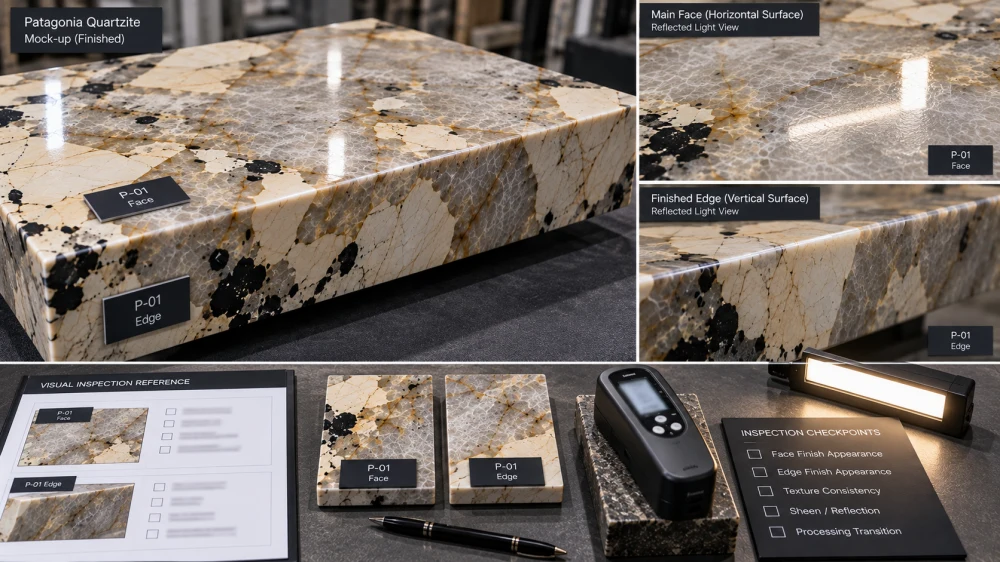
Specify Face and Edge Gloss Separately Where Needed
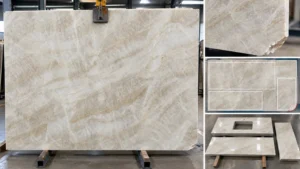
A countertop mock-up may include a broad horizontal face and a polished, honed, mitered, eased, or profiled edge.
Do not automatically assume that matching the face measurement proves the edge matches visually.
Edge finishing can involve:
patagonia-quartzite-face-edge-gloss-mock-up
different tools;
different working direction;
smaller processing areas;
different access;
profile geometry; and
different reflected-light behavior.
If the edge is a visible design element, include it in the mock-up approval separately.
Mock-Up Size Should Represent the Decision Being Made
A very small chip may be useful for initial finish development.
It may not be enough to approve the finish of a large island, long vanity, wall panel, reception counter, or other broad architectural surface.
Build an Acceptance Range From the Project Reference
If the project requires numerical control, an agreed range is generally more meaningful than pretending every point on a Natural Quartzite surface must produce one exact number.
But the range should come from the project’s approved method and reference—not from a generic online table.
The approval record should answer:
What is being measured?
Which sample established the target?
Which measurement method applies?
Which geometry applies?
Where are readings taken?
How many readings are required?
How are the results evaluated?
What project-specific range or acceptance rule applies?
Does visual approval also apply?
Who has authority to approve?
A Useful Quartzite Surface Gloss Specification
A project specification can follow this structure:
Edge Requirement: [Separate visual / measurement requirement where applicable]
Approval Owner: [Named project role]
Production Scope Released: [Defined pieces / area / slab group]
This format intentionally leaves project-specific numerical fields open until the responsible team defines them.
That is safer than inserting an unsupported universal gloss target.
Do Not Let One Mock-Up Approve Unlimited Production
An approved mock-up should have a defined scope.
Record whether it applies to:
a named slab or slab group;
a defined project area;
a particular finish process;
specified faces;
specified edge conditions;
a particular fabrication facility or process where relevant; and
a stated production revision.
If a meaningful variable changes, decide whether another review is required.
उदाहरण के लिए:
New Slab Group → New Finish Process → Different Surface Treatment → Different Edge → Different Mock-Up Scale → Re-review as Required
Connect the Mock-Up to Production QC
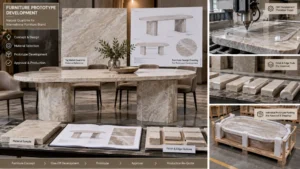
A mock-up has limited value if it disappears after design approval.
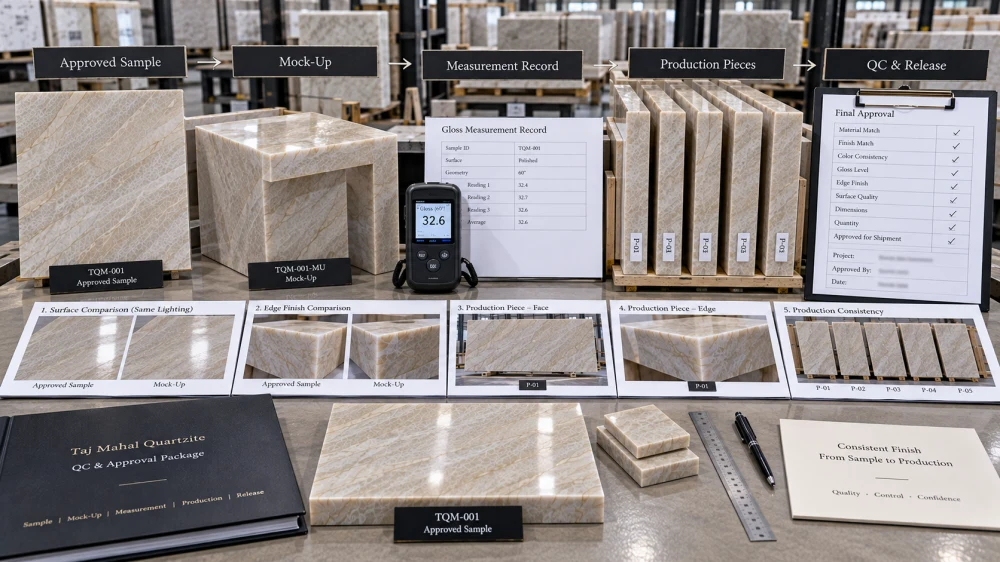
The approved reference should remain available to the production and QC teams.
A useful control chain is:
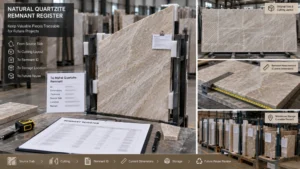
Approved Sample → Mock-Up ID → Finish Process → Measurement Record → Production Piece → QC Record → Final Approval
If the project later asks whether a finished piece matches the approved surface, the team should be able to trace the answer back to the same control reference.
What Buyers Should Confirm Before Mock-Up Approval
प्रश्न
Why It Matters
Which physical sample is the control reference?
Prevents approval from relying on a generic finish name
Is approval visual, numerical, or both?
Defines how the mock-up will actually be judged
What measurement method applies?
Makes numerical readings reproducible
Where are readings taken?
Prevents selective measurement after results are known
Are face and edge reviewed separately?
Different geometries can show different finish behavior
Is the mock-up large enough?
Small samples can hide large-area processing variation
What production scope does approval release?
Prevents one sample approval from becoming an unlimited guarantee
quartzite-approved-gloss-mock-up-production-qc
सामान्य प्रश्न
1. How should surface gloss be specified for a Quartzite mock-up?
प्राकृतिक क्वार्ट्ज़ाइट नियंत्रण नमूने की पहचान करें, अभिप्रेत दृश्य परिशोधन का वर्णन करें, मॉक-अप के आकार और सतह की स्थिति को परिभाषित करें, तथा बताएं कि स्वीकृति दृश्य आधारित है, यंत्र आधारित है, या दोनों आधारित है। यदि संख्यात्मक चमक मापन पठनों की आवश्यकता हो, तो मापन विधि, ज्यामिति, स्थान, पठनों की संख्या, स्वीकृति नियम और अनुमोदन के मालिक को भी परिभाषित करें।.
2. Is “honed finish” enough to specify Quartzite gloss?
हमेशा नहीं। होन्डेड एक सामान्य फिनिश दिशा को पहचानता है, लेकिन दो होन्डेड सतहें भी चमक, प्रतिबिंबित प्रकाश के व्यवहार, बनावट, रंग की गहराई और प्रसंस्करण की एकरूपता में अलग-अलग हो सकती हैं। जिन परियोजनाओं में उपस्थिति का विशेष ध्यान रखा जाता है, उनके लिए फिनिश के नाम को एक अनुमोदित भौतिक संदर्भ और परियोजना-विशिष्ट स्वीकृति विधि से जोड़ें।.
3. What gloss unit should polished or honed Quartzite have?
There is no single universal gloss value that should automatically be applied to every polished or honed Natural Quartzite project. If a numerical requirement is needed, establish it using the project’s selected material, approved reference, measurement method, geometry, and acceptance criteria.
4. Why does measurement angle matter when checking Quartzite gloss?
ग्लॉस मापन के पठन चयनित विधि या उपकरण द्वारा उपयोग की गई मापन ज्यामिति पर निर्भर करते हैं। इसलिए, एक संख्यात्मक परिणाम को अपनी मापन प्रक्रिया से जोड़ा जाना चाहिए। विभिन्न ज्यामितियों का उपयोग करके प्राप्त परिणामों को उचित तकनीकी औचित्य के बिना सीधे आपस में विनिमय योग्य माना नहीं जाना चाहिए।.
5. Should a Quartzite mock-up use several gloss readings?
यदि संख्यात्मक माप की आवश्यकता हो, तो एक सुविधाजनक पठन के बजाय कई पूर्वनिर्धारित स्थान अधिक उपयोगी रिकॉर्ड प्रदान कर सकते हैं, खासकर एक स्वाभाविक रूप से परिवर्तनशील सतह पर। परीक्षण से पहले परियोजना को माप के स्थानों, पठनों की संख्या और मूल्यांकन नियम को परिभाषित करना चाहिए।.
6. Should Quartzite edges use the same gloss requirement as the main face?
यह मान लेना ठीक नहीं है कि वे स्वचालित रूप से समान दिखेंगे। एज ज्यामिति और प्रसंस्करण से प्रतिबिंबित प्रकाश के व्यवहार में परिवर्तन हो सकता है। यदि समाप्त एज दृश्य रूप से महत्वपूर्ण हैं, तो उन्हें मॉक-अप समीक्षा में अलग से शामिल करें और अनुमोदित फेस फिनिश के साथ आवश्यक संबंध को परिभाषित करें।.
7. Does an approved Quartzite mock-up automatically approve all production slabs?
नहीं। अनुमोदन रिकॉर्ड में यह निर्धारित किया जाना चाहिए कि वह किस सामग्री, स्लैब समूह, फिनिश प्रक्रिया, सतहों, टुकड़ों या परियोजना क्षेत्र को कवर करता है। सामग्री या प्रसंस्करण में एक सार्थक परिवर्तन के लिए एक और समीक्षा की आवश्यकता हो सकती है।.
Final Gloss-Specification RuleDo not specify Quartzite surface gloss with one adjective or one unexplained number. Keep the control chain complete: Design Intent → Control Sample → Visual Finish → Measurement Method if Required → Geometry → Test Locations → Acceptance Rule → Mock-Up Approval → Production QC.
For project-based Natural Quartzite fabrication, HRST STONE can coordinate actual stone references, finish trials, mock-up samples, fabrication drawings, finish comparison photographs, production QC records, piece identification, packing, and export documentation for the confirmed scope. Send Josh the material name, approved or proposed finish reference, drawings, dimensions, quantities, visible surfaces, mock-up requirement, measurement specification if applicable, and delivery destination before bulk production release.
Hi, I am the author of this article. I have been working in the field of Natural Stone for more than 15 years. If you need customized Natural Stone services, please feel free to contact me.