

A quartzite seam should be moved when the revised position gives the project a better overall result without creating a new fabrication, support, installation or visual problem. The strongest explanation is a before-and-after layout using the same identified slabs and current component geometry. It should show what the original seam interrupted, what triggered the revision, where the new seam sits, and which trade-offs remain before cutting is released.
Trigger: actual slab review, updated drawings, cutout geometry, support information, site access or buyer visual priorities expose the conflict.
After: seam is relocated and the complete layout is reviewed again—not just the seam line.
Release: the revised layout becomes the controlling approval only after the appropriate project parties accept the new relationship.
ए quartzite seam layout is a project-specific cutting arrangement showing how finished stone components, seams, openings, visible faces and important natural slab features relate to the actual physical Quartzite selected for fabrication.
The seam itself is only one line.
Moving it can change much more than one line.
It can affect:
Piece Geometry → Vein Relationship → Opening Position → Support → Slab Yield → Handling → Installation → Finished Appearance
A useful before-and-after drawing should do more than show that the seam moved 200 mm, 400 mm or any other project-specific distance.
It should explain why the new relationship is preferable.
Both layouts should use the same controlled project information wherever possible:
This prevents the comparison from becoming misleading.
If the “before” drawing uses an old cabinet plan while the “after” layout uses updated dimensions, the viewer is not evaluating seam movement alone.
They are comparing two different project conditions.
The safest record identifies what changed and what stayed constant.
An initial seam does not have to be obviously wrong for a better location to exist.
The first layout may have been prepared before:
As project information becomes more complete, seam logic may improve.
That is design and fabrication development—not automatically an error in the earlier drawing.
“Is the original seam possible?”
पूछें:
“Given the actual slab, current openings, support, access and visual priorities, is this still the best available seam position for the project?”
Most useful seam revisions can be traced to one or more of three types of conflict.
A seam may divide a strong natural feature in an awkward way.

For directional Quartzite, a prominent vein, ribbon, crystal zone or dark mineral movement can make the joint more visually obvious if the two sides create an abrupt transition.
Moving the seam may allow:
This does not mean a seam can be made invisible.
Natural stone remains natural, and two fabricated pieces remain two fabricated pieces.
The objective is controlled composition rather than a promise of perfect matching.
The seam may interact poorly with:
The responsible fabricator should review these relationships against the current stone, equipment information and finished component geometry.
A buyer should not invent one universal rule stating that a seam must always pass through or always avoid a particular point.
A single piece may work beautifully on the slab and still be impractical to move into the building.
A doorway, service lift, tight corridor or installation sequence can require the component strategy to change.
साइट का Quartzite installation access survey explains why access should be resolved before cutting oversized components. If segmentation changes, the seam relationship normally returns to the layout for review.
Do not compare only the location of the seam line.
Compare the consequences of moving it.
| समीक्षा बिंदु | Before Layout | Revised Layout |
| Seam Visibility | Does the seam interrupt a major natural feature? | Is the visual transition more controlled? |
| Openings | How does the seam relate to sink / cooktop geometry? | Has the relationship improved without creating another conflict? |
| Stone Features | Which mineral zones fall near the original joint? | Which features now fall in each finished piece? |
| Support | Is support coordination unresolved? | Does the revised seam suit the approved support concept? |
| Piece Size | Are any pieces difficult to fabricate, transport or install? | Does the new split create more practical components? |
| Slab Yield | What material remains? | Does relocation consume another slab or reduce useful reserve stone? |
| इंस्टालेशन | How are pieces delivered and assembled? | Does the revised strategy remain installable? |
This table turns:
“We moved the seam because it looks better.”
into:
“Here is what the seam relocation improves, here is what it changes, and here is what still requires approval.”
A generic countertop CAD drawing contains geometry but no natural stone.
The actual slab adds another layer of information.
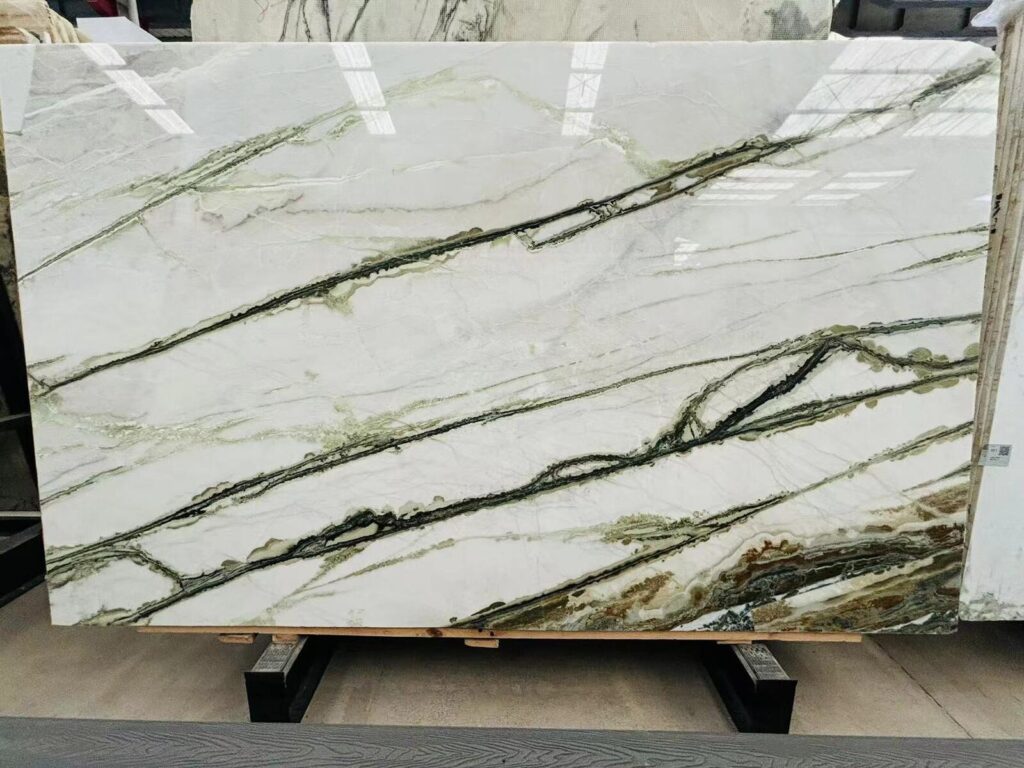
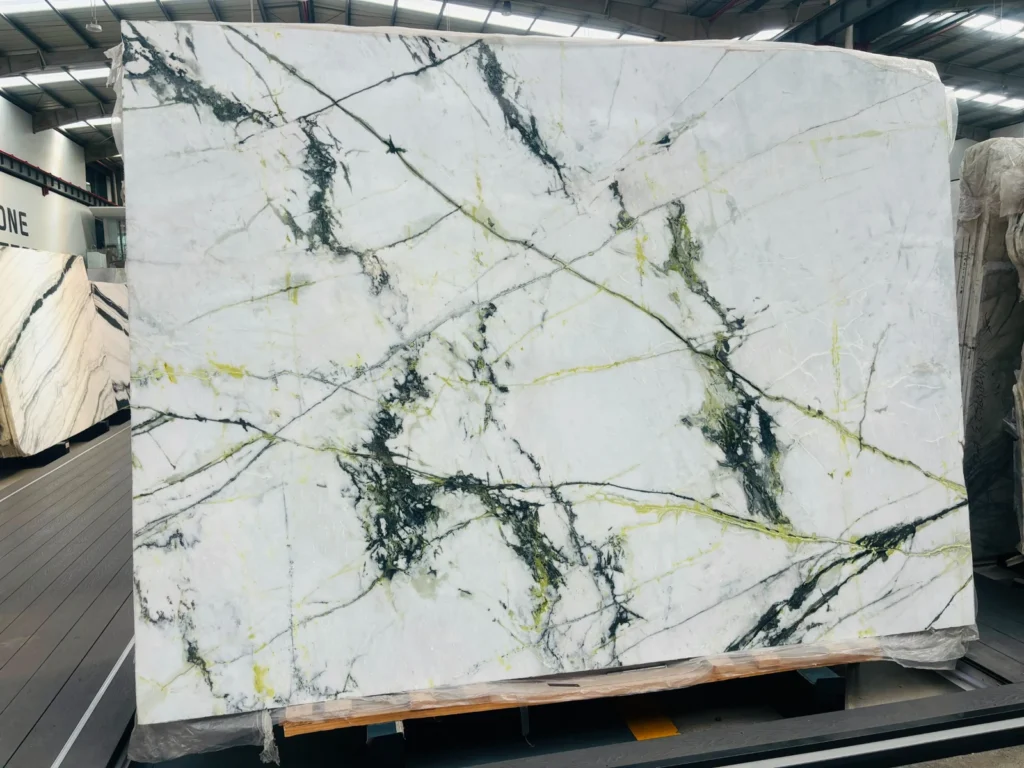
For visually active materials such as Blue Roma Quartzite, Patagonia Quartzite or strongly directional Macaubas-type Quartzites, seam placement should be reviewed against the real mineral composition rather than only against an empty outline.
Consider an illustrative Blue Roma Quartzite layout.
The original seam may cross a strong dark brown fissure movement in one piece and meet a pale crystalline area in the next.
Both pieces may be dimensionally valid.
But when the real slab image is placed below the cutting outlines, the transition looks abrupt.
A revised layout shifts the joint into a quieter blue-grey zone while preserving the stronger mineral movement within the main visual field.
The revised seam may therefore improve composition.
But the review is not finished yet.
The project must still check openings, yield, support and installation.
This is why seam planning should use:
Actual Slab → Finished Component Outlines → Seam → Natural Features → Technical Constraints → Approval
rather than:
Generic Rectangle → Seam
This is another reason a before-and-after layout can become valuable.

A current slab review may identify a repair, fissure-like feature, mineral transition or another observed condition that needs project-specific review.
The condition itself does not automatically mean the slab should be rejected.
Location matters.
The Quartzite slab condition-map guide connects each observed area to the exact board, location and proposed finished-piece position.
Once that condition is overlaid onto the cutting layout, the project can see whether it falls:
A seam relocation can then become one possible layout response.
But it should be presented as:
Observed Condition → Location → Layout Consequence → Revised Proposal
not:
“This area looks bad, so move the seam.”
हाँ।.
This is one of the most important points in the article.
A seam moved into a visually quiet area may create:

For that reason, the strongest seam decision passes three questions.
2 — Technical: Is the revised component geometry acceptable to the responsible fabricator and compatible with openings, edges, support and other fabrication conditions?
3 — Practical: Can the revised pieces be handled, transported and installed under the actual project conditions?
A seam should not be declared “better” until all three perspectives have been considered.
Support should be coordinated before final cutting on complex countertops and islands.
A preliminary layout may position a joint where the cabinet or support design later creates a conflict.
उदाहरण के लिए:

a concealed frame may need to occupy the same region, a support member may interact with the proposed joint, or a cabinet transition may change the preferred component break.
The stone fabricator and responsible support designer should resolve the actual project-specific relationship.
The buyer’s role is to make sure the seam layout and support information are not being reviewed in separate document worlds.
A seam revision caused by support should show:
Original Joint → Support Conflict / Coordination Issue → Revised Joint → Current Support Basis
Do not simply move the line in the stone drawing while leaving an outdated support drawing in circulation.
A seam move can improve visual composition while reducing material efficiency.
It can also do the opposite.
Relocating a component may:
This is why buyers should not treat seam approval as a purely aesthetic markup.
When the change materially affects quantity or usable yield, procurement should see the consequence before approval.
A technically valid seam that adds another slab may still be the correct decision—but that commercial effect should be visible.
The old drawing should not disappear.
Keep enough revision history to explain why the current layout exists.
A strong comparison package can contain:
BEFORE
Layout R02
Original seam location
Original slab positions
Reason the layout was reconsidered
CHANGE
Actual slab condition / visual issue / opening revision / support coordination / site access / other defined trigger
AFTER
लेआउट R03
New seam location
New piece positions
Changes to vein movement, openings, yield or installation
DECISION
Accepted / revise again / technical review pending / visual review pending / production hold / released
The existing Quartzite layout approval guide explains why approval should identify the exact slabs, layout revision, piece positions, visible faces and seam positions being reviewed.
Do not reuse an old “APPROVED” email after the layout has materially changed.
This distinction matters for both procurement and factory execution.
If someone opens a PDF, draws a new seam in red and writes:
“Move joint here.”
the comment may be useful for discussion.
It is not necessarily the final fabrication instruction.
The fabricator should incorporate the agreed change into the controlled layout and return the updated revision where required.
This allows the project to verify that moving the seam has not unintentionally changed:
The revised layout—not the informal markup—should become the controlling fabrication reference.
For a project where the seam position has changed, a short record can make the revision much easier to understand later.
| फील्ड | रिकॉर्ड |
| Material / Board IDs | Actual Quartzite slabs under review |
| Previous Layout | Revision number / date |
| Original Seam | Identified joint / component relationship |
| Reason for Review | Visual / opening / slab condition / support / access / other |
| Revised Layout | वर्तमान संस्करण |
| New Seam | Current joint relationship |
| Visual Effect | What improves / changes |
| Technical Effect | Openings / support / geometry / fabrication comments |
| Commercial Effect | Slab quantity / yield / spare material if affected |
| Installation Effect | Piece size / access / sequence if affected |
| स्थिति | Pending / accepted / revise / released |
This record is particularly useful when several people are involved because it keeps the discussion attached to a specific layout revision rather than to screenshots circulating in different chats.

A seam may be moved after actual slab review, final opening information, support coordination, condition mapping, site-access review or visual-layout feedback shows that another position provides a better overall project result. The revised location should still be reviewed for fabrication and installation feasibility.
No universal seam position is correct for every project. Seam placement should be reviewed against the actual countertop geometry, sink or equipment information, stone, support, slab layout, handling and project appearance. The responsible fabricator should approve the project-specific fabrication solution.
Visual improvement can be a valid reason to study another seam location, especially with strongly directional Quartzite. However, the new location should also remain acceptable for openings, component geometry, support, fabrication, handling and installation.
If the seam relocation materially changes finished-piece positions, natural-feature placement, slab allocation, openings, yield or another approved relationship, issue and review a revised layout rather than relying on the earlier approval.
Potentially. First identify the condition and its exact slab location. Once it is overlaid on the proposed cutting layout, the team can decide whether the current position is acceptable, whether additional evidence is needed or whether moving the layout or seam is a better project-specific response.
Yes. If an oversized component cannot be moved through the actual delivery route, the project may need different segmentation. That change can alter seam position, slab layout, vein relationships, packing and installation sequence, so it should be resolved before final cutting.
Send the current slab references, latest countertop or project drawing, existing layout revision, sink and cooktop information, edge and waterfall details, relevant support or access information, and a clear explanation of why the current seam is being reconsidered. Identify whether the requested review is visual, technical, logistical or a combination of these.
Approve the relationship created by that line: the two finished pieces, the natural pattern transition, openings, support, slab yield, handling and installation conditions.
Buyer Next Step: Ask for the original and revised layouts side by side and require the revision note to state what the moved seam improves and what other project conditions it changes before fabrication is released.