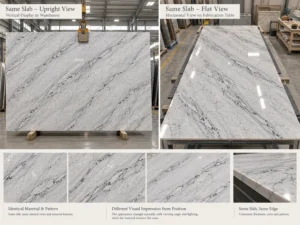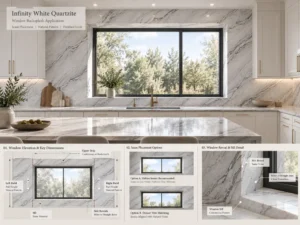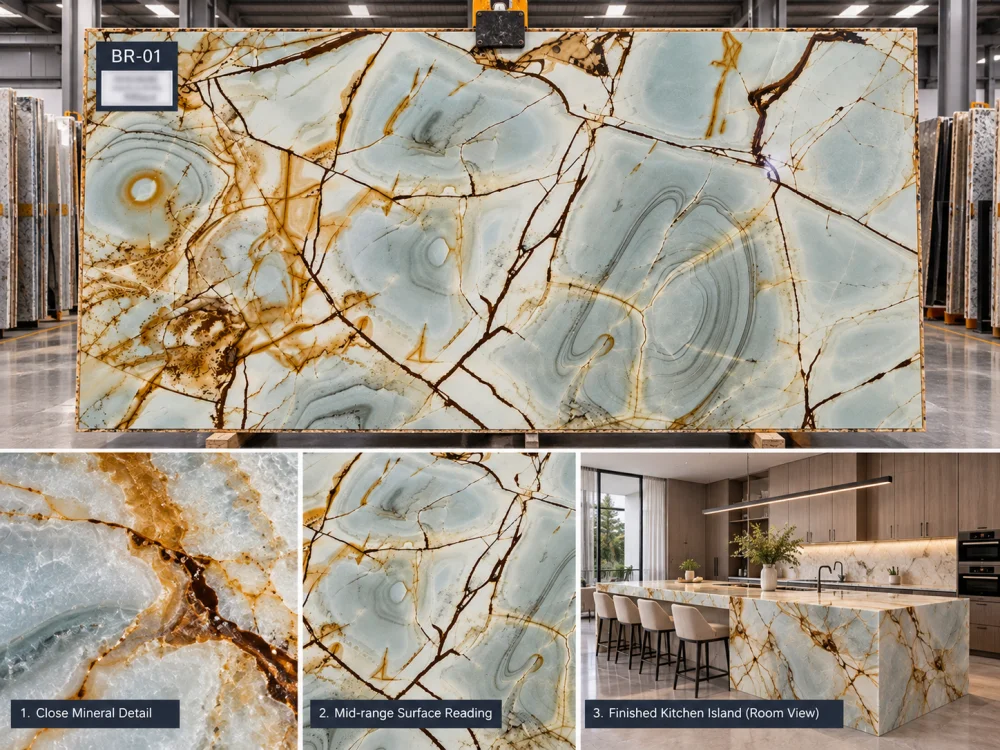
संक्षिप्त सारांश
क्वार्ट्ज़ाइट पैटर्न के पैमाने का आंकलन एक से अधिक दूरी से किया जाना चाहिए। एक क्लोज़-अप में क्रिस्टल, फिस्चर, रंग के संक्रमण और फिनिश का पता चल सकता है, लेकिन यह यह नहीं दिखा सकता कि एक किचन आइलैंड, फीचर वॉल, वैनिटी या रिसेप्शन काउंटर पर स्लैब की समग्र गति कैसी दिखेगी। दृश्य दिशा को मंजूरी देने से पहले, पूरे प्राकृतिक क्वार्ट्ज़ाइट स्लैब, प्रस्तावित फिनिश्ड पीस क्रॉप, संभावित कमरे के दृश्य रेखाएँ, देखने की दूरी, आसन्न फिनिश और प्रकाश व्यवस्था का समीक्षा करें।.
एक प्राकृतिक क्वार्ट्ज़ाइट स्लैब से 30 सेमी दूर खड़े होकर आप क्रिस्टल, छोटी खनिज रेखाएँ, रंग के संक्रमण और व्यक्तिगत भूवैज्ञानिक विवरण देख सकते हैं।.
कई मीटर दूर जाने पर उनमें से कई विवरण गायब हो जाते हैं।.
अब स्लैब एक व्यापक तिरछी गति, एक गहरे केंद्रीय द्रव्यमान, एक शांत पीले क्षेत्र या बड़े विपरीत क्षेत्रों की श्रृंखला के रूप में दिखाई दे सकता है।.
यह अंतर है क्वार्ट्ज़ाइट पैटर्न का पैमाना व्यावहारिक डिज़ाइन के संदर्भ में।.
यह बताता है कि एक छोटा नमूना सुंदर क्यों दिखाई दे सकता है, जबकि कमरे के दूसरी ओर से एक बड़े आइलैंड या फीचर वॉल का अनुभव कैसा होगा, इसके बारे में बहुत कम जानकारी दे सकता है।.
प्राकृतिक क्वार्ट्ज़ाइट की समीक्षा केवल एक ही दूरी से नहीं की जानी चाहिए।.
01 — क्लोज़ व्यू
क्रिस्टल, सूक्ष्म खनिज रेखाएँ, स्थानीय रंग परिवर्तन, सतह का फिनिश और छोटी प्राकृतिक विशेषताएँ पढ़ें।.
02 — वर्किंग डिस्टेंस
पत्थर को ऐसे पढ़ें, जैसे कोई सामान्य उपयोग के दौरान काउंटरटॉप, वैनिटी, बार या डाइनिंग सरफ़ेस का अनुभव करता है।.
03 — रूम डिस्टेंस
प्रमुख दृश्य गति, विपरीतता, संतुलन और कमरे के साथ समग्र संबंध को पढ़ें।.
उद्देश्य एक एकल सार्वभौमिक देखने की दूरी तय करना नहीं है।.
संबंधित दूरी वास्तविक अनुप्रयोग और लोगों के अनुभव के तरीके से आती है।.
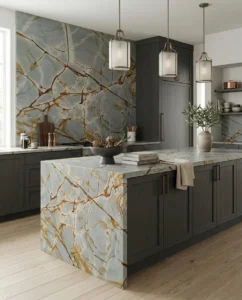
एक ब्लू रोमा क्वार्ट्ज़ाइट स्लैब की कल्पना करें।.
क्लोज़ रेंज से, ध्यान व्यक्तिगत क्रिस्टलीय संरचनाओं, गहरे शाखादार खनिज रेखाओं और छोटे रंग संक्रमण पर जा सकता है।.
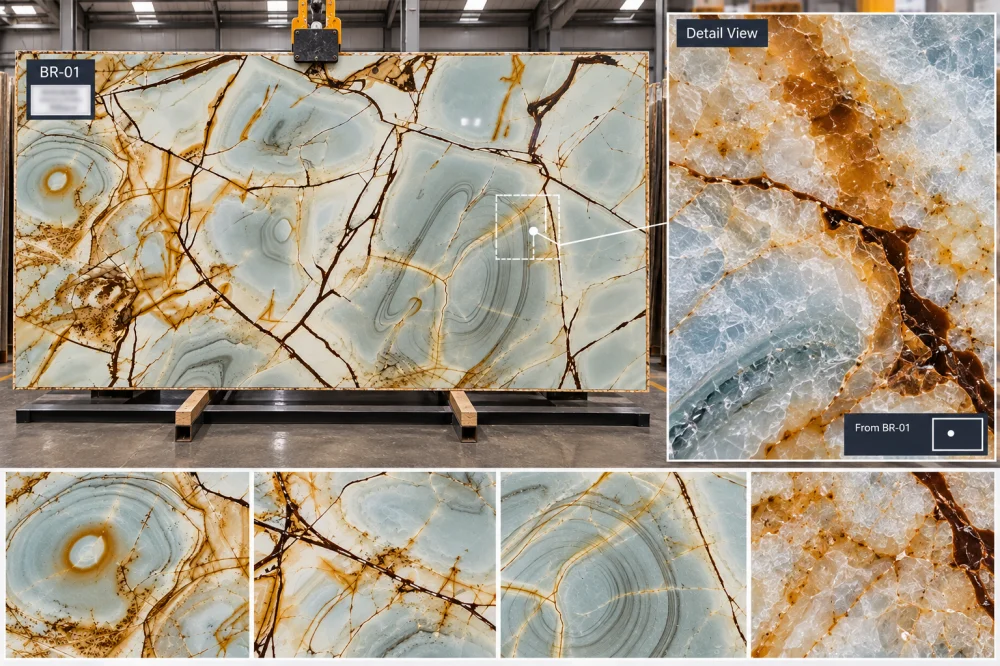
वर्किंग डिस्टेंस पर, वे स्थानीय विवरण बड़े भूवैज्ञानिक समूहों में जुड़ने लगते हैं।.
कमरे के प्रवेश द्वार से, प्रमुख पठन बदलकर व्यापक नीले-ग्रे क्षेत्रों, गहरी गति और बड़े विपरीत खनिज संरचनाओं के बीच का संबंध बन सकता है।.
इनमें से कोई भी दृश्य अन्य की तुलना में ज़रूरी रूप से अधिक “सही” नहीं है।.
वे अलग-अलग डिज़ाइन प्रश्नों का उत्तर देते हैं।.
एक छोटा नमूना समीक्षा के लिए उपयोगी हो सकता है:
लेकिन एक छोटा नमूना कमरे की दूरी पर पूरे स्लैब को परिभाषित करने वाली विशेषताओं को छोड़ सकता है।.
छोटा नमूना
यह जवाब देता है: सामग्री का यह स्थानीय क्षेत्र कैसा दिखता है और कैसा लगता है?
पूरा स्लैब
यह जवाब देता है: उपलब्ध पत्थर में भूवैज्ञानिक गति कैसे वितरित है?
इसीलिए एक क्लोज़-अप को पूरे स्लैब की समीक्षा का समर्थन करना चाहिए, न कि उसे बदलना चाहिए।.
एक और कदम है।.
एक पूरा स्लैब शोरूम डिस्प्ले पर हावी होने के लिए लगभग पर्याप्त आकार का हो सकता है, जबकि फिनिश्ड प्रोजेक्ट में उस स्लैब से केवल एक विशेष क्रॉप का उपयोग किया जा सकता है।.
ग्राहक अप्रयुक्त हिस्सों का अनुभव नहीं करेंगे।.
वे अनुभव करेंगे फिनिश्ड पीस क्रॉप.
के लिए क्वार्ट्ज़ाइट पैटर्न का पैमाना, that transformation is critical.
Suppose a dramatic Patagonia Quartzite slab contains several visually different geological areas.
A kitchen island uses only the central portion.
The correct design question is therefore not simply:
“Do we like this slab?”
यह है:
“What will this particular part of this slab look like when it becomes this particular island?”
THE CROP TEST
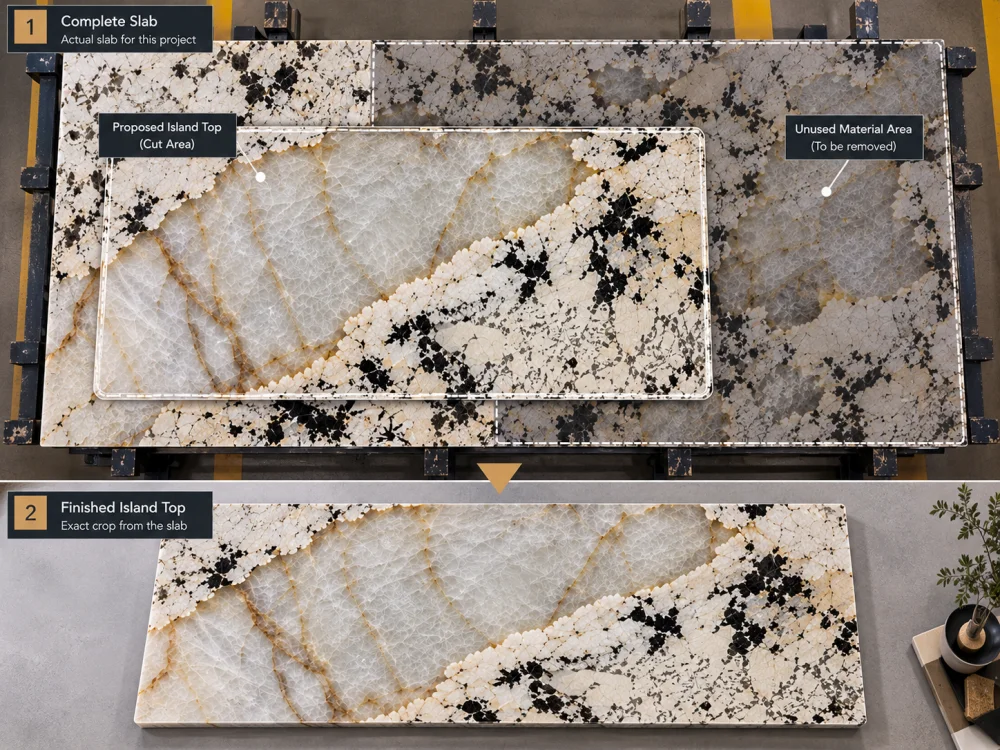
चरण 1: View the complete identified slab.
चरण 2: Overlay the actual finished-piece outline.
चरण 3: Hide or visually reduce the material outside that outline.
चरण 4: Rotate the crop into its intended installed orientation.
चरण 5: Review the resulting composition from the likely room view.
Step 6: Decide whether the dominant pattern is positioned where the design intends it to be.
Some Natural Quartzite slabs appear extremely active when viewed closely.
At room distance, many small features visually merge.
The result may become much calmer than the close photograph suggests.
This can happen when:
A close photograph can therefore exaggerate the importance of local detail relative to the installed room experience.
Pattern scale is not only about the physical size of a vein or mineral area.
Contrast matters.
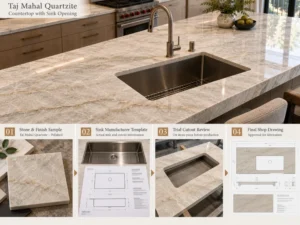
A relatively narrow dark feature crossing an otherwise pale Taj Mahal Quartzite island may become highly noticeable from the entrance to a room.
Meanwhile, a much larger low-contrast tonal transition may disappear into the overall composition.
ROOM-DISTANCE QUESTION
When you stop studying individual stone details, what becomes the first feature your eye reads?
That question is often more useful than asking whether the slab has “large” or “small” veins.
A stone surface does not exist without a viewpoint.
For an island, ask where the viewer is likely to first see it:
For a hotel reception counter, the dominant view may begin much farther away.
For a bathroom vanity, the primary experience may be comparatively close.
For a feature wall, the full composition may be visible immediately on entering the room.
Different applications therefore create different pattern-scale questions.
KITCHEN ISLAND
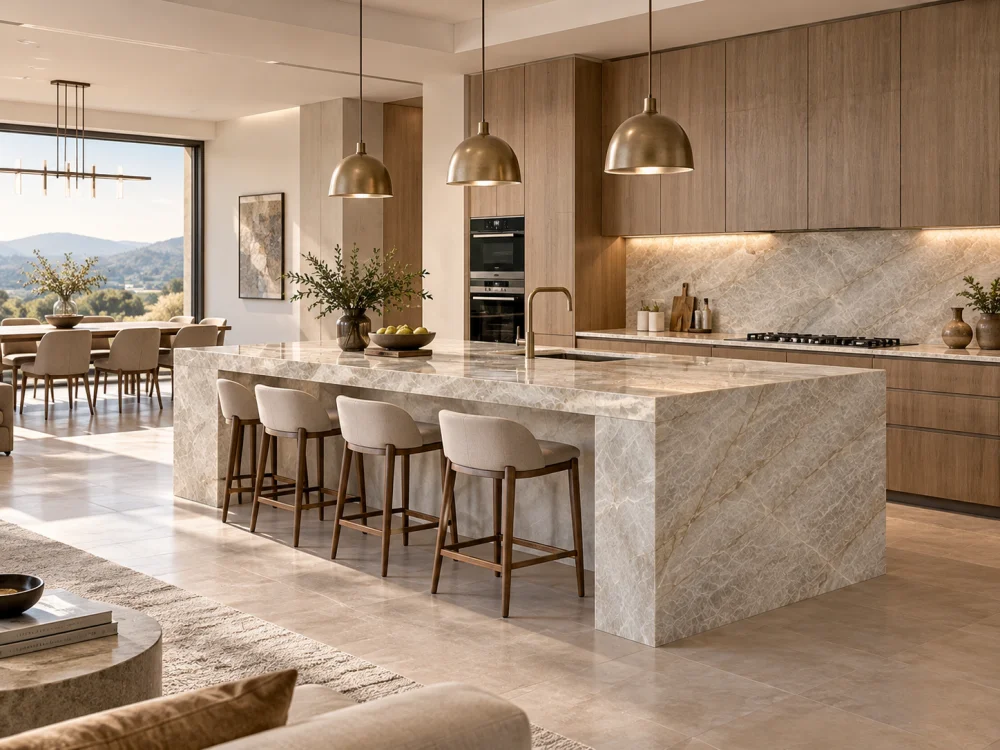
Review both normal working views and longer views from connected living or dining areas.
VANITY
Local pattern and finish may carry greater visual weight because the user is normally closer to the surface.
FEATURE WALL
Large-scale composition can dominate because much of the installation may be visible at once.
HOTEL RECEPTION
Review the stone from the approach path as well as from the counter itself.
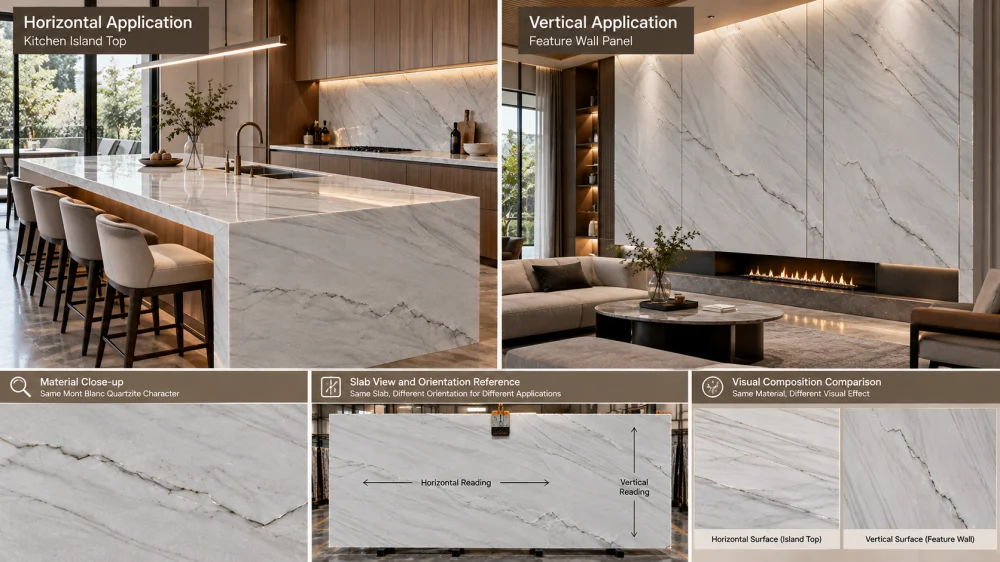
Orientation changes the composition.
A long movement running across a horizontal island may visually lengthen the surface.
The same geological movement used vertically on a wall can create a different visual emphasis.
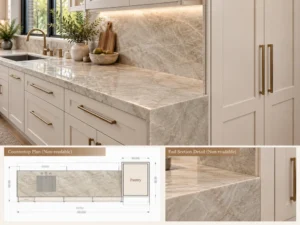
Waterfall applications add another question because a horizontal surface turns downward into a vertical face.
DO NOT REVIEW ONLY THE FLAT CUTTING PLAN
When the application changes orientation, review the finished faces in the orientation in which the room will actually present them.
A waterfall island is a useful example.
First, the project needs to understand the relationship between the top and vertical return at the mitred edge.
Second, it needs to step farther back and read the entire object as one composition.
A convincing corner detail does not automatically guarantee that the complete island composition will feel balanced from the main room sightline.
Pattern scale is also relational.
Place the same Quartzite beside quiet warm-white cabinetry and its darker mineral features may become more prominent.
Place it beside strongly grained timber and the visual relationship changes again.
Useful comparisons can include:
The objective is not to make every material match.
It is to understand which element will dominate the composition from the intended view.
Lighting does not create a different slab, but it can change which characteristics are visually emphasized.
Directional light may make surface reflection more noticeable.
Strong side lighting may emphasize certain local transitions.
Different room brightness and surrounding colours can also affect visual perception.
Therefore, avoid using one dramatically lit showroom photograph as the sole basis for approving क्वार्ट्ज़ाइट पैटर्न का पैमाना.
USEFUL REVIEW SET
Complete slab photograph + closer material detail + proposed finished-piece crop + installed orientation + representative room view + adjacent finish references.
A large-scale pattern is not automatically better than a fine-scale pattern.
A quiet slab is not automatically more suitable than a dramatic slab.
Those are design choices.
Pattern scale describes how the visual structure reads at the relevant size and distance.
The project then decides whether that reading supports the intended design.
This distinction keeps the discussion factual:
अवलोकन: “A high-contrast mineral band becomes the dominant feature when the proposed island crop is viewed from the room entrance.”
Design Decision: “We want that band to remain the focal point.”
The first statement describes what the layout shows.
The second records the project’s preference.
A phone photograph can be useful evidence, but the framing matters.
A close photograph may fill the entire screen with an area that represents only a small percentage of the full slab.
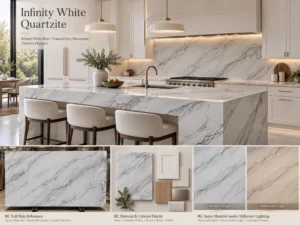
For remote Quartzite selection, request a sequence rather than one image:
Frame 1 — Full Slab: All four slab edges visible.
Frame 2 — Pair / Slab Set: Related slabs shown together where relevant.
Frame 3 — Mid-Range: Enough distance to read major movement.
Frame 4 — Detail: Local mineral structure and finish.
Frame 5 — Proposed Crop: Finished-piece outline shown against the actual slab.
Frame 6 — Room Context: Drawing, elevation or visual reference showing how the finished surface will be experienced.
A rendering can help a customer understand scale.
For example, it can show whether a large dark movement is expected to sit near the center or edge of an island.
But the rendering should remain connected to the actual selected slab.
Do not let a generic digital stone texture replace the real slab photograph.
This is particularly important when choosing between several slabs of the same commercial material.
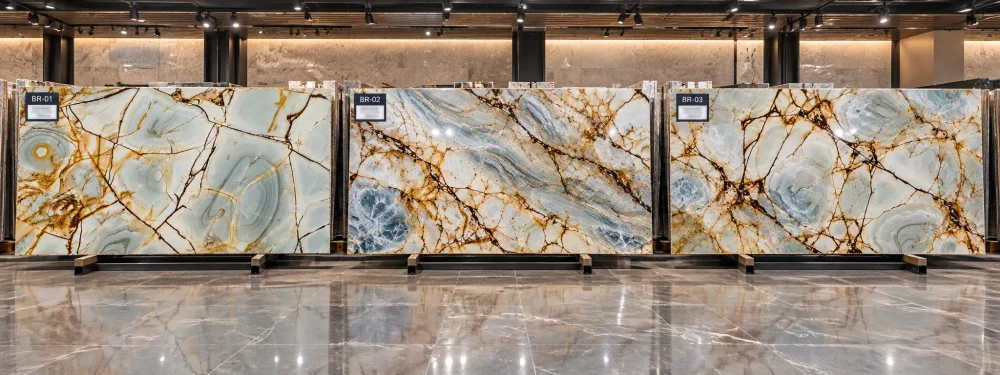
Imagine three slabs that share a similar local colour palette.
At close range, all three may seem acceptable.
From farther away:
Slab A may read as one broad diagonal movement.
Slab B may contain two competing high-contrast areas.
Slab C may read more evenly across its full width.
The close-up details did not necessarily reveal that difference.
The complete composition did.
Once a slab has been selected, the question changes again.
The project is no longer choosing only between slabs.
It is deciding which parts of those slabs become visible finished surfaces.
THE DESIGN QUESTION CHANGES
During Selection:
Which slab composition supports the room?
During Layout:
Which portion of that slab should become each finished piece?
Before Cutting:
Does the proposed crop still create the intended composition from the important room views?
Instead of telling the supplier:
“We want a dramatic slab.”
give a room-based visual priority.
Example 1: “From the living-room entrance, we want the island to read mostly light, with the stronger geological movement concentrated toward the seating end.”
Example 2: “The feature wall should retain the broad central crystalline area because it is visible from across the lobby.”
Example 3: “The vanity will mainly be viewed at close range, so local mineral detail is more important than preserving the full-slab movement.”
Those instructions are much easier to translate into a slab-layout discussion.
If the answer matches the intended design priority, the pattern-scale review has done its job.
If it does not, the project may need to reconsider the slab, finished-piece crop, orientation or relationship with adjacent finishes before cutting.
Quartzite pattern scale describes how the size, contrast and overall movement of Natural Quartzite read across the finished surface and from the relevant viewing distance. It includes more than individual veins or mineral details.
एक छोटा सैंपल स्थानीय रंग, फिनिश, बनावट और खनिज चरित्र को प्रदर्शित कर सकता है, लेकिन यह उस व्यापक भूवैज्ञानिक गति को छोड़ सकता है जो दूर से देखे जाने पर एक पूर्ण स्लैब, द्वीप या दीवार पर हावी होती है।.
कोई एक सार्वभौमिक देखने की दूरी नहीं होती। पत्थर का निकट से, सामान्य कार्य-दूरी से और वास्तविक उपयोग के कारण बनने वाली संभावित कमरे की दृश्य रेखाओं से समीक्षा करें। एक होटल की दीवार, किचन आइलैंड और बाथरूम वैनिटी में से प्रत्येक के लिए अलग-अलग दृश्य समीक्षा दूरियों की आवश्यकता हो सकती है।.
दोनों की समीक्षा करें। पूर्ण स्लैब से समग्र भूवैज्ञानिक वितरण का पता चलता है, जबकि प्रस्तावित कट क्षेत्र से यह पता चलता है कि फैब्रिकेशन के बाद ग्राहक को वास्तव में क्या दिखाई देगा। तैयार टुकड़े के क्रॉप की अपने इरादे से लगाए जाने के अनुरूप अवस्था में भी समीक्षा की जानी चाहिए।.
जरूरी नहीं है। कंट्रास्ट, रंग, अभिविन्यास, आसपास के फिनिश, प्रकाश और देखने की दूरी सभी इस बात को प्रभावित कर सकते हैं कि दृश्य रूप से कौन सी विशेषताएँ छाप छोड़ती हैं। एक अपेक्षाकृत छोटी, उच्च कंट्रास्ट वाली विशेषता भी एक बहुत बड़े, कम कंट्रास्ट वाले क्षेत्र से अधिक ध्यान आकर्षित कर सकती है।.
एक रेंडरिंग कमरे की संदर्भ और डिजाइन की नीयत को समझाने में मदद कर सकता है, लेकिन यह वास्तविक चुनी गई स्लैब छवि और प्रस्तावित कटिंग लेआउट का स्थान नहीं ले सकता। सामान्य डिजिटल बनावट ठीक-ठीक स्लैब या तैयार टुकड़े के क्रॉप का प्रतिनिधित्व नहीं कर सकती।.
हाँ। शीर्ष से जलप्रपात के संक्रमण पर स्थानीय संबंध और महत्वपूर्ण कमरों की दृश्य रेखाओं से पूर्ण द्वीप रचना दोनों का समीक्षा करें। एक अच्छा कोने का संबंध और एक संतुलित कमरे-दूरी की रचना आपस में संबंधित हैं, लेकिन अलग-अलग दृश्य मुद्दे हैं।.
जोश को चुनी गई स्लैब संदर्भ, पूर्ण-स्लैब की तस्वीरें, प्रोजेक्ट ड्राइंग्स, तैयार टुकड़े के आयाम, प्रस्तावित लेआउट, अभिप्रेत अवस्थिति, मुख्य कमरे के दृश्य, निकटवर्ती फिनिश संदर्भ और तैयार पत्थर से प्राप्त करना चाहते हैं उसकी दृश्य प्राथमिकता भेजें।.
Review the Stone at the Scale of the Finished Room
HRST STONE can coordinate full-slab photographs, selected board references, CAD/shop drawings, proposed cutting layouts, visible-face orientation, project finish references and pre-fabrication visual review for Natural Quartzite orders. For pattern-sensitive islands, walls, vanities, reception counters and custom stone furniture, send Josh the actual slab references, finished dimensions, drawings and important room sightlines so the layout discussion can remain tied to the selected material.
© HRST STONE / XIAMEN HRST STONE CO., LTD. सभी अधिकार सुरक्षित हैं।.