

संक्षिप्त सारांशQuartzite Bedside Tables should be selected from the finished furniture outline rather than from the beauty of the full slab alone. A Natural Quartzite slab may contain broad mineral bands, quiet fields, crystalline areas, dark fissures, and several different visual zones. Once the tabletop becomes a small square, rectangle, round, oval, or custom shape, only one limited part of that geology remains visible. Overlay the actual tabletop template on the identified slab, compare several crop positions, review the installed orientation and normal close viewing distance, and plan both bedside tables together when they belong to the same room. Also coordinate the stone edge, base support, fixing method, finish, bedside lighting, and any retained remnant before cutting. The best small furniture pattern is not automatically the smallest pattern; it is the crop that creates a complete and intentional composition inside the actual tabletop.
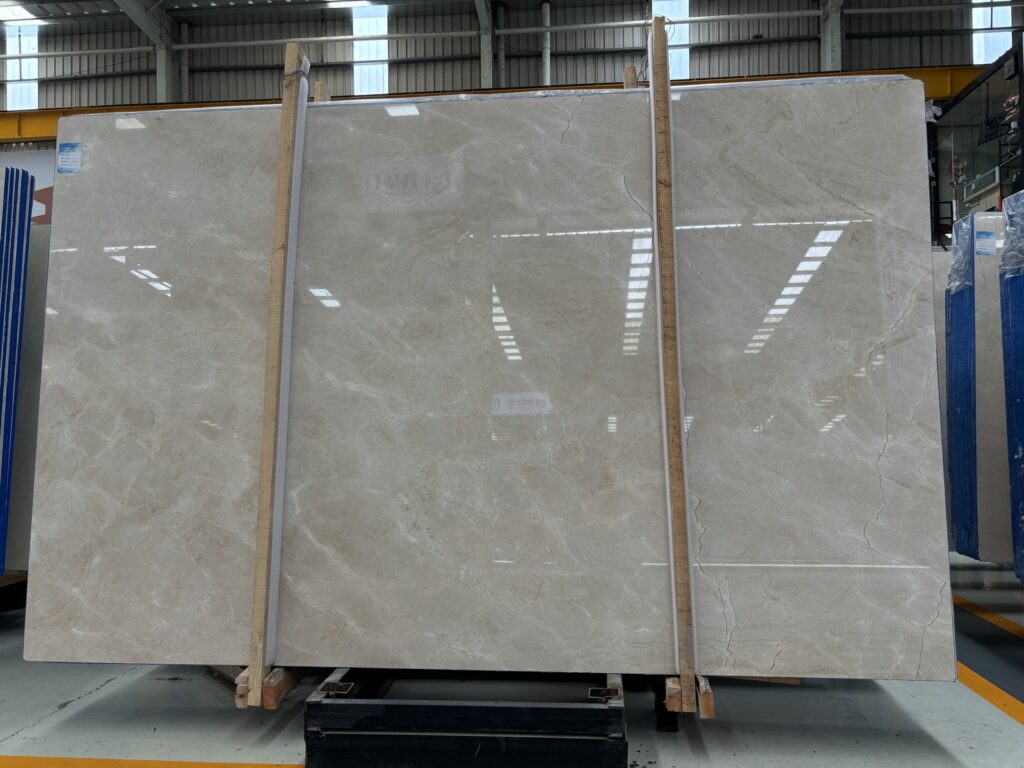
A Natural Quartzite slab can look spectacular at full size.
One broad mineral band crosses from left to right.
A crystalline area creates a focal point near the centre.
A darker feature balances the opposite side.
Then a small bedside-table outline is placed over one corner of the slab.
Most of the composition disappears.
The finished top contains only half of the dark feature and a pale empty field.
The material is still beautiful.
The crop is not.
This is the central design problem behind Quartzite Bedside Tables: Choosing a Pattern That Works at Small Scale.
A bedside table does not display the entire slab.
It displays one small edited section of the slab, usually from close range and often as one of a pair.
The correct selection question is therefore not:
“Do we like this Quartzite slab?”
यह है:
“Does this exact part of this slab create a complete furniture-scale composition inside this exact bedside-table shape?”
Large architectural surfaces and small furniture surfaces read natural pattern differently.
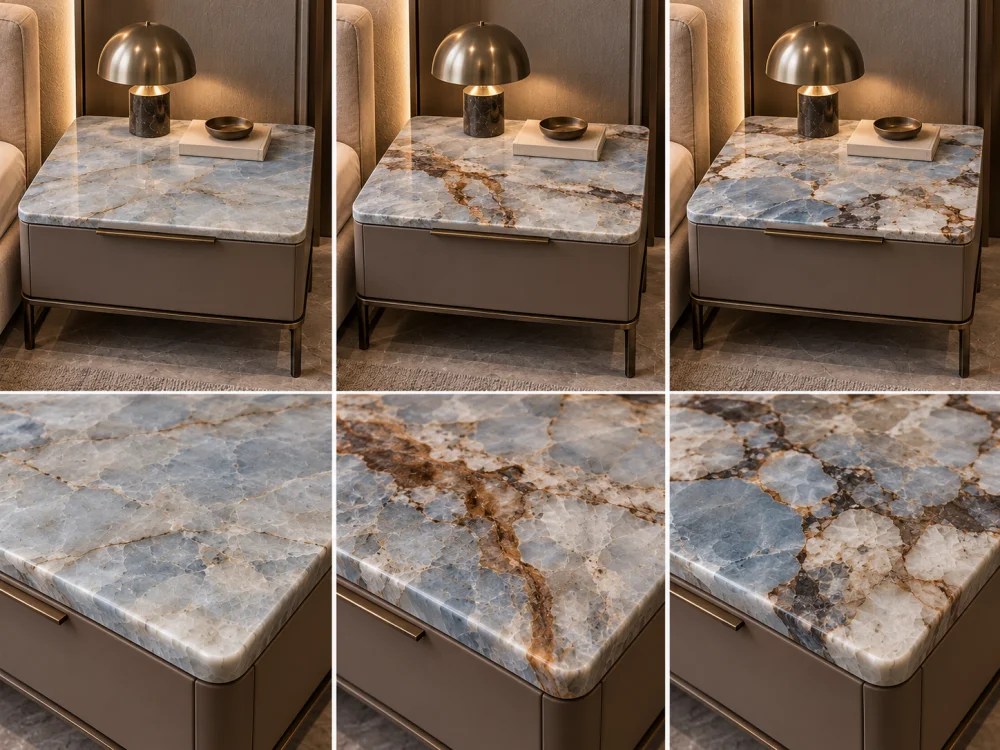
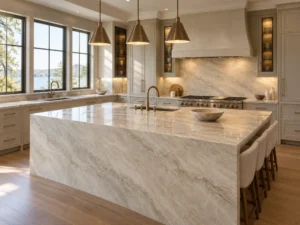
A kitchen island may preserve several major geological zones.
A bedside-table top may contain only one.
Imagine a wide grey-brown mineral band running diagonally across a complete Quartzite slab.
Across a large island, the band may create elegant movement from one end to the other.
Inside a small square tabletop, the same band may become:
The geology has not changed.
The framing has.
The opposite can also occur.
A modest crystalline area that looks secondary on the full slab can become the focal point of a bedside table when the tabletop is positioned directly around it.
This is one reason small custom furniture can make very selective use of Natural Quartzite.
Do not create a rule that bedside tables always need fine veins or uniform stone.
A broad natural feature can work beautifully at small scale if the crop preserves a visually complete section.
A fine but high-contrast pattern can feel much busier than a large low-contrast mineral field.
The relevant variables are:
The क्वार्ट्ज़ाइट पैटर्न स्केल: कमरे की दूरी से स्लैब का पठन guide explains the broader principle: Natural Quartzite should be reviewed as a complete slab, a finished-piece crop, and an installed surface rather than from one close-up alone.
Small-Scale Pattern Rule
Full-Slab Beauty ≠ Furniture-Crop Beauty. The relevant composition is the geological pattern that remains inside the actual finished tabletop outline after cutting.
The tabletop outline should exist before the final pattern position is approved.
A furniture design changes which stone area can work.
The project may require:
Do not approve one crop and then significantly change the tabletop shape without repeating the visual layout.
The physical tabletop dimensions determine how much of the geological pattern remains visible.
A crop that works for a wider table may lose its balance when the furniture becomes narrower.
A design that increases the top in one direction can bring another mineral area into the finished piece.
The visible top outline is not always identical to the first conceptual template.
Depending on the approved design, fabrication may include:
The responsible fabricator should reconcile the actual geometry, fabrication allowance, edge construction, and final visible surface before cutting.
A bedside table placed between a bed and wall may have one strongly visible front edge and one less visible rear edge.
A freestanding hotel bedside table may be visible from several directions.
The crop can therefore prioritize the surfaces that actually matter to the room.
This is the most important design step.
Do not describe the desired pattern only with words.
Place the actual finished-tabletop outline over the actual slab image or controlled slab layout.
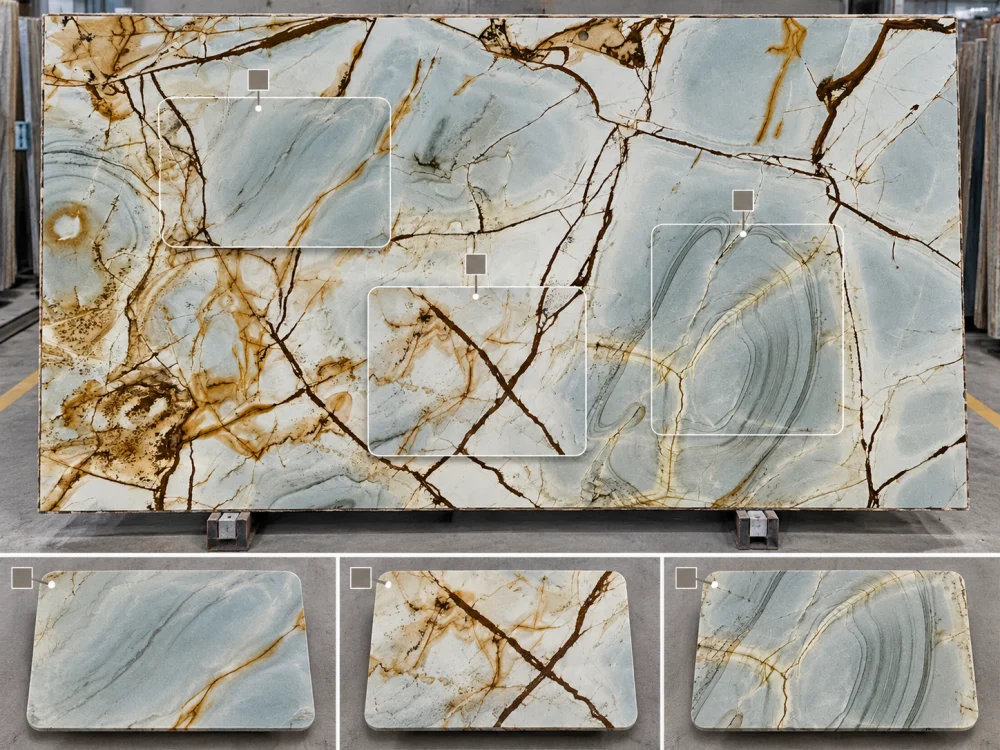
For one tabletop, create several realistic alternatives.
उदाहरण के लिए:
Crop A — Quiet Field
Mostly pale material with restrained movement.
Crop B — One Controlled Focal Feature
A mineral band or crystalline structure enters the top deliberately and remains visually balanced.
Crop C — High-Contrast Feature
A stronger geological condition becomes the main visual event.
The project can then compare finished compositions rather than arguing about whether the complete slab is “too dramatic.”
When reviewing the layout digitally, visually reduce or hide the surrounding slab.
This prevents the eye from using geological information that will not exist in the finished furniture piece.
Ask:
If I can see only the final tabletop, does the composition still make sense?
A tabletop pattern approved on a vertical slab photograph may read differently once the piece is rotated horizontally.
Review the crop in the orientation in which the finished bedside table will actually be installed.
If the preferred mineral feature sits very close to the cutting boundary, verify whether the finished edge treatment changes how much of it remains visible.
A layout should describe the actual finished piece, not an idealized pre-fabrication rectangle.
| Crop Condition | Small-Scale Effect | समीक्षा प्रश्न |
| Broad quiet field | Calm furniture surface | Does it become too visually empty for the design intent? |
| One complete mineral feature | Controlled focal composition | Is the feature positioned intentionally within the shape? |
| Feature cut by one edge | Can create directional movement | Does the crop look intentional or accidentally truncated? |
| Several high-contrast fragments | Potentially busy at close range | Do the fragments form one composition or compete with each other? |
A bedroom commonly contains two bedside tables.
That turns the selection into a pair-planning problem.
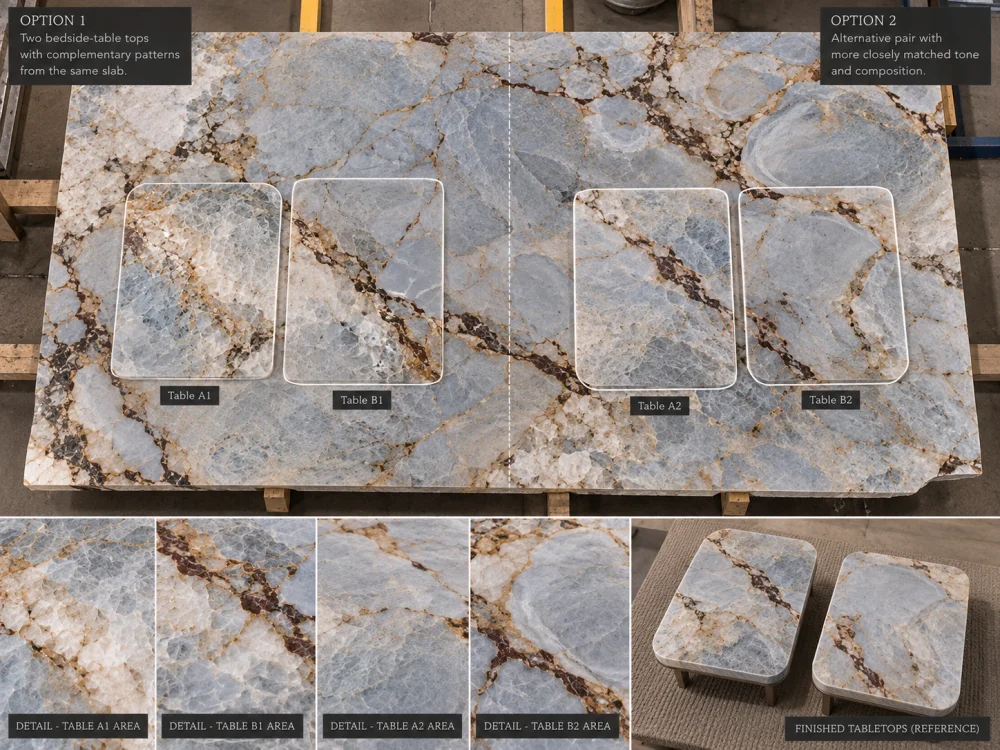
A matched pair aims for a relatively close visual relationship.
This does not necessarily mean perfect mirror symmetry.
The two tops may use adjoining or visually related areas of one slab so they share:
A related pair allows each table to have its own natural composition while preserving enough common character that the pair still belongs together.
For Natural Quartzite, this can often look more believable than forcing artificial symmetry.
उदाहरण के लिए:
Table A may contain one stronger coffee-brown mineral line.
Table B may contain a related but different line from the same slab group.
The background, direction, and overall contrast remain coordinated.
Some interiors intentionally allow each bedside table to be unique.
This may work when:
The important point is to choose this intentionally rather than discovering after fabrication that the two pieces look unrelated.
Do not approve Table A, cut it, and then search the remaining stone for Table B.
Where the project requires visual pairing, place both tabletop outlines on the actual slab or slab set before the first irreversible cut.
Pair Planning
Table A + Table B → Same Layout Review → Compare Pattern Weight → Compare Direction → Compare Background → Approve the Pair → Cut. Do not treat the second table as an afterthought.
The same slab area can create very different furniture depending on how the finished outline is rotated.
A directional geological feature can:
Each orientation produces a different reading.
Do not assume the original slab orientation is automatically the best furniture orientation.
A round outline removes corners and changes how a linear feature enters and exits the composition.
A strong diagonal band that feels abrupt in a small square may become more balanced when contained inside a circular boundary.
The opposite can also occur.
An oval shape introduces a long axis.
Directional Quartzite can reinforce that axis or deliberately cross it.
Review both options rather than automatically aligning every vein with the furniture length.
A sculptural tabletop can sometimes follow or respond to a particular natural feature.
However, stone shape, usable slab area, fabrication, edge treatment, furniture support, and the final design still need to be coordinated.
Do not draw an irregular furniture outline only to preserve one vein without checking whether the finished object remains practical.
A bedside table is normally viewed from close range.
The edge therefore carries more visual weight than it might on a large distant architectural surface.
A visually restrained edge can make the stone top appear lighter and more furniture-like.
The exact physical thickness and support design should be coordinated with the responsible fabricator and furniture designer rather than copied from another project.
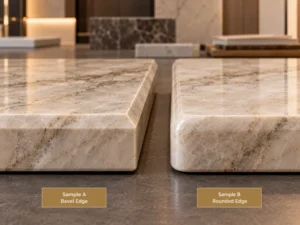
A mitred or otherwise built-up thick-look edge can increase the visual mass of a small table.
This may be desirable for a sculptural piece.
But it also introduces another stone face and potentially another pattern relationship.
A Natural Quartzite edge can read differently from the broad top because it exposes the stone from another direction.
Where the edge is highly visible, review an actual worked edge or representative fabrication sample.
For a compact furniture piece, the eye often sees the top and front edge at the same time.
The final approval should therefore include:
Top Crop → Edge Profile → Visible Edge Appearance → Complete Furniture Object.
A beautiful stone crop is not a complete bedside table.
The top needs to work with the supporting furniture structure.
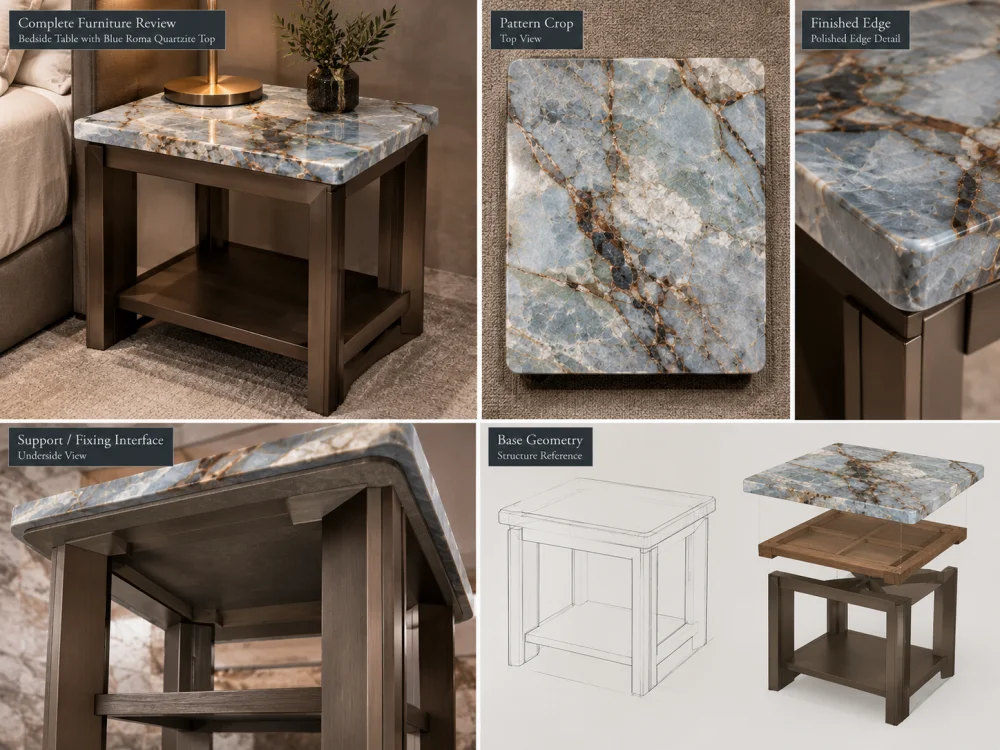
The base may be:
Record the actual support condition rather than designing the top independently.
The stone fabricator and furniture designer should coordinate where the Quartzite is supported and how it interfaces with the base.
This can affect:
This article deliberately does not prescribe universal support spacing, fixing hardware, or stone thickness.
Those decisions depend on the actual furniture geometry, material, top size, weight, and structural system.
If the stone requires holes, recesses, inserts, or another base-related machining operation, connect those operations to the current approved furniture drawing before production.
An attractive tabletop crop should not be ruined by discovering later that the fixing detail conflicts with the preferred stone area.
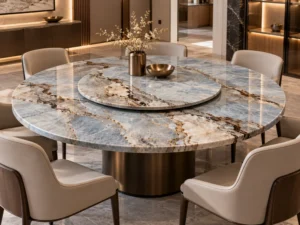
HRST’s ब्लू रोमा क्वार्टजाइट टेबल page follows the same furniture-planning logic: finished outline, actual slab position, edge, base, support, and cutting approval should remain connected.
A bedside table does not have the same viewing environment as a kitchen island.
The user may see the tabletop while:
Fine mineral lines, crystal areas, edge quality, polish, and local repairs can therefore carry more visual weight than they would on a surface mainly viewed from across a room.
A lamp positioned directly above or beside the stone may create:
Do not confuse a reflected lamp shape with the intrinsic Quartzite pattern.
A polished top generally presents stronger reflection and greater colour depth.
A honed top creates a softer reflected-light response.
Neither is automatically better for bedside furniture.
Compare the intended finish under representative bedroom lighting.
During daylight, the stone may be illuminated by a window.
At night, the bedside lamp may become the dominant source.
Where appearance is important, review both conditions rather than approving the pattern only under warehouse lighting.
Small furniture is one application where a useful Quartzite remnant can have real value.
A remnant may contain enough stone for:
But “remnant” does not mean “ready to cut.”
A leftover stone section may have:
Its old bounding dimensions do not prove that the new tabletop fits.
Place the actual bedside-table template on the current usable area.
Where the remnant’s source slab is known, retain that relationship.
This is especially useful when the bedside tables are intended to coordinate with another stone component in the same project.
साइट का Quartzite Slab Ownership and Storage guide explains why retained remnants should remain connected to their source slab, current physical condition, storage location, and later reuse review.
A stored remnant may physically exist but still be unsuitable because:
Recheck the actual stone before using an old record as production approval.
A useful furniture approval should connect the material to the finished object.
The sequence can be:
Furniture Drawing → Actual Slab / Remnant → Tabletop Template → Crop Options → Pair Relationship → Installed Orientation → Edge → Base / Support → Finish → Lighting Review → Cutting Approval → Trial Assembly / QC.
□ Exact Natural Quartzite material identified.
□ Actual slab, board, or remnant reference confirmed where relevant.
□ Current tabletop shape and finished dimensions confirmed.
□ Proposed tabletop outline overlaid on the actual stone.
□ Stone outside the crop visually excluded during pattern review.
□ Installed pattern direction approved.
□ Both bedside tables reviewed together when supplied as a pair.
□ Matched / related / individual pair strategy defined.
□ Edge profile and visible edge appearance reviewed.
□ Furniture base geometry and fixing interface coordinated.
□ Finish reviewed under relevant close-view lighting.
□ Any remnant remeasured and physically rechecked.
□ Current layout connected to production release.
□ Final QC compares the physical tops with the approved layout.
For highly patterned Natural Quartzite, final QC should include a complete overhead view of each tabletop rather than only edge close-ups.
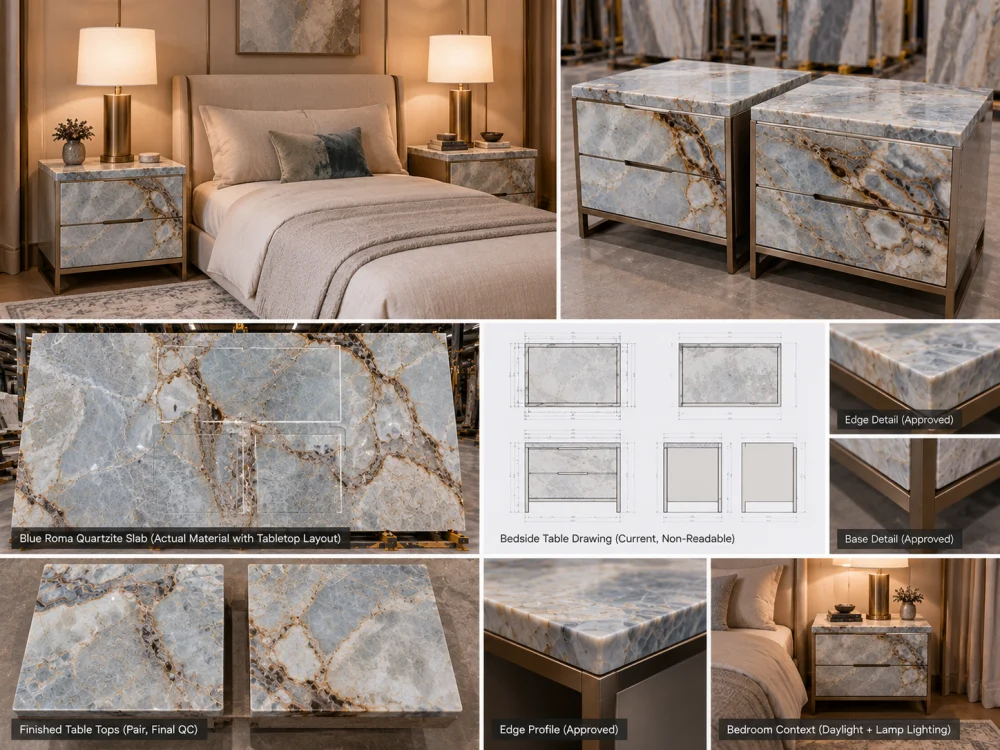
For a pair, place both tops in their intended orientation and review them together.
The question is no longer:
“Are these from the correct material?”
यह है:
“Did the approved small-scale compositions survive fabrication?”
No. Small-scale furniture does not automatically require fine veining. A broad natural feature can work very well if the actual tabletop crop preserves a complete and balanced section. Contrast, crop position, shape, orientation, and viewing distance matter as much as the physical size of the pattern.
Not necessarily. A project can specify a closely matched pair, a visually related pair, or intentionally individual pieces. The important step is to lay out both tabletops together before cutting when their relationship matters to the bedroom design.
Yes, when the current physical remnant provides sufficient usable area and an appropriate pattern crop. Recheck its present dimensions, irregular edges, existing cutouts, finish, condition, source identity where known, and current availability before production.
Yes for visually sensitive custom furniture. The full slab shows the geological source, but the finished tabletop outline reveals what the user will actually see. Compare several realistic positions and review the preferred crop in its intended installed orientation.
The same material can work for both, but shape changes how the natural movement enters and exits the visible composition. A vein that feels abruptly truncated in a square top may read differently inside a round or oval outline, so the exact shape should be included during layout approval.
Yes. The base geometry, support condition, fixing method, overhang, underside machining, edge clearance, and any holes or inserts should be coordinated before irreversible stone fabrication. Do not approve the visible stone crop separately from the furniture interface.
Send Josh the proposed Natural Quartzite material, slab or remnant reference where available, required quantity, furniture drawings, tabletop shape and finished dimensions, pair-matching preference, intended pattern direction, surface finish, edge profile, base drawings or support information, fixing requirements within the confirmed scope, bedroom material references where useful, and delivery destination. Identify whether you want a matched pair, related pair, or individually composed tops before the cutting layout is approved.
Furniture Pattern Approval SummaryA Quartzite bedside table should be approved from the actual finished furniture crop rather than the complete slab alone. Start with the current tabletop geometry, overlay that shape on the identified slab or remnant, compare several pattern positions, rotate the selected crop into its installed orientation, and review both bedside tables together when they form a pair. Coordinate the visible stone with the edge, furniture base, support and fixing interface, finish, close viewing distance, and bedside lighting. If the top dimensions, shape, slab allocation, pair relationship, edge, or base design changes materially, repeat the affected layout before cutting.
For custom Natural Quartzite bedside tables, nightstands, side tables, coffee tables, consoles, and standalone furniture tops, HRST STONE can coordinate available full-slab photographs, remnant references where applicable, tabletop CAD templates, pattern-crop options, pair layouts, edge samples, base-interface review within the confirmed stone scope, fabrication QC, trial assembly coordination, piece identification, packing, and export documentation. Send Josh the furniture drawings, Quartzite selection, dimensions, quantity, pair preference, finish, edge design, base information, and delivery destination for review.