
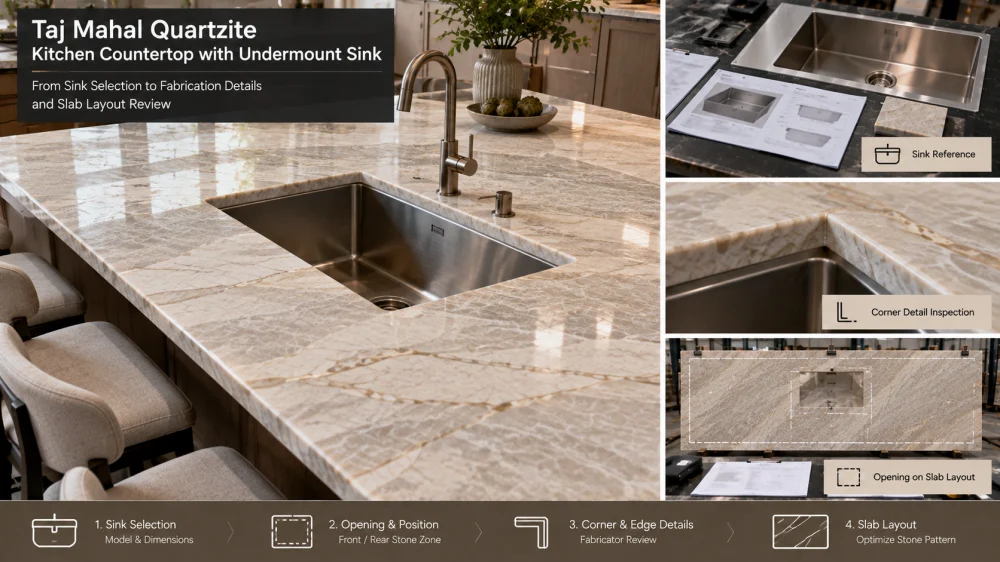
संक्षिप्त सारांश
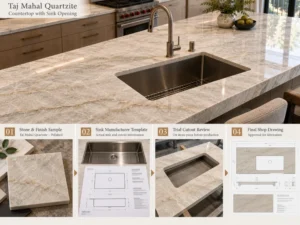
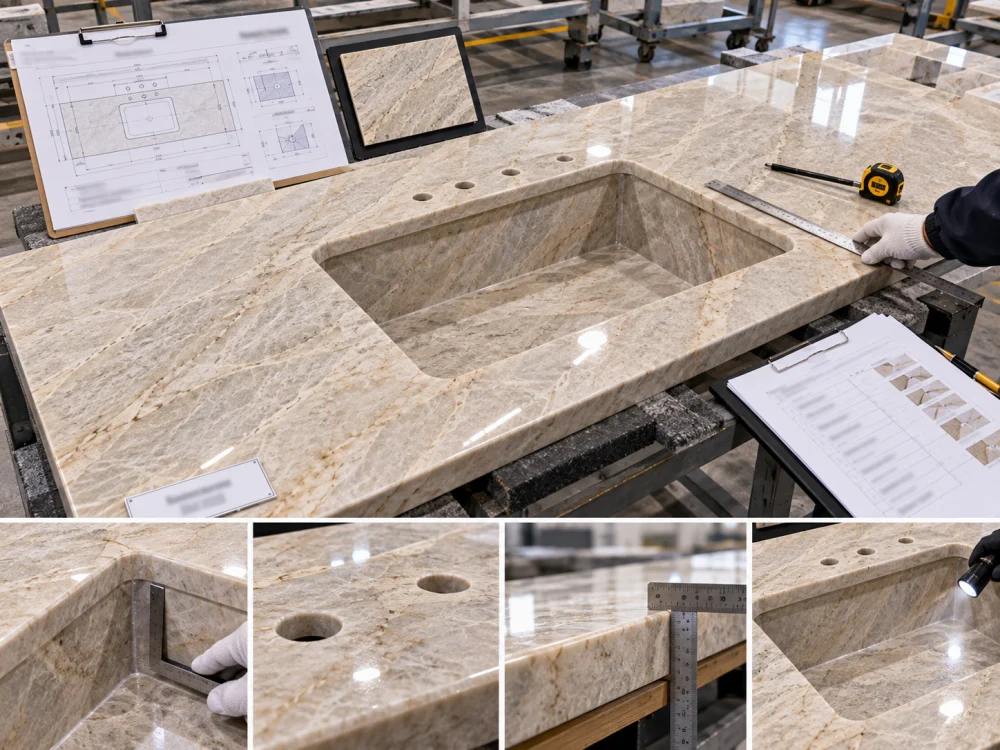
क्वार्ट्ज़ाइट सिंक कटआउट को एक सामान्य कोने की त्रिज्या या अनुमानित सिंक के आयाम से मुक्त नहीं किया जाना चाहिए। जिम्मेदार फैब्रिकेटर को वर्तमान सिंक मॉडल, निर्माता की जानकारी या अनुमोदित टेम्पलेट, माउंटिंग प्रकार, रिवील आवश्यकता, काउंटरटॉप ड्राइंग, वास्तविक स्लैब लेआउट, नजदीकी पत्थर की ज्यामिति, दृश्यमान किनारे की आवश्यकताएं, समर्थन संदर्भ और अन्य प्रोजेक्ट-विशिष्ट फैब्रिकेशन इनपुट्स की आवश्यकता होती है। कोने की ज्यामिति पूर्ण ओपनिंग का एक हिस्सा है—यह एक अलग नंबर नहीं है जिसे किसी अन्य प्रोजेक्ट से कॉपी किया जाना चाहिए।.
एक खरीदार काउंटरटॉप ड्राइंग को देखकर एक ऐसा सरल लगने वाला प्रश्न पूछ सकता है:
“हमें सिंक के कोनों पर किस त्रिज्या का उपयोग करना चाहिए?”
नेचुरल क्वार्ट्ज़ाइट के लिए, इस प्रश्न को आमतौर पर वास्तविक प्रोजेक्ट की जानकारी के साथ जिम्मेदार फैब्रिकेटर के पास वापस भेज देना चाहिए।.
इसका कारण यह नहीं है कि कोने के विवरण रहस्यमय हैं। बल्कि यह है कि सिंक ओपनिंग एक आपस में जुड़ी हुई फैब्रिकेशन स्थिति है।.
कोना एक ओपनिंग के अंदर स्थित होता है। वह ओपनिंग एक काउंटरटॉप कंपोनेंट के अंदर स्थित होता है। यह कंपोनेंट एक नेचुरल स्लैब के विशेष क्षेत्र से आता है और सिंक, दृश्यमान किनारों, नल के छेद, नजदीकी ज्वाइंट्स, समर्थन की स्थितियों और हैंडलिंग आवश्यकताओं के साथ बातचीत करता है।.
इन सभी संदर्भों को हटाकर एक एकल सार्वभौमिक कोने के आंकड़े की मांग करना एक प्रोजेक्ट-विशिष्ट फैब्रिकेशन निर्णय को असमर्थित नियम में बदल सकता है।.
01 — सिंक
सटीक निर्माता, मॉडल और उत्पाद का संस्करण।.
02 — माउंटिंग की स्थिति
अंडरमाउंट, टॉपमाउंट, फ्लश कंडीशन, एप्रन-फ्रंट व्यवस्था या किसी अन्य प्रोजेक्ट-विशिष्ट सिस्टम।.
03 — ओपनिंग
अनुमोदित फैब्रिकेशन जानकारी से निकाली गई वास्तविक पत्थर के कटआउट की ज्यामिति।.
04 — कोने
कोने की ज्यामिति, पूर्ण ओपनिंग का हिस्सा है, अलग-थलग विवरण नहीं।.
05 — दृश्यमान कट किनारा
विशेष रूप से तब जरूरी है जब अंडरमाउंट कंडीशन फैब्रिकेटेड ओपनिंग के किनारे को उजागर करता है।.
06 — आसपास का पत्थर
फ्रंट रेल, रियर रेल, साइड एरिया और नजदीकी छेद, ज्वाइंट्स या किनारों के आसपास बचे पत्थर।.
07 — वास्तविक स्लैब की स्थिति
चुने गए नेचुरल क्वार्ट्ज़ाइट स्लैब के अंदर पूरे काउंटरटॉप कंपोनेंट और कटआउट का स्थान।.
यह है उपयोगी समीक्षा पैमाना क्वार्ट्ज़ाइट सिंक कटआउट्स.
सबसे आसान गलतियों में से एक है एक कुल सिंक के आयाम को प्राप्त करना और उसे काउंटरटॉप ओपनिंग के रूप में लेना।.
समग्र सिंक आकार
सिंक बॉडी, रिम, फ्लैंज या किसी अन्य निर्माता द्वारा निर्धारित उत्पाद के आयाम के बाहरी आयामों का वर्णन करता है।.
पत्थर का कटआउट
अनुमोदित सिंक और प्रोजेक्ट जानकारी के अनुसार क्वार्ट्ज़ाइट में वास्तव में फैब्रिकेट किए जाने वाले ओपनिंग को परिभाषित करता है।.
उन्हें स्वचालित रूप से एक ही आयाम माना नहीं जाना चाहिए।.
विशेष रूप से ऑनर-सप्लाइड सिंक के मामले में, फैब्रिकेशन टीम को ठीक उत्पाद जानकारी प्राप्त करनी चाहिए, न कि एक तस्वीर, अनुमानित कैटलॉग आकार या सामान्य सिंक प्रतीक से अपरिवर्तनीय ओपनिंग निकालने के लिए कहना चाहिए।.
जहाँ सिंक को पत्थर से अलग खरीदा जाता है, उन प्रोजेक्ट्स के लिए, संबंधित गाइड देखें मालिक द्वारा उपलब्ध कराए गए सिंक के साथ क्वार्टज़ाइट ऑर्डर फैब्रिकेशन से पहले समन्वय किए जाने वाले व्यापक विनिर्देश पैकेज के लिए।.
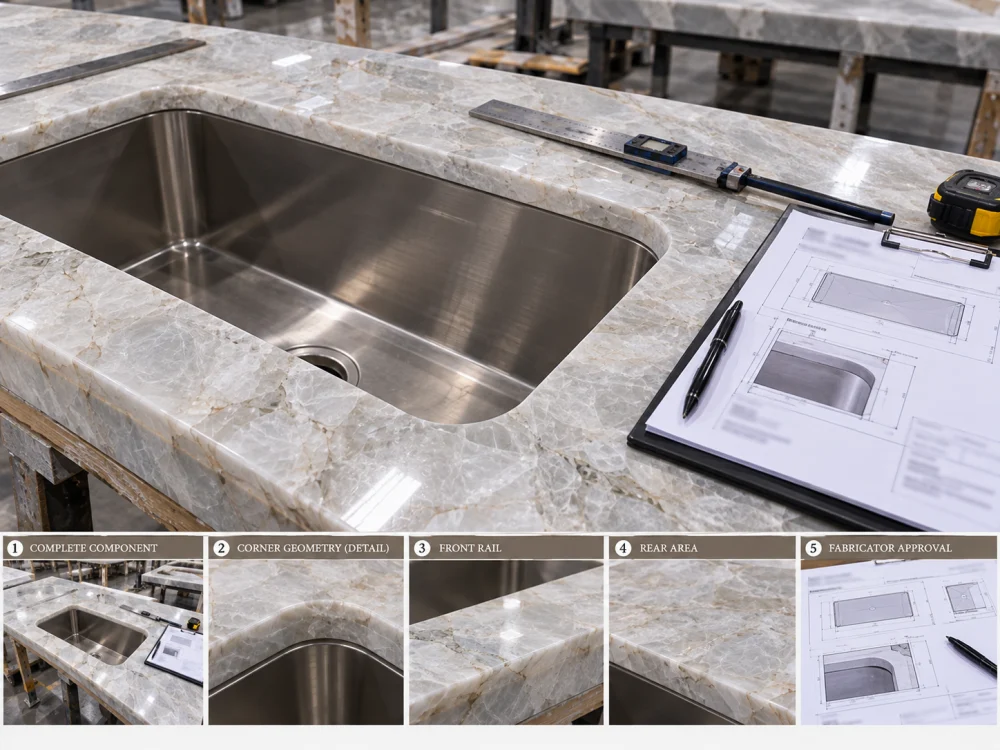
कल्पना करें कि आप एक अंडरमाउंट सिंक ओपनिंग के एक कोने को ज़ूम कर रहे हैं।.
कोना अपने आप एक छोटे ज्यामितीय विवरण की तरह दिखाई दे सकता है, लेकिन फैब्रिकेटर को उसके आसपास की कई स्थितियों के साथ उसके संबंध को ध्यान में रखना पड़ सकता है।.
| नजदीकी स्थिति | क्यों यह समीक्षा में शामिल होना चाहिए |
| सिंक टेम्पलेट | वास्तविक सिंक के लिए अनुमानित आकार के बजाय इरादा ओपनिंग के संबंध को परिभाषित करता है।. |
| रिवील | जहाँ लागू हो, सिंक बाउल और तैयार पत्थर के ओपनिंग के बीच दृश्यमान संबंध को बदलता है।. |
| फ्रंट / रियर पत्थर | ओपनिंग अपने आसपास बचे पत्थर को छोड़ता है, और उस ज्यामिति को पूरे कंपोनेंट के हिस्से के रूप में समीक्षा करना चाहिए।. |
| नल / एक्सेसरी छेद | एक ही काउंटरटॉप जोन में अतिरिक्त ओपनिंग हो सकते हैं।. |
| नजदीकी ज्वाइंट या किनारा | The sink opening should be reviewed in the geometry of the finished component, not as a floating shape. |
| Natural stone condition | The proposed cutout position should be reviewed against the actual selected slab where material features are relevant. |
A buyer may search for a single recommended minimum radius for every Natural Quartzite sink opening.
This article deliberately does not provide one.
Fabrication Boundary
The appropriate corner geometry should be reviewed by the responsible fabricator against the actual sink information, opening geometry, material, countertop component, machining approach, surrounding stone, support and installation context. A number used on another project should not automatically become the specification for the current one.
The buyer’s job is therefore not to invent a radius.
The buyer should make sure the fabricator receives enough controlled information to make and approve the project-specific fabrication decision.
On a drawing, it is tempting to focus on C1, C2, C3 and C4 as four identical geometric points.
In the real countertop, their surroundings can differ.
C1 — Front Left
Review in relation to the front stone section, side condition and actual slab position.
C2 — Front Right
Review in relation to the front stone section and any nearby edge, seam or project feature.
C3 — Rear Right
Review together with rear stone geometry, faucet or accessory openings where applicable, and the surrounding layout.
C4 — Rear Left
Review using the same controlled project information and actual component geometry.
The C1–C4 labels are only a communication device. They do not prescribe a fabrication method or imply that different radii are required.
The benefit is that a reviewer can say “check the condition near C3” instead of sending an ambiguous cropped photograph.
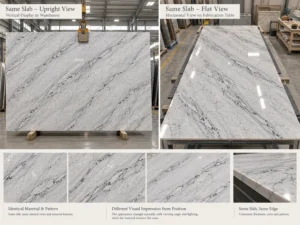
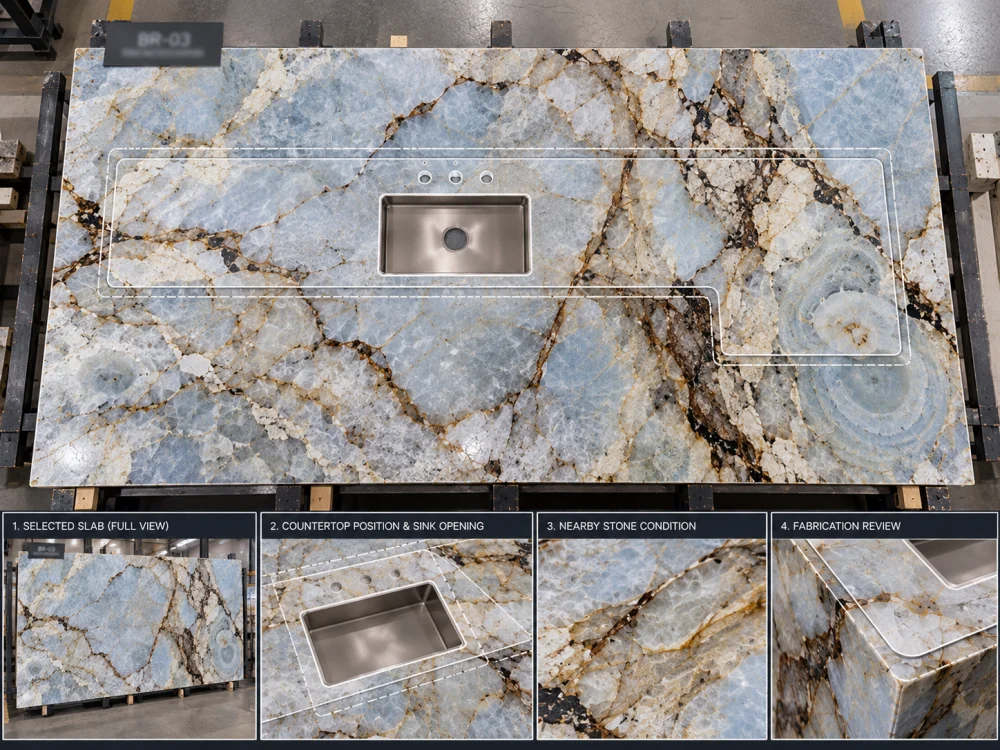
Natural Quartzite is not a visually or structurally uniform manufactured sheet.

The selected slab can contain changing mineral structures, natural fissures, crystalline areas, tonal transitions and other geological features.
That does not mean every visible feature is a defect.
It does mean that the sink cutout should be considered within the actual slab layout when the material condition is relevant to fabrication.
Do Not Review Only This:
Generic rectangular countertop + generic sink symbol.
Review This When Required:
Identified Natural Quartzite slab + proposed finished countertop outline + actual sink cutout position + nearby stone conditions + current drawing revision.
Do not classify the condition from a photograph alone and do not automatically assume the entire slab must be rejected.
First locate the feature relative to the finished geometry.
A useful technical review can distinguish:
Condition outside the finished piece
The area may not remain in the fabricated countertop.
Condition inside the finished piece but away from the opening
Its relevance should be reviewed against the actual application and project requirements.
Condition near the sink opening, narrow stone area, seam or other critical geometry
Escalate it to the responsible fabricator for project-specific review before cutting.
This same location-based principle is useful when reviewing repairs or other documented slab conditions: the meaningful question is not only what the condition looks like, but where it falls in relation to the finished component.
Consider this sequence:
If R03 is current, a screenshot from R01 should not quietly remain the cutting instruction.
This is especially important because the change may affect more than the opening itself. It can affect the countertop layout, faucet-hole position, surrounding stone geometry, slab nesting and other coordinated details.
With an undermount sink, part of the cut opening may remain visible after installation.
The project therefore needs more than an opening outline.
Depending on the approved design and sink system, the fabrication information may need to identify:
“Undermount sink” alone does not completely define the finished stone opening.
The opening is only one part of the geometry.
The remaining Quartzite matters too.
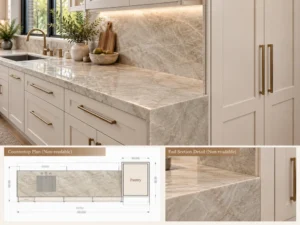
FRONT ZONE
Stone between the sink opening and the finished front edge.
REAR ZONE
Stone behind the opening, potentially interacting with faucet and accessory holes.
SIDE ZONES
Stone between the opening and countertop ends, seams or adjacent conditions.
BETWEEN OPENINGS
Stone remaining between a sink and another opening where the design includes more than one cutout.
This is another reason not to specify a sink corner independently from the complete countertop geometry.
A sink opening may be approved correctly while a nearby faucet or accessory hole is still missing, outdated or incorrectly positioned.
Where applicable, coordinate:
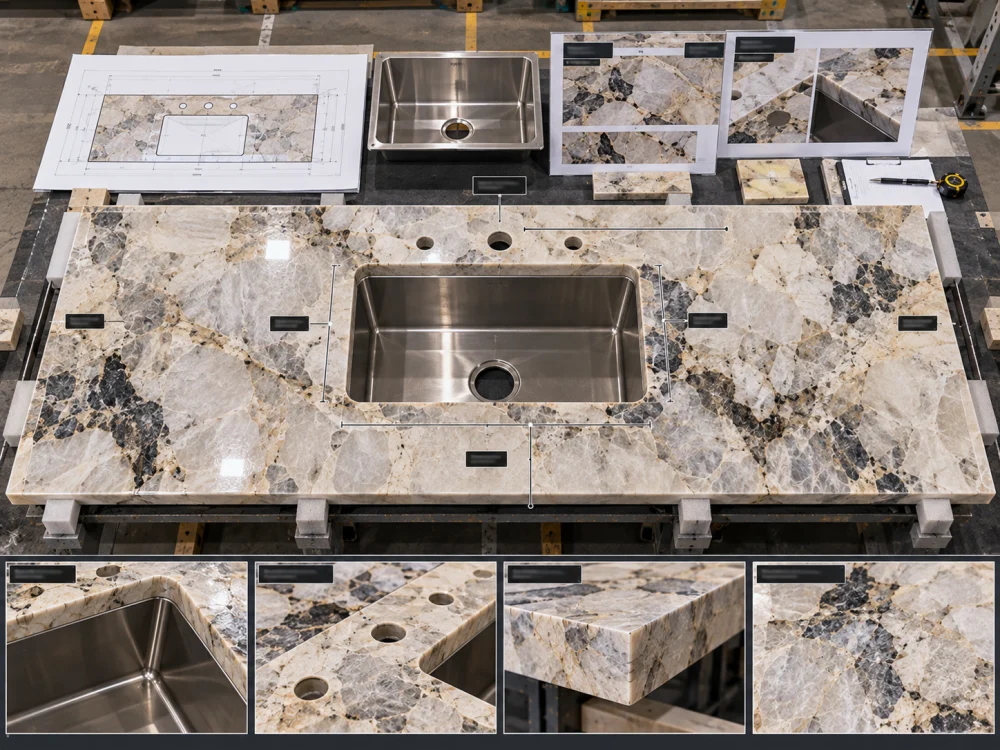
The objective is to review the countertop as one fabricated component rather than approving each opening in isolation.
Instead of giving buyers a universal corner specification, use a controlled release gate.
□ Exact sink manufacturer and model identified
□ Current manufacturer information / applicable template identified
□ Sink mounting condition confirmed
□ Intended reveal / visible relationship confirmed where applicable
□ Current countertop drawing revision identified
□ Finished countertop dimensions confirmed for the current fabrication stage
□ Sink opening position coordinated
□ Faucet / accessory openings coordinated where applicable
□ Visible cut-edge finish defined where applicable
□ Actual slab / cutting layout reviewed where relevant
□ Nearby natural stone conditions reviewed where relevant
□ Surrounding countertop geometry reviewed
□ Required support / installation interfaces communicated to the responsible project parties
□ Responsible fabricator / authorized project party has released the current cutout information for fabrication
The buyer does not need to become the stone machinist.
| Buyer / Project Team Should Make Clear | Responsible Fabrication Review Should Resolve |
| Exact sink being used | Approved opening geometry based on the actual project inputs |
| Mounting / reveal design intent | Fabrication interpretation of the approved sink interface |
| Current project dimensions and drawing | Machining details appropriate to the component and material |
| Visible finish expectation | How the visible cut edge is fabricated to the approved requirement |
| Required appliance / cabinet / site interfaces | Fabrication review within the responsible scope and coordination of unresolved technical issues |
For a fabricated Natural Quartzite countertop, send Josh:
प्राकृतिक क्वार्ट्जाइट: Material name and selected slab references where available
Countertop: Current finished dimensions and drawing revision
Sink: Manufacturer, exact model and current technical information
Installation Type: Undermount / top-mount / project-specific condition
Template: Manufacturer or approved project cutout reference where applicable
Reveal: Required relationship where applicable
Openings: Faucet and accessory-hole information
Edges: Visible edge / backsplash / adjacent fabrication details
Interfaces: Relevant cabinet, support or site information
गंतव्य: Project delivery location for quotation and logistics coordination
HRST can then coordinate the confirmed information into the shop drawing and fabrication review instead of asking the factory to interpret a sink photograph or approximate opening.
क्योंकि कॉर्नर पूरी सिंक ओपनिंग और तैयार काउंटरटॉप ज्यामिति का हिस्सा है। जिम्मेदार फैब्रिकेटर को कटिंग से पहले वास्तविक सिंक की जानकारी, ओपनिंग, आसपास की स्टोन, स्लैब की स्थिति (जहाँ संबंधित हो), मशीनिंग दृष्टिकोण, समर्थन और अन्य प्रोजेक्ट-विशिष्ट फैब्रिकेशन की स्थितियों की समीक्षा करनी चाहिए।.
इस गाइड में प्रत्येक प्राकृतिक क्वार्टज़ाइट काउंटरटॉप के लिए निर्धारित किया जाने वाला कोई सार्वभौमिक त्रिज्या नहीं है। उचित कोने की ज्यामिति को जिम्मेदार फैब्रिकेटर द्वारा वास्तविक सिंक, अनुमोदित खोलने की जानकारी, सामग्री और परियोजना की स्थितियों का उपयोग करके निर्धारित किया जाना चाहिए।.
स्वचालित रूप से नहीं। समग्र सिंक आयाम सिंक उत्पाद का वर्णन करते हैं, जबकि पत्थर का कटआउट काउंटरटॉप में बनाए गए खुले हिस्से को निर्धारित करता है। वास्तविक सिंक के लिए लागू निर्माता या अनुमोदित परियोजना जानकारी का उपयोग करें, न कि किसी समग्र आयाम को सीधे कटिंग निर्देश में परिवर्तित करें।.
अंडरमाउंट स्थिति के कारण निर्मित खुली जगह का कुछ हिस्सा दिखाई दे सकता है। इसलिए, परियोजना को अभिप्रेत रिवील और दृश्य सतह की आवश्यकता को परिभाषित करना चाहिए, जबकि जिम्मेदार निर्माता लागू निर्माण विवरण की पुष्टि करे।.
जहाँ स्लैब-विशिष्ट प्राकृतिक विशेषताएँ या लेआउट की स्थितियाँ प्रस्तावित काउंटरटॉप पर प्रभाव डाल सकती हैं, वहाँ चयनित वास्तविक स्लैब के अनुरूप खोल का समीक्षा करने से फैब्रिकेटर कटिंग से पहले तैयार ज्यामिति का मूल्यांकन करने में सहायता प्राप्त कर सकता है।.
एक रेंडरिंग या फोटोग्राफ डिज़ाइन के इरादे को संवाद कर सकता है, लेकिन वह वास्तविक खुलने के लिए आवश्यक नियंत्रित निर्माण जानकारी का स्थान नहीं ले सकता। उचित मामलों में, सटीक सिंक मॉडल, वर्तमान तकनीकी जानकारी, अनुमोदित टेम्पलेट और वर्तमान काउंटरटॉप ड्राइंग का उपयोग करें।.
निर्माण से पहले खोल की फिर से समीक्षा की जानी चाहिए। किसी अन्य उत्पाद के लिए अनुमोदित खोल या ड्राइंग का उपयोग जारी रखते हुए, बस सिंक मॉडल का नाम बदलने का प्रयास न करें।.
जोश को प्राकृतिक क्वार्ट्ज़ाइट सामग्री और स्लैब संदर्भ, वर्तमान काउंटरटॉप ड्राइंग, फिनिश्ड आयाम, सटीक सिंक निर्माता और मॉडल, तकनीकी दस्तावेज या लागू टेम्प्लेट, माउंटिंग प्रकार, रिवील आवश्यकता, नल और एक्सेसरी छेद, दृश्यमान किनारे की आवश्यकताएं, संबंधित इंटरफ़ेस तथा डिलीवरी का गंतव्य भेजें।.
Project-Specific Cutout Coordination
HRST STONE can coordinate selected Natural Quartzite slabs, CAD/shop drawings, sink information, cutting layouts, fabrication records, QC photographs and export packing around the confirmed project scope. For irreversible sink openings, the current approved fabrication information should remain identifiable before cutting begins.
© HRST STONE / XIAMEN HRST STONE CO., LTD. सभी अधिकार सुरक्षित हैं।.