क्वार्ट्जाइट ड्राई-ले फोटोग्राफी: एक ही रिकॉर्ड में पूरा सेट कैप्चर करना
Post navigation
संक्षिप्त सारांश
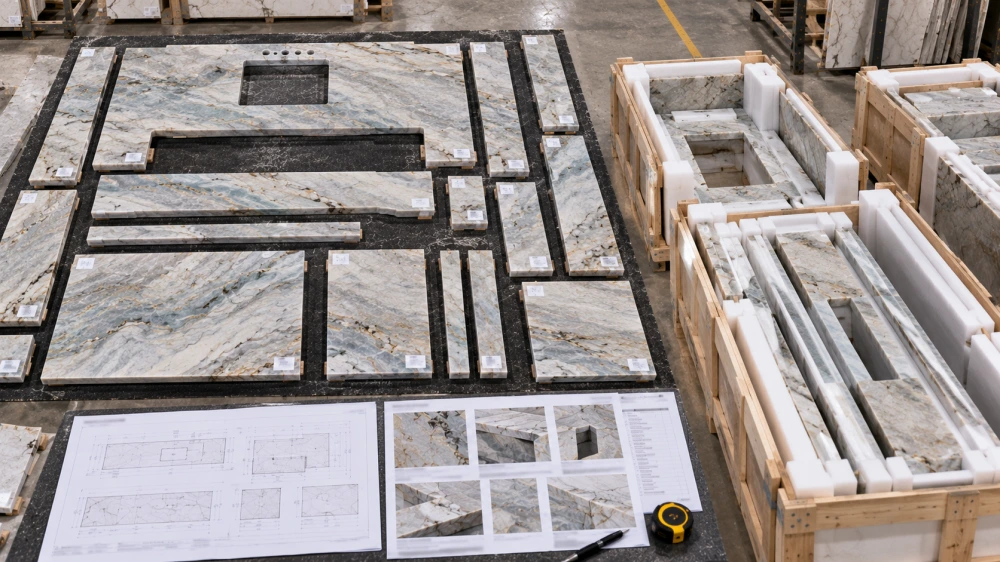
Quartzite dry-lay photography should document the complete proposed set, not only the most attractive individual pieces. A useful record normally combines one master whole-set view with piece IDs, current drawing revision, sequence or viewing direction, seam and return locations, and targeted detail photographs. The goal is to let a buyer, designer, fabricator, or installer understand exactly what was reviewed without reconstructing the project from scattered phone images.
Quartzite dry-lay photography becomes valuable when a Natural Quartzite project contains several fabricated pieces that need to work together visually.
A kitchen may include an island top, waterfall panels, perimeter counters, backsplashes, and returns. A wall project may contain twenty or more panels. A staircase can contain treads, risers, landings, border pieces, and special-shaped components.
Photographing each piece separately does not necessarily show whether the complete set works as a composition.
The most useful dry-lay record therefore starts with one principle:
Record the whole set first. Use detail photos to explain it, not to replace it.
What Should a Quartzite Dry-Lay Photography Record Prove?
A dry-lay record should answer a defined visual or production-control question.
Review Question
What the Photography Should Show
Is the complete set present?
Master whole-set view and piece references
Does the pattern flow logically?
Sequence, orientation, adjacent pieces, and joints
Are visible transitions acceptable?
Seams, miters, returns, borders, and changes of plane
Do pieces match the current drawing?
Drawing revision, piece IDs, and layout relationship
What still needs review?
Targeted detail images and written comments
A folder containing twenty attractive photographs but no master view, piece IDs, or revision reference is much weaker than a smaller controlled photo set that clearly shows the project relationship.
1. Start With One Master Whole-Set Photograph
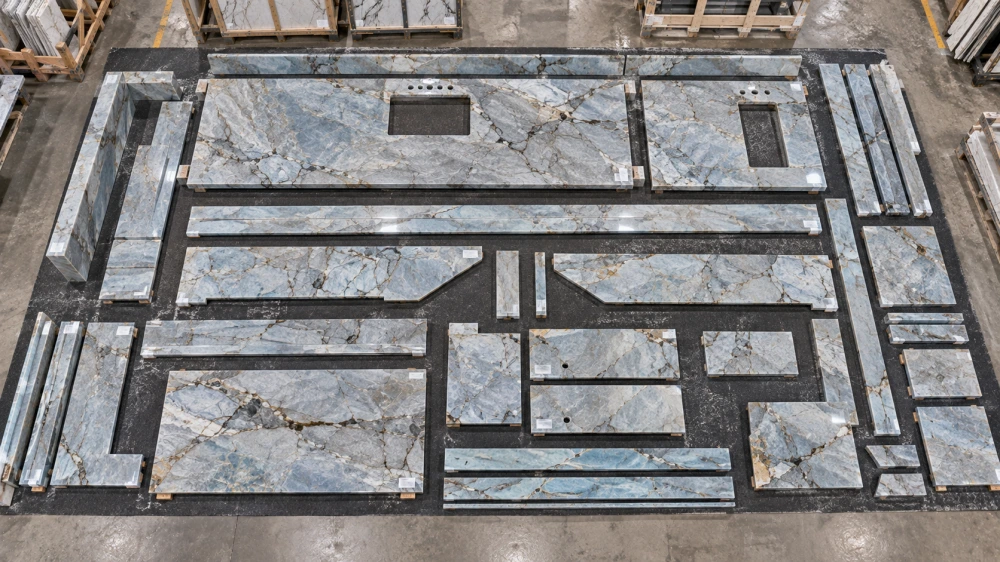
The most important image is usually the photograph that shows the complete dry lay in one understandable record.
For a large project, this may require:
blue-roma-quartzite-master-whole-set-dry-lay
a high camera position;
a near-vertical overhead view;
adequate working distance;
several rows of components arranged within one visible field; or
a controlled stitched overview when the physical layout is too large for a single practical camera position.
The master photograph should show enough of the surrounding factory floor or layout boundary to make the complete set understandable.
Do not crop so tightly that edge pieces, returns, border components, or smaller numbered parts disappear from the record.
Whole-Set Rule
If a reviewer cannot tell from the master image whether all important project pieces are present, the photography record is incomplete even if the close-up photographs are excellent.
2. Arrange the Dry Lay According to Project Logic
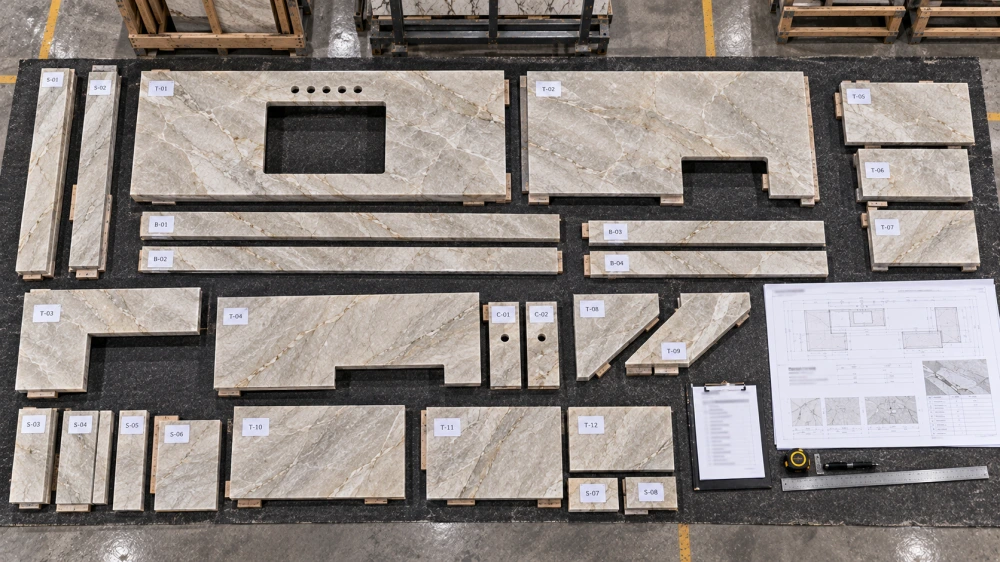
The dry lay should not become a random collection of finished stone pieces placed wherever floor space is available.
Where practical, organize pieces according to how the project will be understood:
The exact coding system can vary. What matters is consistency.
The same piece reference should be traceable across:
shop drawings;
cutting layouts;
dry-lay photography;
QC comments;
packing lists; and
installation references where required.
For directional materials, piece IDs are especially useful because a component can otherwise be accidentally rotated after fabrication.
4. Connect the Photography to the Current Drawing Revision
A dry-lay record should state which drawing or layout revision it represents.
This matters because one revision can change:
तैयार आयाम;
piece quantity;
cutout positions;
सीम के स्थानों की;
panel divisions;
returns;
edge details; or
visible-face requirements.
If the project drawing changes after photography, the earlier record may remain historically useful but may no longer represent the current production layout.
TRACEABILITY CHAIN
Drawing Revision → Piece ID → Dry-Lay Position → Photo Record → Review Comment → Approval / Revision
5. Show Direction, Not Just Piece Position
A piece can be in the correct location and still be rotated incorrectly.
This is particularly important for quartzites with:
strong linear movement;
long mineral bands;
layered patterns;
major crystal structures;
bookmatched compositions; or
waterfall transitions.
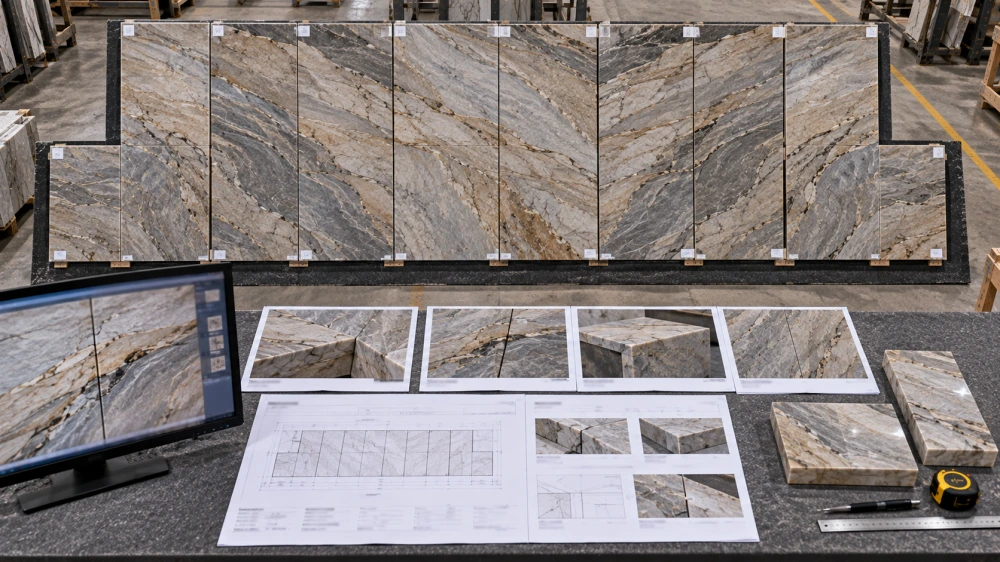
Directional intent can be controlled through shop drawings, piece IDs, arrows, visible-face information, and actual slab layouts.
हमारा शॉप ड्राइंग के लिए क्वार्टजाइट वेन-दिशा सिंबल गाइड explains why arrows should be coordinated with piece IDs, seams, visible faces, and actual slab layouts instead of being used as isolated instructions.
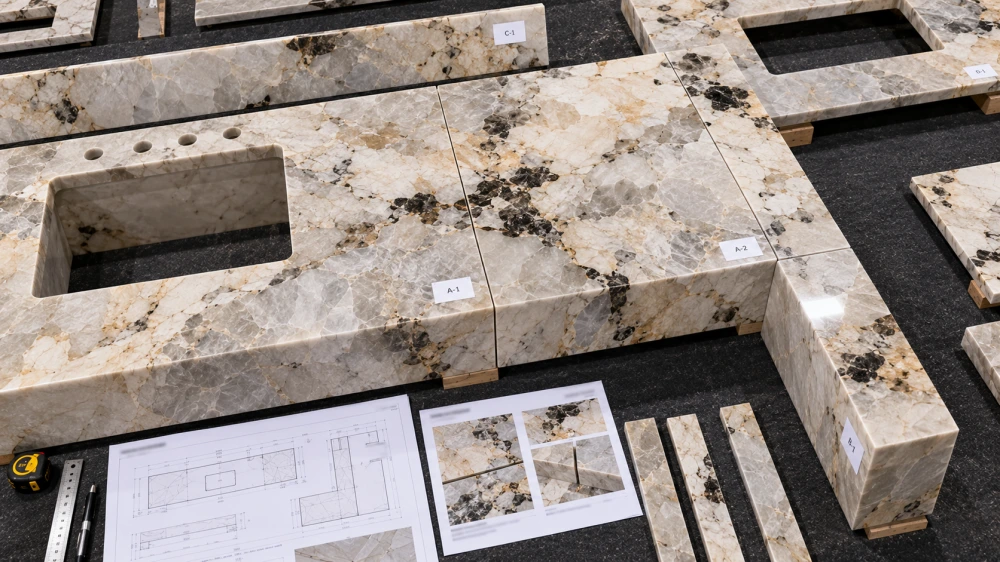
6. Photograph Seams and Joints as Part of the Composition
A dry lay should not visually hide the locations where separate components meet.
Dry-lay documentation becomes confusing when every image is rotated differently.
Where possible, establish one consistent orientation for the project record.
उदाहरण के लिए:
top of image = top of wall elevation;
left side of image = room entrance side;
island front always faces the lower side of the photograph; or
stair sequence always progresses left to right.
For projects where viewing direction matters, add the relevant direction to the drawing or photo index rather than expecting reviewers to remember how the camera was positioned.
9. Use Neutral, Repeatable Lighting
Dry-lay photography is a review tool, so dramatic photography is usually less useful than consistent documentation.
Where practical:
use even factory lighting;
avoid intense localized glare;
avoid heavy color casts;
do not intentionally oversaturate the stone;
keep camera processing consistent across the set; and
identify when two groups of photographs were taken under materially different conditions.
Natural Quartzite can contain subtle grey, cream, green, blue, gold, or translucent mineral areas. Uneven photography can make a normal slab-to-slab difference appear much larger—or smaller—than it actually is.
10. Do Not Crop Out Factory Context Completely
For aesthetic marketing photographs, a clean crop may be desirable.
For a technical dry-lay record, some context is useful.
A controlled amount of surrounding factory environment can help show:
where the whole set begins and ends;
whether smaller components are present;
the relative scale of long pieces;
separate groups or project zones; and
how components are physically positioned for review.
The goal is not to make the factory look untidy. It is to avoid turning a production record into an artificially isolated showroom image.
11. Dry Lay Is Especially Important for Multi-Piece Projects
The value of dry-lay photography increases as the number of visually connected pieces increases.
फीचर वॉल्स
Large wall elevations benefit from whole-set photography because a buyer can review mineral movement, tone grouping, sequence, and joint rhythm across the complete composition.
मंजिलों
Large floors can reveal sudden changes in pattern direction or tone that are difficult to understand from individual piece photographs.
Stair Packages
Treads, risers, landings, edge strips, and special pieces can be reviewed together and connected to the installation sequence.
Waterfall Islands
The top, waterfall panel, backsplash, and related pieces should be reviewed together when visual continuity is important.
12. Keep Approval Comments in One Controlled Trail
A dry-lay record becomes much less useful when feedback is scattered across email, WhatsApp, screenshots, marked-up images, and verbal calls without one final reference.
A clearer review comment identifies:
project or area;
drawing revision;
master photo reference;
piece ID or joint reference;
what is accepted;
what needs adjustment; and
what remains pending.
Better Approval Language
“Dry-lay arrangement for pieces W01–W12 accepted visually per Master View B, drawing revision R04. Please revise the W07/W08 joint relationship and return a new detail image before final cutting release.”
This is much more useful than a message such as “looks good.”
13. Separate Dry-Lay Approval From Fabrication Release
Dry-lay photography can support a visual approval, but it should not automatically be interpreted as approval of every other project condition.
The record may confirm:
piece sequence;
color grouping;
pattern direction;
joint relationship; or
visual arrangement.
It does not by itself confirm:
structural adequacy;
installation method;
site dimensions;
support design;
packing performance;
shipping condition; or
other project responsibilities outside the reviewed photographic scope.
The approval record should therefore say exactly what has been approved.
When Should the Dry-Lay Record Be Repeated?
A new review may be required when a material change affects the relationship that was previously approved.
□ A slab is substituted
□ Piece dimensions change
□ The drawing revision changes the layout
□ A seam or panel division moves
□ A piece is recut
□ An important component is replaced
□ Orientation changes
□ A new visible face or return is added
The key question is not whether something changed, but whether that change affects what the original dry-lay approval was intended to confirm.
Recommended Quartzite Dry-Lay Photography Set
For a visually important multi-piece Natural Quartzite project, a practical photography package can follow this structure:
Photo
उद्देश्य
01 — Master Whole-Set View
Show the complete proposed arrangement
02 — Piece-ID Overview
Make important component references identifiable
03 — Left / First Zone Detail
Show movement and joint relationships
04 — Center Zone Detail
Show main focal area or transition
05 — Right / Final Zone Detail
Complete the sequence
06+ — Exception Details
Document cutouts, miters, tonal changes, repairs, or special interfaces requiring review
More photographs are not automatically better. The objective is complete coverage with clear traceability.
Quartzite Dry-Lay Photography Checklist
□ Complete set is visible
quartzite-dry-lay-piece-id-packing-traceability
□ Piece IDs correspond to current drawings
□ Drawing revision is recorded
□ Sequence is understandable
□ Viewing direction is clear where relevant
□ Seams and miters remain visible
□ Returns and smaller pieces are not omitted
□ Lighting is reasonably consistent
□ Detail photos can be traced back to the master view
□ Comments identify exact piece or joint references
□ Approval scope is stated clearly
□ Re-review triggers are defined
सामान्य प्रश्न
1. What is the most important photo in a Quartzite dry-lay record?
The master whole-set view is usually the most important because it allows the reviewer to see whether all major pieces are present and understand their overall visual relationship. Detail photos should support this view rather than replace it.
2. Should every Quartzite dry-lay piece have a number?
Not every very small or simple project needs a complex coding system, but important pieces in multi-component projects should have stable references that connect the dry lay to shop drawings, QC comments, packing, and installation information where required.
3. Why should the drawing revision be included with dry-lay photos?
Dimensions, panel divisions, cutouts, seams, returns, and visible faces can change between revisions. Recording the drawing revision makes clear which project arrangement the photography actually represents.
4. Can close-up photos replace a complete dry-lay photograph?
No. Close-ups are useful for joints, cutouts, color transitions, miters, or special details, but they cannot show whether the full proposed set works together as one composition.
5. Should seams remain visible in Quartzite dry-lay photography?
Yes. Proposed seams, joints, and changes of plane should remain understandable so reviewers can evaluate how the natural movement relates across separate pieces. The photograph should not create the false impression of a joint-free installation.
6. Does approval of dry-lay photographs authorize installation?
No. Dry-lay photography is primarily a visual and project-record tool. Installation, support, structural, site, and other technical approvals remain subject to the responsible project parties and applicable project documentation.
7. When should a Quartzite dry lay be photographed again?
A new review may be appropriate when a slab is substituted, a piece is recut, dimensions change, a seam moves, orientation changes, or another revision alters the visual relationship that the previous dry-lay record was intended to approve.
Final Documentation Rule
A useful Quartzite dry-lay record should allow a new project team member to understand what pieces were reviewed, how they were arranged, which drawing revision applied, where the important joints and directions were, what was approved, and what still required action without reconstructing the project from scattered photographs.
For multi-piece Natural Quartzite projects, HRST STONE can coordinate finished-piece numbering, CAD and shop drawings, dry-lay arrangement, visual QC, production photography, packing references, and other project documentation according to the confirmed scope. Send Josh the current drawings, piece quantities, required finish, visual priorities, key seams or interfaces, material references, and delivery destination when requesting a project-specific dry-lay review.
Hi, I am the author of this article. I have been working in the field of Natural Stone for more than 15 years. If you need customized Natural Stone services, please feel free to contact me.