एक पेट्रोग्राफिक रिपोर्ट प्राकृतिक क्वार्टज़ाइट के खरीदार को क्या बता सकती है?
Post navigation
संक्षिप्त सारांश
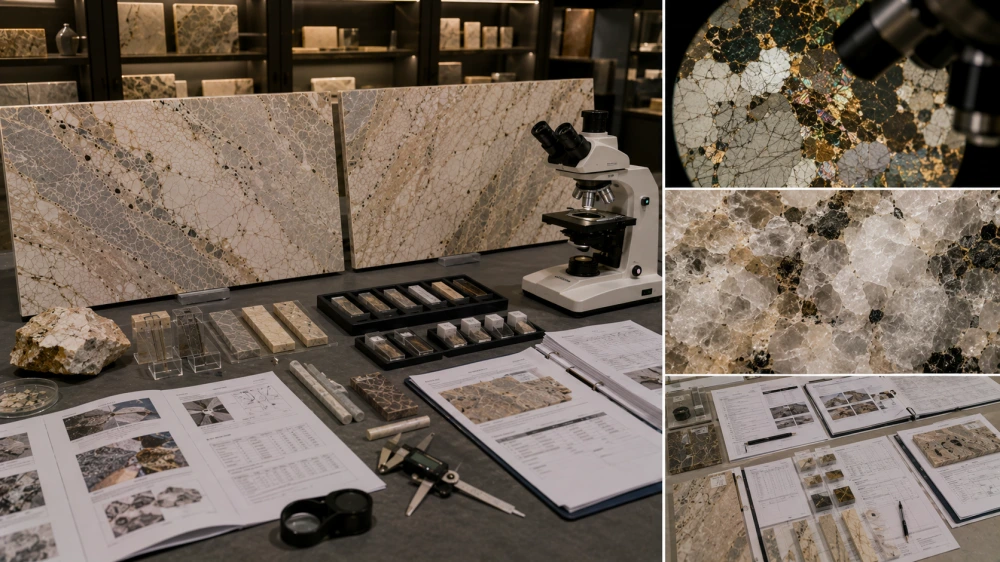
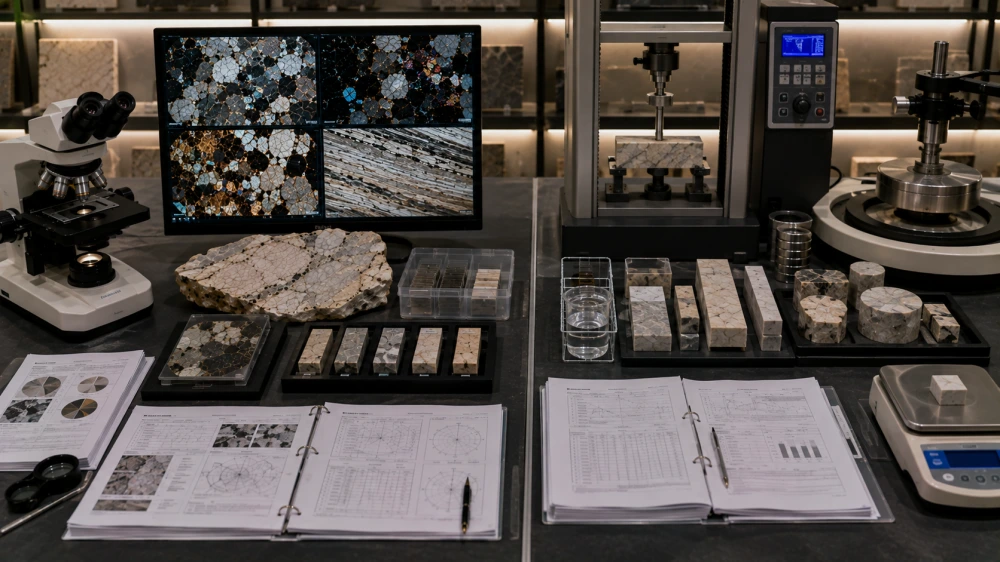
एक पेट्रोग्राफिक रिपोर्ट एक प्राकृतिक क्वार्ट्जाइट खरीदार को यह समझने में मदद कर सकती है कि प्रस्तुत किया गया पत्थर का नमूना किससे बना है और उसके खनिज तथा बनावट किस प्रकार व्यवस्थित हैं। प्रयोगशाला की विधि और रिपोर्ट के दायरे के आधार पर, पेट्रोग्राफिक परीक्षण में खनिज संरचना, चट्टान का वर्गीकरण, दाने के आपसी संबंध, बनावट, सहायक खनिज, परिवर्तन, दरारें या अन्य सूक्ष्म विशेषताओं का वर्णन किया जा सकता है। हालाँकि, एक पेट्रोग्राफिक रिपोर्ट केवल परीक्षण किए गए नमूने का वर्णन करती है; यह एक ही वाणिज्यिक नाम के तहत बेची जाने वाली हर चट्टान के प्रदर्शन, दिखावट या स्थिरता को स्वचालित रूप से साबित नहीं करती है। खरीदारों को पेट्रोग्राफी को नमूना पहचान, चट्टान की समीक्षा, परियोजना के विनिर्देशों और इच्छित अनुप्रयोग के लिए आवश्यक किसी भी अलग भौतिक या यांत्रिक परीक्षण के साथ मिलाकर पढ़ना चाहिए।.
प्राकृतिक क्वार्ट्जाइट को अक्सर एक वाणिज्यिक पत्थर के नाम से खरीदा जाता है, लेकिन केवल एक व्यापारिक नाम से सामग्री का पूरा भूवैज्ञानिक वर्णन प्राप्त नहीं होता है।.
खरीदारों, वास्तुकारों, निर्माताओं, ठेकेदारों और परियोजना क्रय टीमों के लिए, एक प्राकृतिक क्वार्ट्जाइट के लिए पेट्रोग्राफिक रिपोर्ट एक प्रतिनिधि प्रस्तुत नमूने की खनिज और बनावट के स्तर पर जाँच करके सामग्री की जानकारी का एक और स्तर प्रदान कर सकती है।.
यह विशेष रूप से तब उपयोगी होता है जब खरीदार इन प्रश्नों को समझना चाहता है:
परीक्षण किए गए नमूने में कौन-कौन से खनिज मौजूद हैं?
क्वार्ट्ज क्या प्रमुख खनिज है?
खनिज दाने किस प्रकार व्यवस्थित और आपस में जुड़े हुए हैं?
क्या सहायक खनिज मौजूद हैं?
क्या दरारें, परिवर्तन, परतदार बनावट या अन्य विशेषताएँ देखी गई हैं?
प्रयोगशाला ने चट्टान का वर्गीकरण या वर्णन किस प्रकार किया है?
हालाँकि, पेट्रोग्राफी की भी कुछ महत्वपूर्ण सीमाएँ हैं। एक प्रस्तुत नमूने से लिया गया एक पतला अनुभाग स्वचालित रूप से हर चट्टान, हर खदान क्षेत्र, हर उत्पादन बैच या एक ही वाणिज्यिक नाम के तहत बेची जाने वाली हर पत्थर का प्रतिनिधित्व नहीं कर सकता है।.
इसलिए सबसे उपयोगी दृष्टिकोण है:
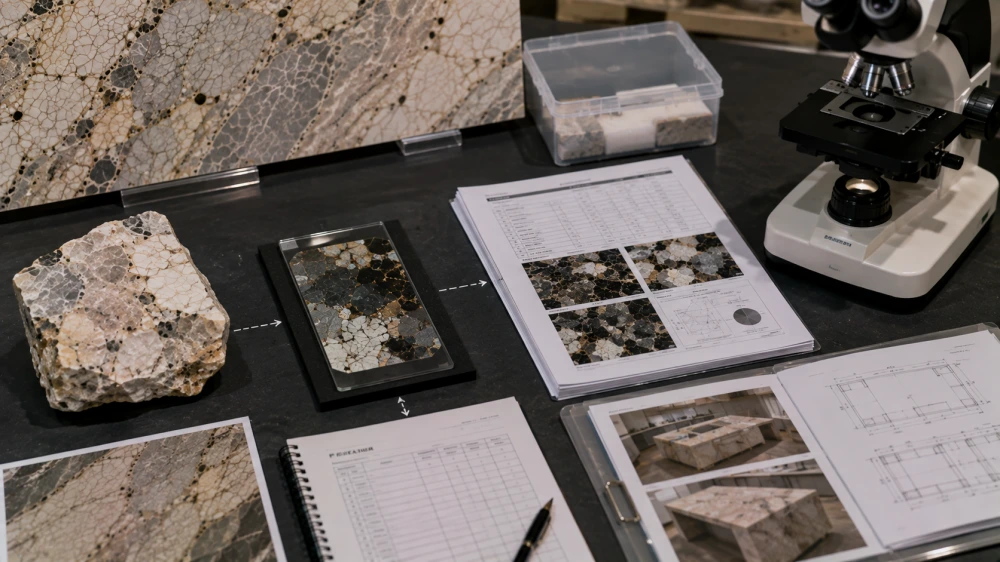
नमूने की पहचान → पेट्रोग्राफिक वर्णन का अध्ययन → खनिज विज्ञान और बनावट की समझ → रिपोर्ट की सीमाओं का जानना → अन्य परियोजना साक्ष्यों के साथ तुलना → क्रय निर्णय लेना।.
प्राकृतिक क्वार्ट्जाइट के लिए पेट्रोग्राफिक रिपोर्ट क्या है?
एक पेट्रोग्राफिक रिपोर्ट एक चट्टान के नमूने का प्रयोगशाला द्वारा उसके खनिज संरचना, बनावट, बनावट और अन्य देखी जाने वाली भूवैज्ञानिक विशेषताओं के आधार पर दिया गया वर्णन है।.
प्रयोगशाला की प्रक्रिया और दायरे के आधार पर, परीक्षण में सूक्ष्म दृष्टि के साथ तैयार किए गए पतले अनुभाग का सूक्ष्म परीक्षण भी शामिल हो सकता है।.
एक पतला अनुभाग चट्टान का एक बहुत ही पतला टुकड़ा होता है, जिसे इस तरह तैयार किया जाता है ताकि खनिजों और उनके आपसी संबंधों का पेट्रोग्राफिक माइक्रोस्कोप के जरिए अध्ययन किया जा सके।.
परिणामी रिपोर्ट इन चीजों का वर्णन करने में मदद कर सकती है:
प्रमुख खनिज
सहायक खनिज
खनिजों के अनुपात का आकलन
दाने का आकार
दाने की सीमाएँ
खनिजों का उन्मुखीकरण
चट्टान की बनावट और बनावट
दरारें या सूक्ष्म दरारें
परिवर्तन के उत्पाद
चट्टान का वर्गीकरण या भूवैज्ञानिक वर्णन
सटीक जानकारी प्रयोगशाला, परीक्षण की विधि, नमूने की गुणवत्ता और माँगे गए दायरे पर निर्भर करती है।.
प्राकृतिक क्वार्ट्जाइट खरीदते समय पेट्रोग्राफी क्यों मायने रखती है?
वाणिज्यिक पत्थर की शब्दावली और भूवैज्ञानिक शब्दावली हमेशा एक ही प्रश्न का उत्तर नहीं देती हैं।.
एक वाणिज्यिक नाम प्राकृतिक पत्थर की आपूर्ति श्रृंखला में एक पत्थर की पहचान और विपणन में मदद करता है। वहीं, पेट्रोग्राफिक परीक्षण वास्तविक प्रस्तुत चट्टान के नमूने को देखता है।.
एक खरीदार के लिए, यह अंतर महत्वपूर्ण है क्योंकि एक जैसी दिखने वाली चट्टानें अलग-अलग खनिज संरचना और भूवैज्ञानिक बनावट रख सकती हैं।.
इसलिए, पेट्रोग्राफी इन चीजों का सबूत प्रदान कर सकती है जो इनका पूरक हैं:
वाणिज्यिक पत्थर का नाम
चट्टान की तस्वीरें
भौतिक नमूने
निर्माता का अनुभव
भौतिक गुणों के परीक्षण के डेटा
परियोजना के विनिर्देश
आमतौर पर इसे सामग्री के मूल्यांकन पैकेज का एक हिस्सा माना जाना चाहिए, न कि एक स्वतंत्र क्रय प्रमाण पत्र के रूप में।.
एक पेट्रोग्राफिक रिपोर्ट क्वार्ट्जाइट खरीदार को क्या बता सकती है?
रिपोर्ट का क्षेत्र
वह क्या वर्णन कर सकती है
वह एक खरीदार के लिए क्यों महत्वपूर्ण है
खनिज संरचना
नमूने में देखे गए क्वार्ट्ज और अन्य खनिज
खरीदार को यह समझने में मदद करता है कि परीक्षण किए गए पत्थर की वास्तविक संरचना क्या है
चट्टान का वर्गीकरण
अवलोकित विशेषताओं के आधार पर भूवैज्ञानिक वर्णन या वर्गीकरण
वाणिज्यिक व्यापार नाम से परे जानकारी प्रदान करता है
बनावट
दाने का आकार, दानों के आपसी संबंध, एक-दूसरे से जुड़ी हुई संरचना या अन्य सूक्ष्म बनावट
नमूने की आंतरिक भूवैज्ञानिक संरचना को समझाने में मदद करता है
फैब्रिक
उपस्थिति में उन्मुखीकरण, फोलिएशन, बैंडिंग या दिशात्मक खनिज व्यवस्था
पत्थर में दिखाई देने वाली दिशात्मक भूवैज्ञानिक विशेषताओं के संदर्भ को प्रदान कर सकता है
सहायक खनिज
प्रमुख खनिज समूह के अलावा छोटे खनिज
रंग, खनिज धब्बे, बैंड या अन्य प्राकृतिक विशेषताओं को समझाने में मदद कर सकता है
परिवर्तन
देखे गए स्थानों पर परिवर्तित खनिज क्षेत्र या द्वितीयक खनिज उत्पाद
अतिरिक्त भूवैज्ञानिक संदर्भ प्रदान करता है, जो परियोजना के अनुसार आगे की समीक्षा को उचित ठहरा सकता है
दरारें
परीक्षित खंड में उपस्थित प्राकृतिक दरारें या सूक्ष्म दरारें
परीक्षण किए गए नमूने में ऐसी विशेषताओं की पहचान कर सकता है, जो स्लैब और निर्माण समीक्षा के साथ संबंधित हो सकती हैं
खनिज संरचना: क्या क्वार्ट्ज वास्तव में प्रमुख है?
भूवैज्ञानिक रिपोर्ट का सबसे उपयोगी हिस्सा खनिज विशेषताओं का वर्णन है।.
प्राकृतिक क्वार्ट्जाइट एक क्वार्ट्ज-समृद्ध भूवैज्ञानिक संरचना से जुड़ा होता है, लेकिन खरीदारों को इस सामान्य बयान को एक अपरीक्षित स्लैब के बारे में धारणा में नहीं बदलना चाहिए।.
एक भूवैज्ञानिक परीक्षण द्वारा प्रस्तुत नमूने में देखे गए खनिजों की पहचान की जा सकती है और विश्लेषणात्मक विधि के आधार पर उनकी सापेक्ष मात्रा के बारे में भी जानकारी मिल सकती है।.
क्वार्ट्ज के अलावा, रिपोर्ट में सहायक या द्वितीयक खनिजों की पहचान की जा सकती है।.
ये इन चीजों में योगदान दे सकते हैं:
रंग में भिन्नता
गहरे या हल्के खनिज बैंड
सूक्ष्म अंतर्निहित वस्तुएं
दिशात्मक विशेषताएं
अन्य भूवैज्ञानिक विशेषताएं
महत्वपूर्ण खरीदार का प्रश्न यह नहीं है कि:
“क्या इस रिपोर्ट में क्वार्ट्ज का उल्लेख है?”
एक बेहतर सवाल है:
“रिपोर्ट में किस खनिज समूह का वर्णन है और प्रयोगशाला परीक्षण किए गए पत्थर का वर्णन कैसे करती है?”
चट्टान का वर्गीकरण: वाणिज्यिक नाम बनाम भूवैज्ञानिक वर्णन
एक वाणिज्यिक पत्थर का नाम और एक भूवैज्ञानिक चट्टान का वर्गीकरण अलग-अलग उद्देश्यों के लिए इस्तेमाल होते हैं।.
वाणिज्यिक नाम का उपयोग पत्थर के बाजार में उत्पाद की पहचान के लिए किया जाता है। यह दिखावे, मूल, ऐतिहासिक नामकरण या स्थापित व्यापार प्रथा को दर्शाता हो सकता है।.
भूवैज्ञानिक वर्णन प्रयोगशाला द्वारा परीक्षित नमूने के आधार पर होता है।.
इसका मतलब है कि खरीदार को यह मानना नहीं चाहिए कि “क्वार्ट्जाइट” शब्द के साथ बाजार में बेचे जाने वाले हर उत्पाद को स्वचालित रूप से एक ही भूवैज्ञानिक पत्थर के रूप में भूवैज्ञानिक रूप से सत्यापित कर लिया गया है।.
इसी तरह, एक नमूने के लिए भूवैज्ञानिक परिणाम को समान वाणिज्यिक नाम वाले असंबंधित सामग्रियों पर स्वचालित रूप से लागू नहीं किया जाना चाहिए।.
खरीद के लिए, रिकॉर्ड में दोनों पहचानों को संरक्षित रखें:
वाणिज्यिक सामग्री का नाम + नमूने की पहचान + भूवैज्ञानिक वर्गीकरण
यह व्यापार नाम पर निर्भर रहने की तुलना में एक स्पष्ट साक्ष्य प्रणाली बनाता है।.
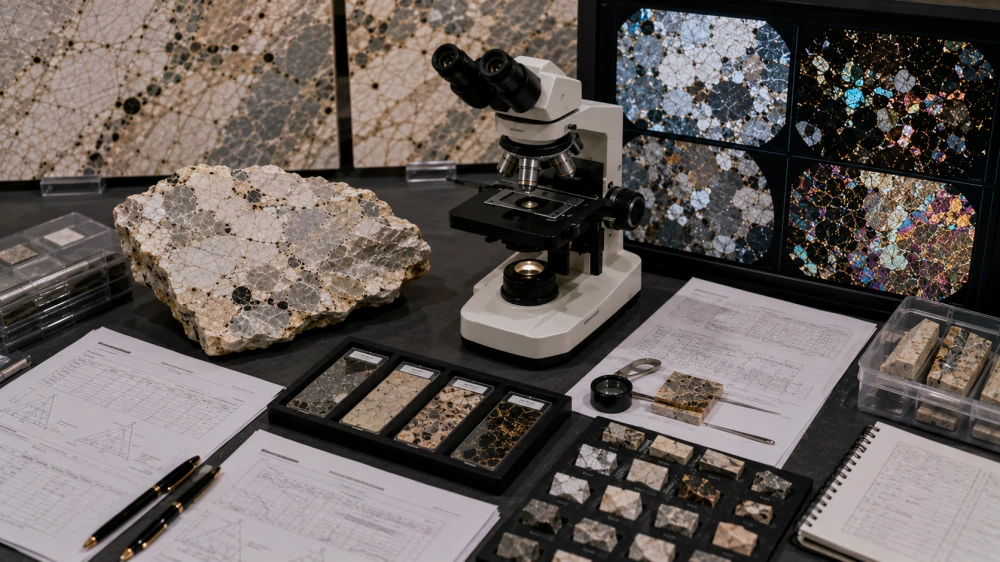
भूवैज्ञानिक परीक्षण सूक्ष्म स्तर पर खनिज दानों के आपसी संबंधों को प्रकट कर सकता है।.
रिपोर्ट में ऐसी विशेषताओं का वर्णन हो सकता है जैसे कि:
सूक्ष्म, मध्यम या बड़े दाने का आकार
एक-दूसरे से जुड़े हुए दाने
बढ़े हुए या उन्मुख खनिज
Recrystallized textures
Grain-boundary relationships
Mineral bands
Localized fractures
For a buyer, these observations provide a more detailed geological picture than a polished slab photograph alone.
However, microscopic texture should not be converted into an unsupported performance guarantee. If the project requires specific strength, absorption, abrasion, or other physical-property values, those questions should be addressed with the appropriate separate tests and project criteria.
Can a Petrographic Report Identify Accessory Minerals?
Yes, depending on the sample, analytical method, and report scope, petrographic examination can identify minerals other than quartz.
Accessory minerals may be visually minor but geologically informative.
They can help explain why a Natural Quartzite slab contains:
Dark mineral spots
Brown or grey bands
Greenish zones
Micaceous-looking areas
Contrasting mineral streaks
Localized color changes
Not every visible feature can be identified confidently from a photograph. If mineral identity matters to the project, laboratory analysis is more useful than visual guessing.
What Can Fractures and Microfractures Tell You?
A petrographic examination may document fractures or microfractures observed in the tested section.
This information can be useful, but it must be interpreted carefully.
A microscopic fracture in one small sample does not automatically describe the fracture distribution of an entire slab. Conversely, a thin section without a particular fracture does not prove that the full slab contains none.
For fabricated projects, the petrographic observation should therefore be correlated with:
Full-slab inspection
कटिंग लेआउट
Location of sink and cooktop openings
Narrow stone sections
Long overhangs
मिटर्ड किनारे
वॉटरफॉल पैनल्स
Fabricator handling requirements
Petrography can identify microscopic evidence. The fabrication plan determines how the actual slab is used.
A petrographic report can identify mineral composition that may be relevant to discussions about acid-sensitive minerals, but buyers should be careful not to turn a mineralogical description into an automatic field-performance prediction.
If a stone contains minerals that are potentially relevant to acid response, that information can help the project team decide whether additional testing is appropriate.
For countertop or hospitality applications where exposure to acidic substances is a concern, a project-specific test on a representative sample can provide more directly relevant information than relying only on the commercial stone name.
The useful distinction is:
Petrography identifies and describes minerals; a specific performance test evaluates a specific performance question.
Can a Petrographic Report Prove Quartzite Performance?
No. A petrographic report should not be treated as a complete performance certificate for every property of the stone.
Petrography describes mineralogical and textural characteristics of the tested sample. Other questions may require different test methods.
खरीदार का प्रश्न
Can Petrography Help?
May Separate Testing Be Needed?
What minerals are present?
Yes, this is a core petrographic question
Additional analytical methods may be used where more specific identification is required
How is the rock classified?
Yes, depending on report scope
Not necessarily for basic petrographic classification
What is the water absorption?
Not established by petrographic description alone
Yes
What is the flexural strength?
Not established by petrographic description alone
Yes
What is the abrasion resistance?
Not established by petrographic description alone
Yes, when relevant to the project
Will every slab have the same mineral distribution?
नहीं
Actual slab and lot review remains important
Why Sample Identity Is Critical
The value of a petrographic report depends heavily on knowing what was actually tested.
Before relying on a report, the buyer should check whether the sample identity can be connected to the material being offered.
Useful records may include:
वाणिज्यिक सामग्री का नाम
Sample number
Laboratory report number
Testing date
Supplier or submitting party
Batch or lot reference where available
Photograph of the submitted sample where provided
Relevant project reference
If the chain between the laboratory sample and the offered material is unclear, the buyer should avoid assuming that the report automatically represents the slabs under consideration.
Does One Petrographic Sample Represent Every Slab?
No. Petrographic results should be interpreted within the scope of the sample that was tested.
Natural stone can vary because of geological changes within the deposit and differences between extraction zones, blocks, slabs, and batches.
A petrographic report can provide valuable evidence about a submitted sample, but it does not prove that every future slab will have identical:
Mineral proportions
रंग
Vein distribution
Fracture frequency
Accessory mineral distribution
Visual character
This is why petrographic evidence and current slab review serve different purposes.
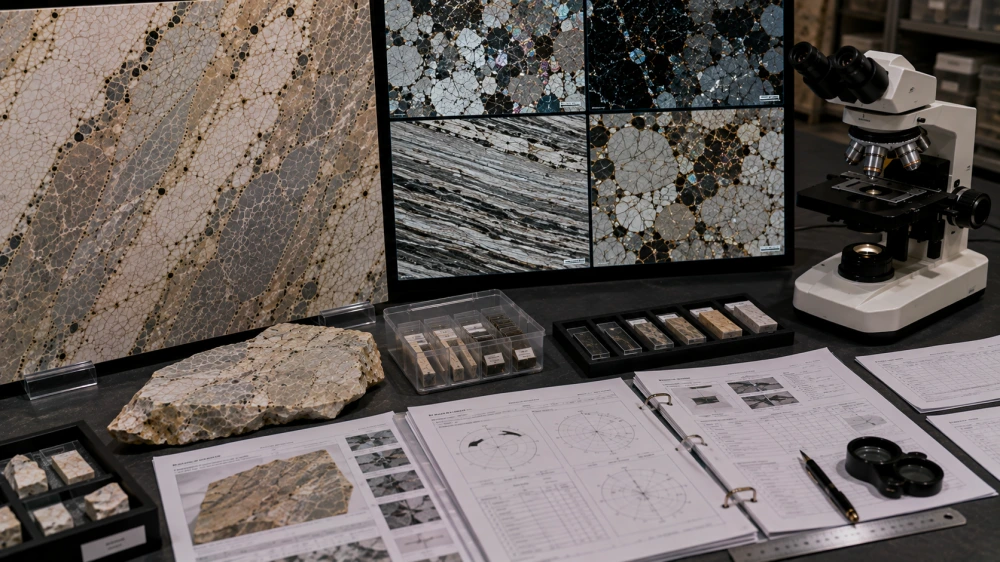
Petrography helps explain the tested rock. Slab review confirms the actual material being purchased.
Petrographic Report vs Physical Test Report
Buyers sometimes treat all laboratory documents as though they answer the same questions. They do not.
Document Type
Main Question
Typical Buyer Use
पेट्रोग्राफिक रिपोर्ट
What is the tested rock made of and how is it structured?
Mineralogy, texture, geological description, and material verification context
Water Absorption Test
How much water does the tested specimen absorb under the specified method?
Project performance review where absorption is relevant
Density / Specific Gravity Test
What are the measured density-related properties?
Material characterization and project engineering input
Flexural Strength Test
How does the tested specimen respond under the specified bending test?
Engineering and application-specific evaluation
Abrasion Test
How does the tested material respond to the specified abrasion method?
Flooring and wear-related evaluation where applicable
A strong technical submittal may therefore contain several documents, each answering a different question.
quartzite-petrographic-report-vs-physical-testing
How Should a Buyer Read a Petrographic Report?
A buyer does not need to become a geologist to use a petrographic report effectively. A structured review is usually more useful than focusing on isolated technical words.
1. Confirm the Sample
Check what material was submitted, when it was tested, and whether it can reasonably be linked to the stone currently offered.
2. Read the Rock Description
Identify how the laboratory describes or classifies the sample rather than relying only on the commercial stone name.
3. Review the Dominant Mineralogy
Look at the minerals identified and their reported relationships or proportions where provided.
4. Review Texture and Fabric
Note grain size, recrystallization, orientation, foliation, banding, fractures, or other reported structural features.
5. Identify Accessory or Altered Minerals
These may help explain visible geological variation or identify questions that deserve further review.
6. Read the Limitations
Check whether the laboratory defines the scope of the examination, sample limitations, or other qualifications.
7. Match the Report to the Project Question
Do not ask petrography to answer a question it was not designed to answer. If the project needs physical performance values, use the appropriate additional test data.
When Should a Quartzite Buyer Request Petrographic Analysis?
Not every residential slab purchase requires a petrographic report. The value depends on the project and the uncertainty being addressed.
A buyer may consider requesting or reviewing petrographic analysis when:
Material classification is important to the specification
The commercial stone name creates uncertainty about geological identity
The project has a formal technical-submittal process
An architect or consultant requests mineralogical verification
The buyer wants additional evidence beyond visual slab inspection
Unexpected mineralogical or geological features need investigation
A large project requires a more documented material-approval process
The request should have a defined purpose. Testing without a clear question can produce a technical document that the project team does not know how to use.
Common Mistakes When Using Petrographic Reports
आम गलती
Why It Is a Problem
बेहतर दृष्टिकोण
Assuming the trade name proves geology
Commercial naming and geological classification serve different purposes
Read the actual petrographic description
Applying one report to every slab
Natural stone can vary between blocks and batches
Confirm sample identity and current material
Using petrography as a strength test
Mineralogical description does not provide every engineering property
Use appropriate physical or mechanical testing
Ignoring accessory minerals
Minor minerals may be relevant to understanding natural variation
Review the full mineralogical description
Ignoring sample traceability
The buyer may not know whether the report relates to the offered material
Record sample, report, supplier, and material references
Skipping actual slab review
Microscopic analysis cannot approve the visual layout of the purchased slabs
Combine laboratory evidence with current slab selection
Before using a petrographic report in a Natural Quartzite purchasing decision, check:
सामग्री की पहचान: What commercial stone name is associated with the sample?
नमूना ID: Is the tested specimen clearly identified?
रिपोर्ट की तारीख: When was the examination performed?
Laboratory: Who performed the examination?
Method / Scope: What type of examination or analytical scope is described?
Rock Classification: How does the report describe the tested rock?
Dominant Minerals: Which minerals make up the main mineral assemblage?
Accessory Minerals: What additional minerals are reported?
बनावट: What grain relationships or recrystallized features are described?
Fabric: Is foliation, banding, orientation, or another directional feature reported?
Fractures: Are fractures or microfractures noted in the examined sample?
Alteration: Are altered or secondary minerals described?
सीमाएँ: What does the report not establish?
Slab Correlation: Can the report reasonably be connected to the current material being offered?
Additional Tests: Does the intended application require separate physical or mechanical data?
खरीदार के लिए अक्सर पूछे जाने वाले प्रश्न
1. What does a petrographic report tell you about Natural Quartzite?
एक पेट्रोग्राफिक रिपोर्ट में परीक्षण किए गए नमूने में देखी गई खनिज संरचना, चट्टान का वर्गीकरण, बनावट, संरचना, सहायक खनिज, दरारें, परिवर्तन और अन्य भूवैज्ञानिक विशेषताओं का वर्णन किया जा सकता है। सटीक जानकारी प्रयोगशाला की पद्धति और रिपोर्ट के दायरे पर निर्भर करती है।.
2. Can a petrographic report confirm that a stone is quartzite?
A petrographic examination can provide a geological description and classification of the submitted sample based on its observed mineralogy and texture. Buyers should read the laboratory’s actual conclusion rather than assuming that a commercial trade name alone establishes geological classification.
3. Does a petrographic report show how much quartz is in the stone?
यह विश्लेषणात्मक विधि और दायरे के आधार पर खनिजों का अनुपात या खनिजों की प्रचुरता का अनुमान प्रदान कर सकता है। खरीदारों को यह मान लेने के बजाय, वास्तविक प्रयोगशाला रिपोर्ट में उल्लिखित मूल्यों और शब्दावली का उपयोग करना चाहिए, कि हर पेट्रोग्राफिक जांच एक ही प्रकार के परिमाणात्मक डेटा प्रदान करती है।.
4. Can petrography tell whether Natural Quartzite will etch?
पेट्रोग्राफी से ऐसे खनिजों की पहचान हो सकती है, जो एसिड संवेदनशीलता के मामले में महत्वपूर्ण हो सकते हैं, लेकिन इसे स्वतः ही सीधे एटच-प्रदर्शन परीक्षण के रूप में नहीं लिया जाना चाहिए। यदि एसिड प्रतिक्रिया आवेदन के लिए महत्वपूर्ण है, तो प्रतिनिधि परियोजना-विशिष्ट परीक्षण उचित हो सकता है।.
5. Does one petrographic report represent every slab from a quarry?
नहीं। पेट्रोग्राफिक रिपोर्ट जांचे गए नमूने का वर्णन करती है। प्राकृतिक पत्थर में खदान के विभिन्न क्षेत्रों, ब्लॉकों, स्लैबों और बैचों के बीच भिन्नता हो सकती है, इसलिए नमूने की पहचान और सामग्री में भिन्नता को ध्यान में रखे बिना, रिपोर्ट को स्वचालित रूप से हर भविष्य के स्लैब पर लागू नहीं किया जाना चाहिए।.
6. Is a petrographic report the same as a physical-property test report?
नहीं। पेट्रोग्राफी मुख्य रूप से खनिजविज्ञान, बनावट, संरचना और भूवैज्ञानिक विशेषताओं का वर्णन करती है। जल अवशोषण, झुकाव ताकत या घर्षण प्रतिरोध जैसे गुणों की आवश्यकता होने पर, उन मूल्यों के लिए उचित अलग-अलग परीक्षण विधियों की आवश्यकता होती है।.
7. Should buyers still inspect the actual quartzite slabs?
हाँ। पेट्रोग्राफी और स्लैब निरीक्षण अलग-अलग प्रश्नों का उत्तर देते हैं। पेट्रोग्राफी परीक्षण किए गए नमूने का खनिज और बनावट के स्तर पर वर्णन करती है, जबकि स्लैब निरीक्षण खरीदे जा रहे सामग्री के वास्तविक रंग, आंदोलन, प्राकृतिक विशेषताओं, आयामों, उपयोगी क्षेत्रों और दृश्य सुसंगतता की पुष्टि करता है।.
8. When is a petrographic report useful for a quartzite project?
यह तब उपयोगी हो सकता है जब भूवैज्ञानिक वर्गीकरण महत्वपूर्ण हो, वाणिज्यिक पत्थर का नाम अनिश्चितता पैदा करे, किसी परियोजना को तकनीकी प्रस्तुतियों की आवश्यकता हो, कोई परामर्शदाता खनिजीकरण के सत्यापन का अनुरोध करे, या खरीदार को दृष्टिगत स्लैब समीक्षा के अलावा अतिरिक्त साक्ष्यों की आवश्यकता हो। परीक्षण का अनुरोध एक परिभाषित परियोजना प्रश्न से जुड़ा होना चाहिए।.
अंतिम नोट
A petrographic report is most valuable when it is used for the question it can actually answer: what the tested Natural Quartzite sample is made of and how its minerals and geological fabric are organized. It should not be stretched into a guarantee for every slab or every performance property. For procurement, connect the report to a clearly identified sample, review the laboratory’s mineralogical and classification findings, understand the stated limitations, compare the findings with the actual slabs being offered, and request separate physical or mechanical testing when the project specification requires it.
Hi, I am the author of this article. I have been working in the field of Natural Stone for more than 15 years. If you need customized Natural Stone services, please feel free to contact me.