
Résumé rapide
When sourcing Natural Quartzite or granite from China, compare actual material availability and project controls-not assumptions based on a category or commercial name.
For an international buyer, the question is not which label sounds stronger. It is whether the selected natural stone, the approved slab range, the fabrication plan, and the maintenance expectations fit the intended use. Sourcing Reality: Availability of Quartzite vs Granite from China should therefore be evaluated as a project decision, not as a shortcut based on a showroom sample. Natural Quartzite and granite are both natural stones, yet their commercial names, mineral makeup, movement, absorption behavior, and suitability can vary by individual material. A disciplined comparison keeps the conversation specific and helps the project team avoid assumptions before cutting begins.

Sourcing questions require an approval path from material selection through fabrication, quality control, packing, and delivery planning. For importers, fabricators, designers, architects, contractors, and project procurement teams, the useful starting point is a written brief: intended application, drawings, finished dimensions, thickness, edge treatment, finish, quantity, approval process, and delivery destination. That brief lets the supplier and fabricator evaluate the chosen material as a system. It also prevents a broad “Quartzite versus granite” conversation from obscuring the details that affect a real order.
| Decision point | Questions to put in the project brief | Why it matters |
|---|---|---|
| Material request | What commercial name, application, visual direction, and dimensions are required? | The supplier can review the request against current material information. |
| Slab approval | How will variation, lot selection, and cut layout be reviewed? | Natural stone needs a documented visual approval path. |
| Processing scope | Are slabs, cut-to-size pieces, finish, and edges clearly defined? | Fabrication requirements influence yield and packing. |
| Logistics brief | What quantity, destination, and delivery basis should be evaluated? | Export planning should reflect the actual project scope. |
Natural Quartzite is a natural stone category and must not be confused with engineered quartz, which is a manufactured composite. Granite is also a natural stone, but it is not interchangeable with every quartzite sold under a commercial stone name. Performance statements should remain material-specific. Review the actual slabs, ask the fabricator how the selected finish and details will be handled, and confirm any proposed treatment or sealing approach against the stone and project conditions. That is more dependable than treating a category-level claim as a guarantee.
Slab approval should be an active part of the comparison. Ask to see current slab photographs or live video where practical, then check background tone, movement, fissures, filled areas, edge character, thickness consistency, and the relationship between the visible face and the planned cut layout. Natural variation is part of natural stone. The key commercial question is whether the approved range supports the design intent and whether the number of slabs, yield allowance, and layout decisions are understood before fabrication.
Fabrication changes how a material performs in service. Openings, narrow rails, unsupported overhangs, edge profiles, seams, and transitions need to be reviewed in relation to the actual slab and the fabricator’s process. A project team should share shop drawings early, identify vulnerable areas, and agree on who approves vein direction and piece placement. This is especially valuable when a visual statement and a demanding daily-use surface must work together.
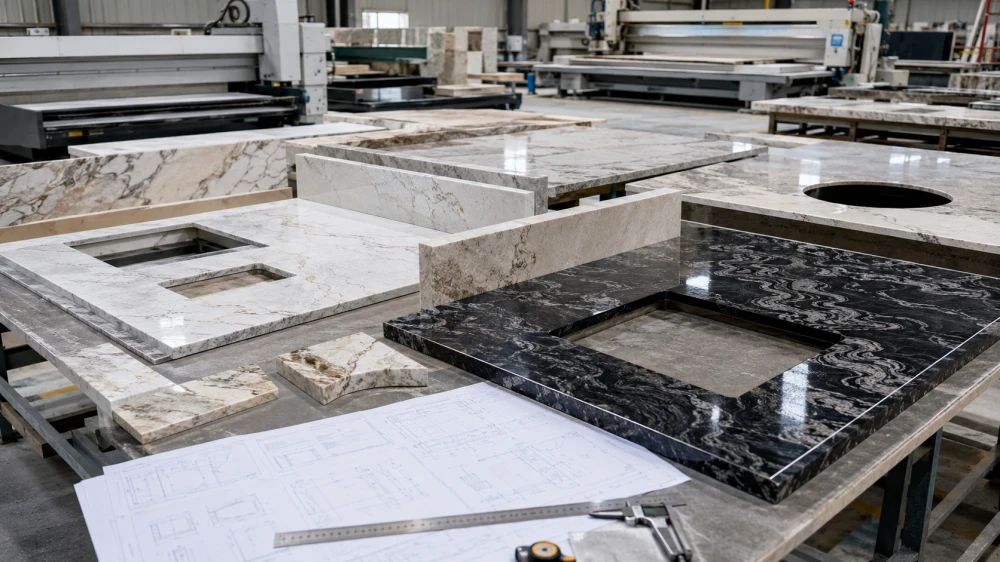
Commercial clarity is equally important. A useful quotation separates the approved material scope from fabrication, finishing, packaging, logistics, and destination-side work where those items are in scope. It should not imply inventory, price, lead time, origin, testing, or certification that has not been confirmed. If alternatives are being compared, keep the same application, dimensions, quantity, finish, edge requirements, and delivery basis in each request. Like-for-like inputs make a purchasing decision easier to audit.
| Stage | Buyer action | Decision output |
|---|---|---|
| Material review | Compare actual slabs and the stated application. | An approved visual and material range. |
| Technical review | Share drawings, dimensions, finish, and edge details. | A fabrication-aware approach. |
| Commercial review | Align quantities, scope, packaging, and destination. | Comparable supplier inputs. |
| Final approval | Confirm selected slabs and the current drawing revision. | A clear release point before processing. |
Daily use is not one condition. A private kitchen, hotel breakfast counter, retail service desk, wet bar, vanity, exterior feature, and reception desk each introduce different patterns of moisture, cleaning, impact, heat exposure, and user behavior. The design team should map the surface to those conditions, then discuss care instructions and practical limitations with the fabricator. A realistic maintenance plan, documented for the operator, is preferable to promises that any natural stone will be completely maintenance-free.
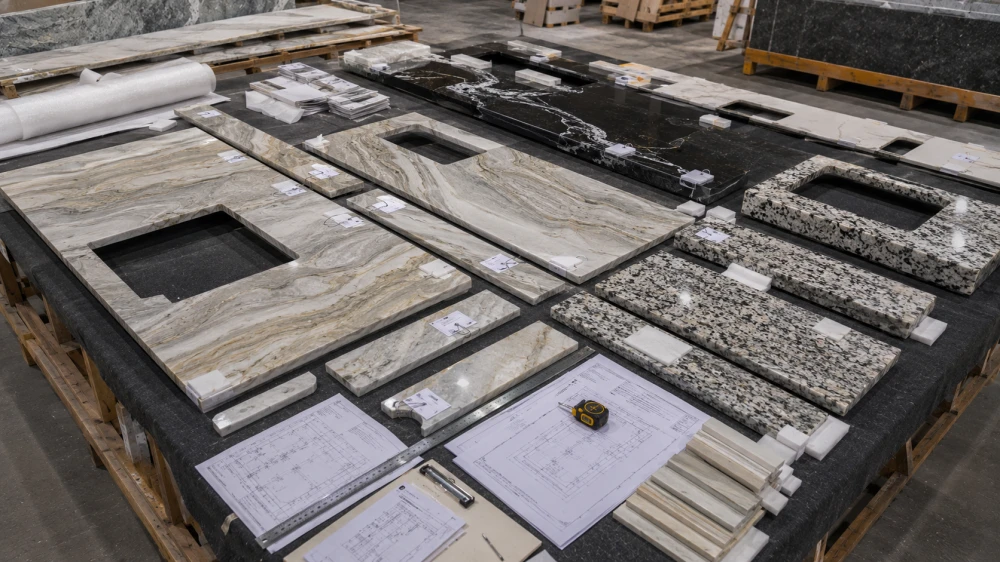
China sourcing should begin with a precise request rather than a generic category query. The buyer should identify whether the need is for slabs, cut-to-size work, or a combination; the intended application; approximate dimensions and quantity; visual direction; required finish; edge details; drawings; and delivery destination. This keeps a Natural Quartzite inquiry focused on the project rather than on unverified availability claims.
Natural variation is a central sourcing consideration. A commercial name can describe a visual family, but it should not be treated as a promise that every slab will have identical background, movement, or pattern distribution. Ask for current material visuals and establish an approval route before processing. Where layout matters, review slab positioning with the relevant drawings and define who gives the final approval.
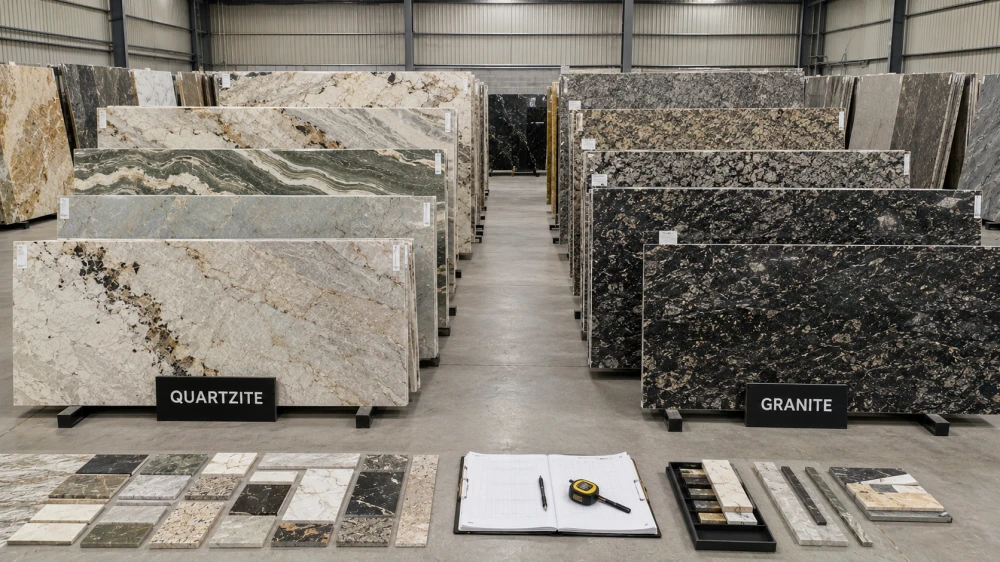
Granite can be a useful comparison material when the application and procurement brief are the same. The comparison should not turn the supplier into a general stone catalog. For a Natural Quartzite-led request, granite is considered only to help the buyer assess visual direction, fabrication scope, care expectations, and commercial fit for the stated project.
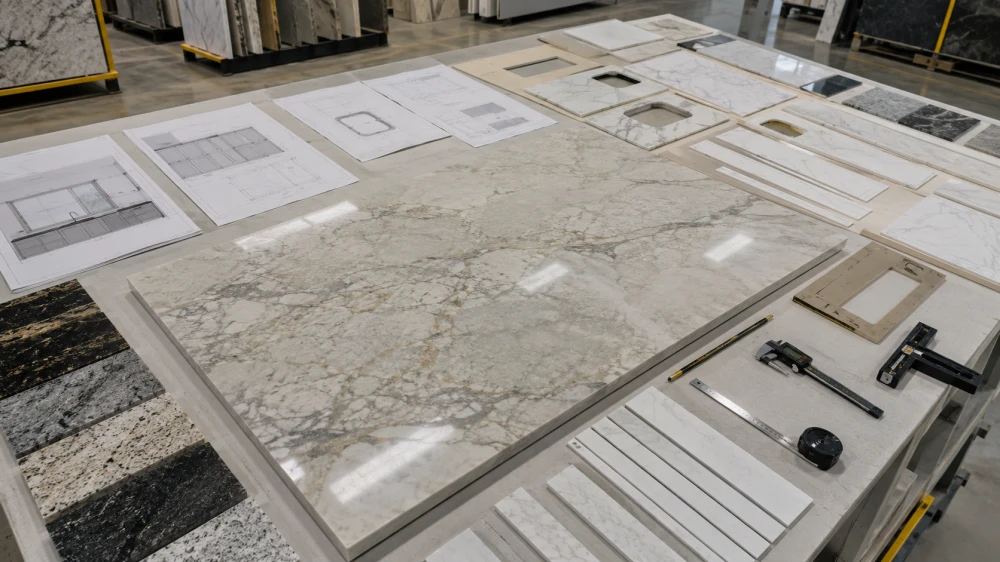
A material choice can pass through a designer, owner, purchasing manager, fabricator, installer, and facilities representative. Each person may use different language for the same requirement. A short decision record keeps those views aligned: name the proposed material, identify the approved slab images or samples, state the proposed application, record the finish and edge details, and note any assumptions that still require specialist confirmation. This record is particularly useful when a project compares Natural Quartzite with granite, because it makes clear that the comparison is about a defined scope rather than a general preference.
Set a clear communication cadence for long-distance purchasing. After an initial brief, consolidate material questions, drawing questions, and logistics questions so that each review results in an explicit next action. Keep visual approvals separate from changes to dimensions or processing scope, because they often involve different reviewers. Where a point cannot be confirmed from the available information, record it as pending rather than converting it into an assumption. A controlled record helps the buyer, supplier, and fabricator coordinate responsibly without overstating the facts available at that stage.
Use dimensional information early. Thickness, finished edge, overhang, sink or appliance cutouts, backsplash transitions, and any changes in plane can affect both the visual result and the fabrication review. A drawing does not need to be overly complex to be valuable; it needs to be current, measurable, and attached to the material conversation. If a design detail is important to the buyer, it should be visible in the information supplied for quotation and approval rather than being left as an informal instruction.
For projects with several pieces, include a layout conversation before release. Consider which faces will be most visible, how movement should continue across adjoining pieces where relevant, which areas may have seams, and whether book-matching or another directional approach is intended. Natural Quartzite can offer expressive variation, so a buyer should ask how the proposed layout will be reviewed against the available slabs. Granite may require the same discipline. The goal is transparent expectation-setting, not a promise of identical natural patterning.
Risk management should be practical. Instead of asking for broad assurances, ask focused questions about the conditions the completed surface will encounter. Describe the location, expected traffic, cleaning practice, contact with water or heat, and any unusual operational activity. The fabricator and appropriate project professionals can then evaluate the selected material and detail in context. This approach helps the team identify where a protective practice, adjusted detail, or different material route deserves consideration before costs are committed.
Receiving and handover deserve attention too. A procurement team benefits from a clear packing list, piece identification where applicable, and an agreed process for visual and dimensional checks on receipt. The project should also maintain the final approved drawings, material visuals, and care information in a handover file. This is useful for installation coordination and for later maintenance questions. It is more reliable than trying to reconstruct what was approved after materials have moved through several parties.
When comparing suppliers, keep the brief consistent. Send the same material name or visual direction, quantities, drawings, finishes, edge details, delivery destination, and requested service scope to each party. Responses can then be assessed on what they actually cover. If an item is unknown, leave it as an open point rather than assuming it is included. This discipline improves communication without inventing claims about price, availability, timing, origin, testing, or project experience.
Finally, schedule approvals in the order they affect the project. Confirm the intended application and comparison criteria first; review current material visuals next; align fabrication details and drawings; then agree the release point for processing and packing. That sequence gives decision-makers a chance to address visual, technical, and operational questions while changes are still manageable. Sourcing questions require an approval path from material selection through fabrication, quality control, packing, and delivery planning. It is the kind of measured process that supports an international Natural Quartzite purchase from early inquiry through delivery planning.
Quality control works best when it is visible and sequenced. Before packing, buyers can request confirmation of the approved material identifier, dimensions, finish, edge work, labeling, and the agreed packing approach. For cut-to-size work, the approved drawing revision should be unambiguous. For slabs, the project team should agree how bundle identification, slab selection, and visual inspection will be recorded. These steps do not replace professional site inspection, but they reduce avoidable misunderstandings across borders.
Ask for a single current drawing revision and nominate the person authorized to approve slab selection and cut layout. This helps prevent production decisions being made from outdated dimensions.
Ask how the finished pieces will be identified against the drawing and packing list. Clear identification helps receiving teams compare the shipment with the approved scope.
Ask the buyer’s logistics team to provide the delivery destination and any receiving constraints early. Packaging and delivery discussion should be grounded in the actual shipment, not generic claims.
Before final approval, circulate the comparison record to the buyer, design team, fabricator, and procurement contact. Confirm that the material selection, scope, drawings, finish, operational assumptions, and receiving requirements describe the same project. This short cross-check helps avoid decisions based on incomplete or conflicting information and supports a more orderly release for fabrication.
Yes. A like-for-like brief can compare Natural Quartzite and granite for the same application, dimensions, quantity, finish, drawings, and delivery destination.
Natural stone varies. Reviewing current slabs or current material visuals helps the buyer assess background, movement, and suitability for the proposed cut layout before processing.
No. A commercial name should not be treated as a guarantee of identical appearance. Natural variation should be reviewed through the approved material selection.
Confirm the approved material scope, finished dimensions, drawing revision, finish, labeling approach, and the agreed packing and delivery requirements for the project.
Send Josh the material name, dimensions, quantity, drawings, surface finish, and delivery destination so the Natural Quartzite request can be reviewed in a project-specific way.
Note finale
Reliable sourcing is not a claim that every natural stone category behaves the same. It is a documented route from a precise request, through current material approval and fabrication review, to controlled packing and delivery planning.
Talk with Josh: Send the material name, dimensions, quantity, drawings, required surface finish, and delivery destination. HRST STONE can help structure a Natural Quartzite request for review by your procurement and fabrication teams.
Copyright (c) HRST STONE / XIAMEN HRST STONE CO., LTD. All rights reserved.