Comprar losas de cuarcita frente a piezas cortadas a medida: ¿qué cotización se adapta mejor al proyecto?
Post navigation
Resumen rápido
Buying Quartzite slabs and buying cut-to-size pieces are two different procurement routes. Slab purchasing gives the buyer or local fabricator more control over final cutting and installation, while cut-to-size supply can transfer more fabrication, layout, QC, and packing responsibility to the stone supplier. The better quote depends on project design maturity, local fabrication capability, actual slab selection, usable yield, cutouts, edge work, packing, logistics, and who is expected to manage each step.
Quartzite slabs vs cut-to-size pieces is not simply a price comparison.
Both routes can be appropriate, but they transfer different responsibilities between the stone supplier, fabricator, contractor, installer, designer, and buyer.
A buyer with an experienced local stone fabricator may prefer to purchase selected slabs and complete fabrication locally.
A project with approved shop drawings, complex waterfalls, multiple room packages, or limited local fabrication support may instead benefit from receiving finished cut-to-size components.
The right question is therefore not:
“Which quote has the lower unit price?”
Sino:
“Which supply route matches the way this project will actually be executed?”
Supplier fabricates components from approved drawings and material.
Supplier scope may include:
• cutting layout
• cutouts
• edge work
• miters
• piece numbering
• factory QC
• export packing
Neither route is automatically better. The better choice depends on where the project’s strongest fabrication and coordination capability already exists.
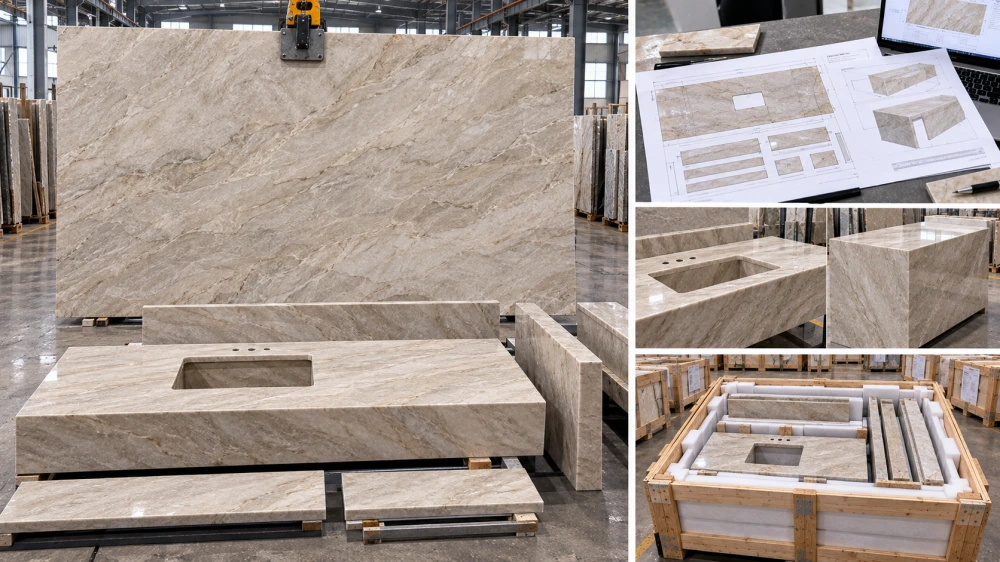
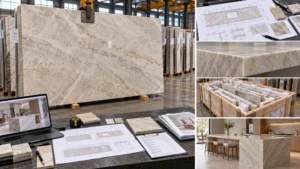
mont-blanc-quartzite-full-slab-procurement
Start With Project Design Maturity
The maturity of the project drawings is one of the fastest ways to determine which quotation route is realistic.
If the buyer only knows that the project requires “approximately three Quartzite slabs,” it may be too early to request a fully fabricated cut-to-size quotation.
If the project already has:
dimensiones finales;
piece quantities;
sink and cooktop models;
cutout dimensions;
edge profiles;
backsplash heights;
geometría de la cascada;
joint positions; and
approved shop drawings;
then a cut-to-size quotation can be much more meaningful.
Which Route Fits an Early-Stage Project?
Early Design Stage
Concept drawings only
Appliances not finalized
Edges still under design
Site dimensions not templated
Usually easier to evaluate as slab supply first, or as a provisional fabrication quote with clearly stated assumptions.
Trying to force a final cut-to-size price too early often creates an apparently precise quotation based on inputs that are still changing.
Which Route Fits a Fully Designed Project?
A cut-to-size quotation becomes much more useful when the finished pieces can be defined clearly.
This is particularly relevant for:
hotel projects;
villa packages;
repeated vanity tops;
wall-panel packages;
stone stair packages;
kitchen islands with waterfalls;
custom stone furniture; and
projects where the buyer wants fabrication completed before export.
The Biggest Difference: Who Owns the Yield Risk?
When a buyer purchases whole slabs, the buyer or local fabricator normally assumes more responsibility for turning the gross slab area into finished project pieces.
That means the slab must be evaluated for:
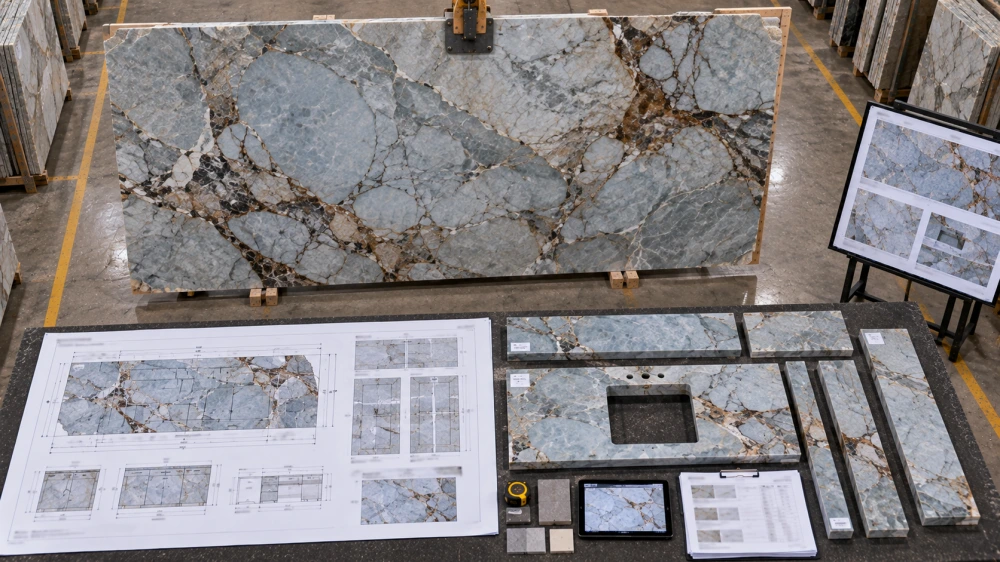
blue-roma-quartzite-slab-yield-cutting-layout
actual usable dimensions;
irregular edges;
natural fissures or features;
movement direction;
visual priority areas;
cutout locations;
seam strategy;
edge allowances; and
yield efficiency.
A nominal slab size does not automatically represent the area available for every finished component.
With Cut-to-Size Supply, Layout Responsibility Moves Earlier
When the supplier is asked to quote finished pieces, slab yield becomes part of the fabrication discussion much earlier.
The supplier may need to evaluate:
how many actual slabs are required;
which pieces fit each slab;
where the main visual zones should be allocated;
which direction each piece should run;
how waterfall pieces relate;
how seams affect slab consumption; and
whether additional slab area is needed to meet visual priorities.
This is one reason a finished-piece quote should not be compared directly with a simple slab-per-square-meter price.
Compare the Two Quotes by Responsibility, Not Just Price
Project Item
Slab Quote
Cut-to-Size Quote
Actual slab selection
Usually central to purchase
Still important before fabrication
Yield planning
Mostly buyer / local fabricator
Usually part of supplier fabrication planning
Cutouts
Usually completed locally
May be included if fully specified
Edges and miters
Usually local fabrication scope
Can be factory fabricated
Piece numbering
Usually not relevant until local fabrication
Useful for project traceability
Fabrication QC
Performed locally
Can be performed before export
Export packing complexity
Slab-frame / slab packing
Piece-specific crate planning
Local Fabrication Capability Can Decide the Answer
If the destination already has a trusted and experienced fabricator, buying slabs can make strong practical sense.
The local fabricator can:
template the actual installed cabinetry;
adjust for real wall conditions;
confirm appliance positions;
fabricate locally;
manage last-minute site tolerances; and
install the finished pieces directly.
In this situation, imported cut-to-size pieces may transfer fabrication work overseas without eliminating the need for local installation coordination.
When Cut-to-Size Supply Adds More Value
Cut-to-size Quartzite becomes more attractive when the project wants a larger portion of the stone workflow completed at the source.
Examples include projects where:
local fabrication cost is unusually high;
the supplier has already selected the slabs;
the design is fully approved;
the same supplier is managing layout and fabrication;
multiple pieces require sequencing;
dry-lay review is valuable;
waterfall continuity is important;
factory QC documentation is required; or
the project is already structured around imported finished stone components.
Cutouts and Edges Can Completely Change the Quote
A cut-to-size quotation should not be understood as simply “the slab cut into rectangles.”
The finished-piece scope may involve:
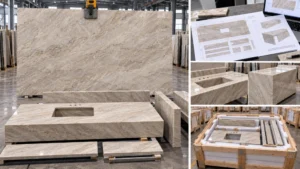
patagonia-quartzite-cut-to-size-fabricated-pieces
sink openings;
aperturas para cocinas;
agujeros para grifos;
drainer grooves;
polished exposed edges;
45-degree miters;
waterfall edges;
bordes construidos;
backsplash returns;
special shapes; and
reinforcement review where applicable.
These items create real fabrication work, so a cut-to-size quote should state whether they are included, excluded, or pending final information.
Do Not Compare Slab $/m² With Finished Piece $/m²
This is one of the easiest procurement mistakes to make.
A slab price may refer to gross material area.
A finished-piece price may already reflect:
slab consumption;
waste;
cutting;
polishing;
edges;
cutouts;
miters;
QC;
packing; or
other project-specific work.
Price Comparison Rule
Raw slab unit price and fabricated finished-piece unit price are different commercial units. Convert both options to the same completed project scope before deciding which route is less expensive.
Use Total Project Cost, Not Only Supplier Invoice Value
A more useful comparison is:
SLAB ROUTESlab purchase
+ International freight
+ Local slab transport
+ Local fabrication
+ Cutouts and edges
+ Local handling
+ Installation
CUT-TO-SIZE ROUTEMaterial consumption
+ Factory fabrication
+ Project packing
+ International freight
+ Destination handling
+ Site fitting / seams
+ Installation
Quartzite project budgeting is better understood as material + fabrication + installation rather than slab price alone. Our Quartzite Cost Guide for Kitchen Countertops explains this broader cost structure in more detail.
Shipping Can Favor Different Routes in Different Projects
The lowest fabrication cost does not automatically create the lowest landed cost.
Shipping Slabs
Slabs are shipped in large stone frames or appropriate slab-packing systems. The local fabricator then cuts the finished pieces after arrival.
Shipping Finished Pieces
Finished components may need:
foam separators;
edge protection;
corner guards;
support around cutouts;
numeración de piezas;
internal blocking; and
cajas de madera reforzadas y fumigadas.
This can increase packing work, but the shipment arrives closer to its final installation form.
Responsibility Transfer Map
Project Stage
Buy Slabs
Buy Cut-to-Size
Selección de las losas
Supplier + Buyer
Supplier + Buyer
Final measurement
Local project team
Must be supplied / confirmed before overseas fabrication
Diseño de corte
Local fabricator
Stone supplier / fabricator
Fabrication
Local fabricator
Stone supplier / factory
Factory QC
Slab supply QC
Finished component QC
Instalación
Local installer
Usually still local installer unless expressly included
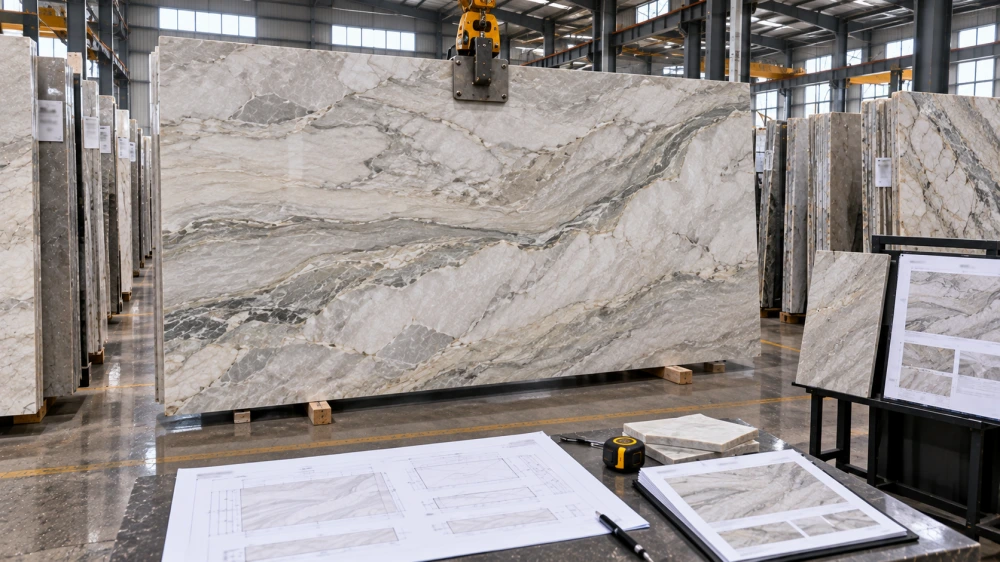
quartzite-slab-route-vs-finished-piece-route
Which Route Gives Better Visual Control?
Both routes can provide strong visual control, but the control occurs at different stages.
Buying Slabs
The buyer chooses the slabs first, then the local fabricator decides exactly how the finished pieces will be nested.
Buying Cut-to-Size Pieces
The buyer may approve both the slabs and the proposed cutting layout before fabrication.
For visually important kitchens, full-slab review should still come before final cutting. A Natural Quartzite project should not rely on a trade name alone.
El Guía del comprador de encimeras de cocina de cuarcita also recommends reviewing actual slabs, movement, fissures, finish, cutouts, seams, and fabrication planning together rather than treating the countertop as a generic material purchase.
Best-Fit Scenarios
Scenario 1 — Residential Kitchen + Trusted Local Fabricator
Buying selected slabs can be efficient because final templating, fabrication, fitting, and installation stay with one local team.
Scenario 2 — Large Villa With Many Stone Components
Cut-to-size supply may simplify piece numbering, centralized fabrication, dry-lay review, QC, and export packing.
Scenario 3 — Design Still Changing
A slab quote or provisional fabrication quote is safer than pretending unfinished drawings support a final cut-to-size commitment.
Scenario 4 — Repetitive Hotel Vanity Package
Cut-to-size production can be attractive when dimensions, quantities, edge details, and piece references are already standardized and approved.
Decision Scorecard: Slabs or Cut-to-Size?
If This Is True…
Route to Consider First
Strong local fabrication and installation team
Losas
Final site dimensions still uncertain
Slabs / provisional piece quote
Approved detailed shop drawings available
Cut-to-size becomes more practical
Complex factory-controlled dry lay required
Cut-to-size
Buyer wants maximum local adjustment after templating
Losas
Large repeated piece package
Cut-to-size may be more efficient
Questions to Ask Before Comparing the Quotes
Are both quotations based on the same Natural Quartzite?
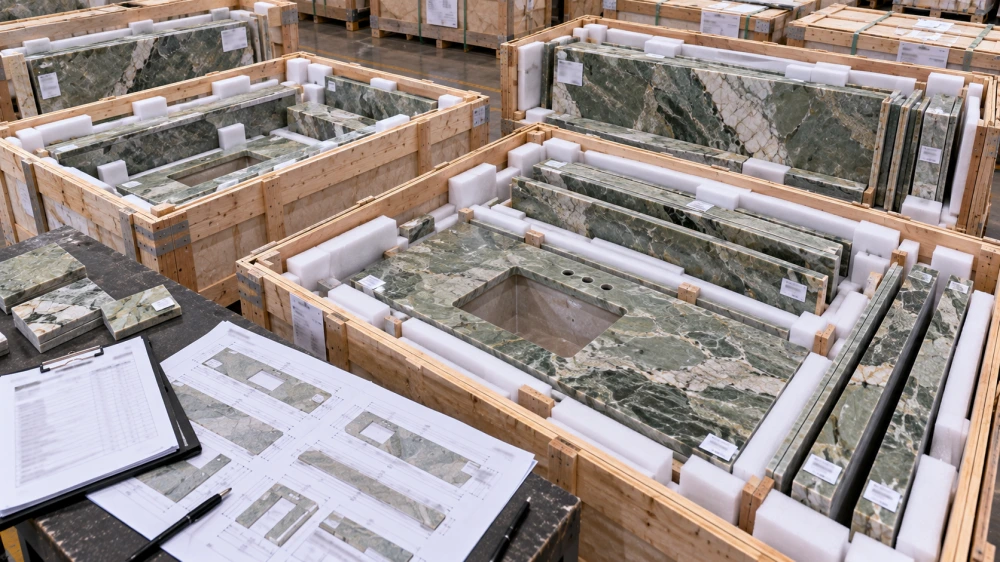
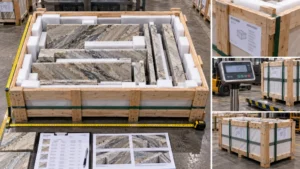
quartzite-cut-to-size-components-export-packing
Are the actual slab references confirmed?
Is the same thickness and finish being priced?
Are both quotations based on the same drawing revision?
Who is responsible for slab yield and cutting layout?
Are sink and cooktop cutouts included?
Are edges, miters, waterfalls, and returns included?
Is reinforcement included where applicable?
Does the cut-to-size quote include dry-lay or piece numbering?
What packing is included?
What Incoterm is being quoted?
Who handles installation and site fitting?
Preguntas más frecuentes
1. Is it cheaper to buy Quartzite slabs or cut-to-size pieces?
There is no universal answer. Slabs can have a lower apparent material cost but still require local fabrication, cutouts, edges, handling, and installation. Cut-to-size pieces include more factory processing but may reduce local fabrication scope. Compare both routes at the same completed project stage.
2. When does buying Quartzite slabs make more sense?
Buying slabs often makes sense when the project has a trusted local fabricator, site templating is important, dimensions may still require adjustment, or the buyer prefers to control fabrication and installation locally.
3. When does buying cut-to-size Quartzite make more sense?
Cut-to-size supply becomes more attractive when shop drawings are well developed, the supplier is managing slab layout and fabrication, multiple pieces require sequencing, or the buyer wants more fabrication and QC completed before export.
4. Does a cut-to-size quote automatically include cutouts and edge work?
No. Sink openings, cooktop cutouts, faucet holes, edge profiles, miters, waterfalls, reinforcement, and special fabrication should be confirmed individually rather than assumed from the phrase “cut to size.”
5. Can I compare slab price per square meter with finished-piece price per square meter?
Not directly. Gross slab area and finished fabricated area represent different commercial scopes. A meaningful comparison should include material consumption, yield, fabrication, packing, logistics, local fabrication, and installation as applicable.
6. Who should approve the cutting layout for cut-to-size Quartzite?
The project should identify the responsible reviewer. The supplier can prepare a proposed layout based on actual slabs and current drawings, but visual priorities, seams, piece orientation, and final release should follow the agreed project approval process.
7. What should I send HRST STONE for both quotation options?
Send the Natural Quartzite name, current drawings, dimensions, quantities, thickness, finish, sink and cooktop information, edge and miter details, visual priorities, preferred slab selection, trade term, and destination. HRST STONE can then separate slab-supply scope from cut-to-size fabrication scope for comparison.
Regla final de adquisiciónBuy Quartzite slabs when the project benefits from local templating, local fabrication, and maximum adjustment after the stone reaches the destination. Consider cut-to-size pieces when drawings are sufficiently mature and the project benefits from factory-controlled layout, fabrication, QC, piece numbering, and packing. Compare both options only after bringing them to the same final project scope.
HRST STONE can quote Natural Quartzite as slab supply or as project-specific cut-to-size components depending on the confirmed requirements. For a meaningful comparison, send Josh the material name, latest drawings, finished dimensions, quantities, thickness, surface finish, cutout and edge details, layout priorities, trade term, and destination so the two supply routes can be separated clearly.
Hi, I am the author of this article. I have been working in the field of Natural Stone for more than 15 years. If you need customized Natural Stone services, please feel free to contact me.
Fabricante y proveedor de mármol, granito, cuarcita, ágata de China - HRST STONE
¡Bienvenido a HRST STONE!
Hola, me gustaría conocer más sobre sus productos. ¿Podría facilitarme información sobre precios, cantidades mínimas de pedido, opciones de personalización y muestras?