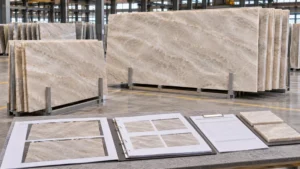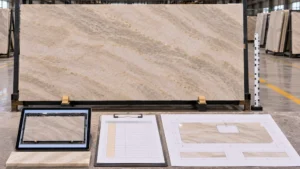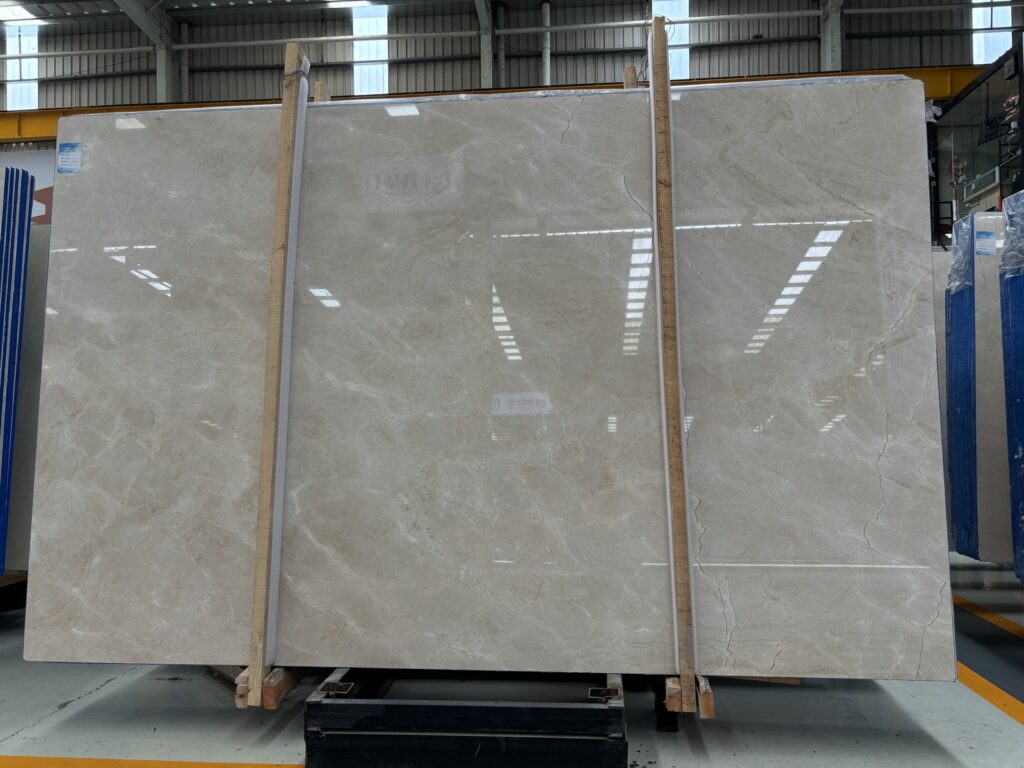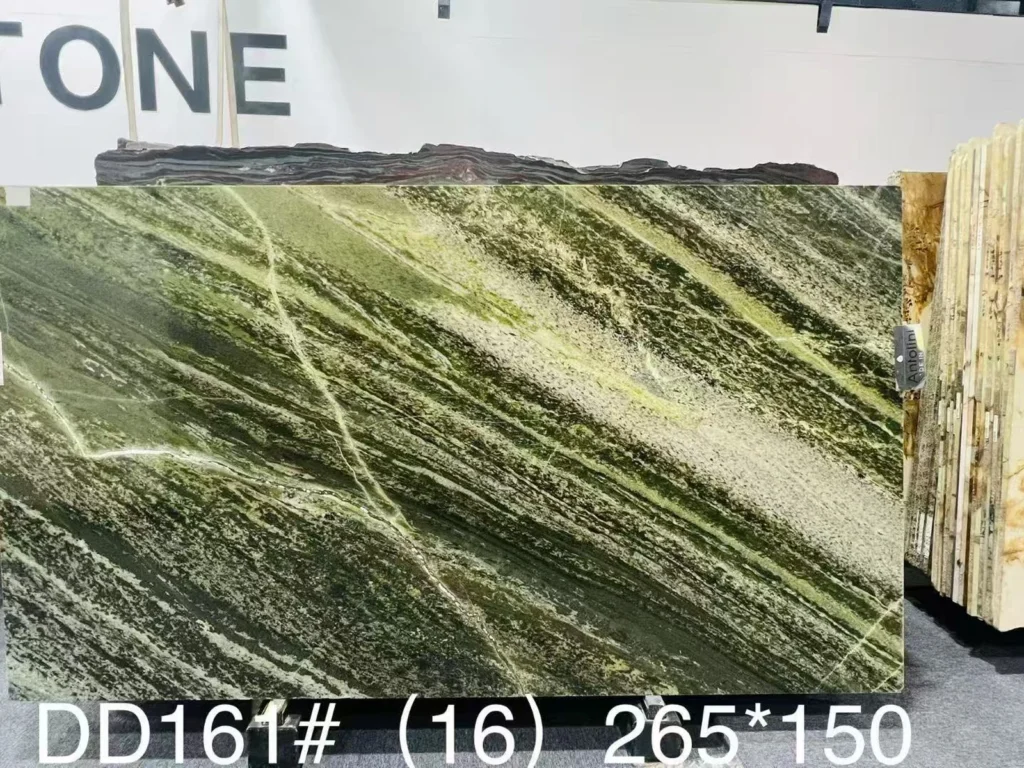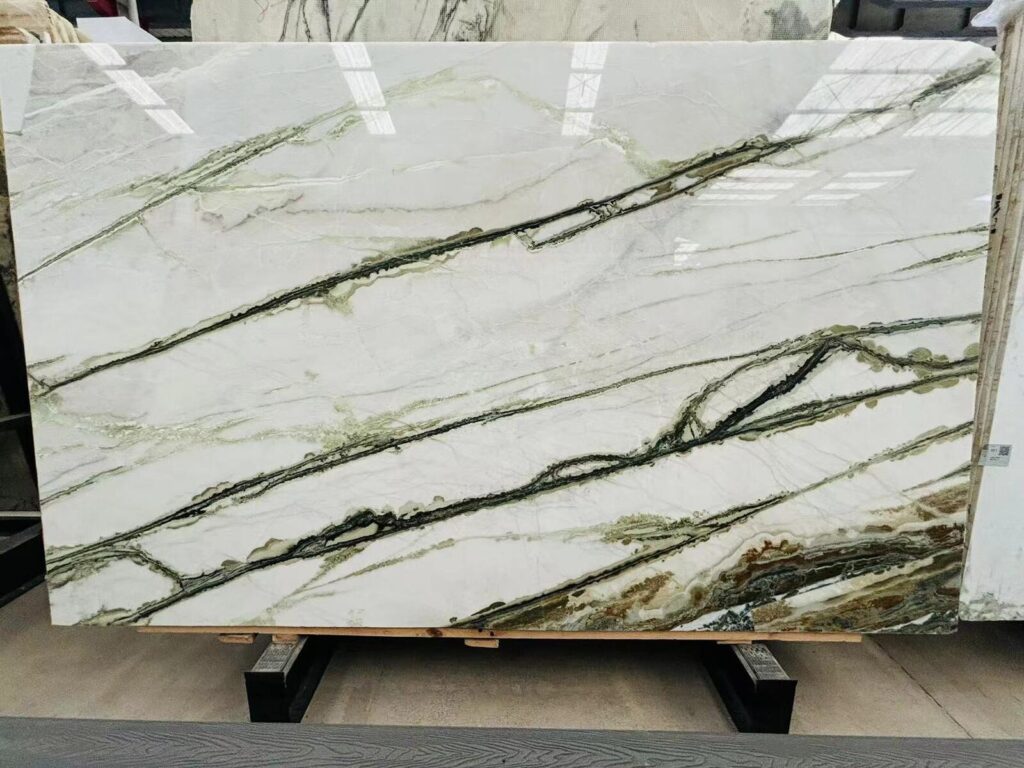


Un proyecto de cuarcita natural ya está diseñado.
La superficie principal puede permanecer pulida u hondeada.
Pero se pretende que un detalle arquitectónico tenga un aspecto diferente.
Quizá sea:
El diseñador propone un acabado arenado.
El plano parece convincente.
La descripción del acabado suena sencilla.
Luego se procesa el recorte real de cuarcita.
La piedra parece más clara.
La profundidad del pulido desaparece.
Las líneas minerales finas se suavizan mientras que algunas áreas cristalinas se vuelven más táctiles.
Un rasgo oscuro reacciona de manera diferente al fondo pálido.
La textura luce excelente bajo luz lateral, pero notablemente más áspera cuando se observa de cerca.
Esta es la verdadera razón para realizar la prueba Detalles arenados de cuarcita: Probar un acabado decorativo en un recorte.
El proyecto no debería preguntar:
“¿Es la cuarcita arenada un buen acabado?”
Debería preguntar:
“¿Produce este acabado arenado controlado el resultado visual y táctil previsto en esta cuarcita natural identificada, en esta ubicación del proyecto, con esta iluminación y detalle de fabricación?”
La primera corrección es conceptual.
El proyecto no está comparando:
Cuarcita natural
frente a
Material arenado.
Está comparando dos condiciones superficiales de la misma piedra.
El control puede comenzar como:
El chorro abrasivo modifica la cara expuesta y crea una superficie texturizada.
Dependiendo de la piedra y el proceso reales, el resultado puede variar:
No asuma que una cuarcita natural reaccionará exactamente igual que otra.
Registre:
Si el recorte proviene de la losa seleccionada originalmente, registre esa relación.
Si es solo una muestra representativa de otro grupo de losas, indíquelo.
Misma cuarcita natural → Referencia original → Prueba con chorro de arena. El acabado modifica la condición superficial; no crea una nueva categoría de material.
Una muestra con chorro de arena es mucho más fácil de interpretar cuando parte de la piedra original sigue disponible para la comparación.
Un enfoque útil consiste en dividir un recorte representativo en áreas controladas:
Superficie original → Zona de prueba con chorro de arena.
Esto reduce la variación no relacionada entre dos piezas completamente diferentes de cuarcita natural.
Si el proceso de fabricación requiere piezas separadas, elija recortes que estén lo más relacionados posible.
Registre que son muestras independientes.
Sin la referencia original, los revisores pueden olvidar:
Antes del proceso abrasivo, registre:
El sitio’s Grabado frente a manchas en una muestra de cuarcita La guía utiliza el mismo principio de comparación controlada: la evidencia visual más sólida suele provenir de la muestra identificada, con el mismo historial de acabado, la misma iluminación y un control adyacente, en lugar de una fotografía aleatoria de internet.
Una prueba de acabado puede responder a la pregunta equivocada si utiliza únicamente el área más fácil de la losa.
Un área pálida uniforme puede mostrar claramente el cambio general de textura y color.
Pero podría no revelar cómo interactúa el proceso con características naturales más marcadas.

Si el detalle de producción cruza una banda mineral principal, pruebe un recorte que incluya un movimiento comparable, cuando sea práctico.
Las áreas cristalinas pueden presentar diferente profundidad visual o textura después de eliminar la superficie reflectante.
Revise en lugar de suponer.
Un área más oscura puede conservar una relación de contraste diferente tras el chorreado respecto a la piedra pálida circundante.
Si el área de producción real contiene conocido:
consider whether the finish test should include a representative area.
Do not assume that a trial on one pristine offcut automatically approves every treated or repaired zone.
El Cómo definir las reparaciones aceptables en un pedido de cuarcita natural guide explains why natural features, existing repairs, treatments, finished-piece location and fabrication evidence should remain connected.
A visual sample is useful.
A repeatable production reference is stronger.
Where known and controlled by the fabricator, the result can be influenced by factors such as:
This article does not prescribe universal settings.
The responsible fabricator should define and reproduce the process appropriate to the actual Natural Quartzite and required finish.
Two samples can both be described as sandblasted while showing noticeably different texture.
A useful approval therefore records:
A setting that produces an acceptable decorative surface on one limestone, granite, or another Quartzite should not automatically become the production specification for the current stone.
Use the project offcut to establish the current result.
| Test Variable | Qué registrar |
| Quartzite Reference | Material, sample ID and slab relationship where known |
| Original Condition | Polished / honed / sawn / other documented starting surface |
| Test Area | Representative mineral zone and sample face |
| Blasting Process | Controlled fabricator process reference where required |
| Post-Process Treatment | Brushing / washing / sealing / none / other confirmed step |
| Aprobación | Accepted / revise / reject / larger-area trial required |
The finish can change how the same geology is read.
A polished surface often gives Natural Quartzite greater visual depth and stronger reflection.
When that reflective face becomes textured, the stone may read lighter or flatter.
Do not treat this visual change automatically as damage or contamination.
Fine mineral lines that appear crisp under polish may become less visually dominant on a textured low-sheen face.
Broad bands, colour fields and major geological structures can remain clearly visible even after fine detail becomes softer.
The eye is no longer reading only the geological pattern.
It is also reading the granular or pitted surface texture.
At close range, that texture may dominate.
At room distance, the major stone movement may become more important again.
Revisión:
El sitio’s Cuarzita pulida frente a cuarzita lijada para encimeras de cocina guide explains the broader principle that reducing surface reflection changes perceived colour depth, contrast and pattern presentation even when the physical stone remains the same.
Original Quartzite → Colour Depth → Pattern Clarity → Reflection → Sandblasted Quartzite → Texture → Lower Reflection → Revised Pattern Reading. Approve the complete change, not only the roughness.
A textured finish can look very different depending on light direction.
This is useful for understanding:

Raking light can make the small surface relief much more visible.
It can help identify:
Raking light is useful for finding texture differences.
It can also exaggerate how noticeable those differences appear compared with normal viewing.
Revisión:
Normal Light → Raking Light → Normal Light Again.
El Cuarcita bajo luz rasante: por qué las marcas superficiales se vuelven más visibles guide explains why low-angle light is an effective diagnostic condition but should not answer the entire appearance-acceptance question by itself.
A decorative detail often contains a boundary between different finishes.
This can become more visually important than the centre of the sandblasted area.
If one finished component combines:
Polished Face → Sandblasted Decorative Zone
review the boundary.
Check whether it is:
Where the finish stops at a precise line, the trial should show whether the transition can be fabricated cleanly.

If the sandblasted surface reaches a visible edge, review:
Decorative wall and reception details may include:
The offcut or larger mock-up should include these interfaces if they are central to the design.
A flat 150 mm sample can show texture.
It may not show:
Expand the trial if those details are visually important.
A rougher decorative finish changes the way the surface interacts with water, residue and cleaning tools.
The test should reflect the actual application.
Use only the project-approved or technically appropriate cleaning approach.
Observe whether:
Photograph the sample clean and dry first.

For locations that may be cleaned with water or experience occasional wetting, compare:
Dry Before → Wet → Drying → Dry After.
A textured Natural Quartzite surface may look temporarily darker while wet.
Do not automatically call temporary wet darkening a permanent stain.
The sandblasted finish should be tested under the project’s expected exposure.
Do not state that all sandblasted Quartzite:
Those questions depend on the selected stone, finish, treatment, environment, substances and maintenance system.
If the detail is intended for flooring, steps or another walking surface, visual roughness alone does not establish a project-specific slip-resistance result.
Any required performance criterion should be addressed through the applicable project specification and appropriate testing route.
| Offcut Review | Pregunta |
| Dry Appearance | Is colour, texture and pattern acceptable? |
| [Luz de rastrillado][/Luz de rastrillado] | Is the texture reasonably consistent for the approved visual standard? |
| Wet Condition | How does temporary wetting change appearance? |
| Dry After | Does the sample return to the expected dry appearance? |
| Limpieza | Can normal project maintenance remove expected residue acceptably? |
| Transition / Edge | Does the decorative finish terminate cleanly at adjoining surfaces? |
A small offcut can answer many finish questions.
It cannot answer every project question.
A larger mock-up may be justified for:
A useful record can say:
Approved: sandblasted texture, dry colour direction and local polished-to-sandblasted transition on Sample SB-01.
Pending: large-panel uniformity and final production slab review.
This is stronger than:
“Sandblast approved.”
The sample becomes useful only when production can reproduce the approved intent.
Show exactly which surface is sandblasted.
Identifique:

If the selected production slab contains significantly different geological zones from the test offcut, review whether the previous sample remains representative.
For important custom decorative work, the first finished production piece can provide an additional checkpoint.
Compare it with the approved sample using:
Do not submit only one attractive 50 mm close-up.
Muestre:
□ Se identificó cuarzita natural real.
□ Offcut or sample ID recorded.
□ Relationship to selected slab or slab group recorded where known.
□ Original surface condition documented before testing.
□ Untreated control retained where practical.
□ Representative mineral zone selected for the test.
□ Sandblasting process reference recorded where required.
□ Any brushing, washing, sealing or post-treatment recorded.
□ Dry appearance reviewed.
□ Colour shift reviewed.
□ Pattern visibility reviewed.
□ Texture uniformity reviewed.
□ Normal-light appearance reviewed.
□ Raking-light appearance reviewed where useful.
□ Edge and finish-transition detail reviewed where relevant.
□ Cleaning trial completed where maintenance is part of the decision.
□ Wet / dry appearance reviewed where relevant.
□ No unsupported slip-resistance claim made from visual texture alone.
□ Small offcut scope distinguished from large-area approval.
□ Current drawing identifies the exact decorative-finish zone.
□ Actual production slab or piece confirmed before finish transfer.
□ First-production review required where the project specifies it.
□ Final QC compares the actual decorative detail with the approved finish reference.
Los acabados arenados pueden aplicarse a determinadas piedras naturales de base cuarzosa, incluidas algunas cuarcitas, pero el resultado real debe comprobarse en la cuarcita natural específica que se esté considerando. La estructura mineral, los tratamientos previos, el historial del acabado y los requisitos del proyecto pueden influir en el resultado. Utilice un recorte identificado o una muestra representativa antes de iniciar trabajos de producción importantes.
[Puede hacer que la superficie parezca más clara o menos saturada en color porque el arenado elimina el acabado pulido y reflectante, creando una superficie texturizada que interactúa con la luz de manera diferente. El cambio visual real depende de la piedra y del proceso, por lo que compare la muestra arenada directamente con una pieza de control sin tratar del mismo material o de un material estrechamente relacionado.].
Eso resulta útil cuando es práctico, especialmente para un detalle decorativo que requiere atención visual. Si la muestra proviene de otro grupo representativo de losas, consigne esa limitación. Un acabado aprobado en un recorte no debe extenderse automáticamente a zonas minerales materialmente diferentes ni a futuras losas no relacionadas sin una revisión previa.
No siempre. Un pequeño recorte puede permitir evaluar la textura, el cambio general de color, la reducción del brillo y la calidad local del acabado, pero podría no ser suficiente para comprobar la uniformidad en áreas extensas, las transiciones prolongadas del acabado, la consistencia entre pasadas o el aspecto en varias zonas geológicas. Trabajos de gran tamaño o muy visibles pueden requerir una maqueta más grande o una revisión de la primera producción.
No debe aplicarse ninguna afirmación universal. La superficie texturizada modifica la forma en que las herramientas de limpieza, el agua y los residuos interactúan con la piedra, pero el mantenimiento práctico depende de la textura real, la piedra, el tratamiento, el uso y el sistema de limpieza. Pruebe la muestra identificada utilizando el método de cuidado previsto cuando el mantenimiento forme parte de la decisión del proyecto.
No. Una apariencia texturizada no debe considerarse como un resultado de resistencia al deslizamiento específico del proyecto. Cuando el acabado se propone para suelos, escalones u otras superficies de tránsito, utilice la especificación del proyecto correspondiente y las pruebas de rendimiento adecuadas, en lugar de inferir el cumplimiento únicamente a partir de la aspereza visual.
Envíe a Josh el material propuesto de cuarcita natural, la referencia de la losa actual o de un recorte disponible, la ubicación decorativa prevista, las dimensiones acabadas, la cantidad, el acabado inicial, el área que requiere chorro de arena, los bordes y transiciones, los planos del proyecto, el contexto de iluminación, la limpieza esperada o la exposición a la humedad cuando sea pertinente, y el destino de entrega. Indique si necesita un pequeño recorte de prueba, una maqueta de acabado más grande, una muestra de bordes o transiciones, o la aprobación de la primera producción antes de procesar el pedido completo.
For custom Natural Quartzite decorative finishes, HRST STONE can coordinate identified offcuts, polished or honed control references, sandblasted finish trials, edge and transition samples, larger mock-ups where required, project drawings, actual-slab references, fabrication QC, first-production photographs, packing and export documentation within the confirmed stone scope. Send Josh the material, intended finish location, drawings, dimensions, quantity, starting finish, edge or transition requirements, visual priorities and destination before full production release.