Resumen rápido
Un formulario de aprobación de diseño para cuarcita debe indicar al cliente exactamente qué se está aprobando: las losas de cuarcita natural identificadas, la versión actual del diseño, la posición de las piezas terminadas, las caras visibles, la orientación, la colocación específica del patrón, las juntas o uniones mostradas, así como cualquier prioridad visual marcada específicamente. También debe señalar lo que la aprobación no cubre. La reserva de las losas, la aprobación del diseño, la revisión técnica de fabricación y la autorización para comenzar el corte son etapas relacionadas del proyecto, pero no deben considerarse como una misma decisión.
El cliente recibe un PDF que muestra tres losas de cuarcita natural con las piezas de la encimera dibujadas sobre ellas.
En la parte inferior se encuentra un espacio para la firma:
APROBADO.
El cliente firma el documento.
Dos semanas después surge una pregunta:
¿Qué aprobó exactamente esa firma?
¿Aprobó las losas?
¿La posición de cada pieza?
¿La dirección de las vetas?
¿La relación con la caída de agua?
¿La junta?
¿El recorte para el fregadero?
¿El método de fabricación?
¿O simplemente autorizó a la fábrica para que comenzara el corte?
Un profesional El formulario de aprobación del diseño de cuarcita debe responder a estas preguntas antes de añadir la firma, no después de haber iniciado la fabricación.
El cliente debería ver el alcance de la aprobación antes del espacio para la firma
La parte más importante de un formulario de aprobación de diseño no es la firma.
Es la declaración situada justo encima de ella.
APROBACIÓN DEL DISEÑO — ¿QUÉ SE ESTÁ APROBANDO?
Material: [Nombre de la cuarcita natural]
Identificadores de las losas/tablas: [Las losas exactas identificadas]
Revisión del diseño: [Número de revisión / fecha]
Piezas terminadas mostradas: [Isla / caída de agua / perímetro / tocador / paneles]
Aprobación visual por parte del cliente: Colocación de las piezas, orientación visible, posicionamiento principal del patrón, relaciones entre piezas adyacentes identificadas y posiciones específicas de juntas o uniones mostradas.
Condiciones abiertas: [Listar cualquier elemento pendiente]
Liberación para producción: [Incluido en esta aprobación / requerida liberación separada]
Si el formulario no puede explicar la aprobación en lenguaje sencillo, la firma lleva consigo demasiada ambigüedad.
Lo que el cliente realmente está firmando
Para un proyecto de cuarcita natural sensible a aspectos visuales, la aprobación del diseño por parte del cliente suele referirse al resultado visible representado por el diseño actual.
Dependiendo del proyecto y del documento real de aprobación, esto puede incluir lo siguiente.
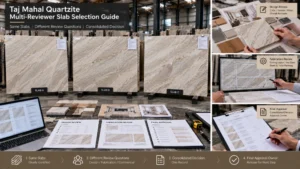
1. Las losas exactas de cuarcita mostradas
La aprobación debe identificar las losas físicas utilizadas en la propuesta.
Por ejemplo:
Cuarcita Taj Mahal — TM-231 / TM-232 / TM-233
Esto es mucho más preciso que:
Cuarcita Taj Mahal — 3 losas
La cuarcita natural varía de una losa a otra; por lo tanto, aprobar un diseño elaborado sobre TM-231 no implica automáticamente la aprobación de una losa diferente que se sustituya posteriormente.
Por esta razón también es importante que la reserva de las losas siga siendo rastreable mediante el número de tabla. El correspondiente Guía del formulario de reserva de losas de cuarcita explica cómo controlar los números exactos de las tablas, el estado de la reserva y las reglas de sustitución antes de la producción.
2. La posición de las piezas terminadas sobre esas losas
The customer may also be approving where important finished pieces are positioned within the actual slab.
Por ejemplo:
TM-231 → Island Top
TM-232 → Left + Right Waterfall Returns
TM-233 → Perimeter Countertops + Spare Material
This matters when the stone contains areas that the customer specifically wants to feature or avoid.
3. The Visible Orientation
Natural Quartzite often has a readable visual direction.
A piece can be cut from the correct slab and still look different from the approved design if it is rotated or reversed relative to the reviewed layout.
The approval record should therefore make orientation understandable where it matters.
ACTUAL SLAB
↓
PIECE POSITION
↓
TOP / BOTTOM ORIENTATION
↓
VISIBLE FACE
↓
INSTALLED VIEW
4. Major Vein, Crystal or Pattern Placement
A buyer may approve a particular crystalline area in the center of an island.
Another project may intentionally keep a darker mineral zone toward one end.
A Blue Roma Quartzite layout may be reviewed for the relationship between its larger geological movement and the finished island geometry.
The form does not need to describe every mineral feature.
It should preserve the visual priorities that materially influenced the approved layout.
5. The Relationship Between Adjacent Visible Pieces
This becomes especially important for:
- island top + waterfall end;
- left waterfall + island + right waterfall;
- backsplash + countertop;
- adjacent wall panels;
- fireplace surround components;
- reception desk faces; and
- other intentionally coordinated stone pieces.
The customer may be approving the relationship, not merely each piece in isolation.
A Waterfall Approval Is More Than “I Like This Slab”
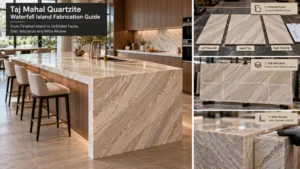
Consider a Taj Mahal Quartzite waterfall island.
The layout shows:
LEFT WATERFALL ← ISLAND TOP → RIGHT WATERFALL
The customer reviews all three visible faces together, including their orientation, major visual movement and intended relationships at the mitred ends.
Signing that visual layout should mean that the customer accepts the represented arrangement within the stated approval scope.
It should not silently mean that the customer has personally verified the bridge-saw sequence, mitre preparation method, reinforcement method or another fabrication decision outside the customer’s approval role.
The Customer Is Usually Not Approving These Things
This is where a good approval form becomes significantly safer and clearer.
NOT A MATERIAL TEST
Visual layout approval does not certify geological identity, physical properties or laboratory performance.
NOT A FABRICATION METHOD
The customer is not normally specifying saw sequence, tooling, reinforcement or fabrication procedure merely by approving the visual layout.
NOT AN INSTALLATION METHOD
Layout approval does not automatically approve supports, fixing, substrate, adhesive or site installation conditions.
NOT A UNIVERSAL WARRANTY
A visual approval should not be interpreted as a guarantee covering every natural feature or future condition.
Layout Approval Is Not the Same as Slab Selection
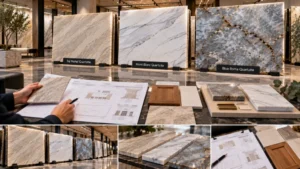
A customer can approve the slabs before approving how those slabs will be cut.
SLAB SELECTION
“Yes, these are the physical slabs we want to use.”
↓
LAYOUT APPROVAL
“Yes, we accept this represented allocation and visual arrangement of the finished pieces.”
↓
PRODUCTION RELEASE
“The required project approvals are complete and fabrication may proceed according to the controlling production documents.”
Depending on the project, these decisions may occur together or separately.
The form should say which one is happening.
Layout Approval Is Also Not Automatically Production Release
This distinction deserves its own line on the form.
PRODUCTION RELEASE STATUS
□ Visual layout approved — production release remains pending
□ Visual layout approved subject to listed conditions
□ Final project release issued under the identified controlling documents
This prevents a visual “looks good” message from automatically becoming an instruction to cut.
What Should Be Visible on the Drawing the Customer Approves?
The approval drawing should contain enough information for the customer to understand the visual decision without becoming an unreadable fabrication document.
| Approval Information |
Propósito |
| Material + Board ID |
Identifies the physical Natural Quartzite being reviewed. |
| Complete Slab Image |
Preserves the relationship between the proposed pieces and actual slab. |
| Finished-Piece Outlines |
Shows where each relevant component is proposed. |
| Piece IDs |
Connects the layout to project drawings and later fabrication records. |
| Orientación |
Clarifies intended visible direction where visually important. |
| Relevant Seams / Joints |
Shows visible divisions included in the review. |
| Revision + Date |
Defines which layout the signature applies to. |
What Does the Signature Apply To?
A signature should be attached to a revision, not merely to a project name.
Por ejemplo:
APPROVAL BASISProject: Residence A — Kitchen Island
Material: Cuarcita patagónica
Boards: PQ-116 / PQ-117
Layout: LAYOUT-R04
Drawing Date: [Date]
Approval Scope: Island-top position, left/right waterfall allocation, visible orientation and represented visual relationships
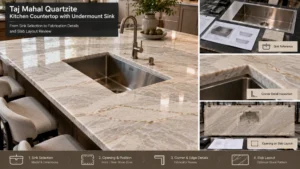
Open Item: Final sink-cutout geometry remains subject to current fabrication drawing and responsible fabricator review
The customer is approving R04.
Not every future drawing carrying the same project name.
What Happens If the Drawing Changes After Signature?
Not every change requires the entire approval process to restart.
But the team should ask one question:
Does the revision change something that was inside the customer’s approval scope?
CHANGE OUTSIDE VISUAL APPROVAL
An internal production annotation changes without changing the approved visible layout.
Action: Control through the appropriate fabrication document; customer re-approval may not be required solely because the internal note changed.
CHANGE INSIDE VISUAL APPROVAL
Island position moves, waterfall allocation changes, visible orientation reverses, or a seam moves.
Action: Return the affected visual decision for review.
Do Not Hide Revisions Behind the Same File Name
Suppose the customer approves:
Layout R03
Then the island is shifted to avoid a condition on the slab.
The new proposal is:
Layout R04
R04 should not overwrite R03 and continue using the old signature as though nothing changed.
Revision Control
Preserve the previous approved record, identify what changed, issue the new revision, and state whether the change affects the customer’s previous approval.
Conditional Approval Is Better Than an Ambiguous “Approved”
Sometimes the customer is ready to approve the visual arrangement while another issue remains open.
That does not always require rejecting the entire layout.
It may require a conditional approval.
EXAMPLE
The visual placement and orientation of the identified Taj Mahal Quartzite island and waterfall components shown in Layout R05 are approved.
Final sink-cutout geometry remains subject to the current fabrication drawing and responsible fabricator review.
This approval does not authorize a change of slab, piece orientation or visible layout without further review.
That is much clearer than:
“Approved with comments.”
What If the Customer Writes “Looks Good” on WhatsApp?
That message can be useful evidence of a conversation.
But before treating it as a controlled Quartzite layout approval, connect it to:
- the exact slab IDs;
- the exact layout revision;
- the drawing or image reviewed;
- the approval scope;
- any conditions;
- the approver; and
- the date.
A short confirmation can then convert an informal conversation into a usable project record.
The Customer Does Not Need to Approve Every Fabrication Detail
The approval form should not force the customer to sign technical statements that belong to the responsible fabricator.
For example, a customer may approve:
“Keep this crystalline area in the center of the island.”
The fabricator may still need to determine how that design intent interacts with:
- actual slab condition;
- sink or cooktop openings;
- remaining stone geometry;
- edge fabrication;
- mitres;
- equipment;
- handling; and
- other production considerations.
The two roles are related but not interchangeable.
What If a Different Slab Has to Be Used?
If the customer approved a layout on one identified slab and that slab later changes, the visual basis of the approval may also change.
APPROVED BOARD
↓
BOARD CHANGES
↓
NEW SLAB IMAGE
↓
NEW PIECE POSITION
↓
NEW VISUAL REVIEW
Do not assume that another slab with the same commercial Quartzite name automatically inherits the previous layout approval.
The Approval Form Should End with an Explicit Statement
A good form should not make the customer infer what the signature means.
CUSTOMER LAYOUT APPROVAL STATEMENT — EXAMPLE
I confirm that I have reviewed the identified Natural Quartzite slabs and the finished-piece layout shown in the revision referenced above. Within the scope shown on this approval record, I accept the represented piece positions, visible orientation, major pattern placement, identified visible relationships and seam/joint locations shown for customer review.
I understand that Natural Quartzite has natural variation and that this approval applies to the identified slabs and current layout revision.
Items specifically listed as open, conditional or subject to fabricator/technical review are not closed by this visual approval.
Any later change to the identified slab, approved visible-piece allocation or other item within this approval scope requires review according to the project’s change-control process.
The exact wording should be adapted to the project’s contract, responsibility structure and production process rather than copied as a universal legal clause.
A Practical Quartzite Layout Approval Form
PROJECT / MATERIAL
Project: ______________________________
Area / Application: ____________________
Natural Quartzite: _____________________
Board IDs: ____________________________
Finish: _______________________________
CONTROLLING LAYOUT
Drawing / Layout Number: _______________
Revision: ______________________________
Date: _________________________________
Related Slab Images: ___________________
CUSTOMER VISUAL REVIEW
□ Slab identity shown
□ Finished-piece positions reviewed
□ Visible orientation reviewed
□ Major pattern / feature placement reviewed
□ Relevant adjacent-piece relationships reviewed
□ Relevant visible seams / joints reviewed
OPEN / CONDITIONAL ITEMS
1. _____________________________________
2. _____________________________________
3. _____________________________________
RELEASE STATUS
□ Visual layout approved
□ Approved subject to listed conditions
□ Revision required before approval
□ Production release remains separate
□ Production release included under identified project procedure
APPROVAL RECORD
Approver: ______________________________
Role: __________________________________
Signature / Recorded Approval: __________
Date: __________________________________
Preguntas más frecuentes
1. What is a Quartzite layout approval form?
A Quartzite layout approval form is a project record that connects an identified Natural Quartzite slab or slab set to a specific layout revision and records the customer’s approval of the defined visual arrangement before the next project stage.
2. What does the customer actually approve on a Quartzite layout?
De acuerdo con el alcance de aprobación establecido, el cliente podrá aprobar las losas identificadas, la colocación de las piezas terminadas, la orientación visible, la posición del patrón principal, las relaciones entre piezas adyacentes y la ubicación de las juntas o uniones visibles que se muestran en la versión actual. El formulario deberá indicar explícitamente qué elementos están incluidos.
3. Is Quartzite layout approval the same as approving the slabs?
No. La selección de losas determina qué losas físicas acepta el proyecto, mientras que la aprobación del diseño se refiere a cómo se proponen las piezas terminadas dentro de esas losas. Un proyecto puede tomar estas decisiones en distintas etapas.
4. Does signing a layout approval form authorize cutting?
Only if the project’s documented process explicitly makes the layout approval part of production release. Otherwise, the form should state that visual approval and authorization to begin fabrication are separate decisions.
5. Does the customer approve fabrication methods on the layout form?
No basta con aprobar la disposición visual. La secuencia de sierras, el refuerzo, la evaluación detallada de los recortes, la fabricación de bordes, la manipulación y otras cuestiones técnicas deberán permanecer bajo la responsabilidad del fabricante encargado u otra parte cualificada del proyecto, salvo que los documentos del proyecto vigentes establezcan lo contrario.
6. What happens if the Quartzite layout changes after approval?
Identify the new revision and determine whether the change affects something inside the customer’s previous approval scope. A changed slab, piece position, visible orientation, major pattern placement or visible seam may require renewed visual review.
7. Can a customer approve a Quartzite layout with conditions?
[SÍ. Una aprobación condicional puede aceptar la dirección visual actual mientras mantiene abiertos los elementos identificados, como una dimensión revisada, la revisión final del recorte u otra cuestión controlada por el fabricante. El formulario debe identificar claramente cada condición y la acción necesaria para cerrarla.].
8. Is a WhatsApp or email message saying “looks good” enough?
Puede formar parte del expediente del proyecto, pero la aprobación resulta más clara cuando el mensaje está vinculado a los identificadores exactos de los forjados, a la revisión actual del plano, al alcance de la aprobación, a las condiciones, al responsable de la aprobación y a la fecha. Esto reduce la ambigüedad respecto a lo que el cliente realmente revisó.
From Quartzite Layout Review to Controlled Fabrication
For project-based Natural Quartzite orders, HRST STONE can coordinate current slab photographs, board references, CAD/shop drawings, proposed cutting layouts, visible-piece orientation, customer review records, fabrication information, dry-lay photographs, QC records and reinforced fumigated wooden-crate packing around the confirmed order scope. Send Josh the selected slabs, current drawings, dimensions, finish, visible priorities, cutouts and required approval stage so the review can be tied to the correct project revision.
© HRST STONE / XIAMEN HRST STONE CO., LTD. Todos los derechos reservados.