So geben Sie den Oberflächenglanz für ein Quarzit-Mock-up an
Post navigation
Kurze Zusammenfassung
To specify Quartzite surface gloss for a mock-up, do more than write polished, honed, shiny, or matte. Identify the Natural Quartzite control sample, define the intended visual appearance, state whether acceptance is visual or instrument-based, and—if gloss readings are required—record the measurement method, geometry, locations, surface condition, and project-specific acceptance range. The approved mock-up should then become a traceable production reference rather than an isolated photograph or gloss number.
A specification says:
Natural Quartzite — honed finish.
The fabricator prepares a mock-up.
The designer says it is too shiny.
The factory says it is already honed.
Who is correct?
The problem may not be workmanship. The project may never have defined what Quartzite surface gloss should actually mean for this mock-up.
A more useful specification creates this chain:
Design Intent → Control Sample → Visual Gloss Target → Measurement Method if Required → Test Locations → Acceptance Range → Mock-Up Approval → Production Reference
Start With Appearance, Not a Gloss Number
Before choosing an instrument value, define what the project is trying to achieve visually.
For example, the design intent might call for:
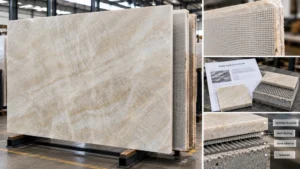
quarzit-oberflächenglanz-mock-up-spezifikation
a highly reflective polished appearance;
a restrained low-sheen honed appearance;
a soft surface with limited direct reflection;
a textured finish with intentionally broken reflection; or
a project-specific appearance established by an approved physical sample.
This matters because the final question is not simply:
“What number did the meter show?”
Sondern:
“Does the finished Natural Quartzite match the appearance the project approved?”
Polished and Honed Are Finish Names, Not Complete Gloss Specifications
Terms such as polished and honed are useful, but they do not by themselves establish a complete project acceptance criterion.
Two surfaces described using the same finish name can still differ visibly in:
reflection strength;
reflection uniformity;
color depth;
mineral definition;
surface texture;
processing direction;
local dull or glossy areas; and
face-to-edge appearance.
For this reason, the finish name should be connected to an actual control reference wherever appearance is important.
Use an Identified Control Sample
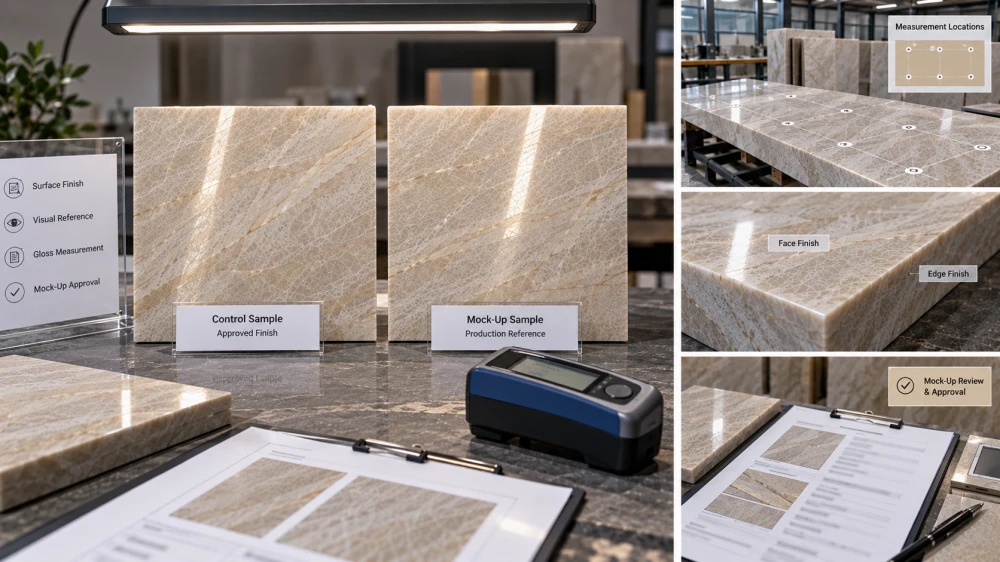
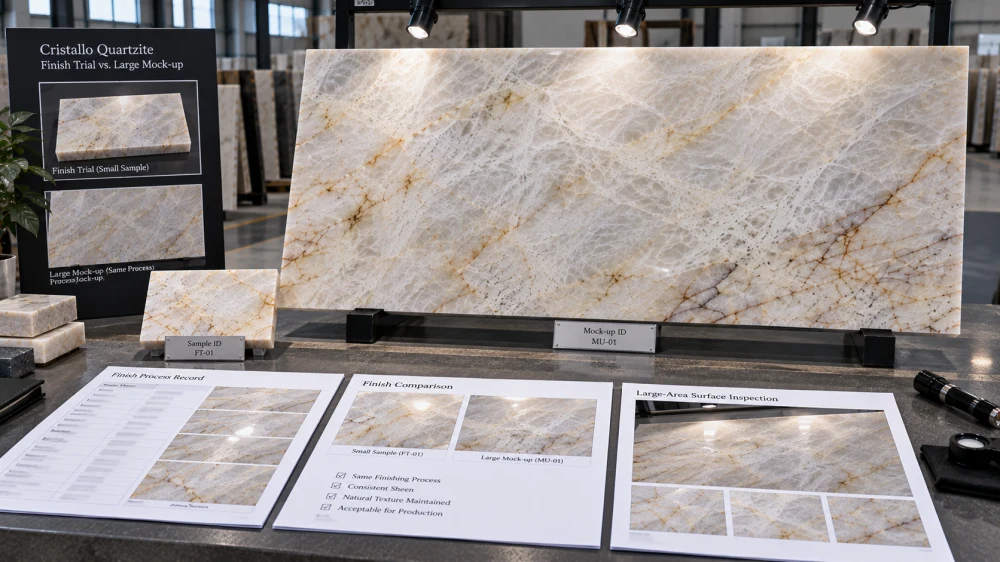
The control sample gives words such as polished, honed, low-sheen, or matte a physical reference.
Record:
Control Item
What to Record
Material
Natural Quartzite trade / project reference
Proben-ID
Stable identifier for the approved reference
Slab Relationship
Known slab / lot / project relationship where available
Beenden
Approved finish description
Reviewed Face
Surface actually used for comparison
Approval Date / Revision
Current project approval record
Do not rely on a photograph labelled “approved honed finish” if the physical reference cannot be traced back to the project record.
Decide Whether Acceptance Is Visual, Instrument-Based, or Both
Not every Quartzite project needs numerical gloss readings.
A useful specification should explicitly choose the approval route.
Visuelle KontrolleCompare the mock-up directly with the approved physical reference under controlled viewing conditions.
Instrument ControlUse a defined measurement method, geometry, locations, and project acceptance range.
Combined ControlUse numerical readings for repeatability while retaining the approved physical sample as the visual reference.
For appearance-sensitive architectural stone, the combined approach can be useful when the project team wants both a physical appearance reference and a reproducible QC record.
But the project—not a generic article—should decide whether instrument measurement is necessary.
If You Specify Gloss Units, Specify the Measurement Method Too
A requirement such as:
Gloss = 30
is incomplete by itself.
If numerical gloss is part of the acceptance requirement, the specification should identify the applicable measurement procedure and enough test information to make the reading reproducible.
Depending on the selected method and equipment, relevant information may include:
measurement standard or agreed procedure;
instrument type or approved instrument;
measurement geometry;
calibration procedure;
sample condition;
measurement locations;
number of readings;
reporting method;
acceptance range; and
responsible reviewer.
Specification Rule
Do not write a universal GU target for Natural Quartzite without defining how the reading is obtained. A gloss number only becomes useful when the project also controls the measurement method, geometry, sample condition, test locations, and acceptance rule.
Why Measurement Geometry Matters
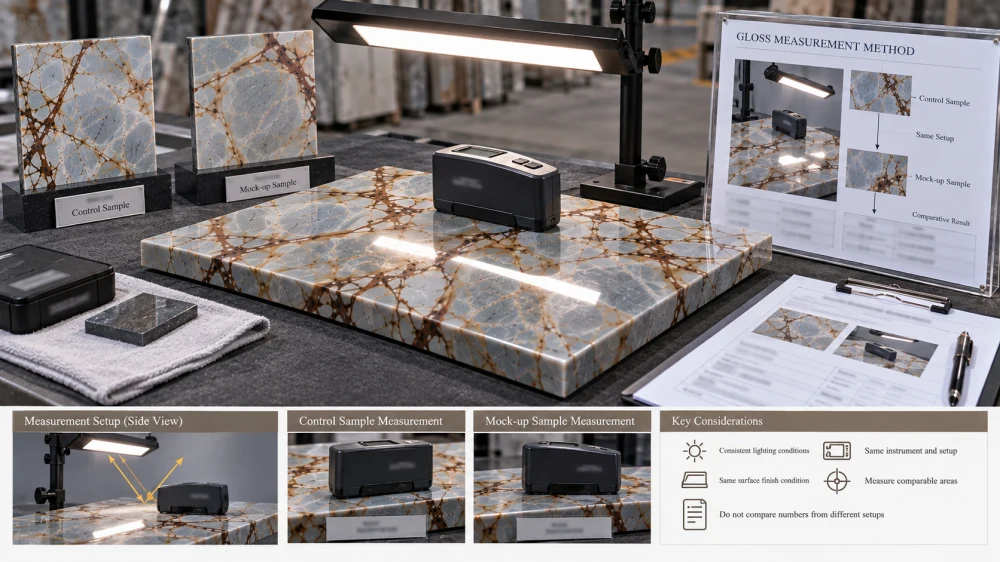
Gloss measurement depends on how light is directed toward the surface and how reflected light is measured.
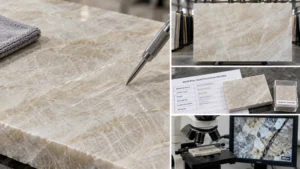
blue-roma-quartzite-gloss-measurement-geometry
Therefore, a project should not copy a gloss number from another specification while omitting the measurement geometry used to produce it.
If the project references a specific standard, instrument procedure, or contractual measurement geometry, use that requirement consistently for:
Control Sample → Mock-Up → Production QC → Final Review
Do not switch methods midway and compare the resulting numbers as though they came from the same test condition.
Do Not Invent a Universal Gloss Range for Polished or Honed Quartzite
This is particularly important for Natural Quartzite.
A specification should not assume that every:
polished Quartzite;
honed Quartzite;
brushed Quartzite;
leathered Quartzite; or
other project finish
must fall inside one universal gloss range.
Material character, mineral distribution, finish process, surface texture, measurement method, and the intended design appearance can all matter.
The safer sequence is:
Develop Representative Finish → Review Mock-Up → Establish Project Criterion → Record Approved Reference → Control Production Against That Reference
Choose Measurement Locations Before Testing
Natural Quartzite is not a visually uniform manufactured sheet.
A single reading from one convenient point may not represent the complete mock-up.
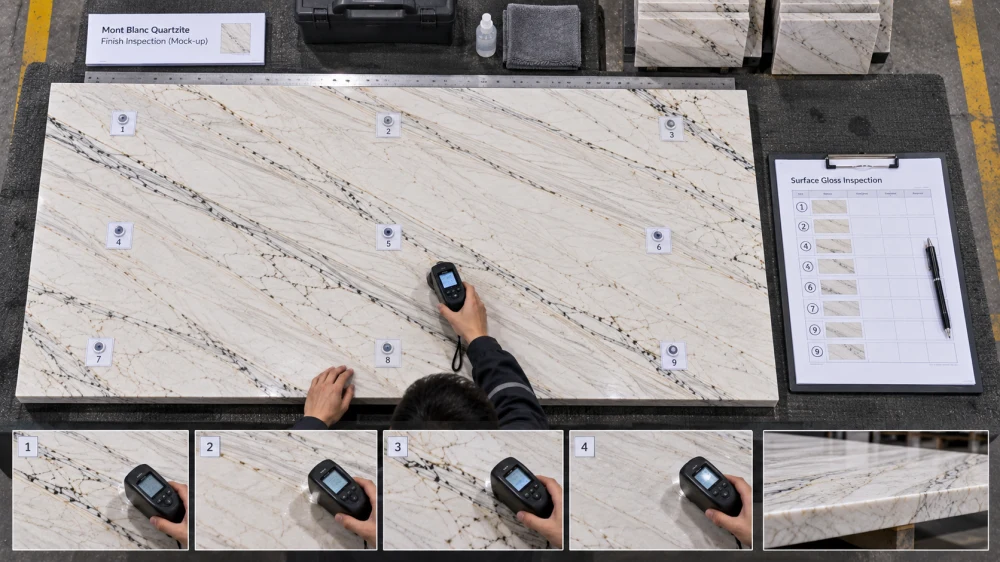
Where numerical measurement is required, define the locations before testing.
Depending on the mock-up geometry, the review might consider:
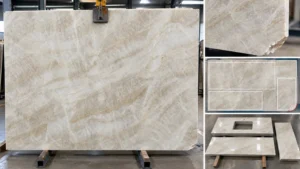
mont-blanc-quartzite-gloss-measurement-locations
central field;
additional field locations;
different visible mineral zones where relevant;
areas near but not distorted by an edge;
separately fabricated returns;
finished edges where the project requires them to match; and
other project-specific visible surfaces.
Do not move the meter around after seeing the readings until a preferred result appears.
The sampling plan should come first.
Use Multiple Readings to Understand Uniformity
If instrument readings are part of the specification, the project may need more than one reading.
The objective is not simply to find one point that falls inside the required range.
The readings should help the team understand whether the reviewed surface is reasonably consistent under the project-defined acceptance method.
The specification should state how the readings are evaluated—for example, whether the project reviews individual locations, an agreed statistical summary, variation between locations, or another defined rule.
Do not invent that rule after the mock-up has already been measured.
Keep the Stone Clean, Dry, and in a Defined Surface Condition
Surface condition can affect both visual review and instrument readings.
Before the mock-up is assessed, record whether the surface is:
clean;
dry;
free from loose polishing residue;
free from temporary protective film;
free from uncontrolled surface contamination; and
in the project-defined condition for approval.
If a sealer, enhancer, coating, treatment, or other surface product is part of the final specified system, that condition should be separately defined rather than silently introduced during the comparison.
Visual Lighting Conditions Still Matter Even When You Use a Gloss Meter
A gloss meter does not eliminate the need for visual review when appearance is part of the design intent.
The mock-up should still be viewed under a documented lighting condition.
Record relevant information such as:
general light source;
light direction;
normal viewing distance;
low-angle viewing where relevant;
sample orientation;
surrounding finishes; and
whether the review represents normal project viewing conditions.
This is especially important because a surface can produce an acceptable instrument reading while still showing localized processing bands, inconsistent reflections, or other visible differences that require discussion.
Natural Mineral Zones Can Affect the Reading
A Natural Quartzite surface can contain different mineral structures across the same piece.
One mock-up may include:
fine crystalline areas;
coarser crystalline zones;
lighter and darker minerals;
vein bands;
natural textural transitions; and
locally treated or reinforced areas where relevant.
If these zones respond differently to finishing, the measurement plan should not pretend the surface is perfectly homogeneous.
Record where readings were taken so the numbers remain connected to the actual stone.
Specify Face and Edge Gloss Separately Where Needed
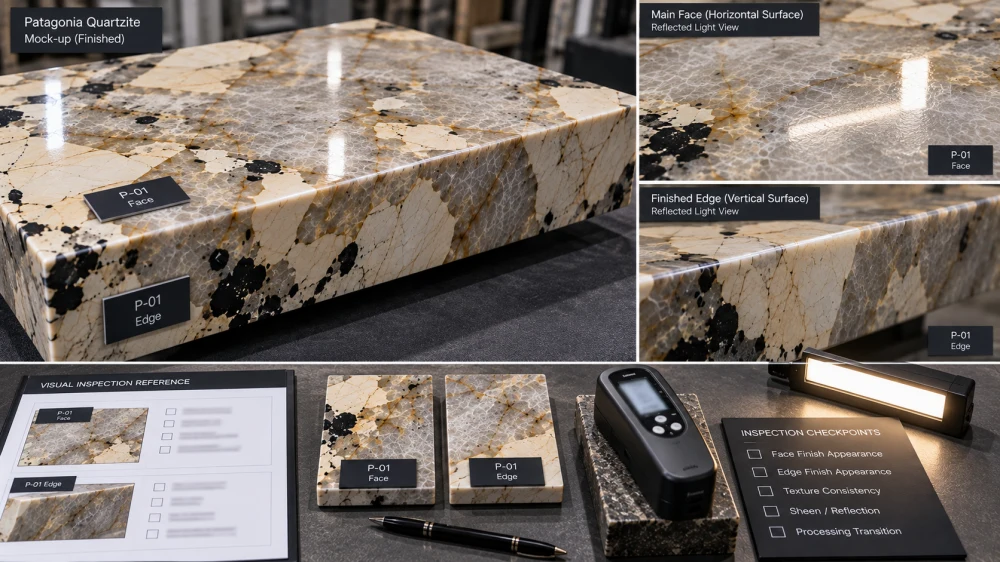
A countertop mock-up may include a broad horizontal face and a polished, honed, mitered, eased, or profiled edge.
Do not automatically assume that matching the face measurement proves the edge matches visually.
Edge finishing can involve:
patagonia-quartzite-face-edge-gloss-mock-up
different tools;
different working direction;
smaller processing areas;
different access;
profile geometry; and
different reflected-light behavior.
If the edge is a visible design element, include it in the mock-up approval separately.
Mock-Up Size Should Represent the Decision Being Made
A very small chip may be useful for initial finish development.
It may not be enough to approve the finish of a large island, long vanity, wall panel, reception counter, or other broad architectural surface.
Build an Acceptance Range From the Project Reference
If the project requires numerical control, an agreed range is generally more meaningful than pretending every point on a Natural Quartzite surface must produce one exact number.
But the range should come from the project’s approved method and reference—not from a generic online table.
The approval record should answer:
What is being measured?
Which sample established the target?
Which measurement method applies?
Which geometry applies?
Where are readings taken?
How many readings are required?
How are the results evaluated?
What project-specific range or acceptance rule applies?
Does visual approval also apply?
Who has authority to approve?
A Useful Quartzite Surface Gloss Specification
A project specification can follow this structure:
Edge Requirement: [Separate visual / measurement requirement where applicable]
Approval Owner: [Named project role]
Production Scope Released: [Defined pieces / area / slab group]
This format intentionally leaves project-specific numerical fields open until the responsible team defines them.
That is safer than inserting an unsupported universal gloss target.
Do Not Let One Mock-Up Approve Unlimited Production
An approved mock-up should have a defined scope.
Record whether it applies to:
a named slab or slab group;
a defined project area;
a particular finish process;
specified faces;
specified edge conditions;
a particular fabrication facility or process where relevant; and
a stated production revision.
If a meaningful variable changes, decide whether another review is required.
Zum Beispiel:
New Slab Group → New Finish Process → Different Surface Treatment → Different Edge → Different Mock-Up Scale → Re-review as Required
Connect the Mock-Up to Production QC
A mock-up has limited value if it disappears after design approval.
The approved reference should remain available to the production and QC teams.
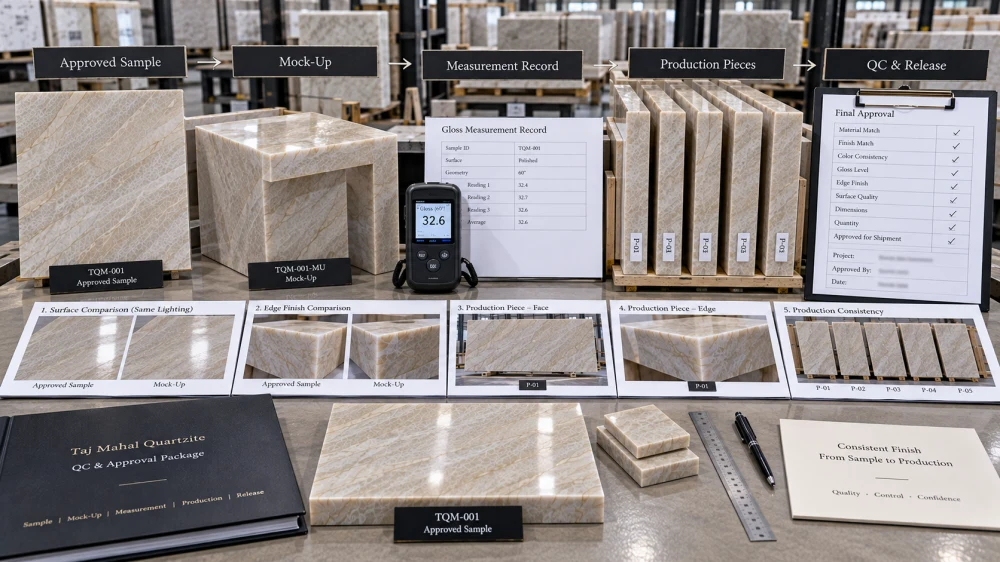
A useful control chain is:
Approved Sample → Mock-Up ID → Finish Process → Measurement Record → Production Piece → QC Record → Final Approval
If the project later asks whether a finished piece matches the approved surface, the team should be able to trace the answer back to the same control reference.
What Buyers Should Confirm Before Mock-Up Approval
Frage
Warum es wichtig ist
Which physical sample is the control reference?
Prevents approval from relying on a generic finish name
Is approval visual, numerical, or both?
Defines how the mock-up will actually be judged
What measurement method applies?
Makes numerical readings reproducible
Where are readings taken?
Prevents selective measurement after results are known
Are face and edge reviewed separately?
Different geometries can show different finish behavior
Is the mock-up large enough?
Small samples can hide large-area processing variation
What production scope does approval release?
Prevents one sample approval from becoming an unlimited guarantee
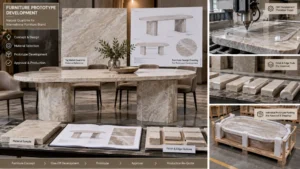
quartzite-approved-gloss-mock-up-production-qc
FAQ
1. How should surface gloss be specified for a Quartzite mock-up?
Identifizieren Sie die Referenzprobe aus natürlichem Quarzit, beschreiben Sie das vorgesehene optische Erscheinungsbild, legen Sie die Größe und den Oberflächenzustand der Musterfläche fest und geben Sie an, ob die Abnahme visuell, instrumentell oder beides erfolgt. Sofern numerische Glanzwerte erforderlich sind, sind zudem das Messverfahren, die Geometrie, die Messpositionen, die Anzahl der Messungen, die Abnahmekriterien sowie der Verantwortliche für die Freigabe zu definieren.
2. Is “honed finish” enough to specify Quartzite gloss?
Nicht immer. Geschliffen kennzeichnet eine allgemeine Oberflächenbearbeitung, doch zwei geschliffene Oberflächen können sich dennoch in Glanz, Reflexionsverhalten, Textur, Farbtiefe und Bearbeitungsgleichmäßigkeit unterscheiden. Für anspruchsvolle Projekte hinsichtlich des Erscheinungsbilds sollte der Oberflächenbezeichnung eine genehmigte physische Referenz sowie eine projektspezifische Abnahmemethode zugeordnet werden.
3. What gloss unit should polished or honed Quartzite have?
There is no single universal gloss value that should automatically be applied to every polished or honed Natural Quartzite project. If a numerical requirement is needed, establish it using the project’s selected material, approved reference, measurement method, geometry, and acceptance criteria.
4. Why does measurement angle matter when checking Quartzite gloss?
[Gloss-Lesungen hängen von der jeweils angewandten Messgeometrie ab, die durch die ausgewählte Methode oder das eingesetzte Instrument bestimmt wird. Ein numerisches Ergebnis sollte daher stets in Verbindung mit seinem jeweiligen Messverfahren betrachtet werden. Ergebnisse, die unter Verwendung unterschiedlicher Geometrien ermittelt wurden, dürfen ohne entsprechende fachliche Begründung nicht als unmittelbar austauschbar angesehen werden.].
5. Should a Quartzite mock-up use several gloss readings?
Wenn eine numerische Messung erforderlich ist, können mehrere vorab festgelegte Messorte ein aussagekräftigeres Ergebnis liefern als eine einzige, leicht zugängliche Messung, insbesondere auf einer von Natur aus variablen Oberfläche. Das Projekt sollte vor Beginn der Tests die Messorte, die Anzahl der Messungen sowie die Auswertungsregel festlegen.
6. Should Quartzite edges use the same gloss requirement as the main face?
Gehen Sie nicht davon aus, dass sie automatisch identisch aussehen. Die Kantengeometrie und die Bearbeitung können das Verhalten des reflektierten Lichts beeinflussen. Sind die fertigen Kanten visuell von Bedeutung, nehmen Sie sie separat in die Mock-up‑Prüfung auf und legen Sie die erforderliche Beziehung zur genehmigten Oberflächenbearbeitung fest.
7. Does an approved Quartzite mock-up automatically approve all production slabs?
No. The approval record should define which material, slab group, finish process, surfaces, pieces, or project area it covers. A meaningful change in material or processing may require another review.
Final Gloss-Specification RuleDo not specify Quartzite surface gloss with one adjective or one unexplained number. Keep the control chain complete: Design Intent → Control Sample → Visual Finish → Measurement Method if Required → Geometry → Test Locations → Acceptance Rule → Mock-Up Approval → Production QC.
For project-based Natural Quartzite fabrication, HRST STONE can coordinate actual stone references, finish trials, mock-up samples, fabrication drawings, finish comparison photographs, production QC records, piece identification, packing, and export documentation for the confirmed scope. Send Josh the material name, approved or proposed finish reference, drawings, dimensions, quantities, visible surfaces, mock-up requirement, measurement specification if applicable, and delivery destination before bulk production release.
Hi, I am the author of this article. I have been working in the field of Natural Stone for more than 15 years. If you need customized Natural Stone services, please feel free to contact me.