
In der Welt der High-End-Architektur ist ein Entwurf nur so gut wie seine Ausführung. Sie haben wahrscheinlich schon die Renderings gesehen: weitläufige parametrische Fassaden, organische Marmortreppen, die der Schwerkraft zu trotzen scheinen, und kunstvolle Reliefwände, die in Kalkstein eine Geschichte erzählen. Doch wie jeder erfahrene Projektmanager weiß, liegt zwischen einer schönen CAD-Datei und einem fertigen Steinmeisterwerk eine lange Reihe technischer Hürden.
Wenn es Zeit ist, vom Bildschirm zum Stein überzugehen, lautet die Frage nicht nur “Wie schneiden wir das?”, sondern vielmehr: “Steinbearbeitung CNC vs Wasserstrahl vs 5-Achsen—welches davon den Budgetrahmen nicht sprengt und den Zeitplan nicht gefährdet?” Die falsche Wahl Steinschneidetechnologie kann zu gezackten Kanten, Materialverschwendung oder einer Rechnung führen, die den Auftraggeber zum Weinen bringt. Dieser Leitfaden nimmt die drei Giganten der Werkstatt unter die Lupe, um Ihnen zu helfen, das richtige Werkzeug für Ihr nächstes komplexes Steinbearbeitungsprojekt auszuwählen.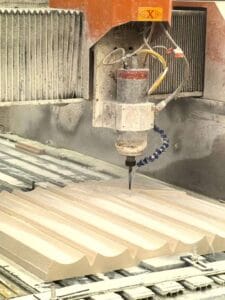
Das Dilemma des Architekten: 3 häufige Problempunkte
Bevor wir uns mit den technischen Details befassen, sollten wir die Kopfschmerzen anerkennen, die Designer nachts wach halten:
-
Der “Verschwinden-Trick” bei Details: Sie entwerfen eine filigrane 3D-Textur, doch der Verarbeiter erklärt, sie sei “unmöglich”, oder liefert ein Stück zurück, das aussieht, als wäre es mit einem Buttermesser geschnitzt worden.
-
Die Budgetexplosion: Die Auswahl einer 5-Achsen-Maschine für einen Auftrag, den eine Standard-CNC hätte bewältigen können, was zu Kosten führt, die dreimal so hoch sind wie nötig.
-
Der strukturelle Knall: Die Wahl eines Schneidverfahrens, das zu starke Vibrationen oder thermische Belastungen auf die Platte ausübt und dazu führt, dass teurer Quarzit oder Marmor bereits in der Endphase der Produktion reißt.
Die Konkurrenten verstehen: Rollen und Definitionen
Um sich zurechtzufinden komplexes Steinbearbeitungsprojekt, muss man zunächst die grundlegende “DNA” jeder Maschine verstehen.
1. CNC-Steinbearbeitung (3-Achsen und 4-Achsen)
Standard CNC-Steinbearbeitung arbeitet im kartesischen Koordinatensystem ($X, Y, Z$). Stellen Sie sich das als einen äußerst disziplinierten Bildhauer vor, der sich von links nach rechts, von vorne nach hinten und von oben nach unten bewegt.
-
Am besten geeignet für: Flache Oberflächen, Abschrägungen, Gravuren und einfache 3D-Reliefs.
-
Der Haken: Sie hat Schwierigkeiten mit Unterkanten oder steilen vertikalen Kurven, weil der Werkzeugkopf stets senkrecht zur Tischfläche steht.
 2. Wasserstrahlschneiden
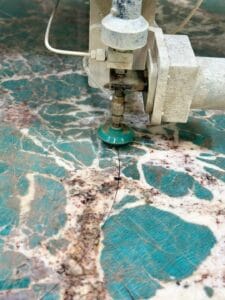
Die Wasserstrahltechnologie nutzt einen Überschall-Wasserstrahl, der mit Granatschleifmittel gemischt ist. Sie ist das “Skalpell” der Branche.
-
Am besten geeignet für: Komplizierte 2D-Umrisse, Steineinlagen (Marqueterie) und das präzise Schneiden dicker Platten (bis zu 200 mm).
-
Der Haken: Es ist streng genommen ein “Durchschneider”. Es kann weder Tiefen, Taschen noch 3D-Schnitzereien erzeugen.
3. 5-Achsen-Bearbeitung
Die 5-Achsen-Maschine fügt dem Standard$A$ Und $B$) zwei Rotationsachsen hinzu ( $X, Y, Z$. Der Schneidkopf kann kippen und rotieren, sodass er den Stein aus jedem Winkel bearbeiten kann.
-
Am besten geeignet für: Echte 3D-Skulpturen, gewundene Treppen und “Unterkanten”-Designs, bei denen das Werkzeug unter eine Steinlippe hindurchgreifen muss.
-
Der Haken: Hohe Programmierkomplexität und teure Stundenlöhne.
Direkter Vergleich: Die Daten
Bei der Entscheidung für Steinschneidetechnologie, verwenden Sie die folgende Matrix, um Ihre Prioritäten abzuwägen.
| Merkmal | CNC (3/4 Achsen) | Wasserstrahl | 5-Achsen-Bearbeitung |
| Dimensionalität | 2,5D (Reliefs) | 2D (Flache Profile) | Vollständiges 3D (Skulptural) |
| Präzision | Hoch | Ultra-Hoch | Hoch |
| Einrichtungszeit | Medium | Schnell | Langsam (Komplexe Programmierung) |
| Materialverschwendung | Mäßig | Minimal (Dünne Schnittbreite) | Mäßig |
| Am besten geeignet für | Küchenarbeitsplatten / Wandpaneele | Bodeninlays / Medaillons | Statuen / Komplexe Kurven |
Tiefenanalyse: Welches Verfahren für welche Form?
Die “Goldene Regel” von komplexes Steinbearbeitungsprojekt ist, die Bewegung des Werkzeugs an die Geometrie des Steins anzupassen.
Szenario A: Parametrische Fassadenplatten
Wenn Ihr Entwurf eine sich wiederholende geometrische Welle aufweist, CNC-Steinbearbeitung ist dies in der Regel die bessere Wahl. Da die Platten größtenteils flach sind und unterschiedliche Tiefen aufweisen, kann eine 3-Achsen-CNC diese effizient in Serie produzieren.
-
Warum nicht 5-Achsen? Das ist übertrieben. Sie zahlen für eine Rotationsbewegung, die Sie gar nicht brauchen.
Szenario B: Aufwändige Bodenmedaillons
Für eine Hotellobby mit ineinander greifenden Marmorfarben, ist Wasserstrahlschneiden die einzig logische Wahl. Der “Kerf” (die Schnittbreite) beträgt weniger als 1 mm, sodass die Teile wie ein perfektes Puzzle zusammenpassen.
-
Warum nicht CNC? Ein mechanisches Schneidwerkzeug hat einen Durchmesser (meist 6–20 mm) und kann scharfe Innenecken nicht schneiden.
Szenario C: Die spiralförmige Massivstein-Treppe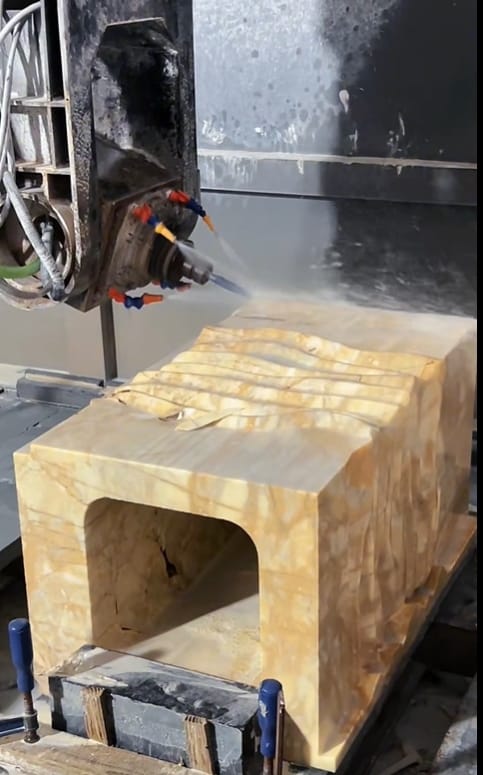
Wenn die Unterseite eines Treppenstufens gebogen und die Seite verdreht ist, benötigen Sie 5-Achsen-Bearbeitung. Das Werkzeug muss der Kurve des Steins in einer fließenden, multidirektionalen Bewegung “folgen”, um ein glattes Finish zu gewährleisten.
-
Warum nicht Wasserstrahl? Es kann nicht schnitzen; es kann nur durchschneiden.
Engineering für den Erfolg: Pro-Tipps für Designer
Über die Maschinenauswahl hinaus hängt der Erfolg von komplexes Steinbearbeitungsprojekt ab, wie Sie das “Digitale Zwilling” vorbereiten.”
-
Achten Sie auf die “Sicherheitsschicht”: Wenn Sie 5-Achsen-Pfade für dünne organische Formen verwenden, lassen Sie im digitalen Modell immer eine “Toleranz” von 2–3 mm. Stein ist ein Naturprodukt mit inneren Spannungen; wenn Sie zu dünn schneiden, zerbricht das Werkzeug durch die Vibration das Stück.
-
Integrierte Befestigungen: Für schwere 3D-Wandverkleidungen verwenden Sie CNC-Steinbearbeitung um die Taschen für Unterkantenanker oder T-Nuten vorzuschneiden. Dies sollte im Werk geschehen, niemals vor Ort.
-
Der hybride Ansatz: Die meisten High-End-Projekte nutzen eine Kombination. Ein Wasserstrahl könnte den groben “Rohling” einer Statue schneiden, um Zeit zu sparen, gefolgt von 5-Achsen-Fräsen für die Details und schließlich manueller Handbearbeitung für die Seele.
Marktkenntnisse und Zukunftstrends
Die Steinindustrie bewegt sich in Richtung “Industrie 4.0”. Wir sehen einen Anstieg bei Roboterarm-Bearbeitung (effektiv 6- oder 7-Achsen), die noch größere Skalen ermöglicht komplexes Steinbearbeitungsprojekt, wie ganze monolithische Säulen.
Nachhaltigkeit treibt auch die Beliebtheit von Wasserstrahlen an. Da sie ein “kaltes Schneiden” verwenden, gibt es keinen thermischen Schock für den Stein, und das Wasser kann in geschlossenen Kreisläufen recycelt werden. Außerdem reduziert die Fähigkeit von Wasserstrahlen, Teile eng anzulegen, den Materialverschnitt – ein entscheidender Faktor bei der Arbeit mit $1.000 pro Quadratmeter Calacatta Borghini.
Fazit: Die richtige Entscheidung treffen
Es gibt keine “beste” Maschine – nur die beste Maschine für Ihre spezifische Geometrie und Ihr Budget.
-
Wählen Sie Wasserstrahl für flache, filigrane Muster und ineinander greifende Teile.
-
Wählen Sie CNC-Steinbearbeitung für traditionelle architektonische Elemente, Stuckprofile und flache Texturen.
-
Wählen Sie 5-Achsen-Bearbeitung für die “unmöglichen” Formen – die Kurven, die Verdrehungen und die echten 3D-Formen.
Bei Quarzitstein, wir sind darauf spezialisiert, die Lücke zwischen ambitioniertem Design und technischer Realität zu schließen. Egal, ob Sie Premium-Quarzitplatten oder Beratung für eine kundenspezifische Installation benötigen, unser Team ist hier, um sicherzustellen, dass Ihre Vision in Stein gemeißelt wird – perfekt.
Bereit, Ihr komplexes Design zum Leben zu erwecken? Kontaktieren Sie noch heute unser Engineering-Team für eine technische Überprüfung Ihrer CAD-Zeichnungen.
FAQ: Häufige Fragen zur Steintechnologie
1. Ist 5-Achsen-Bearbeitung immer teurer als CNC?
Im Allgemeinen ja. Der Stundensatz für die Maschine ist höher, und die “CAM”-Programmierung (Computer-Aided Manufacturing) dauert deutlich länger. Für ein sehr komplexes Teil kann es jedoch günstiger sein, weil es das Teil in einem einzigen Setup fertigstellen kann, während eine 3-Achsen-CNC den Stein mehrmals bewegen und neu kalibrieren müsste.
2. Können Wasserstrahlen 100 mm Granit durchschneiden?
Ja. Moderne Wasserstrahlen können bis zu 200 mm dicke Steine durchschneiden, wobei die Geschwindigkeit mit zunehmender Dicke abnimmt.
3. Welche Methode ist am besten, um Risse in zerbrechlichem Marmor zu verhindern?
Wasserstrahl ist oft am sichersten für fragile Materialien, weil er nur sehr wenig seitliche Kraft auf den Stein ausübt. Bei CNC- und 5-Achsen-Bearbeitung drücken mechanische Schneidköpfe gegen das Material, was zu Vibrationen führen kann.
4. Welche Dateiformate brauche ich für diese Maschinen?
Für Wasserstrahl (2D) ist eine saubere .DXF- oder .DWG-Datei Standard. Für CNC und 5-Achsen (3D) müssen Sie .STEP-, .IGES- oder .STL-Dateien bereitstellen.
5. Bestimmt die Maschinenbearbeitung den endgültigen Poliergrad?
Nein. Zwar können diese Maschinen den Stein sehr nahe an die Endform bringen, aber ein Hochglanzpolierfinish erfordert meist sekundäre oszillierende Köpfe oder manuelles Polieren durch einen Handwerker.
6. Kann ich diese Technologien auch für Sinterstein oder Porzellan verwenden?
Absolut. Tatsächlich ist Wasserstrahl die bevorzugte Methode für Sinterstein, um die internen Spannungsprobleme zu vermeiden, die beim mechanischen Schneiden häufig auftreten.


