ملخص سريع
يصف تقرير اختبار الكوارتزيت عينة محددة تم اختبارها وفقًا لطريقة محددة. ولا يثبت تلقائيًا أن كل بلاطة تُباع بنفس الاسم التجاري، أو كل دفعة لاحقة، أو أي طلب مستقبلي، تمتلك خصائص متطابقة. ولأغراض الشراء، ينبغي للمشترين التحقق من رقم العينة، ومرجع المادة المصدر، ومرجع الدفعة أو الحمولة المتاحة، وطريقة الاختبار، وتاريخ التقرير، والعلاقة بين العينة المختبرة والمادة المراد شراؤها. إن قيمة نتيجة الاختبار لا تعتمد فقط على الرقم المُعلن، بل أيضًا على مدى وضوح إمكانية ربط هذه النتيجة بالمادة الحالية.
قد يزوّد مورّد الكوارتزيت الطبيعي بتقرير بيتروغرافي، أو نتيجة امتصاص الماء، أو نتيجة الكثافة، أو اختبار القوة، أو اختبار التآكل، أو أي وثيقة مخبرية أخرى أثناء استفسار المشروع.
قد تكون الوثيقة صالحة تقنيًا للعينة التي تم اختبارها، لكن ذلك يطرح سؤالًا ثانيًا للمشتري:
ما الذي تم اختباره بالضبط، وكيف ترتبط تلك العينة بالكوارتزيت الذي أنا بصدد شرائه؟
لهذا السبب تكتسب مراجع العينة والدفعة أهمية كبيرة.
يمكن لنتيجة مخبرية دون مرجع مادي قابل للتتبع أن توفر معلومات أساسية، إلا أن صلتها بالطلب الحالي قد تكون غير مؤكدة. فاسم الحجر التجاري وحده عادةً لا يكفي لإثبات هذه العلاقة.
سلسلة الأدلة العملية هي:
الاسم التجاري → رقم العينة المختبرة → البلاطة أو الكتلة المصدر → مرجع الدفعة أو الحمولة → الطلب الحالي → متطلبات المشروع
لا يشترط أن تبدو السلسلة متطابقة لدى كل مورد أو مشروع. إذ تستخدم شركات الحجر الطبيعي أنظمة مختلفة للمخزون، والكتل، والبلاطات، والحزم، والشحنات، وغيرها. المهم هو أن يتم توثيق العلاقة بدلاً من افتراضها.
ماذا يثبت تقرير اختبار الكوارتزيت فعليًا؟
يسجل تقرير اختبار الكوارتزيت النتائج الخاصة بالعينة المحددة في التقرير وفقًا لطريقة الاختبار والظروف المذكورة.
قد يبدو الأمر بسيطًا، لكنه أحد أهم الفروق في شراء الحجر الطبيعي.
لا يثبت التقرير تلقائيًا أن:
- كل بلاطة تحمل نفس الاسم التجاري تمتلك خصائص متطابقة
- كل بلاطة تورّدها الشركة نفسها مصدرها من المادة المختبرة نفسها
- أن الشحنة اللاحقة تنتمي إلى المصدر أو الدفعة نفسها
- أن الطلب الحالي يمثل عينة تاريخية
- أن نتيجة اختبار واحدة تجيب عن كل أسئلة الأداء أو التصنيف
- أن الحجر المختبر مناسب تلقائيًا لكل استخدام
لذلك ينبغي قراءة التقرير على مرحلتين:
المرحلة الأولى — ماذا يقول التقرير المخبري عن العينة المختبرة؟
المرحلة الثانية — ما الأدلة التي تربط تلك العينة بالمادة محل التقييم أو الشراء؟
كلا السؤالين مهمان.
لماذا يحتاج تقرير اختبار الكوارتزيت إلى رقم العينة؟
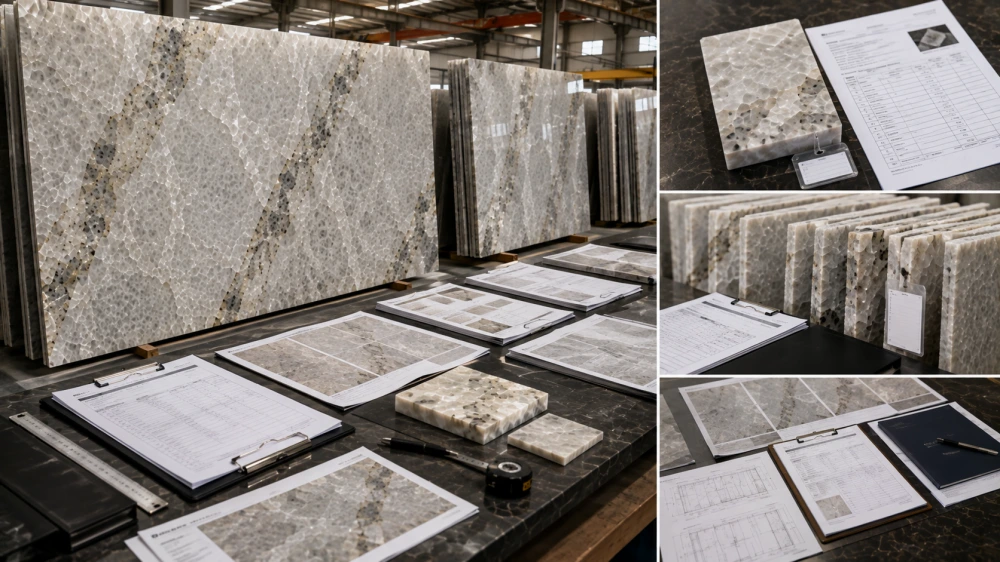
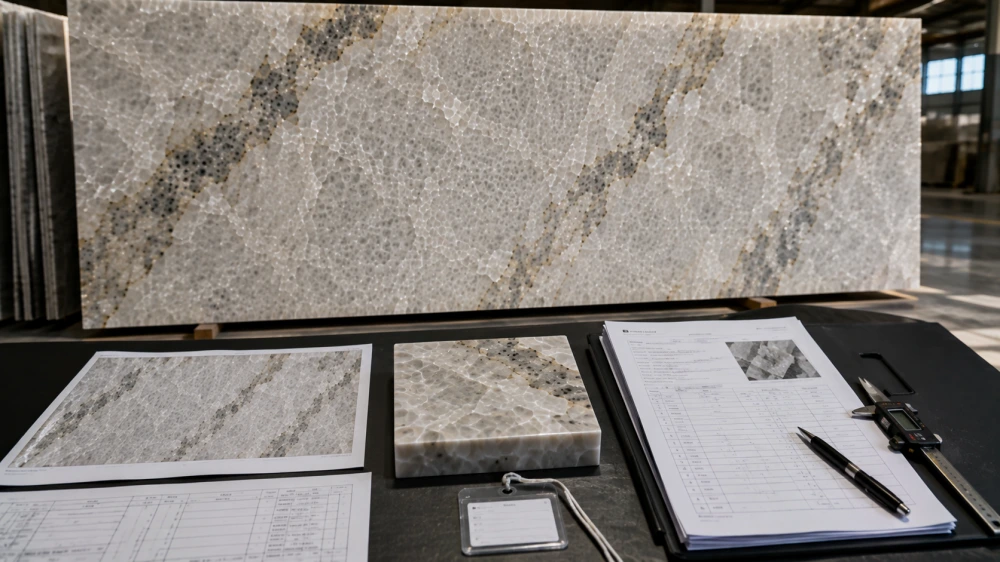
يساعد رقم العينة على تمييز العينة المختبرة عن الأحجار الأخرى، أو العينات، أو البلاطات، أو الطلبات المقدمة.
اعتمادًا على المختبر وعملية الاختبار، يمكن توثيق هوية العينة عبر واحد أو أكثر مما يلي:
- رقم العينة المخبري
- رمز العينة الخاص بالعميل
- وصف المادة
- الاسم التجاري للأحجار
- مرجع المورد
- رقم الكتلة أو البلاطة
- صور فوتوغرافية
- ملصقات أو علامات
- تاريخ التقديم
- معلومات مصدر أخرى قابلة للتتبع
كلما كانت الهوية أقوى، كان من الأسهل للمراجع اللاحق فهم ما تمثله النتيجة.
إذا حدد التقرير العينة فقط كشيء عام مثل “الكوارتزيت الأبيض”، فقد يواجه المشتري صعوبة في تحديد ما إذا كانت تتعلق بالمادة المعروضة حاليًا.
حتى الاسم التجاري الواضح لا يحل كل مشكلات التتبع.
نفس الاسم التجاري ≠ نفس العينة المختبرة.
لماذا يعد مرجع الدفعة أو الحمولة مهمًا للكوارتزيت الطبيعي؟
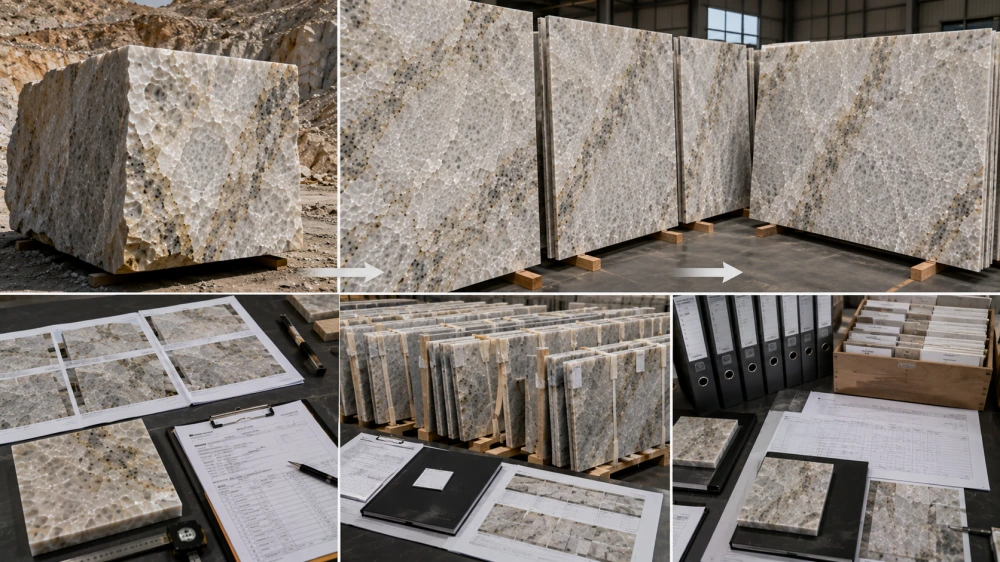
يمكن لمرجع الدفعة أو الحمولة أو الحزمة أو الكتلة أو البلاطة، أو أي ترتيب مشابه، أن يساعد في توثيق كيفية ارتباط العينة المختبرة بمجموعة أكبر من المواد.
وهذا مفيد بشكل خاص لأن الكوارتزيت الطبيعي مادة جيولوجية، وليس سطحًا مصنوعًا وفق وصفة بصرية مسيطر عليها تمامًا.
قد تحدث تباينات طبيعية بين الكتل والبلاطات. ووجود هذه التباينات لا يثبت أن دفعتين يجب أن تمتلكا نتائج اختبار مختلفة، لكنه أحد الأسباب التي تدفع المشترين إلى عدم افتراض أن العينة التاريخية تمثل تلقائيًا كل شحنة مستقبلية.
لذلك فإن الغرض من مرجع الدفعة هو التتبع، وليس وعدًا بالتجانس التام.
من الفروق المفيدة:
مرجع الدفعة = دليل على العلاقة
مرجع الدفعة ≠ دليل على أن كل بلاطة طبيعية متطابقة
Sample, Slab, Block, Batch and Order: What Is the Difference?
Natural stone documentation can become confusing because several references may appear in the same procurement process.
| Reference | What It Identifies | What It Does Not Automatically Prove |
| الاسم التجاري | Commercial identity used to describe or sell the stone | That all material using the name is the same tested specimen, batch, or geological reference |
| Test Sample / Specimen | The physical material submitted for a particular laboratory examination or test | That every other slab has identical measured properties |
| Source Slab | The slab from which a test specimen was taken, where documented | That another slab is automatically represented by the result |
| Block | A quarried stone mass from which slabs may be processed | That every part of the block or every processed slab is perfectly uniform |
| Batch / Lot / Bundle | A grouping used for material, inventory, production, selection, or procurement traceability | That all natural stone pieces within the group are visually or physically identical |
| Current Order | The material actually proposed or confirmed for the buyer’s project | That an older report automatically represents the ordered material |
| Test Report Number | The laboratory or issuer’s document record | That the report applies to another specimen merely because the stone name is similar |
How Strong Is the Link Between a Quartzite Test Report and Your Order?
Instead of asking only whether a supplier has a test report, buyers can ask how strong the traceable relationship is between the report and the proposed material.
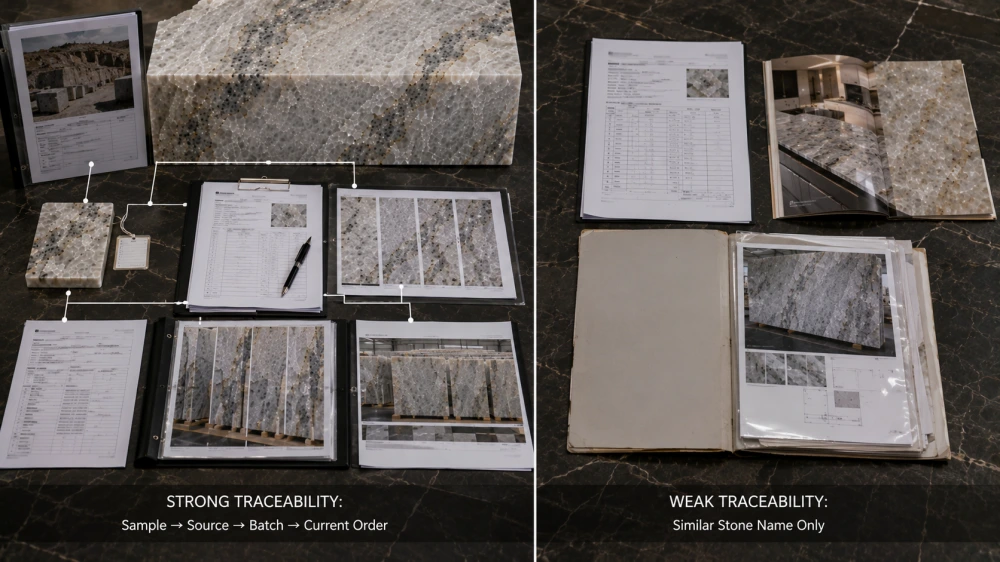
Strong Traceability
A stronger evidence chain may look like:
Test Report → Sample ID → Documented Source Slab / Block / Batch → Material Proposed for Current Order
This does not make every slab identical to the test specimen, but it gives the buyer a documented relationship to evaluate.
Partial Traceability
A partial relationship might look like:
Test Report → Commercial Trade Name → Same Supplier → No Clear Current Batch Connection
The report may still provide useful historical or material-family information, but the buyer should understand the missing link before treating it as project-specific evidence.
Weak Traceability
A weak relationship might look like:
Test Report → Similar Stone Name Only → No Sample ID or Source Relationship to Current Material
In this case, the document may be useful as background reference, but its relevance to the current order is difficult to establish from the available information.
What Should Buyers Check on a Quartzite Test Report?
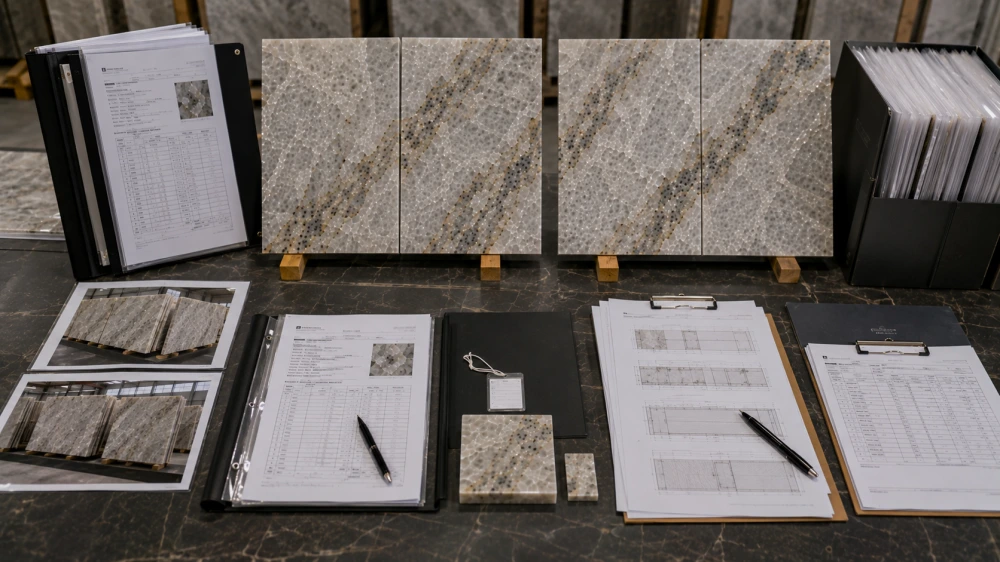
Before focusing on the numerical result, review the document itself.
| Report Item | سؤال المشتري |
| Report Number | Can this document be uniquely identified? |
| Issue / Test Date | When was the specimen tested? |
| Laboratory / Issuer | Who performed or issued the documented work? |
| Sample ID | Which physical specimen was tested? |
| Material Description | How is the tested stone identified? |
| Source / Batch Reference | Is there a documented relationship to a block, slab, batch, lot, or selection? |
| Test Method | What was actually measured or examined, and under which stated method? |
| Results | What does the report state for the tested specimen? |
| Limitations / Notes | Does the issuer define conditions or limits affecting interpretation? |
| Annexes / Photos | Do supporting pages help identify the specimen or testing context? |
Why Should Buyers Read the Test Method Before the Result?
A number has meaning only in relation to what was measured and how it was measured.
Natural Quartzite documentation may include different types of examination or physical testing depending on the project and specification. Examples can include:
- Petrographic examination or rock classification
- امتصاص الماء
- Density or related physical-property testing
- Flexural strength
- معامل الكسر
- Abrasion-related testing where relevant
- Exterior or environmental testing where required by the project specification
- Other project-specific laboratory requirements
These tests do not answer the same question.
على سبيل المثال:
Petrographic Classification ≠ Flexural Strength
Water Absorption Result ≠ Geological Classification
One Test Result ≠ Complete Project Suitability Assessment
A buyer should therefore identify the project requirement first and then confirm whether the submitted report actually addresses it.
Does the Same Quartzite Trade Name Mean the Test Report Applies?
No—not by itself.
A commercial trade name is useful for buying and selling stone, but it is not a complete traceability system.
The same or similar commercial name may appear in different markets, supplier records, or periods of supply. A trade name alone does not identify the physical specimen submitted to a laboratory.
That creates an important procurement distinction:
Trade Name = Commercial Material Identity
Sample ID = Tested Specimen Identity
Batch / Source Reference = Relationship Evidence
All three can be useful, but they perform different jobs.
Does the Same Supplier Mean the Test Report Applies to the Current Batch?
Not automatically.
A supplier may have sold the same commercial Quartzite over multiple years or from multiple blocks and slab groups.
A historical report supplied by the same company may be useful evidence about a previously tested specimen, but supplier identity alone does not establish that the current slabs are from the same tested source.
Ask what connects the report to the current material.
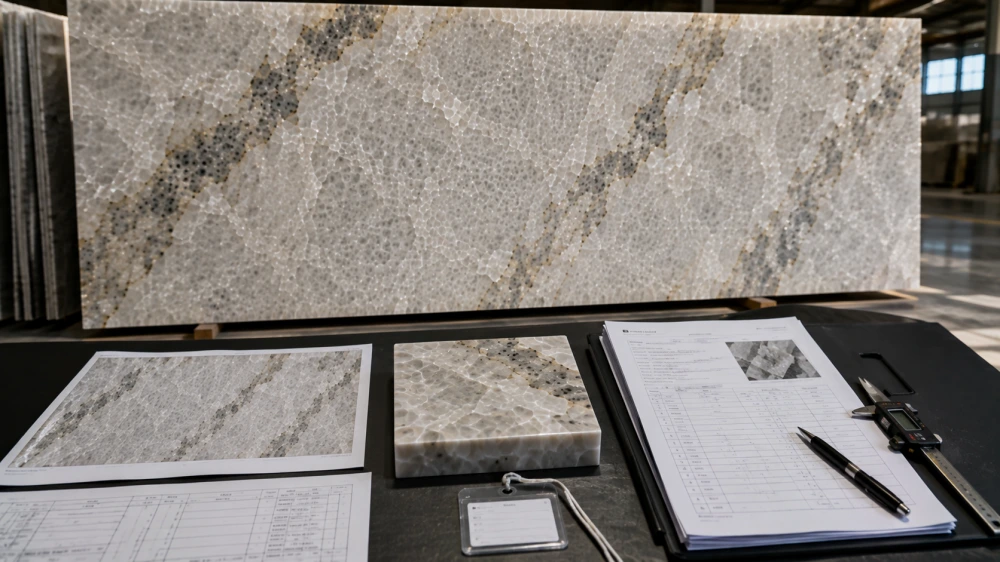
That connection might be a sample number, block reference, slab number, lot, bundle, purchase record, selection record, or another documented identifier.
If the connection is unavailable, the report can still be retained—but the limitation should remain visible.
Can an Old Quartzite Test Report Be Used for a New Order?
Possibly, but the report date alone cannot answer the question.
Suppose a buyer receives a Quartzite test report issued several years before the current order.
The buyer should not automatically reject it simply because it is old. But the buyer should also not assume that it applies simply because the commercial material name is unchanged.
المراجعة:
- The tested sample identity
- The report date
- The test method
- The material description
- The available source, block, batch, or lot information
- The relationship to the currently offered slabs
- Whether the project specification requires current or project-specific testing
- Whether a consultant or other responsible technical party requires additional verification
الفرق الأساسي هو:
Report Age ≠ Report Applicability.
Does a Quartzite Test Report Expire?
There is no useful universal answer based only on the age printed on the document.
An older report is not automatically irrelevant simply because time has passed, and a recent report is not automatically applicable to the buyer’s material simply because it was issued recently.
The more useful question is:
Does this report remain relevant to the specimen, material source, test method, current order, and project requirement being reviewed?
A project specification, contract, consultant, testing program, laboratory procedure, or applicable requirement may impose its own documentation or retesting expectations. Those requirements should be checked separately.
What If the Report Has a Stone Name but No Sample Number?
Do not automatically discard the report, but treat the missing identification as a traceability question.
Look for other evidence such as:
- صور فوتوغرافية
- Supplier submission records
- Laboratory descriptions
- Block or slab references
- Batch or lot numbers
- Dates
- Purchase or selection records
- Correspondence connecting the specimen to the material
If none of these can distinguish the tested specimen, the report may have limited value for proving a relationship to the current order.
The correct response is to document the limitation rather than silently filling the gap.
Does One Tested Sample Represent Every Slab in the Same Batch?
Not in the sense of proving that every natural slab is identical.
A tested specimen can provide evidence about that specimen. A documented batch relationship can explain why the report is being considered in relation to a group of material.
But natural stone can contain mineralogical and structural variation.
This is why buyers should separate two ideas:
Representative Evidence — why the sample is being used to inform a decision about a group of material.
Identical Material — a much stronger claim that should not be assumed simply from a batch reference.
Natural variation is a reason to maintain traceability. It is not, by itself, proof that every slab will perform differently.
Test Report Facts vs Current Order Facts
Another common procurement mistake is mixing information about the laboratory specimen with information about the current commercial order.
| Test Report Facts | Current Order Facts |
| Tested sample ID | Current slab / material reference |
| Report number | Quotation or purchase reference |
| Test method | مواصفات المشروع |
| Test date | Current procurement date |
| Recorded result | Dimensions, quantity, thickness, finish, and application |
| Source or batch reference where documented | Current block, slab, bundle, lot, or selection reference where available |
The buyer’s job is not to merge these columns automatically.
The job is to establish and document the relationship between them.
Worked Example: Historical Quartzite Report vs Current Slab Order
Consider a hypothetical project purchasing Natural Quartzite slabs for a large interior installation.
The supplier provides a laboratory report issued in an earlier year. The commercial stone name on the report matches the name on the current quotation.
At first glance, the documents appear consistent.
But the buyer asks for the sample reference.
Scenario A — Traceable Relationship
The supplier can identify the tested specimen and provide records connecting it to a documented material source that is also relevant to the currently offered slab group.
The historical report now has a clearer relationship to the procurement discussion.
The project team can then decide whether that evidence satisfies the current specification or whether additional testing is required.
Scenario B — Trade Name Only
The report shows the same commercial stone name, but there is no available sample ID, block, slab, batch, lot, or other record connecting the specimen to the current material.
The report may still be useful as historical background.
However, the buyer should not silently convert it into proof that the current slabs have the same measured result.
The difference between the two scenarios is not the number printed on the test report.
It is the strength of the traceable relationship between the tested specimen and the material being purchased.
When Should a Quartzite Buyer Consider New Testing?
New or additional testing may be worth discussing when:
- The project specification explicitly requires it
- The available report cannot be connected adequately to the proposed material
- The material source or relevant batch has changed
- The existing report does not use the method required by the project
- The report addresses a different technical question
- A project consultant or responsible technical reviewer requests verification
- The application has requirements not addressed by the existing evidence
- The buyer and supplier agree that project-specific verification is appropriate
This does not mean every Natural Quartzite order requires a completely new laboratory program.
Testing should follow the project requirement and the strength of the evidence already available.
Quartzite Test Report Buyer Checklist
Before using a report in a procurement or specification decision, check:
- Report Number: Can the laboratory document be uniquely identified?
- تاريخ التقرير: When was the testing or examination performed?
- Issuer: Who issued the report?
- معرّف العينة: Can the tested specimen be identified?
- Material Name: What commercial or technical description appears on the report?
- Source Reference: Is a source slab, block, batch, lot, bundle, or similar reference available?
- Test Method: Does the method answer the project’s actual technical question?
- Current Material: Which slabs or material are currently being offered?
- Traceability: What documented evidence connects the tested specimen to the current material?
- القيود: What relationship remains unverified?
- Project Requirement: Does the specification require a particular method, date, laboratory, frequency, or project-specific test?
- Technical Review: Does the responsible consultant or reviewer need to confirm interpretation?
أسئلة متكررة للمشتري
1. Does a Quartzite test report apply to every slab with the same name?
لا. يُسجل التقرير النتائج الخاصة بالعينة المختبرة المحددة وفقًا للطريقة المذكورة. ولا يعني استخدام الاسم التجاري نفسه تلقائيًا أن كل بلاطة أو دفعة لاحقة أو طلب مستقبلي تمثل تلك العينة.
2. What is a Quartzite sample ID?
معرّف العينة هو مرجع يُستخدم لتحديد العيّنة المادية المقدَّمة للاختبار أو الفحص. وقد يكون هذا المعرّف رقمًا مخبريًا، أو رمزًا من المورِّد، أو مرجعًا للبلاطة أو الكتلة، أو صورة فوتوغرافية، أو علامة، أو أي معرّف موثَّق آخر.
3. Why does a Quartzite test report need a batch or lot reference?
يمكن أن يساعد رقم الدفعة أو الحزمة أو الكتلة أو مجموعة الألواح أو الحزمة أو أي مرجع مشابه في توثيق العلاقة بين العينة المختبرة ومجموعة أكبر من المواد. وهذا يعزز إمكانية التتبع، لكنه لا يعني أن كل لوح من الحجر الطبيعي ضمن تلك المجموعة متطابق.
4. Can an old Quartzite test report be used for a new order?
ربما. فالعمر وحده لا يحدد مدى ملاءمة الاستخدام. يُرجى مراجعة العينة المختبرة، والطريقة المستخدمة، ووصف المادة، والعلاقة بين المصدر أو الدفعة المتاحة، والألواح الحالية، ومتطلبات المشروع قبل اتخاذ قرار بشأن الأهمية النسبية للتقرير التاريخي.
5. Does a Quartzite test report expire?
لا توجد إجابة عامة مفيدة تستند فقط إلى تاريخ التقرير. فقد تفرض مواصفات المشروع، أو الاستشاريون، أو العقود، أو برامج الاختبار، أو متطلبات أخرى توقعاتها الخاصة. والسؤال الأساسي في عملية الشراء هو ما إذا كان التقرير لا يزال ذا صلة بالمواد الحالية وبالقرار المتخذ.
6. What if a Quartzite report has a stone name but no sample number?
ابحث عن أدلة أخرى على التتبع، مثل الصور الفوتوغرافية، ومراجع الألواح أو الكتل، ومعلومات الدفعة، وسجلات التقديم، والتواريخ، أو المراسلات. وإذا ظل من المستحيل تمييز العينة المختبرة، فسجّل هذا القيد بدلاً من افتراض أن التقرير يمثل الطلب الحالي.
7. Should the test report match the actual Quartzite slabs being purchased?
أقوى أدلة الشراء تتمثل في وجود علاقة موثّقة بين العينة المختبرة والمواد الخاضعة للتقييم. وهذا لا يعني أن عينة واحدة تثبت تطابق كل بلاطة، لكن ينبغي أن تكون هذه العلاقة واضحة بما يكفي لتمكين فريق المشروع من فهم سبب استخدام التقرير.
8. When should a buyer request new Quartzite testing?
يُراعى إجراء اختبارات إضافية عند الحاجة وفقًا لمواصفات المشروع، أو عندما يتعذر ربط التقرير المتاح بشكل كافٍ بالمواد المقترحة، أو عند حدوث تغييرات في المصدر أو في الدفعة ذات الصلة، أو عند غياب طريقة الاختبار المطلوبة، أو عند طلب المراجع الفني المسؤول إجراء تحقق خاص بالمشروع.
ملاحظة ختامية
A Quartzite test report should not be judged only by the result printed on the page. Buyers should also ask what specimen was tested, how it was identified, whether a source or batch relationship is documented, what method was used, and how the report relates to the material currently being purchased. The central procurement principle is simple: a test result is only as useful to a buyer as the traceable relationship between the tested specimen and the material being evaluated.
Discuss Your Natural Quartzite Requirement with HRST STONE
For a project-specific Natural Quartzite enquiry, contact Josh at HRST STONE with the material name, current slab or sample references, available test reports, dimensions, quantities, drawings, required surface finish, intended application, and delivery destination. Where batch, block, slab, or other traceability information is available, include it with the enquiry so the material and documentation questions can be reviewed on the same basis.
حقوق الطبع والنشر (c) لشركة HRST STONE / شركة شيامن HRST STONE المحدودة. جميع الحقوق محفوظة.