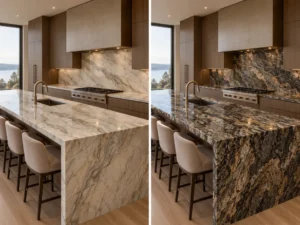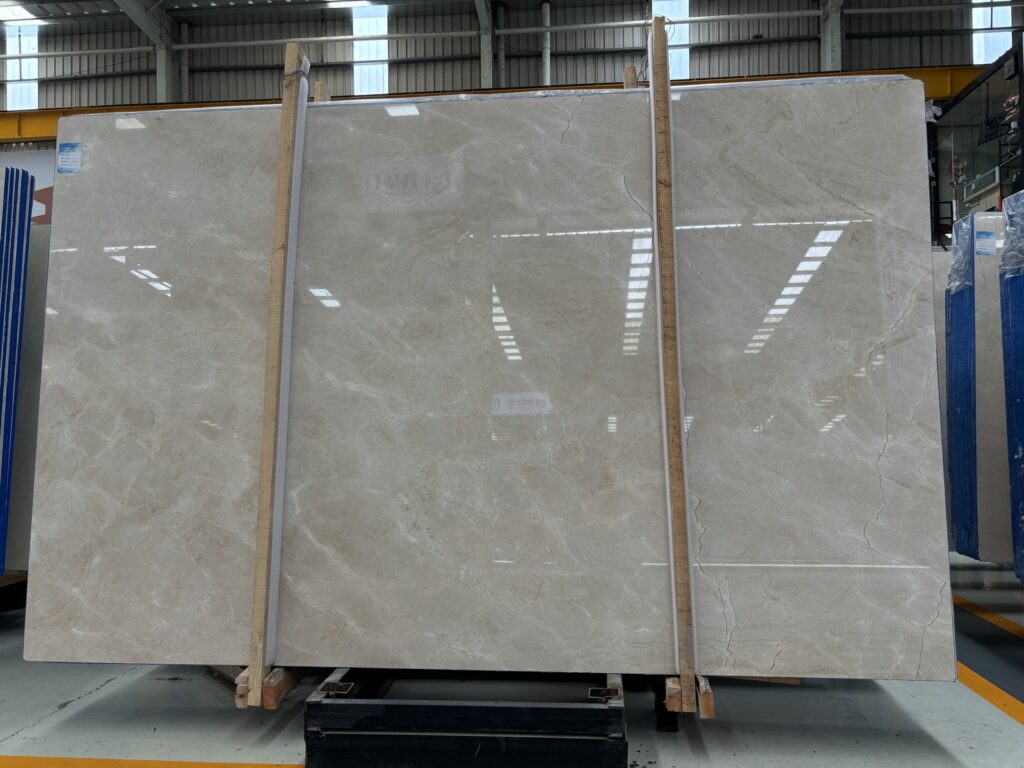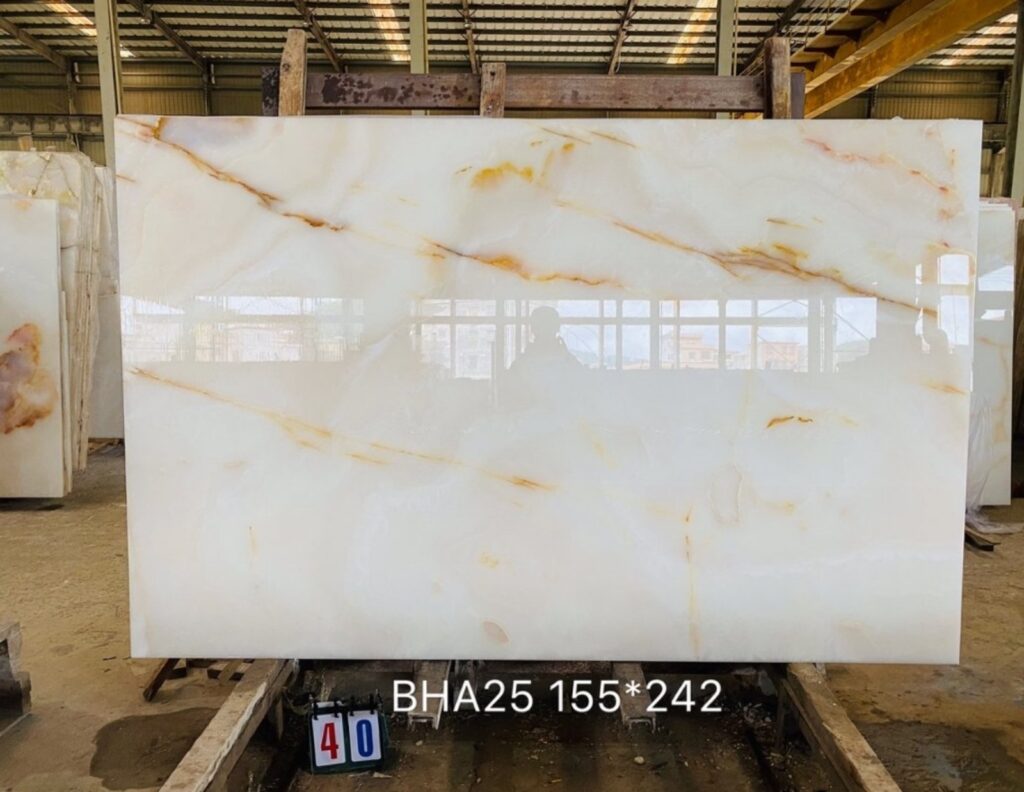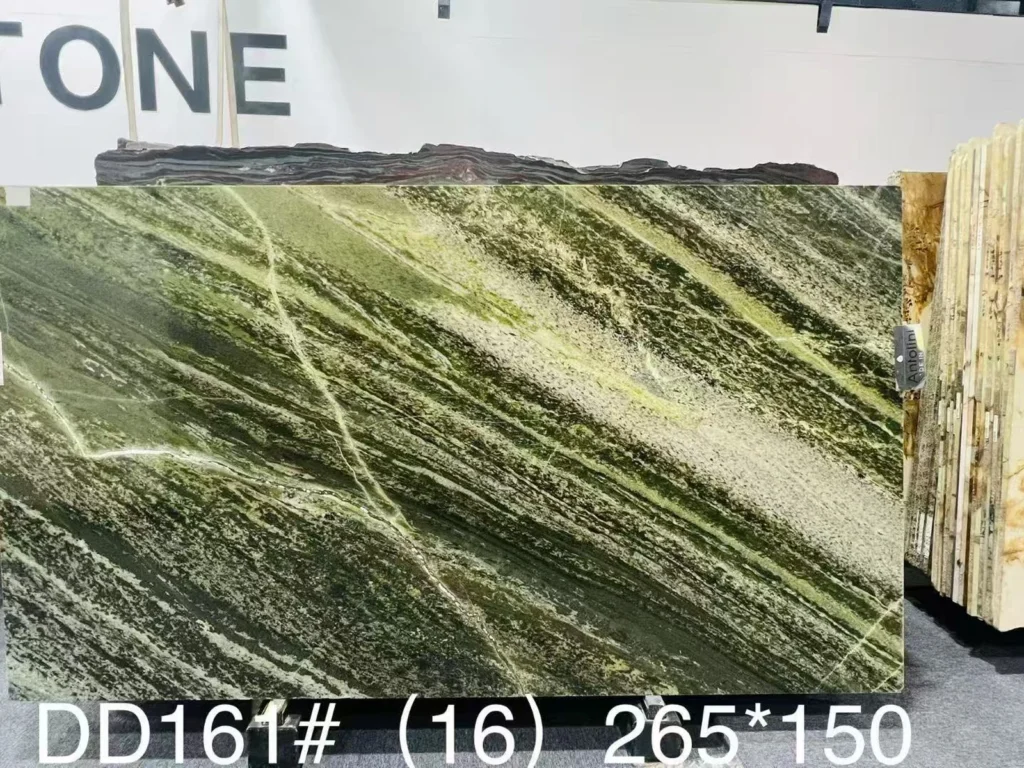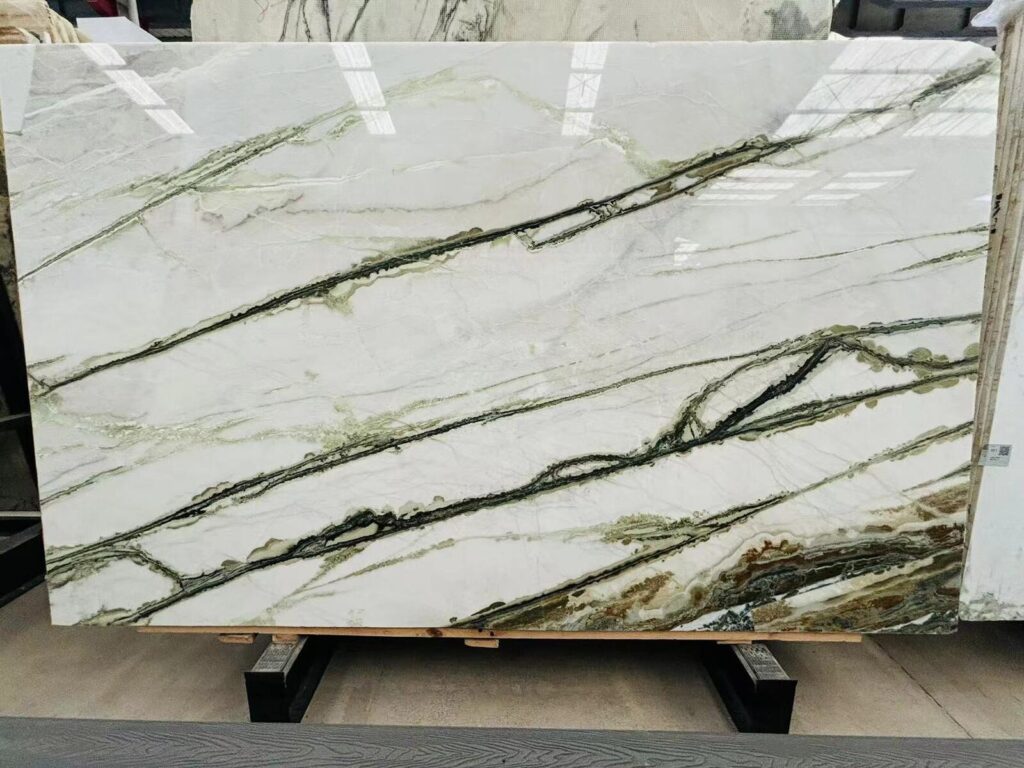

Краткое резюмеNatural Quartzite vs Engineered Quartz for Matching Existing Natural Stone should begin with the installed surface, not with a catalogue name. Existing natural stone may now look different from an archived sample because of lighting, surface condition, wear, cleaning history, refinishing, or normal natural variation across the original installation. Natural Quartzite offers slab-specific geological movement, while engineered quartz follows the visual characteristics of the selected manufactured product. Neither option should be promised as an exact match without a project-specific comparison. Review identified candidates beside the existing surface, check the actual edge and junction, and decide whether the project requires close matching, visual coordination, or deliberate contrast before fabrication.
A natural quartzite countertop was installed several years ago.
Now one section must be extended, repaired, or replaced.
The original slab may be gone. The original board number may be missing. A retained sample may exist, but it has been stored indoors while the installed surface has been exposed to years of use, cleaning, daylight, and normal wear.
The project now faces a practical question:
Should the replacement be another Natural Quartzite slab, or would an Engineered Quartz product create a better relationship with the existing natural stone?
This is very different from selecting material for a new kitchen where every surface is still open for design.
The existing stone has already established the visual reference. The new material must be judged against what is physically installed now—not only against a trade name, old photograph, or catalogue sample.
По этой причине, Natural Quartzite vs Engineered Quartz for Matching Existing Natural Stone is best treated as a replacement and coordination problem rather than a general material-performance comparison.
Before looking at new samples, decide what level of visual relationship the project really requires.
The word “match” can describe at least three different objectives.
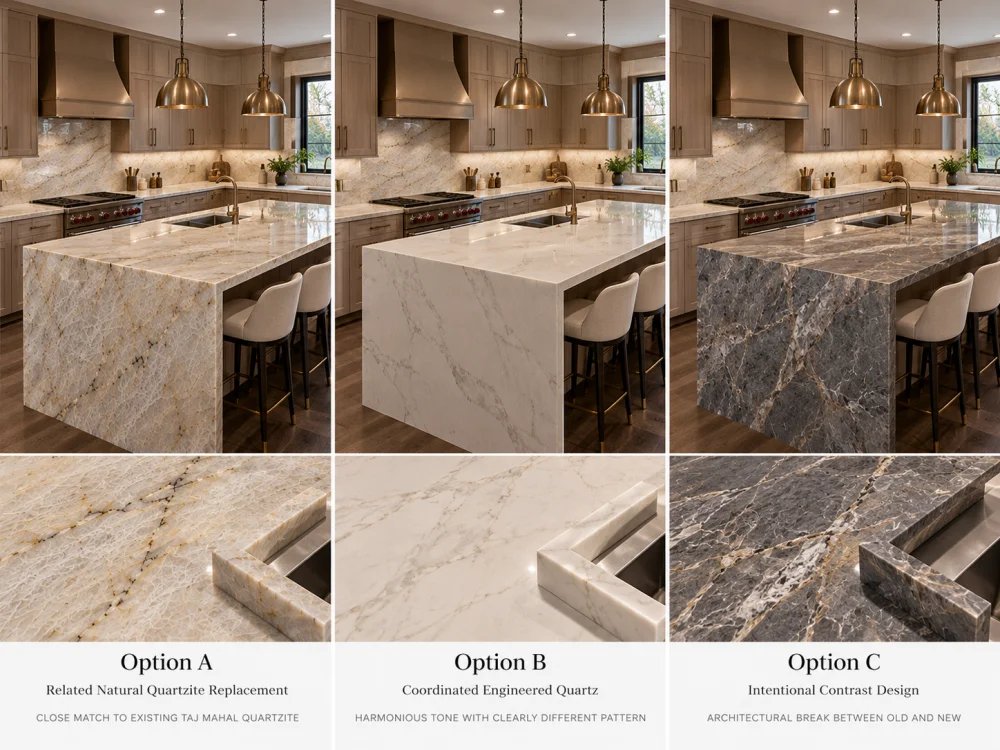
The new material will sit directly beside the existing stone and is expected to appear as closely related as reasonably possible.
This is the most demanding situation because both surfaces may be visible together at close range. Differences in background color, undertone, pattern scale, surface gloss, edge profile, and seam appearance become easy to notice.
The old and new materials are visible in the same room but are separated by an appliance, cabinet, doorway, wall return, or another architectural break.
In this case, the project may prioritize compatible color temperature, pattern intensity, and overall visual weight rather than attempting to reproduce individual veins.
The project accepts that an exact-looking replacement is not practical and intentionally introduces a different but coordinated surface.
A calm Engineered Quartz, for example, may sit successfully beside a highly variable natural stone if the contrast is designed rather than accidental.
A different Natural Quartzite may also become a separate focal surface rather than pretending to continue geological movement that cannot realistically be recreated.
Define the Target Before SearchingClose Match: New and existing surfaces are expected to relate closely at short viewing distance.
Coordinated Match: Similar tone and visual character matter more than individual vein continuation.
Deliberate Contrast: Difference is accepted and incorporated intentionally into the room design.
This distinction prevents a supplier from being asked to find an “exact match” when the actual project only requires compatible visual coordination.
The installed natural stone should become the starting point for the comparison.
Do not begin by selecting a new slab and asking whether it looks generally similar.

Search for available project records such as:
These records can help reconstruct the original material basis.
However, knowing the commercial stone name does not guarantee that a new slab carrying the same name will look identical. Natural Quartzite varies between slabs and across different areas of the same slab.
Next, inspect the stone as it looks today.
Record the broad background color, warm or cool undertone, vein contrast, mineral movement, surface finish, visible gloss, edge profile, and any local variation near the area that will meet the new work.
If the existing installation has visible wear, staining, dullness, refinishing, or other surface changes, record those conditions separately.
Do not automatically describe every difference from an old sample as “aging.” Lighting, cleaning residue, sealers, surface treatment, wear, and natural stone variation can all affect what is observed.
If the condition matters technically, a qualified stone professional should review it for the actual project.
This is one of the most important decisions in the entire process.
Is the new material expected to match:
These references may not look identical.
The approval record should state which one controls the selection.
Natural Quartzite and Engineered Quartz are different material categories and should remain clearly identified as such.
The Natural Stone Institute’s educational material also distinguishes natural quartzite from manufactured quartz surfacing rather than treating the terms as interchangeable. :chatgpt-content-reference{index=”1″}
Natural Quartzite may be the stronger direction when the existing installation has distinctive natural movement and the project wants the replacement to remain visibly related to that geological character.
The selection should be made from current full-slab information whenever possible.
Compare:
The goal is not necessarily to find a slab that looks identical across its full surface.
A replacement piece may occupy only one portion of a slab. The best visual relationship may therefore depend on finding a suitable cutting area within the candidate slab.
Engineered Quartz takes a different approach.
The project selects a specific manufactured product, color, pattern, finish, and slab format.
A relatively controlled background can sometimes coordinate well with an existing natural stone when exact geological continuation is not required.
However, engineered quartz should not be described as reproducing the original natural material simply because the background color is similar.
The manufactured graphic may have a different vein rhythm, depth, repetition, or edge appearance.
For this reason, compare the exact selected product beside the existing stone rather than relying on the generic label “white quartz,” “beige quartz,” or “marble-look quartz.”
This project is about visual matching and project coordination.
If maintenance, heat, staining, cleaning, sealing, or other performance questions are important, they should be reviewed for the exact Natural Quartzite and exact Engineered Quartz product being proposed.
Do not assume that one category is universally maintenance-free or that all materials within a category behave identically.
Two candidate materials can produce very different results depending on where the replacement is installed.
| Отношение к замене | Main Visual Priority | Recommended Review |
| Directly touches existing stone | Tone, pattern, finish, thickness, edge and seam relationship | Physical side-by-side comparison at the actual junction |
| Separated by sink or appliance | Overall compatibility plus the nearest visible transition | Countertop elevation and normal standing view |
| Separated by tall cabinet or doorway | Compatible tone and overall visual weight | Full-room comparison |
| Separate island or furniture top | Coordinated or deliberately contrasting composition | Room material palette and mock-up |

If the new piece shares a seam with existing natural stone, the eye can compare both materials immediately.
A small difference in background tone may appear much stronger when the surfaces touch.
The same applies to gloss, edge thickness, seam color, and pattern movement.
A candidate that looks convincing from several metres away may not look convincing at a direct joint.
A tall cabinet, appliance, wall return, or other deliberate break can separate old and new surfaces visually.
The project may then focus on coordination rather than imitation.
This can be a useful strategy when a direct match is not achievable.
A new kitchen island does not necessarily need to imitate the existing perimeter countertop.
If the old material has strong natural movement, a calmer Engineered Quartz island can sometimes provide intentional balance.
Alternatively, a new Natural Quartzite slab can become a separate focal point with its own approved pattern.
The design team should decide which relationship is intentional before procurement begins.
A replacement material can match well in one category and poorly in another.
Breaking the review into separate visual decisions makes the result easier to understand.
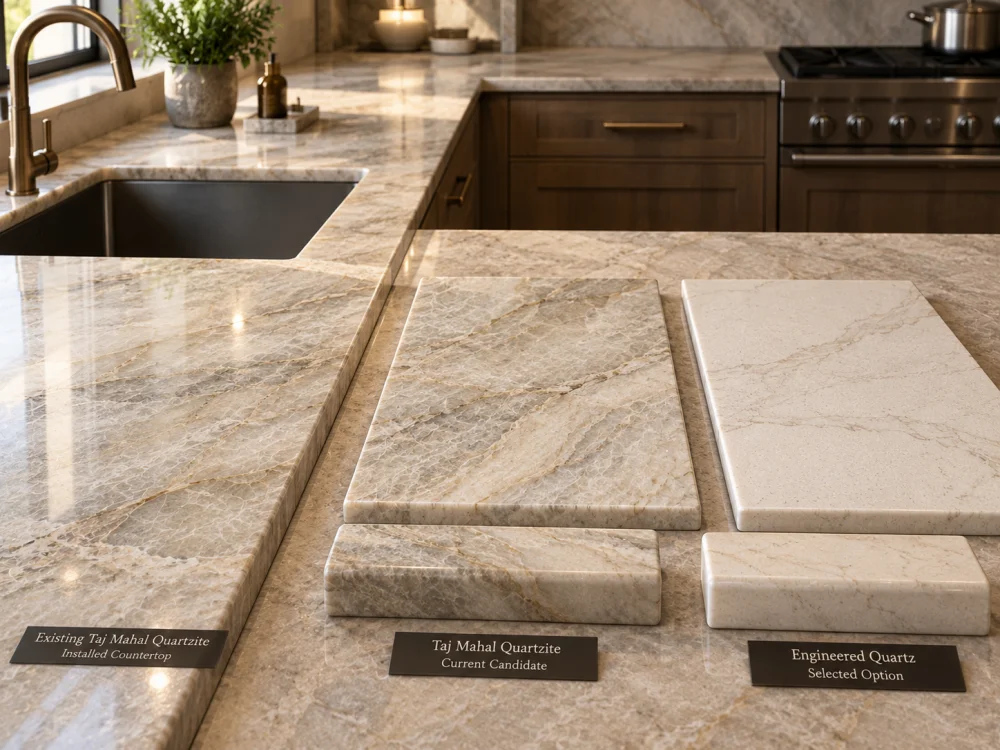
Compare the broad background first.
A photograph may make two surfaces appear white or beige even though one is noticeably warmer or cooler in person.
Place the candidate beside the existing installation under the same relevant lighting.
Next, compare the scale of movement.
An existing Natural Quartzite may contain broad cloudy fields and restrained mineral lines. A manufactured product with frequent, high-contrast printed veins may therefore look unrelated even if its base color is close.
Conversely, a very quiet Engineered Quartz may coordinate successfully when the project wants the old stone to remain the dominant feature.
Natural Quartzite can have strong directional movement.
If direction matters at the replacement junction, show it on the current drawing and connect the finished piece to the actual slab layout.
The Условные обозначения направления кварцитовых жил для рабочих чертежей guide explains why direction marks should be linked to piece IDs, visible faces, seams, and actual slab positions rather than used as isolated arrows.
Finish can make two similar colors look different.
A newly polished surface may reflect much more light than an older installation. A honed replacement may also read differently beside a polished existing surface.
If the existing material is being professionally refinished as part of the renovation, establish that scope before final visual approval of the replacement.
Do not compare only the broad face if the finished edge will remain visible.
Record the existing thickness, edge profile, built-up appearance, mitre, lamination, return, and visible underside where relevant.
Natural Quartzite exposes the natural material through a worked edge.
Engineered Quartz should be reviewed according to the selected product and proposed fabrication detail.
A face sample does not automatically approve the edge appearance.
For a directly adjacent replacement, the seam can become the most important line in the project.
Review what happens immediately on both sides of it.
Do not promise invisible continuation if the replacement material does not support it.
Five-Part Matching Check
Background Tone → Pattern Scale → Direction → Finish / Edge → Seam Relationship. A candidate should be judged across the conditions that remain visible in the finished installation.
For this type of project, a controlled sample review is more useful than comparing new materials remotely in isolation.
Where practical, place identified candidate samples beside the actual existing surface.
If the new work will meet the front edge, compare the samples near that edge.
If the junction will occur beside a backsplash, wall, or cabinet, evaluate the material in that location.
Compare both candidate materials in the lighting that affects the existing installation.
If daylight is important, review a representative daylight condition.
If the space depends heavily on warm evening or under-cabinet lighting, include that condition as well.
Do not compare one candidate in a warehouse and another beside the actual countertop and then treat the color difference as a reliable material comparison.
Start at normal room distance.
Ask whether the candidate belongs visually within the existing interior.
Then move close to the proposed junction.
At this distance, compare color, mineral or printed movement, gloss, edge construction, and the likely seam.
For Natural Quartzite, connect the sample to the current slab reference where possible.
For Engineered Quartz, record the selected manufacturer or supplier reference, product code, color, and finish supplied for review.
Do not allow an unidentified loose sample to become the final purchasing reference.
The original draft correctly emphasizes that a sample approval should remain limited to what was actually reviewed rather than silently approving all future material or fabrication. :chatgpt-content-reference{index=”2″}
Choosing Natural Quartzite is only the first decision.
The next stage is determining where the replacement piece should come from within the selected slab.
Overlay the replacement component onto a current full-slab photograph or controlled slab-layout reference.

Оценивайте:
A candidate slab may contain one area that relates better to the existing stone than another.
Therefore, “this slab matches” is less precise than:
“This proposed cutting area is the preferred visual relationship for the replacement piece.”
If the original board number is available, preserve it in the project record.
If a retained remnant exists, its identity can be particularly valuable because it may retain a direct relationship to the original slab.
That does not automatically mean the remnant is currently usable. Its dimensions, condition, finish, storage status, and actual available area must still be checked.
HRST STONE’s Quartzite Slab Ownership and Storage guide explains why useful remnants should remain connected to their source board and storage record when they are intentionally retained. A traceable remnant can later provide a stronger starting point for replacement work than a commercial stone name alone.
If the original material is no longer available, assign the current candidate its own current identity.
The Форма бронирования кварцитовых плит: номера досок, срок действия и замены guide explains why another slab under the same commercial name should return through a new approval step rather than being treated as though the original physical board had not changed.
Engineered Quartz can be useful when the project decides that controlled coordination is preferable to searching indefinitely for natural geological similarity.
But the approval should still be specific.
Record the exact selected product reference and finish.
If the manufacturer provides different slab formats, graphics, finishes, or other product-specific options, confirm which one the project is reviewing.
Do not assume that a sample from a showroom display automatically establishes the appearance of every future slab or production lot unless the applicable manufacturer information supports that conclusion.
A small Engineered Quartz sample may show only a quiet section of the design.
If the product contains broad printed veins or other large-scale graphics, obtain appropriate full-slab or large-format visual information before approving a major replacement component.
Compare the pattern scale with the existing natural stone.
A face may coordinate convincingly while the finished edge still reveals a different visual character.
If the edge will sit directly beside old natural stone, review the proposed fabricated edge or representative detail.
If the new product does not naturally continue the existing pattern, it may be better to create a clear transition rather than force an almost-match across a highly visible joint.
A visually calm, deliberate contrast is often easier to understand than an attempted imitation that becomes obvious at close range.
Sometimes neither a current Natural Quartzite slab nor an Engineered Quartz candidate creates a convincing direct match.
That should be identified before fabrication.
The project then has several design options.
Continue reviewing current slabs or products, but define what needs to improve.
Например:
“The next candidate needs a warmer background and quieter movement near the replacement seam.”
This is more useful than simply asking for “something closer.”
Where the project allows, relocate the transition to a cabinet, appliance, doorway, corner, or another visually logical boundary.
This can reduce the expectation of geological continuity.
A very small replacement surrounded by existing stone can be difficult to match convincingly.
In some projects, replacing a larger continuous section may create a clearer design result.
This affects material quantity, cost, fabrication, installation, and surrounding work and should therefore be reviewed as a project decision rather than assumed automatically.
If an almost-match would remain visibly different, a deliberate contrast may be more successful.
The new surface can coordinate through cabinetry, wall color, metal finishes, or the overall room palette instead of trying to reproduce the old stone.
If the mismatch is strongly influenced by the condition of the old finish, ask whether appropriate professional cleaning or refinishing of the existing material is part of the renovation.
Any treatment should be assessed for the actual installed stone. Do not promise that refinishing will make old and new materials identical.
Replacement Decision
If a direct match cannot be demonstrated convincingly, change the candidate, change the transition location, enlarge the replacement scope, or make the difference intentional. Do not rely on fabrication to hide a material relationship that was never visually approved.
An exact match should not be promised from the material category or a catalogue image. Natural Quartzite contains slab-specific geological variation, while Engineered Quartz has a manufactured visual pattern. Compare the exact proposed product beside the installed stone and define whether the project requires a close match, coordination, or deliberate contrast.
It may provide a related material character, but the commercial name does not guarantee identical tone, mineral movement, or vein position. Review current candidate slabs and the proposed replacement cutting area before approval.
The project should decide which reference controls. An archived sample, retained remnant, current installed surface, or surface after an approved treatment may look different. Record the agreed matching target before selecting the replacement.
A physical comparison is highly useful where practical, especially when the new and existing materials will be seen together. It allows the project to compare undertone, pattern scale, finish, gloss, edge appearance, and the proposed junction under the same lighting.
A direct seam usually requires the closest visual review because both surfaces are compared at short distance. Evaluate local tone, pattern, finish, thickness, edge treatment, seam position, and the intended acceptance criteria at the actual junction.
Potentially, but its current identity, dimensions, condition, finish, usable area, storage status, and fabrication suitability must be confirmed. A retained remnant can provide useful traceability, but its existence does not automatically mean it is available or suitable for the new piece.
Send Josh photographs of the existing installation, the known material name if available, original slab or board references, retained sample or remnant information, current dimensions, replacement location, shop drawings, existing finish and edge details, candidate material preferences, quantities, and delivery destination. Clearly identify whether the goal is a close match, coordinated match, or intentional contrast.
Project Approval SummaryMatching an existing natural stone installation is not the same as selecting material for a new room. Start with the actual installed surface, identify the required level of visual relationship, compare Natural Quartzite and Engineered Quartz candidates under the same conditions, and review the exact location where old and new work will meet. If Natural Quartzite is selected, connect the replacement piece to an identified current slab and cutting position. If Engineered Quartz is selected, approve the exact manufactured product and relevant finished detail. Record what is accepted before irreversible fabrication begins.
For project-based Natural Quartzite replacement work, HRST STONE can help coordinate available slab photographs, current board references, retained-material information where applicable, CAD/shop drawings, proposed cutting layouts, visible-face review, edge details, visual QC documentation, and export packing according to the confirmed scope. Send Josh the existing-stone information, replacement dimensions, drawings, finish requirements, quantities, visual priorities, and destination for review.