Краткое резюмеQuartzite in rooms with mixed daylight and artificial light should be approved through several representative lighting states rather than one attractive photograph. The same Natural Quartzite can appear warmer, cooler, brighter, darker, higher-contrast, or more reflective as daylight intensity and direction change and electric lighting becomes more or less dominant. Correlated color temperature can help describe whether an electric light source appears warmer or cooler, but it does not by itself predict how every mineral colour in the stone will render. Review the actual Quartzite or selected slab, intended finish, important viewing directions, window relationship, electric-light sources, dimming state where relevant, and surrounding cabinetry, flooring, walls, and metal finishes. Separate intrinsic stone colour from illumination and reflection, then record which daytime, mixed-light, and evening conditions have actually been approved.
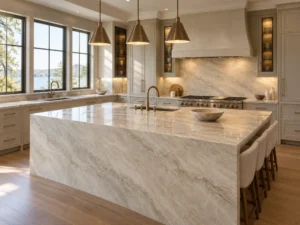
A pale Natural Quartzite island is selected in daylight.
The background looks warm cream.
The taupe-grey mineral movement feels restrained.
The kitchen is installed.
Late in the afternoon, daylight from the windows becomes weaker and the pendants are switched on.
The island now appears warmer near one end and slightly greyer near the other.
At night, with daylight gone, the same stone seems deeper in colour and some veins appear more pronounced.
The next morning, the original pale appearance returns.
Has the Quartzite changed?
Не обязательно.
The lighting balance has changed.
This is the central issue behind Quartzite in Rooms with Mixed Daylight and Artificial Light.
A real interior rarely has one permanent lighting condition.
The important question is therefore not:
“What colour is this Quartzite?”
А именно:
“How does this identified Quartzite read under the lighting states that actually matter to the finished room?”
The first step is to separate intrinsic material characteristics from the illumination under which they are being seen.
The selected Natural Quartzite has its own physical combination of:
Those characteristics belong to the stone.
The room adds another group of variables:
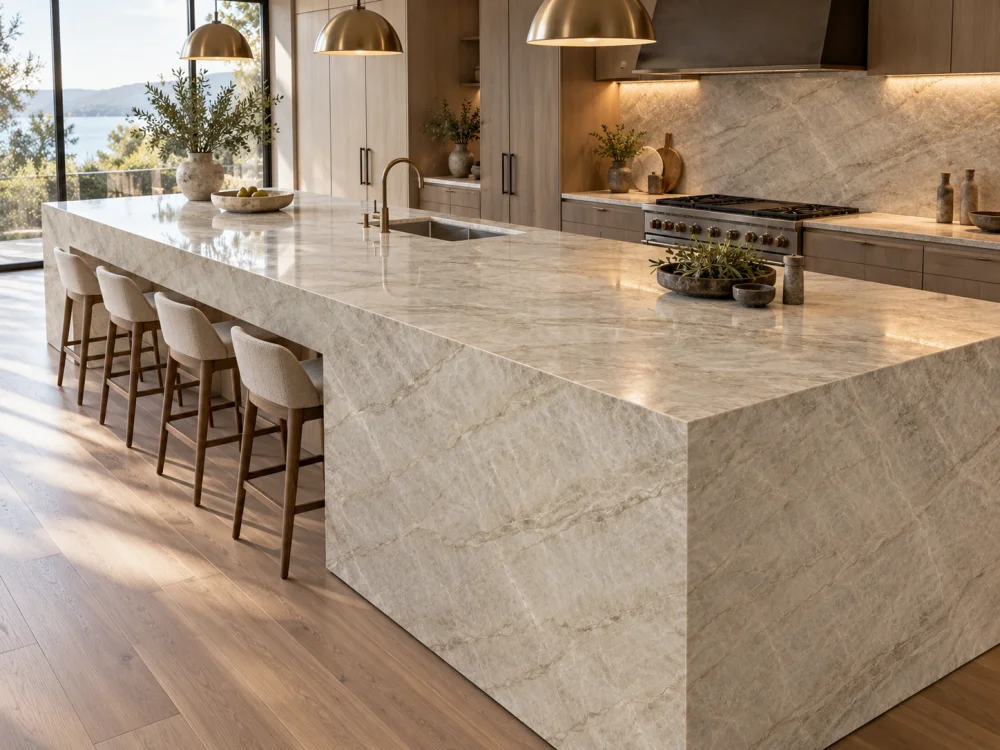
When these variables change, the stone can look different even though the physical slab remains unchanged.
If a pale Quartzite appears warmer in the evening, first ask:
Only after separating these factors should the project decide whether the observed difference belongs to the stone itself.
Lighting-State Rule
Stone Colour + Surface Finish + Light Spectrum / Colour Appearance + Light Direction + Intensity + Reflected Surroundings + Viewing Angle = What the Viewer Sees.
Daylight changes throughout the day.
A Quartzite selection approved at 10:00 a.m. is not necessarily being viewed under the same illumination at 4:00 p.m.
Depending on window orientation and building geometry, light may reach the stone:
Direction can change which mineral features appear prominent.
A bright midday room may allow daylight to dominate the complete surface.
Later, electric lighting may become visually important even before sunset.
This transition period is often where “mixed lighting” becomes most noticeable.
Direct sun can create strong highlights, shadows, and local contrast.
Diffuse daylight produces a much softer visual condition.
Do not approve a material only in an unusually dramatic patch of direct sunlight if that does not represent the normal use of the room.
A clear day and an overcast day may produce different light levels and directional character.
The objective is not to approve every possible weather condition.
It is to understand which daylight states materially affect the design decision.
На объекте Плиты кварцитовые: вид в вертикальном и горизонтальном положении — почему меняется восприятие guide explains the same underlying principle: when light direction, surface orientation, reflection, and observer position change, the same identified Quartzite may be read differently.
Electric lighting is often described with a correlated color temperature, or CCT.
This is useful, but it should not become the only lighting information attached to a colour-sensitive Quartzite approval.
Lower-CCT white light generally appears warmer.
Higher-CCT white light generally appears cooler.
This can influence the atmosphere of the room and the apparent relationship between stone, cabinetry, flooring, paint, and metal finishes.
Two electric light sources can have similar nominal CCT values while rendering particular colours differently.
This is why the project should not approve a sensitive Natural Quartzite palette based only on a number printed beside the fixture specification.
When available, record the selected fixture or lamp information rather than only writing:
“Warm white lighting.”
For a colour-sensitive project, the lighting designer or supplier may provide:
The stone supplier does not need to redesign the lighting system.
The stone-selection team does need to know which lighting condition is being used to judge the material.
There is no single CCT that is universally correct for every Natural Quartzite.
A warm cream Quartzite, icy-white crystalline Quartzite, green Quartzite, or blue-grey Quartzite may each interact differently with the complete interior palette.
The correct decision belongs to the project-specific lighting and design intent.
CCT Limitation
CCT helps describe whether the electric light appears warmer or cooler. It does not, by itself, guarantee how every Quartzite mineral colour will be rendered in the finished room.
Mixed lighting does not always illuminate a complete island or wall evenly.
One long Quartzite surface can exist in several lighting zones at the same time.
The part closest to glazing may be dominated by daylight.
It can appear:
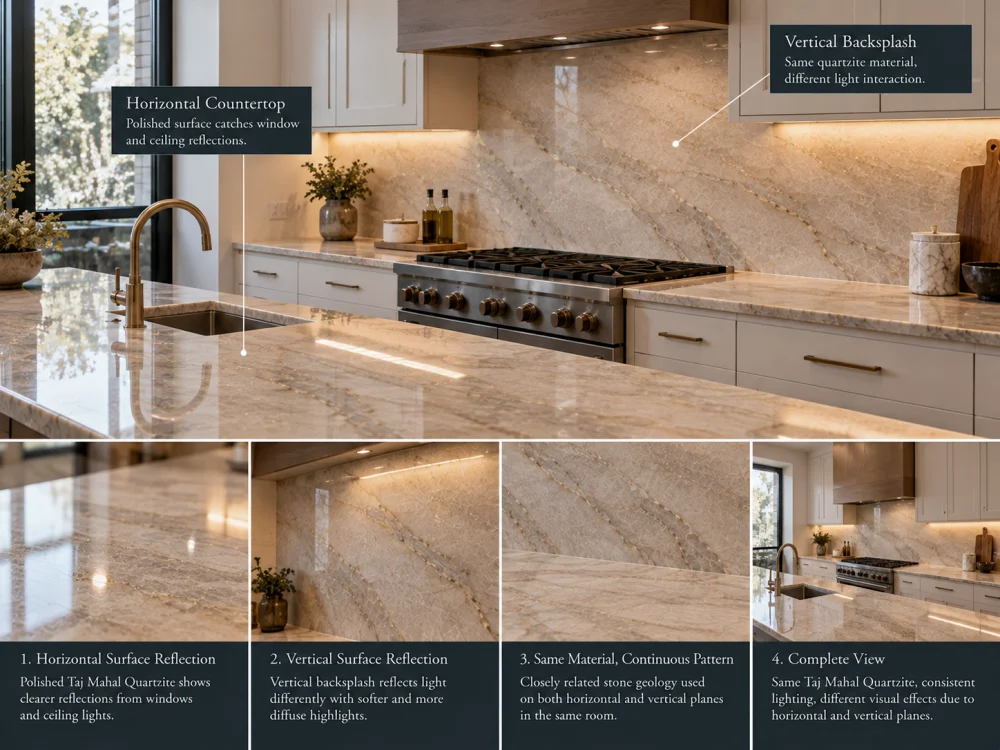
The opposite end may receive weaker daylight and more electric illumination.
The same stone background can therefore look different across the complete surface.
Local pendants can create brighter circles, directional highlights, or shadows.
The Quartzite underneath a pendant is not necessarily a different slab colour from the area between fixtures.
Perimeter countertops may be illuminated strongly by under-cabinet lighting while the island is primarily exposed to daylight and pendants.
Even when the same Quartzite is installed in both locations, the two surfaces may not appear identical at every moment.
A matching Quartzite backsplash faces light from another angle than the horizontal countertop.
This can create a visible difference between two pieces from the same slab family.
Before treating that difference as a slab-matching problem, compare the two planes under controlled lighting.
| Zone | Possible Dominant Light | Вопрос для рассмотрения |
| Near Window | Дневного света | Does strong daylight change brightness or reflection? |
| Room Interior | Daylight + electric light | Does the stone maintain the intended colour relationship? |
| Under Pendant | Local electric light | Are highlights and shadows being mistaken for stone variation? |
| Perimeter Counter | Task lighting + ambient light | Does the same Quartzite read differently from the island? |
| Vertical Stone | Different incident and reflected-light direction | Is plane orientation contributing to the visible difference? |
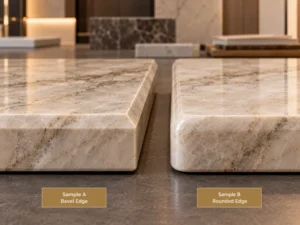
Lighting review should use the intended Quartzite finish wherever practical.
A polished surface can create relatively strong reflections from:
These reflections can temporarily hide, strengthen, or visually overlap the natural stone pattern.

A honed or lower-sheen surface generally produces a softer reflected response.
The stone still responds to daylight and artificial lighting, but reflected objects may be less sharply defined.
A polished finish may be preferred for depth and clarity.
A honed finish may be preferred for a softer visual character.
The correct choice should be coordinated with:
A wet, dusty, recently cleaned, or processing-residue-covered stone surface can add another variable.
For colour-sensitive lighting comparisons, keep the reviewed stone clean and dry and record any exception.
На объекте Шкала рисунка кварцитового камня: чтение плиты на расстоянии комнаты guide also explains why lighting can change which geological features dominate the composition without changing the actual slab pattern.
A Quartzite surface is rarely judged in isolation.
Mixed lighting can alter the relationship between the stone and the rest of the palette.
A warm-white cabinet may appear very close to a pale cream Quartzite during daylight.
Under evening lighting, one may become visibly warmer than the other.
This does not automatically mean either material is wrong.
The question is whether the complete evening palette remains intentional.
Timber can reflect warm colour into polished Quartzite.
When daylight reduces, the warm relationship between wood and stone may become more prominent.
Polished Quartzite may reflect appliance fronts or dark oven glass.
Those reflections can become stronger or weaker as the balance between daylight and electric lighting changes.
A large floor field can contribute reflected colour to both the stone and cabinetry.
Include flooring in a final material review when it occupies enough visual area to influence the room.
Walls surrounding a vertical Quartzite surface can also affect perceived warmth or coolness.
This is particularly important for large feature walls, fireplace surrounds, and full-height backsplashes.
For visually sensitive projects, a useful approval can separate several conditions.
The exact number should follow the real room.
A practical framework is:
Electric decorative lighting is off or secondary.
Обзор:

This may be the most realistic daytime operating condition.
Обзор:
Late afternoon or early evening may create the strongest competition between the remaining daylight and electric lighting.
This state can reveal colour differences that are not obvious under either daylight-only or night-only conditions.
At night, evaluate the Quartzite within the intended artificial-light environment.
Обзор:
These are not universal mandatory stages.
They are a way to stop one photograph from being treated as a complete lighting approval.
Representative Lighting MatrixDaylight Dominant → What does the stone look like naturally?
Daylight + Electric → How do the two light systems interact?
Transition Period → Does colour balance become unstable or noticeably different?
Electric Dominant → Do we approve the normal evening appearance?
Lighting review and stone selection are connected, but they are not the same decision.
Confirms the identified Natural Quartzite boards and their:
Confirms which slab areas become which finished components.
This may include:
Confirms how the selected physical stone is accepted under representative project lighting conditions.
It does not change the material identity.
A client may approve a dramatic evening photograph while still disliking the stone under strong morning daylight.
Or the opposite may occur.
If both experiences are important to the finished project, record both.
На объекте Кварцит Cristallo при выключенном освещении: почему важно получить одобрение в дневное время guide demonstrates the same control principle in a more specialized lighting application: one lighting state should not silently become approval of another.
Not every project needs a full lighting mock-up.
But when stone colour and lighting are central to the design, a controlled physical review can reduce uncertainty.
Progress from:
Representative Sample → Actual Slab → Proposed Finished-Surface Area → Mock-Up Where Required.
Do not approve mixed-light reflections on polished stone if production will be honed.
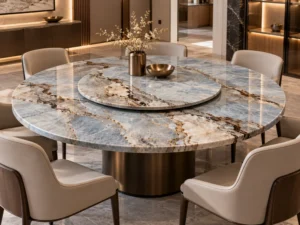
Horizontal island, vertical backsplash, vertical wall panel, and table surface interact with the same room light differently.
The purpose is not to build an entire finished house inside the stone factory.
It is to answer specific questions.
Например:
Where available, record:
This makes the result repeatable enough to remain useful.

The strongest approval is not:
“Quartzite colour approved.”
A better record states what was actually reviewed.
Например:
“Selected Quartzite boards and polished finish approved for the kitchen island under representative daylight, normal daytime electric lighting, and the reviewed evening lighting condition. Window-side reflections and warmer evening appearance are understood as lighting effects. Final fixture selection remains under the lighting-design scope.”
□ Actual Natural Quartzite material identified.
□ Actual slab / board references confirmed where slab-specific approval is required.
□ Intended surface finish confirmed.
□ Main stone orientation identified: horizontal, vertical, or mixed.
□ Important windows and daylight directions identified.
□ Daylight-dominant condition reviewed where relevant.
□ Daylight + electric-light condition reviewed where relevant.
□ Transitional low-daylight condition reviewed if it materially changes the room.
□ Electric-light-dominant evening condition reviewed where relevant.
□ Fixture or light-source references recorded when colour-sensitive decisions depend on them.
□ CCT recorded where available but not treated as the sole predictor of stone colour.
□ Colour-rendering information recorded where useful.
□ Dimming / output condition recorded where it materially changes the result.
□ Polished reflections separated from intrinsic stone colour.
□ Window-side and room-side stone zones compared where illumination differs strongly.
□ Adjacent cabinetry, flooring, walls, metals, and appliances included where visually important.
□ Photography conditions documented when images are used for remote approval.
□ Lighting approval kept separate from slab, layout, and fabrication approval.
□ Approved lighting states and unresolved conditions written into the project record.
Физический камень может оставаться неизменным, тогда как преобладающее освещение меняется. Дневной свет варьируется по интенсивности и направлению, тогда как вечернее электрическое освещение может отличаться по цветовому оттенку, цветопередаче, направлению светильника и характеру отражений. Полированные поверхности также могут отражать разные окружающие объекты по мере изменения освещённости помещения.
Это может изменять воспринимаемое соотношение цветов. На это влияют цветовая характеристика искусственного освещения, цветопередача, окружающая отделка, отражения на поверхности, а также уровень оставшегося дневного света. Не оценивайте эффект только по значению CCT; проверьте фактический камень при условиях освещения, соответствующих проекту.
Не существует универсального значения цветовой температуры Кельвина, которое подошло бы для любого природного кварцитового камня. Цветовая температура (CCT) указывает, насколько белый источник света кажется тёплым или холодным, однако она не полностью отражает то, как будут воспроизводиться оттенки каждого минерала в данном камне. Освещение следует выбирать с учётом общего интерьера и проверять на самом материале, если цвет играет ключевую роль.
When the finished space will regularly be experienced in both conditions and the visual difference matters to the project, reviewing both is useful. A colour-sensitive project may also benefit from a mixed-light or transitional review rather than assuming daytime and nighttime approval automatically cover every intermediate condition.
A long island may cross several lighting zones. One end can receive stronger window daylight while another is dominated by pendants, ceiling lights, cabinetry reflections, or lower ambient illumination. Compare both areas under the same controlled condition before concluding that the stone itself has an unexpected colour difference.
Polished Quartzite generally produces stronger and more defined reflections, so changing windows, fixtures, appliances, and surrounding colours may become more visible on the surface. Honed Quartzite usually produces a softer reflected response. Neither finish is universally better; use the intended project finish during approval.
Send Josh the proposed Natural Quartzite material, current slab references where available, project drawings, application and finished dimensions, quantity, intended finish, window and daylight context, available lighting information, important viewing directions, cabinet and flooring references, photographs or renderings of the room, delivery destination, and the specific lighting concern. Identify whether the question concerns daytime colour, evening colour, reflections, mixed-light zoning, slab matching, or the relationship between horizontal and vertical stone surfaces.
Lighting Approval SummaryA Natural Quartzite should not be approved under a vague condition called “mixed lighting.” Separate the room into representative lighting states and record what each one is intended to answer. Compare the actual stone and intended finish under daylight-dominant, mixed daylight-and-electric, transitional, and evening electric-light conditions where those states materially affect the project. Record fixture information when it matters, but do not use CCT alone as a prediction of stone colour. Separate reflections from intrinsic mineral colour, compare different lighting zones across long surfaces, and include adjacent materials that influence the visual palette. Keep lighting approval distinct from slab selection, cutting-layout approval, fabrication approval, and the lighting designer’s technical responsibilities.
For project-based Natural Quartzite kitchens, islands, wall panels, reception surfaces, bars, and custom furniture in colour-sensitive interiors, HRST STONE can coordinate actual slab photographs, board references, finish samples, proposed cutting layouts, mixed-plane visual review, targeted project-lighting mock-ups where included in scope, fabrication QC, and export documentation. Send Josh the material, drawings, dimensions, quantity, finish, lighting context, adjacent finishes, visual concerns, and delivery destination before final stone approval.