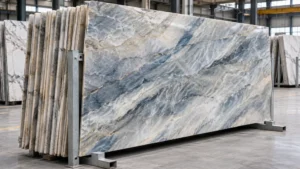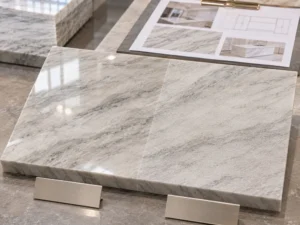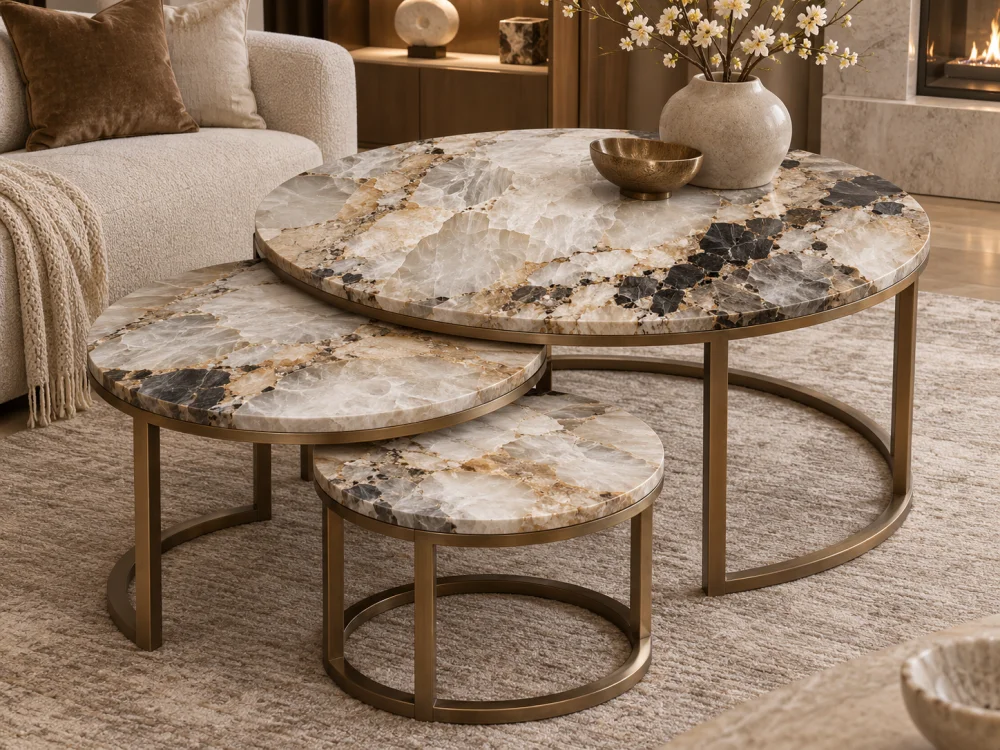
A Natural Quartzite slab contains one extraordinary geological area.
There is a large crystalline structure, a strong mineral transition, or one distinctive dark feature that immediately attracts attention.
The project needs three nesting tables.
Which table should receive that part of the slab?
The largest?
The tallest?
The table that sits on top when the set is nested?
The smallest table because it will often be pulled out and used independently?
Or should the feature be divided across the complete set?
This is the real design question behind Quartzite Nesting Tables: Deciding Which Surface Gets the Main Pattern.
Nesting tables are different from three independent side tables.
They have more than one normal visual state.
When nested, the surfaces overlap and some areas disappear from view.
When separated, every tabletop becomes its own complete Natural Quartzite composition.
The correct slab layout therefore needs to work at both levels:
Set Composition + Individual Table Composition.
The first decision should be how the nesting-table set is intended to behave in the room.

When the tables are stored together, one table may visually dominate.
Depending on the furniture geometry:
This condition should be documented before pattern allocation begins.
Many nesting tables are not used only in fully nested or fully separated positions.
A homeowner or hotel guest may slide one table partway out while leaving the rest grouped.
This can create a very different stone composition because previously hidden areas become visible.
Once the tables are distributed around the room, each top becomes an individual furniture surface.
A crop that looks excellent as one small accent inside the nested composition may feel incomplete when viewed independently.
A useful project review can therefore identify:
State A — Fully Nested
State B — Partially Nested
State C — Fully Separated
The exact number of states can vary.
The important point is to stop evaluating the Quartzite from only one staged furniture photograph.
A nesting-table layout should work when the pieces are together and when they are apart. The dominant stone surface in one condition may not be the dominant surface in another.
“Main pattern” is not a universal geological term.
It is a project-design description for the slab area carrying the strongest visual importance.
For an expressive Natural Quartzite, the main pattern may be:
The most desirable part of the slab is not always the most dramatic.
For a restrained furniture design, the main visual value may come from a particularly calm and balanced area.
A feature that occupies only a small part of the complete slab can dominate a small table.
Likewise, one broad mineral structure may work beautifully on the largest table but become confusing when cropped into a much smaller top.
O Escala de Padrão do Quartizito: Leitura de uma Laje à Distância de Um Ambiente guide explains why the complete slab and the finished-piece crop should be reviewed separately.
For each proposed tabletop, compare:
Do not ask only “Where is the most dramatic part of the slab?” Ask “Which finished tabletop should carry the strongest visual event, and will that event still look complete when that table is used by itself?”
There is no universal rule that the largest nesting table must receive the main pattern.
Several controlled strategies can work.

The largest top receives the strongest geological composition.
The smaller tables use quieter but related slab areas.
This can work when the largest table remains the primary visual surface both nested and separated.
The relationship becomes:
Main Table = Focal Pattern
Secondary Tables = Supporting Pattern
Some furniture geometries leave a smaller upper table very visible while much of the larger lower table is covered.
In that arrangement, the most exposed surface may deserve the stronger pattern.
The decision is based on visibility rather than physical area alone.
The designer may know that one table will frequently be moved beside a sofa or chair and used as an independent side table.
That piece can intentionally receive the most distinctive slab crop.
The other pieces remain quieter when nested around it.
The set may use several related parts of one geological movement.
Por exemplo:
The pieces do not need to create a literal continuous image when moved together.
They can simply share enough geological language to feel intentionally related.
Another approach avoids one dominant hero completely.
Each tabletop receives a different but equally controlled composition.
The set remains coordinated through:
| Pattern Strategy | Best Question to Ask | Main Risk to Review |
| Largest Table Leads | Is the largest top visually dominant in normal use? | Main pattern may be partly hidden when nested |
| Most Exposed Surface Leads | Which top remains most visible in the nested arrangement? | That top may become less important when separated |
| Independent Hero | Which table is most often used independently? | Grouped set must still look balanced |
| Progressive Sequence | Can related geological zones connect the set? | Do not promise permanent vein continuity as tables move |
| Balanced Independent Tops | Can every top work alone without one overpowering the group? | Set may lack a clear focal hierarchy if that was intended |
A slab layout becomes much more useful when it knows which parts of each tabletop will actually remain visible.
Using the current furniture drawing, identify where smaller or taller tables overlap other stone surfaces.
For each tabletop, divide the finished top conceptually into:
Always Visible
Sometimes Visible
Normally Hidden When Nested
If one exceptional slab feature will sit almost completely beneath another tabletop in the normal nested arrangement, ask whether that is the best use of the material.
It may still be appropriate if the table is regularly separated.
But that decision should be intentional.
A smaller table pulled halfway out can expose a narrow crescent, rectangle, or irregular zone of its surface.
Make sure the visible section does not accidentally contain only a disconnected fragment of a stronger pattern.
Do not evaluate only from directly overhead.
Nesting furniture is normally read from an oblique room angle.
From that viewpoint:
Pattern allocation should therefore use both top-view layout and normal room-view review.
This is the most important production rule for the article.
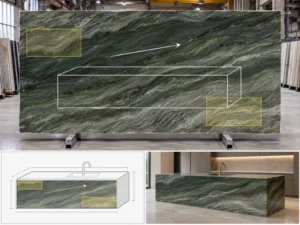
Do not approve Table A, cut it, and then try to fit Tables B and C into whatever stone remains.

The slab layout should show:
T01 → Large Table
T02 → Medium Table
T03 → Small Table
or the project’s equivalent controlled piece IDs.
Place every finished outline on the selected Natural Quartzite before irreversible cutting.
A perfect crop for T01 may consume the only slab area that allows T02 and T03 to form a coherent set.
The correct layout should balance:
If the tables are:
use those actual outlines rather than bounding rectangles.
A circle and rectangle with similar net area can require very different parts of the slab.
The complete slab may make a crop appear more coherent because the eye sees geological information outside the finished piece.
Temporarily hide that surrounding stone.
Then ask:
Does T01 work by itself?
Does T02 work by itself?
Does T03 work by itself?
Do they still work as one set?
O Área Utilizável Natural de Quartzo vs Área Bruta da Laje principle becomes especially important for multi-piece furniture.
The slab may contain enough square metres mathematically while still failing to provide three acceptable finished crops in the required shapes and pattern hierarchy.
Approve T01 + T02 + T03 as one cutting-layout decision. The strongest first tabletop is not a successful layout if it leaves the remaining tables with poor crops or no usable stone.
A natural feature does not have the same visual effect on every tabletop size.
The largest surface can usually preserve more geological context.
It may contain:
The medium surface may work best with:
The smallest top needs especially careful crop review.
A large dark fragment can become the entire composition.
A broad feature may be reduced to one unexplained edge fragment.
A quieter area may therefore become more successful at this scale.
But this is not a universal rule that small tables require quiet stone.
A compact top can intentionally carry one strong focal feature if that crop appears complete.
The project is selecting real Natural Quartzite.
A smaller table does not receive a proportionally reduced version of the same slab pattern.
It receives a smaller physical crop from the real geology.
This is why actual templates matter.
Nesting tables are movable furniture.
Their relationship is less fixed than a kitchen island and waterfall end.
A grouped arrangement may allow two mineral features to relate beautifully.
Move one table beside a chair and that relationship disappears.
This is normal.
Set-wide coordination should therefore rely more on:
than on one fragile alignment that works only in a single staged position.
If the designer wants the set presented in one preferred arrangement, document it.
This can support:
But it should remain a reference arrangement rather than a promise of permanent stone continuity.
If the Quartzite has strong directional movement, each tabletop can have an approved orientation.
Por exemplo:
T01 Direction → Long Axis
T02 Direction → Related Long Axis
T03 Direction → Project-Specific Orientation
The tables can then be rearranged while each individual top still retains an intentional composition.
The slab layout is only the visible top-surface decision.
The furniture still has to physically nest.
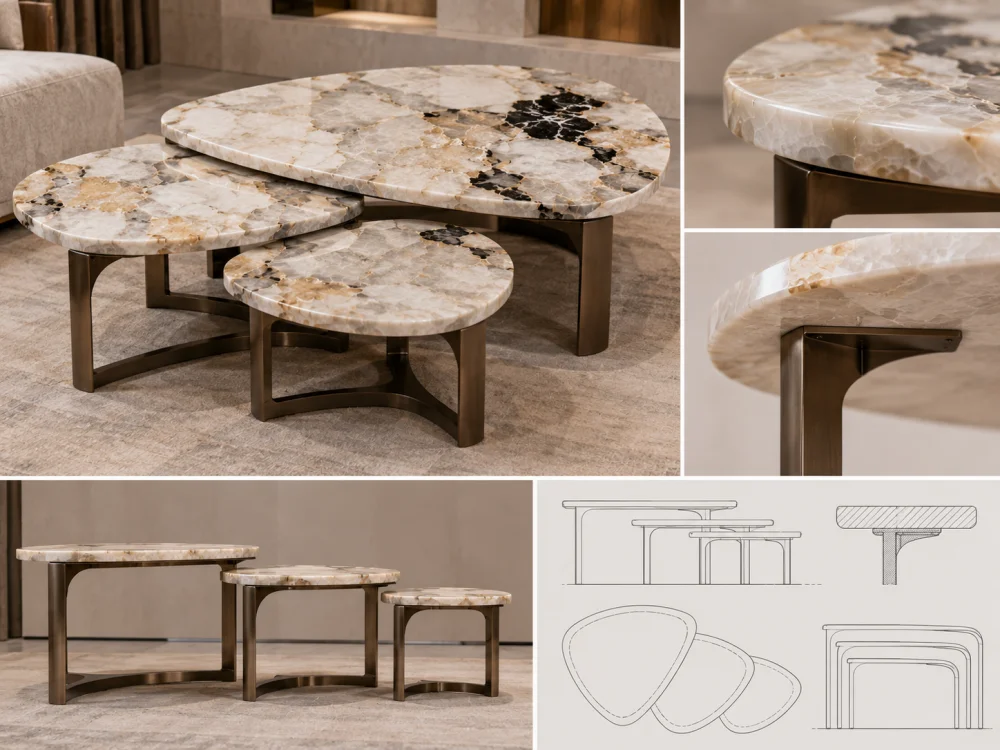
The actual Natural Quartzite thickness and any built-up edge treatment influence:
Do not change the apparent stone thickness late in the project without checking the complete nesting geometry.
Nesting tables are frequently touched and viewed closely.
Revisão:
Confirm the actual furniture-base geometry before cutting.
The responsible furniture designer and fabricator should coordinate:
This article does not prescribe universal nesting clearance, support spacing or stone thickness.
If the furniture system needs:
connect those operations to the current base drawing and approved stone layout.
O Mesa Quartzito Roma Azul page follows the same furniture principle: slab selection, top geometry, edge, base, support and fabrication QC should remain coordinated rather than being approved independently.
Nesting tables can be a useful application for retained Natural Quartzite remnants.
Several smaller surfaces may fit into material that cannot accommodate a large countertop.
But this should not become:
“Use whatever offcuts are available.”
Confirm:
If three tops are required, place all three finished outlines on the current remnant before approving any one of them.
O guia relacionado Quartizita natural vs granito para tampos de móveis pequenos cortados a partir de sobras guide makes this set-planning principle explicit: one attractive first furniture top should not consume the only usable area required for the remaining pieces.
A remnant may be physically present while still being:
Physical existence, usability and commercial availability are separate questions.
If useful stone remains after the nesting-table set is fabricated, update the remaining piece identity, dimensions, photograph and status rather than leaving the previous record unchanged.
The final inspection should not show three stone tops separately and call the set approved.
Confirm:
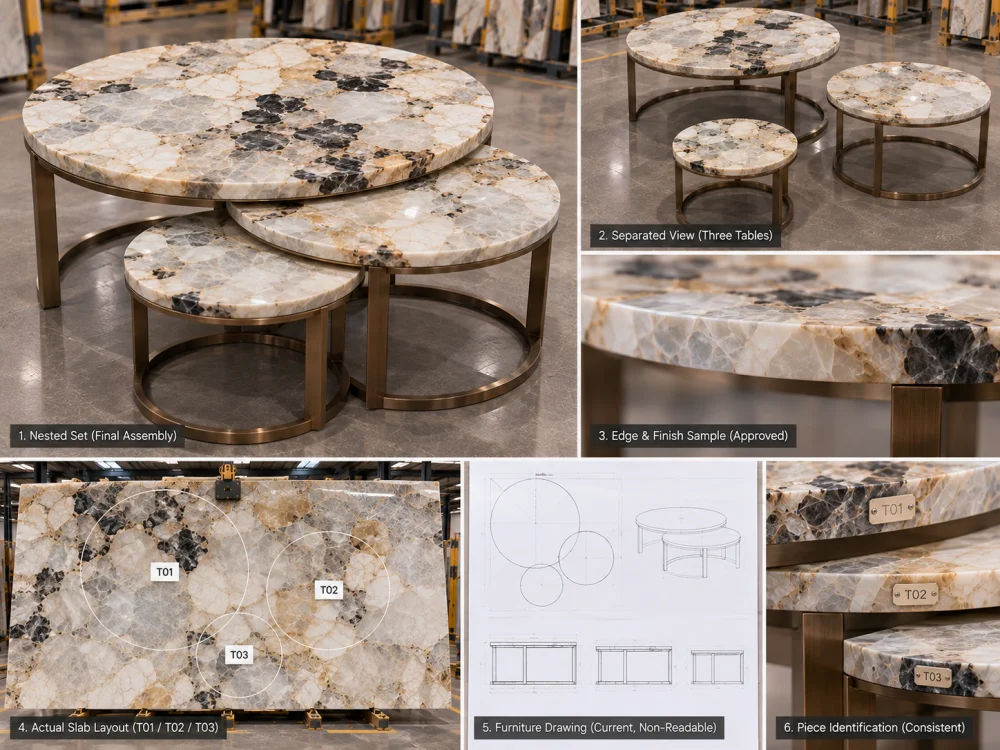
Revisão:
Check whether surfaces that become newly visible still read intentionally.
Each top should also be photographed and inspected as a complete individual composition.
Por exemplo:
T01 — Large Table
T02 — Medium Table
T03 — Small Table
The top, base and packing reference should remain connected so the correct components can be reassembled after shipment.
Packing should respond to:
Do not allow the nesting function itself to cause stone-to-stone impact during transport.
□ Exact Natural Quartzite identified.
□ Actual slab or remnant reference confirmed.
□ Complete nesting-table set drawing confirmed.
□ Large, medium and small tabletop finished shapes confirmed.
□ Fully nested arrangement reviewed.
□ Partially nested arrangement reviewed where relevant.
□ Fully separated condition reviewed.
□ Main-pattern strategy defined.
□ Most-visible surfaces identified in each furniture state.
□ All tabletop templates positioned on the actual stone before the first cut.
□ Each tabletop crop reviewed individually.
□ Complete set reviewed together.
□ Pattern scale reviewed for each different tabletop size.
□ Directional orientation recorded where relevant.
□ Permanent vein continuity is not promised for movable pieces.
□ Surface finish confirmed.
□ Edge profile confirmed.
□ Stone thickness and furniture height coordinated.
□ Base geometry and support reviewed.
□ Nesting clearance confirmed by the responsible furniture design team.
□ Any underside machining or fixing details confirmed before stone machining.
□ Trial assembly completed where required.
□ T01 / T02 / T03 or equivalent piece IDs maintained through QC.
□ Packing keeps the complete set traceable and protects finished stone surfaces and edges.
No. The largest top may be the correct focal surface when it remains visually dominant, but another table may be more exposed when nested or more frequently used independently. Decide the pattern hierarchy from the furniture’s real nested and separated states rather than from surface area alone.
They can have related pattern direction or geological character, but permanent vein continuity is usually a poor approval target for movable furniture. As the tables are separated and rearranged, the relationship changes. Coordinated background tone, pattern intensity, contrast, finish and overall visual weight are often more durable set-wide controls.
Yes for a visually coordinated custom set. Lay out all required finished tabletop shapes together before the first irreversible cut. This allows the project to balance the main-pattern position, secondary crops, usable slab area, orientation and fabrication space across the complete set.
Yes, if the finished crop creates a complete intentional composition. A small table does not automatically need quiet stone. However, one large high-contrast feature can dominate a small surface, so review the actual tabletop outline rather than assuming the feature will scale down visually.
Potentially. Confirm the current physical remnant, usable geometry, finish, thickness, existing cutouts or irregular edges, pattern position and commercial availability. Overlay the complete nesting-table set on the actual remnant before approving the first piece.
Nesting depends on the relationship between table height, stone thickness, base geometry, leg or frame positions, support, fixing and clearance. A late change to the base can make previously approved stone geometry or underside machining unsuitable. Coordinate both before irreversible fabrication.
Send Josh the proposed Natural Quartzite material, slab or remnant reference where available, number of tables, finished tabletop shapes and dimensions, nesting arrangement, individual table heights, finish, edge profiles, preferred pattern hierarchy, furniture-base drawings, fixing or underside-machining information within the confirmed scope, quantity, key room references and delivery destination. Identify whether the set should use one hero pattern, a progressive geological sequence, or balanced individual compositions before the slab layout is approved.
For custom Natural Quartzite nesting tables, coffee-table sets, side tables and coordinated furniture collections, HRST STONE can coordinate full-slab or remnant photographs, tabletop CAD templates, set-wide pattern allocation, actual-slab cutting layouts, edge samples, base-interface review within the confirmed stone scope, fabrication QC, trial assembly, piece identification, protective packing and export documentation. Send Josh the material, slab or remnant reference, complete furniture-set drawings, tabletop dimensions and shapes, finish, edge design, nesting arrangement, base information, pattern priorities, quantity and destination before final cutting approval.