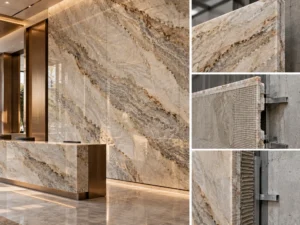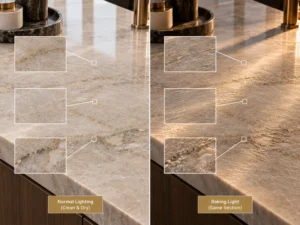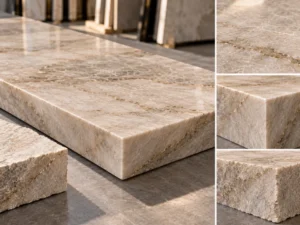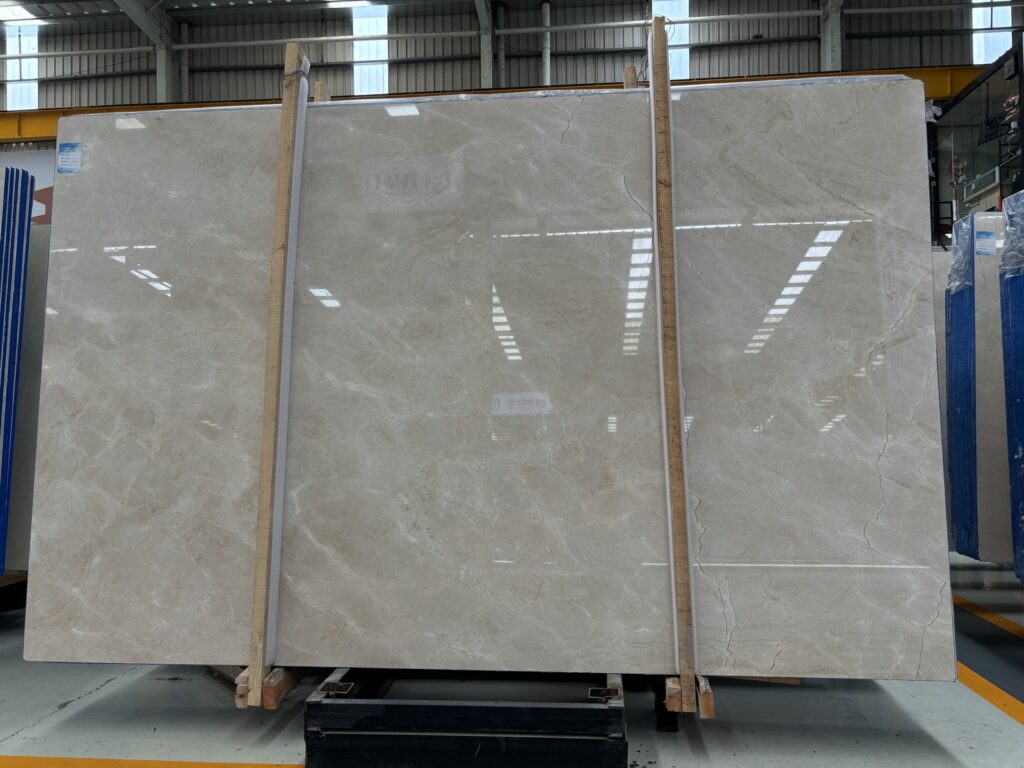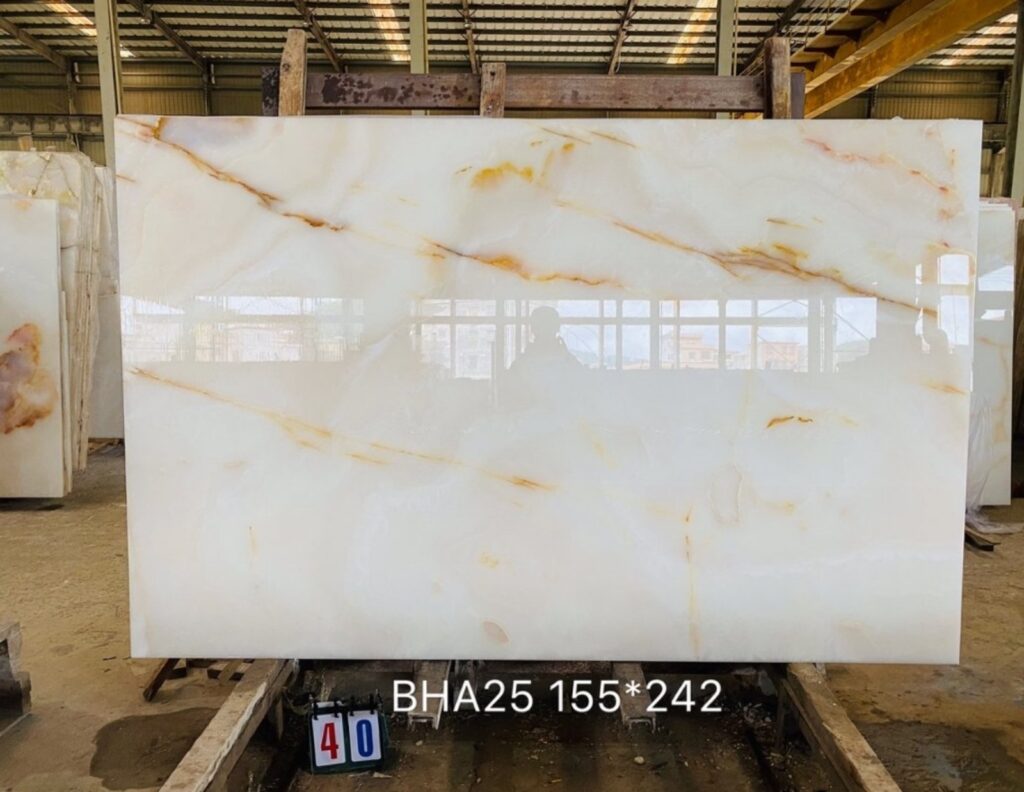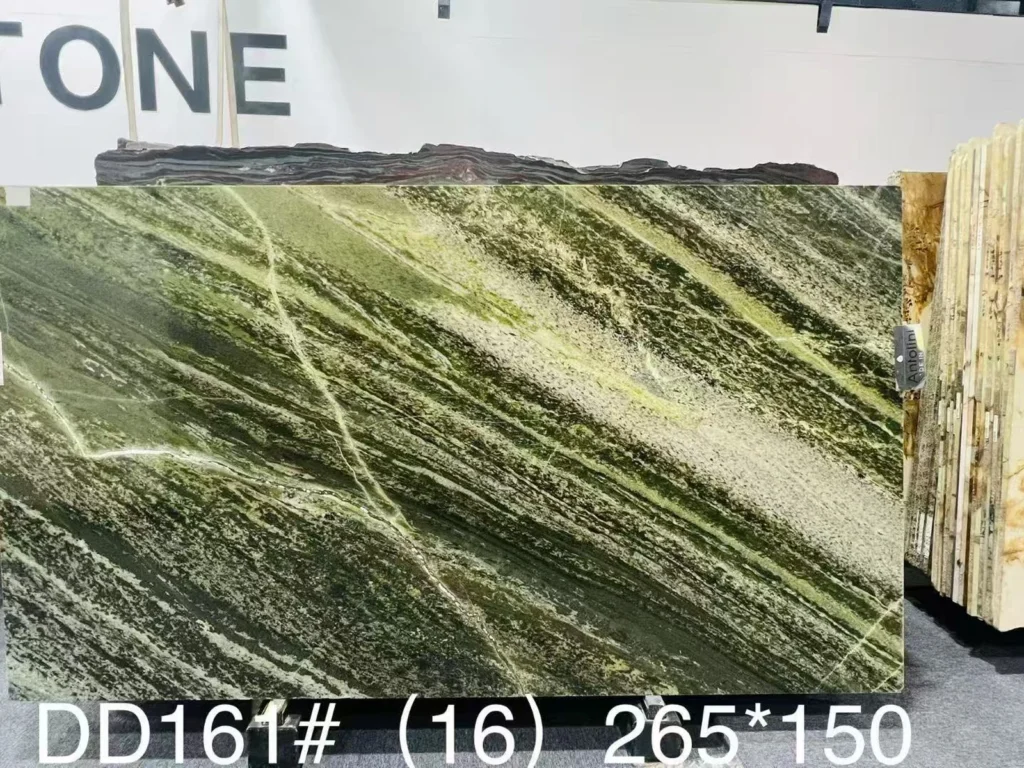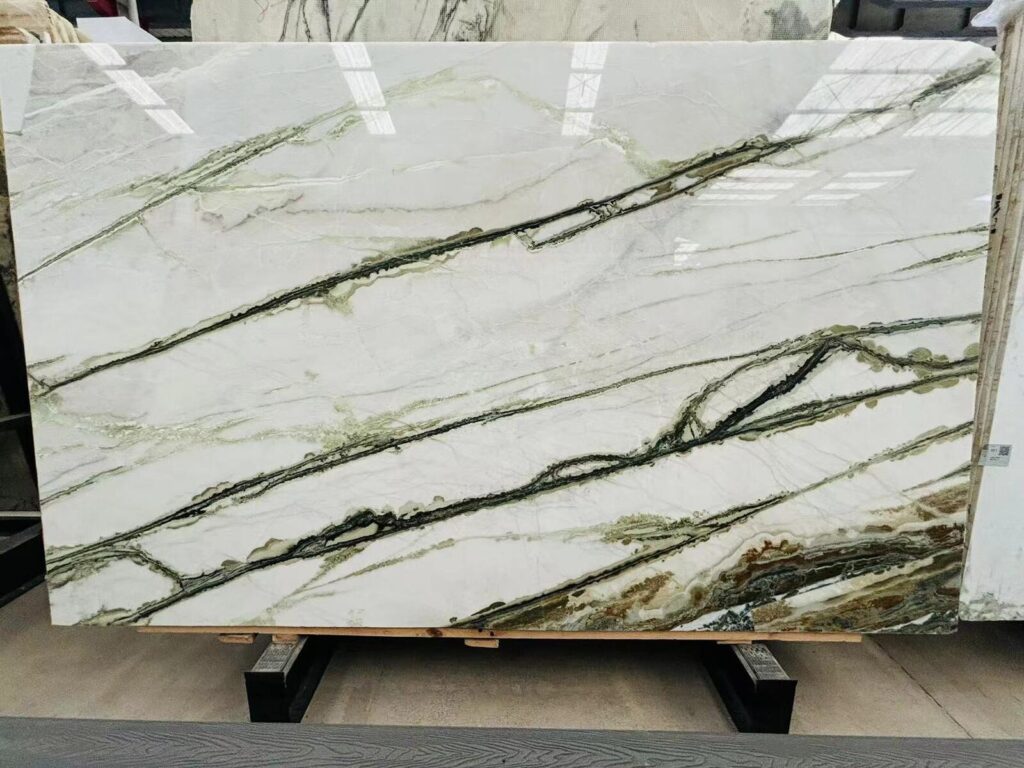

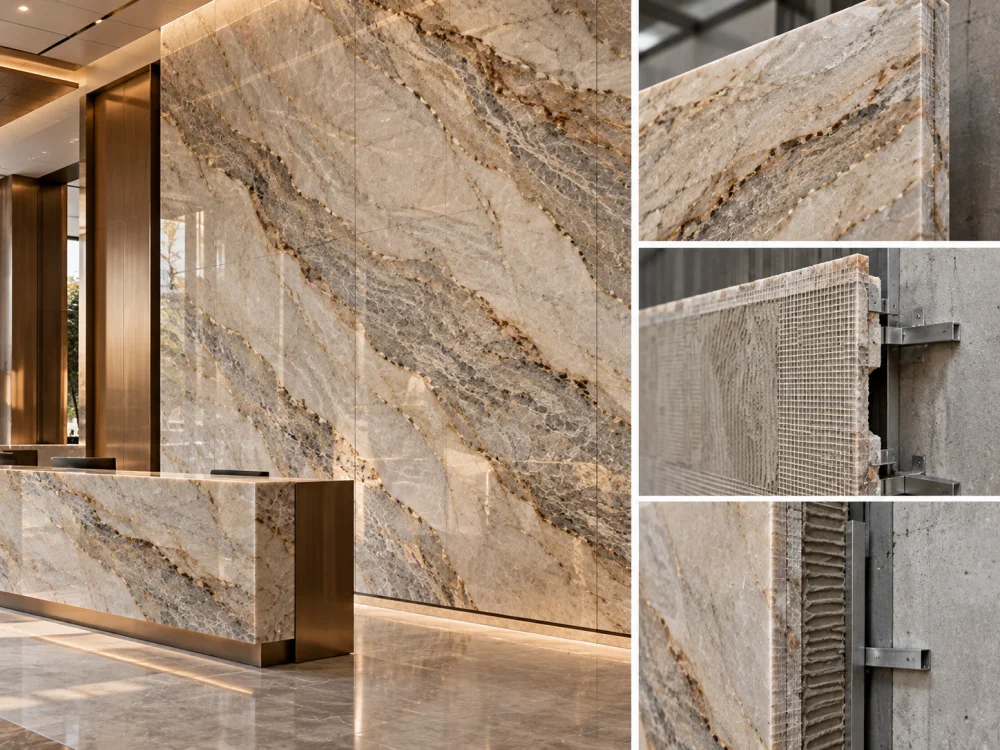
A Natural Quartzite feature wall can appear simple once the installation is complete.
The viewer sees the finished stone face, panel joints, natural veins, corners, and architectural lighting.
The most important installation interfaces are hidden behind the stone.
A wall panel may actually be assembled through several layers:
Natural Quartzite → Existing Back Treatment → Prepared Bond Surface → Installation Adhesive → Primer or Membrane Where Specified → Substrate / Backing Wall.
In some projects, structural support or mechanical fixing may also form part of the wall system.
É por isso que Quartzite Wall Panels and Backing Materials: Checking the Bond Interface should not begin with the question:
“Which glue works with Quartzite?”
A pergunta mais acertada é:
“What two physical surfaces are being bonded together, what lies between them, and has the proposed system been reviewed for that actual project condition?”
The commercial stone name identifies the Natural Quartzite.
It does not automatically identify the installation surface on the back of the finished panel.
The installation team may encounter:
These conditions should not automatically be treated as interchangeable bonding surfaces.
The receiving side of the installation may also vary.
Depending on the approved project design, the substrate may involve:
The exact substrate and its preparation should be confirmed from the project and current installation-system guidance.
An adhesive does not bond to the word “Quartzite.”
It bonds to the physical surface on the back of the panel and to the physical substrate on the wall.
If either side changes, the compatibility question may change.
Quartzite Panel → Existing Mesh / Resin / Treatment → Approved Surface Preparation → Installation Adhesive → Primer / Membrane Where Specified → Actual Wall Substrate → Structural / Mechanical Support Where Applicable.
A full slab may arrive at the factory with one backing condition.
The fabricated wall panel can be different.

Cutting, trimming, mitring, drilling, local reinforcement, repair work, handling preparation, or other fabrication operations may create different back-surface conditions across the finished component.
For a large wall-panel package, record the actual fabricated piece before installation.
Useful information can include:
Seeing fiberglass mesh tells the installer that a reinforcement condition exists.
It does not automatically reveal:
The related Mesh-Backed Quartzite Slabs: What Installers Should Know Before Bonding guide explains why the installer should identify the actual surface that will receive the installation adhesive rather than treating all mesh-backed slabs as one system.
Visible mesh does not automatically mean it should be ground away.
Removing backing can alter the supplied panel condition, reinforcement, repaired areas, handling behavior, or the interface assumed by the approved installation system.
Leaving it untouched should not automatically be assumed acceptable either.
The required surface-preparation route should come from the actual installation method and responsible technical guidance.
This is one of the most important technical points for backed stone.
Imagine that the installation adhesive develops excellent bond to the wall substrate.
The adhesive also remains strongly attached to the visible mesh and resin layer.
But the original resin-backed reinforcement separates from the Natural Quartzite itself.
The wall installation can still fail.
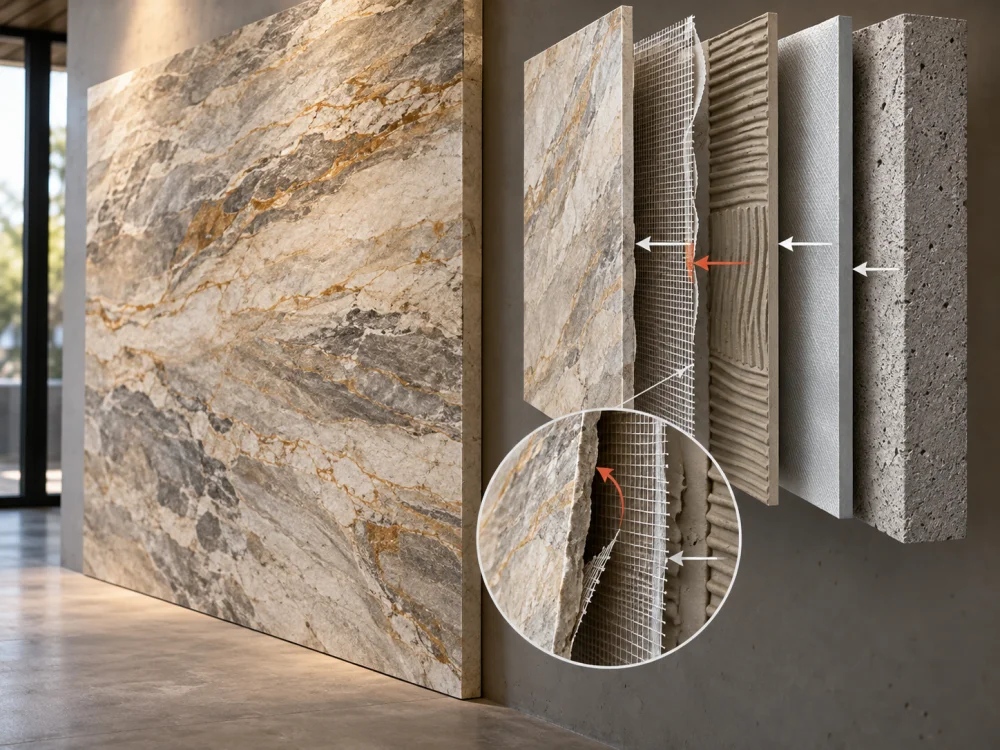
A backed panel can involve:
Stone ↔ Backing Resin
Backing Resin ↔ Mesh
Mesh / Resin Surface ↔ Installation Adhesive
Installation Adhesive ↔ Substrate or Approved System Layer
Each relevant interface has to remain suitable for the project.
If the factory-applied backing has poor attachment to the stone, choosing a stronger adhesive between the backing and wall does not automatically solve the problem.
The installation team should therefore inspect or verify the backing condition rather than checking only the adhesive product data sheet.
Installation-system manufacturers note that polyester, epoxy, urethane, and other backing materials may present different bonding conditions.
Some smooth resin surfaces can be difficult for conventional cement-based mortars to bond to reliably.
Other systems may use a sand-broadcast backing or another treatment intended to improve mechanical adhesion.
Do not assume these conditions behave identically.
The correct installation product and preparation should follow current documentation for the actual interface.
If the panel failed, where would separation occur? Stone-to-backing, within the backing, backing-to-adhesive, adhesive-to-primer, or adhesive-to-substrate? A complete bond review considers the chain—not only the strongest named adhesive.
The wall substrate is the other half of the bond interface.
A correctly selected installation adhesive cannot compensate for an unsuitable, contaminated, unstable, or incorrectly prepared substrate.
Do not write only:
“Install on wall.”
Record the wall construction relevant to the approved installation system.
This can affect:
The approved substrate preparation may need to address:
The installer should follow the current preparation requirements for the selected installation system rather than using a generic cleaning instruction.
A small sample can bridge or hide a local wall irregularity that becomes much more significant across a large stone panel.
Do not use adhesive thickness casually as a substitute for correcting a substrate condition outside the installation system’s permitted range.
The responsible installer and project team should confirm the actual wall plane and required preparation before large panels are installed.
A dry decorative lobby wall and a wet-area wall do not present the same installation environment.
If waterproofing, vapor control, exterior exposure, condensation, or another moisture condition applies, review it as part of the complete wall system.
Do not assume that because an adhesive can bond to a stone backing, the complete moisture-management assembly has also been approved.
“Natural Quartzite adhesive” is not a complete technical specification.
The product should be evaluated against the actual installation job.
The relevant stone-side surface might be:
bare Quartzite;
epoxy-backed Quartzite;
polyester-resin mesh;
sanded resin;
another approved backing;
or a mixed prepared surface.
The wall side may also vary.
Both matter.

The responsible installer or installation-system provider should check the current technical documentation for matters such as:
A package that simply says “for natural stone” does not automatically prove suitability for every backed Quartzite panel and every wall substrate.
An installation-system manufacturer may specify epoxy adhesive for particular resin-backed conditions.
Another approved system may use a different preparation route for a defined backing and substrate.
Use the documentation for the exact proposed system rather than converting one product recommendation into a universal Natural Quartzite rule.
The related Tratamentos com resina para quartzito: perguntas a fazer antes de escolher um adesivo guide explains why factory resin, repair material, fabrication adhesive, installation adhesive, and surface sealer should remain separate technical decisions.

A test is valuable only when the team knows what it represents.
Where a representative bond test or mock-up is required, the closest useful sequence is:
Actual Quartzite → Actual Backing Condition → Intended Surface Preparation → Proposed Adhesive / System → Representative Substrate → Required Cure → Review.
A test using bare stone does not automatically approve a production panel whose back is fully resin-coated.
A test using clean cement board does not automatically represent another wall substrate.
A small indoor test does not automatically establish suitability for a different exterior or wet environment.
| Trial Record | Identify |
| Pedra | Actual Quartzite reference / sample / finished component |
| Revestimento | Bare stone, mesh, resin, sanded resin, mixed surface or other actual condition |
| Preparação | Approved preparation used in the trial |
| Installation product | Exact adhesive / primer / membrane references where applicable |
| Substrato | Representative receiving surface |
| Ambiente | Relevant test or project condition |
| Cure / review | Specified review timing and observed result |
| Approval scope | Exact decision the trial supports and its limitations |
A later project team should be able to reconstruct what was actually tested.
Otherwise, a successful trial can be incorrectly reused after:
A bond trial approves only the interface and conditions that it actually represents. It does not automatically approve every panel, every substrate, every environment, or the complete structural wall system.
A large Natural Quartzite wall panel has weight, geometry, joints, edges, and installation loads.
An adhesive compatibility check addresses only part of the complete assembly.
The project may need independent answers for:
Do not use a successful adhesive sample as proof that these other questions are resolved.
A 300 mm test coupon and a full architectural panel can differ in:
Where panel size or installation consequence makes structural review necessary, the responsible designer, engineer, installer, system supplier, or other qualified project party should resolve it.
Those are different decisions.
The stone supplier can document the supplied Natural Quartzite and fabricated panel condition.
The installation-system provider can address its approved products and substrate requirements.
The installer can document site preparation and installation execution.
The responsible designer or engineer can address structural or mechanical requirements where applicable.
Clear responsibility is part of technical quality control.
Feature walls often depend on a controlled stone sequence.
The visible front requires one type of coordination.
The hidden back requires another.
Por exemplo:
W01 — front orientation confirmed / back condition recorded
W02 — front orientation confirmed / local reinforced area recorded
W03 — front orientation confirmed / mesh coverage recorded
The exact notation can vary.
What matters is that the panel arriving on site can be connected to the approved elevation, backing record, and installation method.
A factory dry-lay is useful for checking:
It does not automatically approve the hidden bond interface.
The related Quartzito Madeirus wall-panel guidance illustrates why wall elevations should retain sequential panel numbering and dry-lay control when a natural-stone composition depends on a particular slab sequence.
Once panels are packed, the complete back may be difficult to inspect again until site installation.
Where backing condition matters to the installation method, factory QC can include:
This gives the installer a more useful record than discovering an unexpected backing condition after the panel has already been lifted into position.
A wall-panel installation should pause if the physical conditions no longer match the approved basis.
A practical release gate can ask:
| Release Item | Status to Confirm |
| Panel identity | Correct fabricated Quartzite component located |
| Back condition | Current mesh / resin / bare / mixed condition photographed |
| Bond surface | What the adhesive will actually contact is identified |
| Preparação da superfície | Current approved procedure confirmed |
| Substrato | Actual receiving wall construction identified and prepared |
| Installation system | Exact adhesive / primer / membrane documentation reviewed |
| Trial | Representative trial completed where required and limitations recorded |
| Other system requirements | Structural, mechanical fixing, movement and waterproofing separately resolved where applicable |
| Liberação | Responsible project party authorizes the current installation basis |
If the panel arrives with unexpected mesh, different backing coverage, another resin treatment, changed dimensions, a changed substrate, or a different installation product, repeat the affected review.
The objective is not to create unnecessary paperwork.
It is to prevent approval of one bond interface from being reused for a physically different assembly.

No universal adhesive should be selected from the Quartzite name alone. Identify the actual surface on the back of the finished panel, the receiving substrate, required surface preparation, installation environment, and current manufacturer or installation-system documentation before approving the bond method.
That cannot be determined from the presence of mesh alone. The mesh may be associated with polyester, epoxy, another resin, sanded backing, or another construction. First identify what the installation adhesive will actually contact and confirm that the proposed system is suitable for that interface.
Not automatically. Removal may change the supplied reinforcement or prepared surface, while leaving it in place may not suit every installation system. Follow the approved surface-preparation procedure for the actual backing, adhesive and project condition.
The adhesive connects both sides of the assembly. A suitable stone-side bond does not compensate for an unsuitable, contaminated, unstable or incorrectly prepared wall substrate. Both sides of the interface and any intermediate system layers need project-specific review.
No. A representative bond trial provides evidence about the materials and conditions included in that test. It does not automatically approve structural adequacy, mechanical fixing, panel-size limits, wall movement, waterproofing, exterior loads, building-code requirements or other system-level conditions.
For projects where backing condition affects installation, back photographs can provide useful traceability, particularly for large panels, mesh-backed stone, locally reinforced components or panels with different installation details. The required QC record should match the actual project risk and approved procedure.
Send Josh the proposed Natural Quartzite material, current slab references, wall elevations, panel schedule, finished dimensions, quantities, surface finish, visible-face and orientation requirements, proposed substrate information, intended installation concept, any known adhesive or system requirements, required back-surface photographs, mechanical-fixing information where applicable, and delivery destination. Clearly identify which installation decisions are already approved and which remain for the installer, system provider, designer or engineer to confirm.
For project-based Natural Quartzite feature walls and architectural panels, HRST STONE can coordinate actual slab references, wall elevations, CAD cutting layouts, panel sequencing, front / back / top orientation, dry-lay photographs, back-surface photographs, visible mesh or reinforcement records, finished-piece QC, piece identification, packing and export documentation according to the confirmed stone scope. Final substrate preparation, installation adhesive, waterproofing, structural support and mechanical-fixing design should be confirmed for the actual project by the responsible installer, installation-system provider, designer, engineer or other qualified project party as applicable.