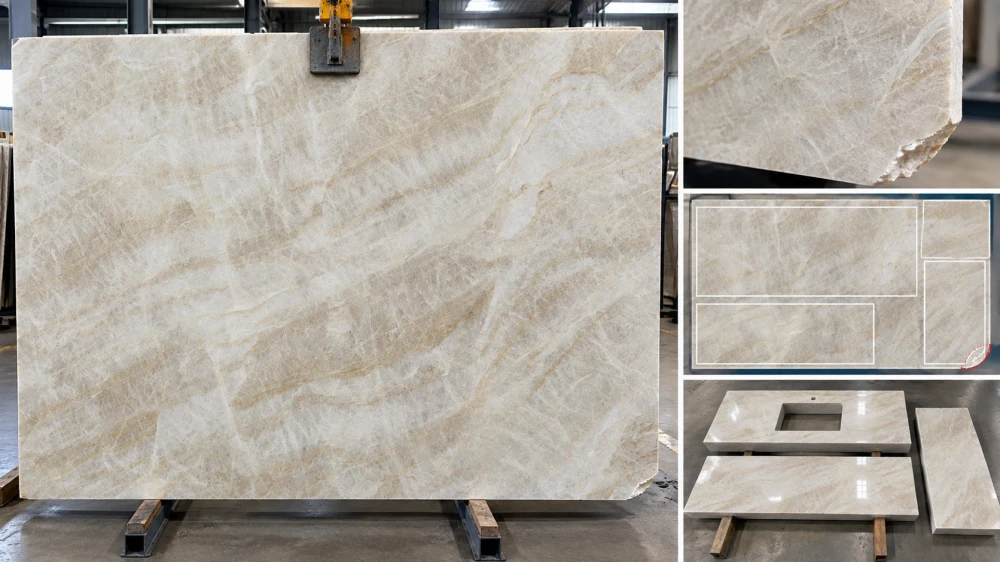
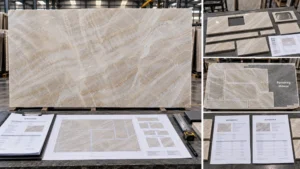
Danos na borda da quartzita antes do corte: quando eles reduzem o rendimento utilizável?
Post navigation
Resumo Rápido
Quartzite edge damage reduces usable yield only when the affected zone interferes with the material required for the approved finished-piece layout. A chipped corner outside all planned components may have little or no effect, while damage extending into a long island, visible finished edge, waterfall, seam zone, or other required piece can force additional trimming, repositioning, a new seam, or another slab. Evaluate the actual slab condition against the cutting plan before deciding how much usable material has been lost.
A buyer receives photographs of a Natural Quartzite slab before cutting and notices a chipped edge or broken corner.
The immediate question is often:
“How much usable area have we lost?”
That question cannot be answered reliably from the chip alone.
A 100 mm damaged area at one corner does not automatically mean that the entire slab must be reduced by 100 mm on both dimensions. Conversely, a relatively small edge condition can matter significantly if it falls directly inside the only workable position for a large island, waterfall panel, long vanity, or another critical finished component.
The correct approach is to connect quartzite edge damage to the actual cutting layout.
Gross Slab Area and Usable Yield Are Different
Gross slab dimensions describe the physical envelope of the slab.
Usable yield describes how much of that particular slab can actually satisfy the project cutting plan.
The difference may be influenced by:
irregular natural slab edges;
edge chips or broken corners;
areas requiring trimming;
natural fissures or repaired areas;
visual zones the buyer wants to include or avoid;
finished-piece geometry;
recortes;
estratégia de juntas;
waterfall relationships;
edge fabrication requirements; and
cutting and fabrication allowances.
This is why a slab should not be judged only by multiplying its overall length by its overall width.
The Key Question: Does the Damage Enter a Required Piece?
EDGE-DAMAGE DECISION RULE
Damage outside all planned pieces
May have little or no effect on project yield.
Damage inside an area already intended for trimming
May be absorbed without changing the finished-piece layout.
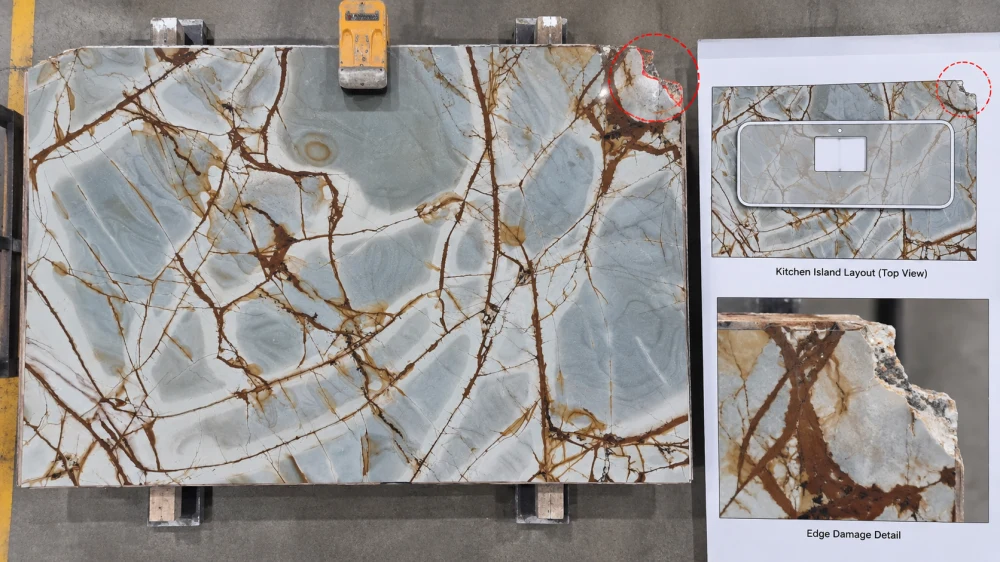
Damage intersects a planned piece but the piece can move
May require layout optimization rather than another slab.
Damage enters a critical piece that cannot move
May reduce usable yield and require a seam, redesign, or additional material.
Damage reaches a required visible finished edge
Requires specific visual and fabrication review even if the gross piece still fits.
Map the Edge Condition Before Discussing Yield
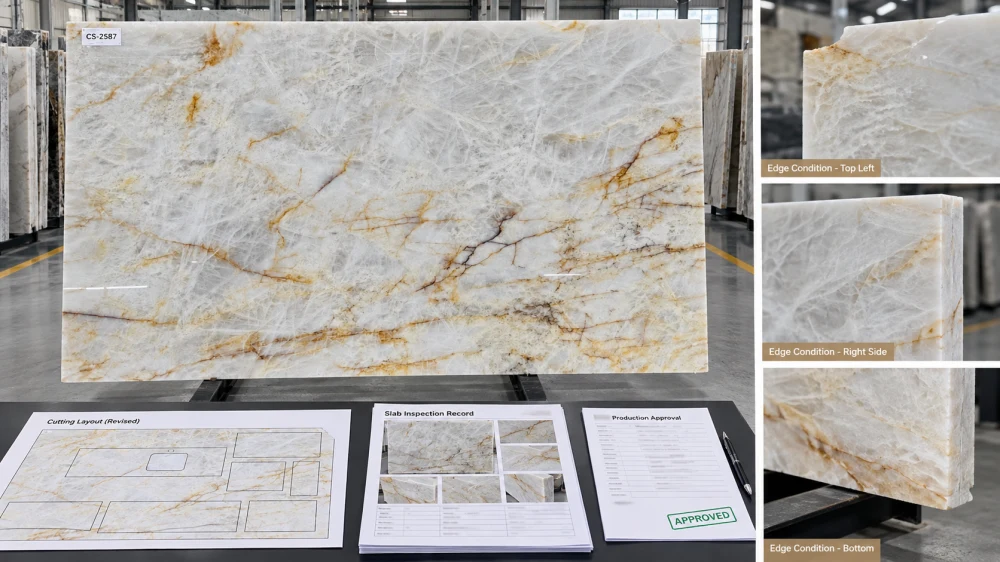
Before deciding whether quartzite edge damage affects the order, create a simple condition record for the actual slab.
Record:
material name;
slab or board number;
current overall slab dimensions;
full-slab photograph;
close-up photograph of the affected edge;
approximate location of the condition;
current cutting-plan revision; and
approval status.
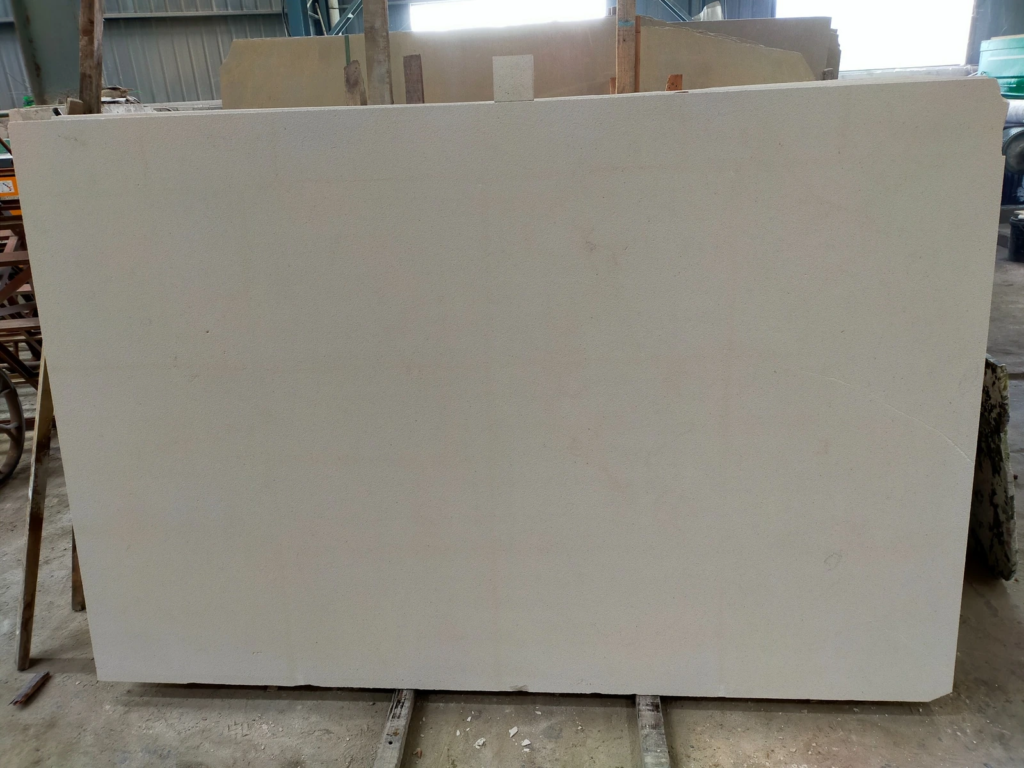
The condition should be identifiable on the complete slab image. A close-up alone can make a small edge chip appear much more important than it is in relation to the whole board.
Four Edge Conditions Can Have Four Different Yield Results
A — Outside Layout
Damage sits beyond every required finished piece. Yield may remain unchanged.
B — Inside Trim Zone
The affected material would already have been removed during squaring or fabrication.
C — Layout Can Move
One or more pieces can be repositioned while maintaining the required project result.
D — Critical Piece Conflict
Damage enters a required component or visible edge and the layout cannot simply move away.
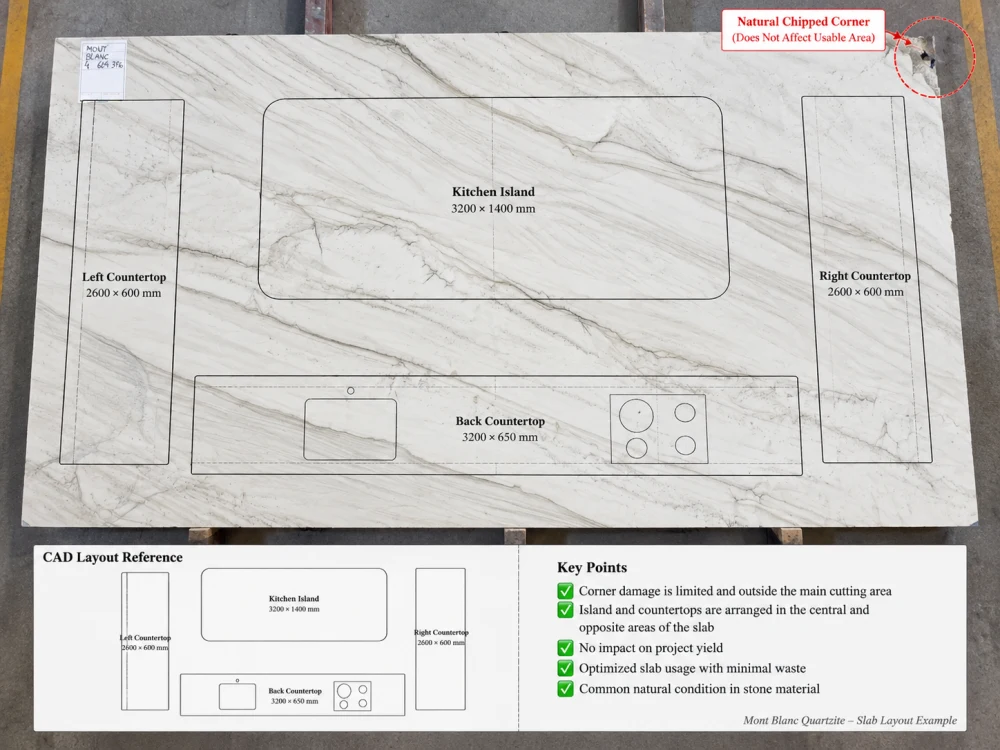
Scenario A: The Chip Is Outside Every Finished Piece
Suppose the slab has an irregular chipped corner, but the cutting plan places:
an island in the central slab area;
two perimeter pieces along the opposite side; and
small backsplash components away from the affected corner.
If none of those components requires the damaged area, the chip may not reduce project yield at all.
The gross slab remains visually damaged at its perimeter, but the project-usable area may be unchanged.
Scenario B: The Damage Falls Inside the Planned Trim Zone
Natural stone slabs do not always have perfectly straight production-ready edges.
A cutting plan may already assume that part of the perimeter will be removed before finished components are produced.
If an edge chip lies completely inside material that was already going to be trimmed away, it may not create an additional yield loss.
Importante
Do not create a universal “standard trimming allowance” for every Quartzite slab. The required trimming depends on the actual slab edge, cutting method, finished-piece geometry, fabrication process, and project requirements.
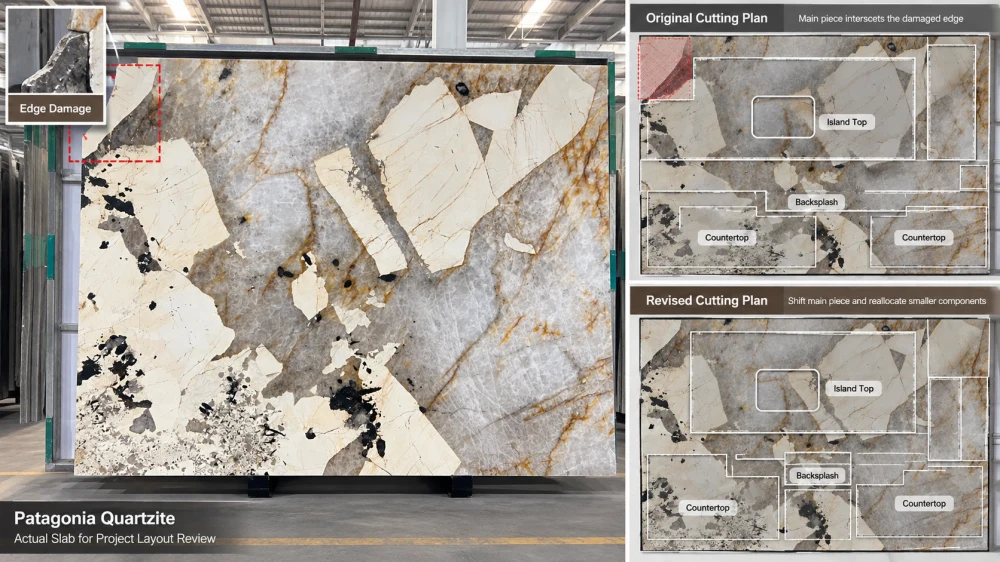
Scenario C: Repositioning the Cutting Layout Solves the Conflict
Sometimes the damage enters the first proposed position of a component but does not make the slab unusable.
The fabricator may be able to reposition the pieces.
However, moving a piece should trigger another question:
What else changes when the piece moves?
Verifique:
vein or mineral direction;
visual focal areas;
continuidade da cascata;
as localizações das juntas;
posições dos recortes;
adjacent-piece relationships;
remaining space for secondary components; and
overall slab utilization.
Solving an edge conflict should not accidentally create a worse visual or fabrication problem elsewhere.
Scenario D: Edge Damage Enters a Critical Finished Piece
This is where quartzite edge damage can genuinely reduce usable yield.
whether the affected zone remains visible after fabrication;
whether additional trimming changes the finished size;
whether the piece can move;
whether the edge detail removes the affected material;
whether a proposed repair would remain visible; and
whether the resulting appearance meets the agreed approval criteria.
A piece can therefore “fit” geometrically while still requiring visual review.
Do Not Measure Yield Loss as Damage Area Alone
This is an important procurement distinction.
If a small damaged corner forces a 3,000 mm-long finished component to move to another slab, the commercial effect may be much larger than the physical area of the chip.
Conversely, a visibly larger edge condition may have almost no project effect if that entire perimeter lies outside all required components.
Yield Principle
Physical damage area and project yield loss are not the same measurement. Yield loss should be evaluated through the cutting plan.
Overlay the Finished Pieces on the Actual Slab
The most useful review is visual.
Place the proposed finished-piece outlines over the actual slab image and show the edge condition in the same record.
This allows the buyer and fabricator to see:
Actual Slab → Edge Condition → Piece Envelope → Trim Zone → Cutouts → Visible Edges → Remaining Material
The site’s Quartzite slab reservation guide similarly recommends checking actual slabs against the project cut list rather than relying on gross dimensions alone. It specifically identifies edge trimming, orientation, natural features, openings, waterfall returns, and cutting layout as factors that can change usable yield.
Keep the Slab Number on the Yield Review
When several slabs from the same bundle are available, a condition report without a board number can quickly become ambiguous.
The yield review should connect:
Board Number → Full-Slab Photo → Edge Condition → Cutting Plan → Finished Pieces
If the cutting layout is revised, retain the same slab identity so the buyer knows which physical board is being reassessed.
For projects where several slabs feed multiple finished components, the Quartzite cutting-plan guide explains how board numbers and finished-piece IDs can maintain this traceability through fabrication.
Edge Damage Near a Sink or Cooktop Needs Extra Attention
A damaged perimeter can become more significant when the planned component also contains a large opening.
For example, moving an island away from an edge chip may shift the sink cutout closer to:
a natural fissure;
another slab edge;
a seam;
a mitered waterfall;
a narrow stone bridge; or
a visually important mineral area.
This is why layout optimization should consider the whole finished component rather than only avoiding the damaged perimeter.
O Ilha de Cozinha em Quartizito Marrom Patagônia page likewise treats usable slab yield as a combination of visual selection, fissures, repairs, cutout position, waterfall matching, edge requirements, spare material, and other risk areas rather than gross slab area alone.
Should a Chipped Edge Be Repaired?
Do not make repair the first question.
First determine whether the affected material is even needed.
Step 1 — Locate the condition
Show it on the complete slab.
Step 2 — Overlay the cutting plan
Determine whether any finished piece enters the affected area.
Step 3 — Test layout alternatives
Check whether repositioning solves the issue without creating another conflict.
Step 4 — Review visible conditions
Determine whether the affected area would remain on a visible finished edge or face.
Step 5 — Consider repair only if relevant
Any repair proposal should then be reviewed for the actual application and agreed acceptance criteria.
Original Yield vs Revised Yield
If the edge condition changes the cutting plan, record both versions.
When Does Edge Damage Actually Reduce Usable Yield?
The practical answer is:
When avoiding, trimming, or accommodating the affected edge prevents the approved finished-piece set from being produced from the slab in the intended layout.
This may happen when:
a required large piece no longer fits;
a one-piece component now requires a seam;
a waterfall relationship cannot be maintained;
a visible finished edge intersects the condition;
moving one piece removes space required by another;
the revised position creates an unacceptable cutout or fissure relationship; or
the project requires additional slab material to complete the approved scope.
When Might Edge Damage Not Reduce Yield?
It may have no meaningful effect when:
the condition lies completely outside all finished pieces;
it falls within material already planned for removal;
the layout can move without compromising other pieces;
the affected zone belongs only to unused remnant material; or
the final fabrication removes the affected perimeter under the approved layout.
The decision still needs to be tied to the actual slab and current cutting plan rather than assumed from these examples.
Buyer Release Record Before Cutting
Before cutting a slab with a recorded edge condition, confirm:
□ Original vs revised yield recorded if layout changed
□ Additional material requirement confirmed if applicable
□ Buyer / designated reviewer approval recorded
Perguntas frequentes
1. Does every chipped Quartzite slab edge reduce usable yield?
No. A chipped edge may lie outside all required finished pieces or inside material that would already be trimmed away. Its effect should be evaluated against the actual slab and cutting plan.
2. How should usable yield be calculated when a Quartzite slab has edge damage?
Review the actual slab dimensions and condition together with the finished-piece layout. Determine whether the affected area changes piece positions, seams, visual relationships, cutouts, or the number of slabs required. Do not calculate yield loss from the physical chip area alone.
3. Can a damaged Quartzite slab still be used for a large island?
Possibly. The answer depends on the location of the damaged area, usable slab dimensions, island size, cutouts, visual priorities, edge requirements, and whether the island can be positioned away from the affected zone while preserving the approved layout.
4. Should a chipped Quartzite edge always be repaired before cutting?
No. First determine whether the affected area is required by the cutting plan. If the damaged material will be removed or lies outside all finished pieces, repair may not be relevant. Any repair to material that remains in the finished component should be reviewed for the actual project.
5. Can moving the cutting layout recover usable yield?
Sometimes. Repositioning pieces can avoid an edge condition, but the revised layout should also be checked for vein direction, visual priorities, seams, cutouts, waterfall relationships, and the space remaining for other components.
6. When does Quartzite edge damage require another slab?
Another slab may be required when the approved finished-piece set can no longer fit within the usable areas of the selected material after the edge condition and other layout requirements are considered. Confirm this through a revised cutting plan rather than from the edge photograph alone.
7. What should I send HRST STONE to review edge damage before cutting?
Send the material name, slab or board number, full-slab photograph, close-up images of the affected edge, slab dimensions, current drawings, finished-piece sizes, cutouts, visible-edge requirements, layout priorities, and the current cutting-plan revision.
Final Yield RuleDo not subtract the physical size of an edge chip from the slab and call the result “usable yield.” First overlay the approved finished pieces on the actual slab. Quartzite edge damage reduces project yield when accommodating that condition changes the ability to produce the required finished-piece set from the selected material.
For project-based Natural Quartzite fabrication, HRST STONE can coordinate actual slab photographs, board identification, CAD cutting layouts, finished-piece positioning, visual review, fabrication QC, and export packing around the approved project scope. Send Josh the slab reference, condition photographs, drawings, required piece sizes, finish, cutouts, edge requirements, and destination when an edge condition needs to be reviewed before cutting.
Hi, I am the author of this article. I have been working in the field of Natural Stone for more than 15 years. If you need customized Natural Stone services, please feel free to contact me.
Fabricante e Fornecedor de Mármore, Granito, Quartzito, Ágata da China - HRST STONE
Bem-vindo à HRST STONE!
Olá, gostaria de saber mais sobre seus produtos. Você poderia compartilhar informações sobre preços, quantidade mínima de pedido, opções de personalização e amostras?