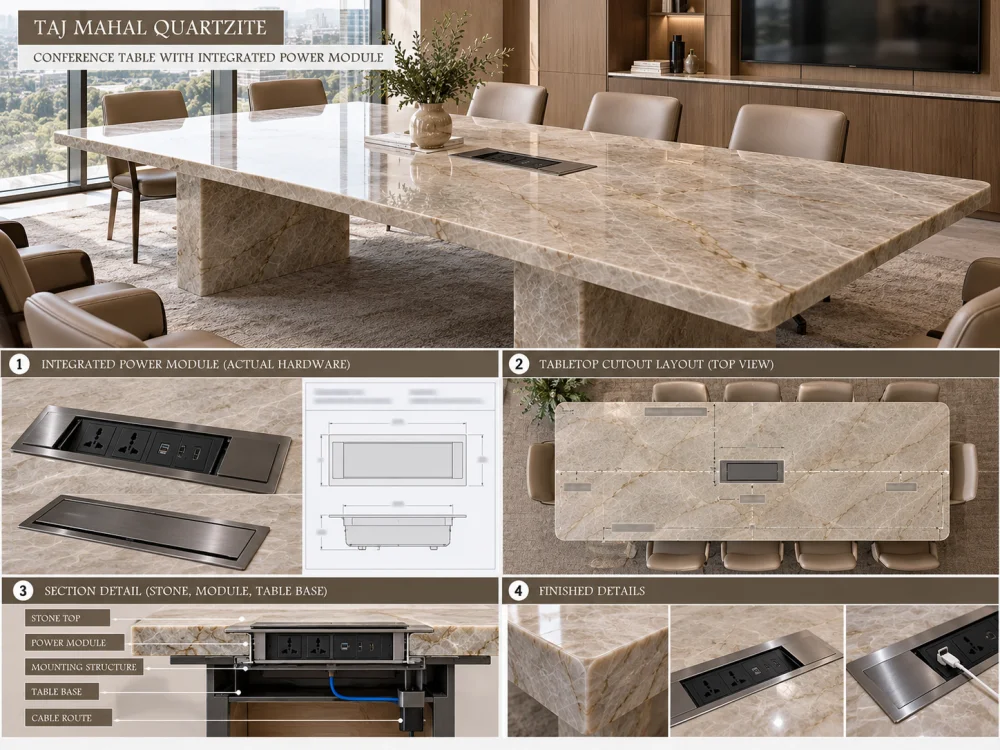
빠른 요약
전원 모듈이 여전히 대략적인 사각형으로 표시된 상태에서는 석영암 회의 테이블을 절단용으로 출고해서는 안 됩니다. 개구부가 되돌릴 수 없게 되기 전에 실제 모듈 모델, 현재 제조사 도면, 전체 하드웨어 외곽 치수, 요구되는 석재 개구부, 덮개 또는 접근 동작, 설치 관계, 하부 공간, 케이블 경로, 테이블 베이스, 선택된 슬랩 배치 및 책임 있는 제작 검토를 조율해야 합니다. 전기 연결, 지지 구조 설계 및 설치 요건은 해당 시스템을 담당하는 자격을 갖춘 당사자의 범위 내에 남아 있습니다.
회의실 도면에는 대형 천연 석영암 테이블이 표시되어 있습니다.
중앙에는 다음과 같이 라벨링된 사각형이 있습니다:
POWER MODULE.
석재 공장은 해당 도면을 받아 상판을 준비합니다.
그런 다음 실제 하드웨어가 도착합니다.
실제 개구부가 다릅니다.
덮개가 예상보다 더 많은 움직임을 필요로 합니다.
모듈 본체가 상판 아래로 연장됩니다.
케이블 경로가 테이블 베이스 일부와 충돌합니다.
이 시점에서 문제는 더 이상 도면상의 문제가 아닙니다.
이는 절단된 천연 석영암 조각입니다.
맞춤형 석영암 회의 테이블, 따라서 전원 모듈은 절단 전에 후일 자동으로 해결될 수 있는 부속품이 아니라 실제 물리적 인터페이스로 취급되어야 합니다.
석재 개구부를 논의하기 전에 테이블이 무엇을 지원해야 하는지 먼저 정의하십시오.
회의 테이블은 다음에 대한 접근이 필요할 수 있습니다:
석재 공급업체가 해당 공간에 어떤 전기 또는 데이터 시스템이 필요한지 결정해서는 안 됩니다.
하지만 필요한 시스템은 석영암 가공업체가 필요로 하는 물리적 정보에 영향을 미칩니다.
첫 번째 주요 프로젝트 이정표는 간단합니다:
“전원 모듈 약 400 × 150 mm”이라는 표현은 현재 기술 문서가 포함된 식별된 하드웨어 모델과 동일한 정보가 아닙니다.
외관상 크기가 유사하더라도 상판 아래에서는 서로 다를 수 있습니다.
가장 흔한 실수 중 하나는 위에서 보이는 부분만을 기준으로 계획을 세우는 것입니다.
전원 모듈은 여러 가지 다른 물리적 외곽 치수를 포함할 수 있습니다.
01 — 보이는 외곽 치수
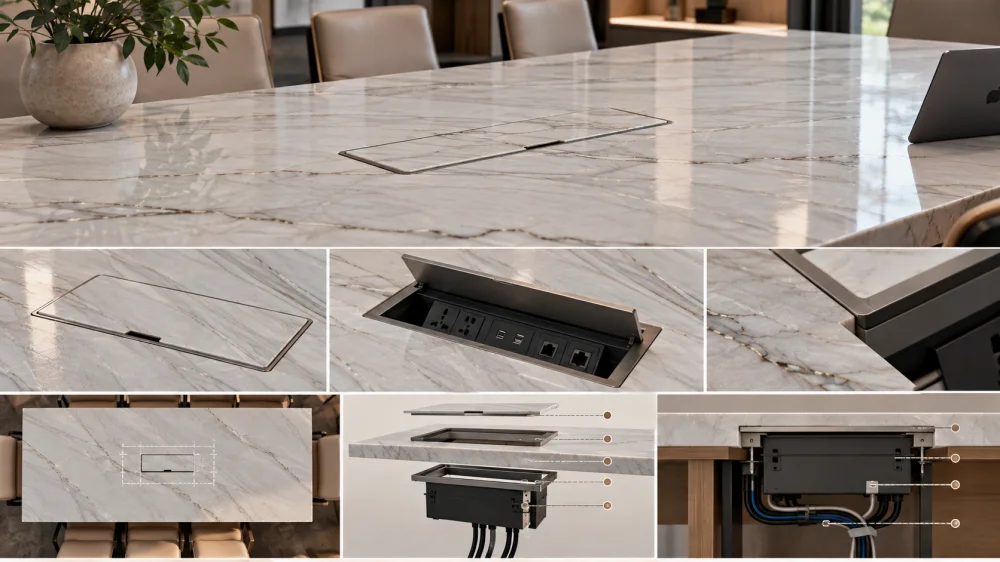
사용자가 완성된 상판에서 보는 모습.
02 — 석재 개구부
확인된 하드웨어/제작 기반에 따라 석영암에 실제로 요구되는 개구부.
03 — 설치 외곽 치수
모듈이 상판 조립체와 결합하거나 관통 설치를 위해 필요한 공간.
04 — 움직임 외곽 치수
해당되는 경우 덮개, 플랩, 커버 또는 기타 이동 부품에 필요한 공간.
05 — 상판 하부 외곽 치수
The module body and other hardware occupying space below the Quartzite.
06 — Service Envelope
Space needed for cables, connectors, access and project-specific servicing requirements.
These envelopes may not be identical.
That is why the top-view rectangle alone may not contain enough information for stone fabrication.
A top view tells only part of the story.
The section is where several interfaces become understandable.
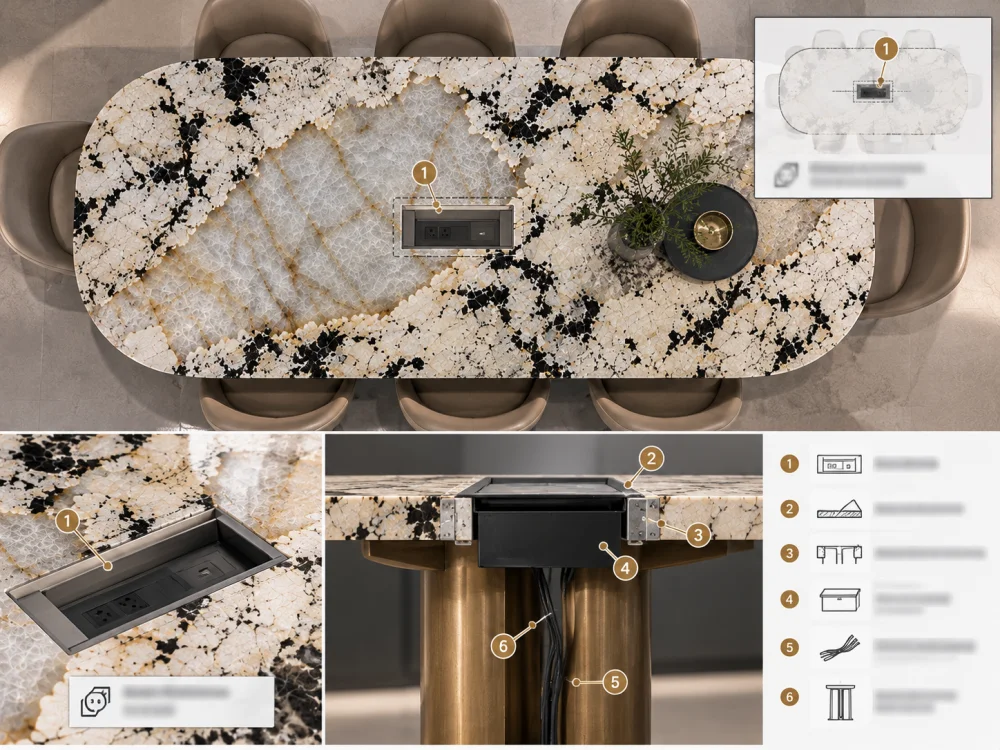
POWER-MODULE LID / VISIBLE FACE
↓
QUARTZITE TABLETOP
↓
MOUNTING INTERFACE
↓
MODULE BODY
↓
UNDERSIDE SUPPORT / TABLE BASE ZONE
↓
CABLE PATH / SERVICE ACCESS
This is where the project can identify whether the hardware concept and the furniture concept are physically compatible before the stone is cut.
This distinction is critical.
OVERALL MODULE SIZE
Describes the hardware or visible assembly according to the relevant manufacturer information.
석재 컷아웃
Defines the opening actually fabricated in the Natural Quartzite tabletop.
They should not be assumed to be the same.
The stone opening should be based on the confirmed project information reviewed by the responsible fabricator.
The module position should make sense for the people using the table.
Depending on the conference-table design, questions may include:
Resolve the functional location first.
Then coordinate the corresponding stone opening.
Architectural drawings often center an accessory because it creates a clean plan.
That does not necessarily mean the position has been coordinated with the finished furniture.
DESIGN QUESTION
Is the power module centered because the conference-table function requires it there, or because the early drawing needed a placeholder?
The answer can affect the Quartzite layout, table base, cable path and visual composition.
Once the proposed opening is positioned, stop looking at the module for a moment.
Look at the stone around it.
The fabricator may need to review:
This article does not prescribe a universal minimum remaining-stone dimension. That decision depends on the actual geometry, Natural Quartzite, fabrication method and responsible technical review.
A technically coordinated opening can still create an undesirable visual result if it removes an important part of the selected slab.
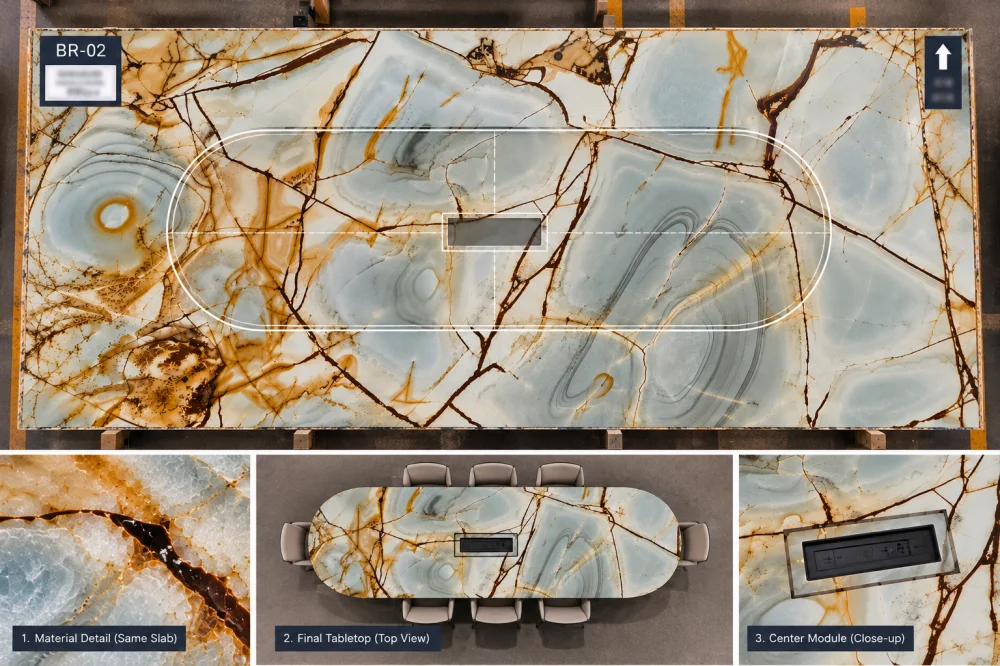
강렬한 인상을 주고자 할 때 석영암 회의 테이블, place the power-module opening on the actual slab layout before cutting.
Selected Slab: Actual identified Natural Quartzite board
Table Outline: Finished tabletop geometry
Primary Viewing Direction: Main conference-room view
Power Module: Confirmed location
Stone Opening: Current reviewed opening geometry
Pattern Priority: Important mineral movement or focal area
Question: What visible stone will disappear when the opening is cut?
If the selected hardware has a lid, flap or moving cover, do not review only the closed position.
The project should understand the applicable manufacturer-defined movement.
Depending on the actual product, this may affect:
Use the current manufacturer documentation rather than inventing a generic lid movement.
A conference table can look perfectly coordinated from above while containing an unresolved collision below.
The power module may extend into the same zone needed by:
UNDERSIDE COORDINATION QUESTION
After the module passes through the tabletop, what physical space does it occupy, and has that space been coordinated with the furniture and support system?
The furniture designer, hardware provider, fabricator and other responsible professionals should resolve these interfaces according to the project scope.
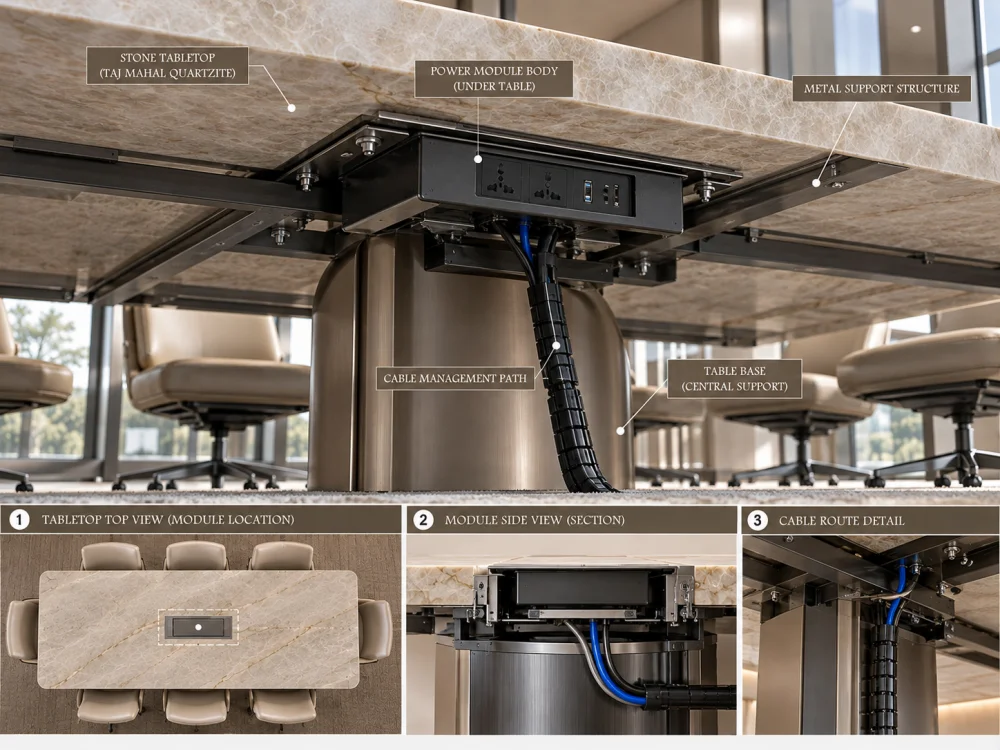
“Cable goes down” is not a complete coordination instruction.
A useful project discussion follows the path farther.
The Quartzite fabricator does not need to design the electrical installation.
But unresolved cable routing can affect the furniture interface and therefore should be identified before the stone layout is treated as complete.
Long conference tables may require more than one service point.
If several modules are proposed, review them as a system rather than duplicating one opening mechanically.
다음 사항을 고려하십시오:
Multiple openings can change both the functional and material logic of the top.
Consider a hypothetical project.
The customer has approved a Taj Mahal Quartzite tabletop layout.
The initial drawing contains Power Module A.
Before cutting, procurement changes to Power Module B.
Do not simply change the product name in the hardware schedule and retain the old stone opening.
OLD INPUT
Module A → Layout Revision R03 → Proposed Opening A
HARDWARE CHANGE
Module B selected → Current manufacturer information issued
REVIEW AGAIN
Opening → Position → Stone Around Opening → Underside Interface → Cable Route → Slab Pattern
If the change affects the visible or fabricated Quartzite layout, issue the appropriate revised drawing before cutting.
A rendering is useful for showing the intended conference-room appearance.
It may show:
But a rendering should not automatically define the final Quartzite opening.
It may not reliably communicate:
Before the 석영암 회의 테이블 is released for cutting, assemble the current project inputs in one place.
| Project Input | Why It Matters to the Tabletop Review |
| Exact Module Model | Replaces an approximate hardware description with an identifiable product. |
| Current Manufacturer Drawing | Provides the current hardware geometry and relevant interface information for review. |
| Tabletop Drawing | Locates the module relative to the finished Quartzite geometry. |
| Table Section | Shows the relationship between stone, module body, support and furniture below. |
| Selected Slab Layout | Shows which part of the Natural Quartzite pattern the opening removes. |
| Furniture / Base Information | Identifies possible underside interfaces. |
| Cable-Route Requirement | Connects the tabletop module to the broader furniture/service coordination. |
| Current Revision / Review Status | Prevents an earlier module or tabletop drawing from remaining in production. |
For a fabricated Natural Quartzite tabletop, the stone-side review can focus on the confirmed project information that affects the finished component.
석영암: Selected material and actual slab reference
Finished Table Size: Current dimensions and shape
마감 처리: Current specified surface finish
모서리: Current edge / built-up-edge requirement
Module: Exact identified hardware
Opening: Current approved fabrication basis
Position: Current tabletop location
Pattern: Important visible slab areas
Other Openings: Any additional table penetrations
Base Interface: Relevant confirmed furniture information
Drawing: Current revision to be used for review
CONFERENCE-TABLE CUTTING REVIEW
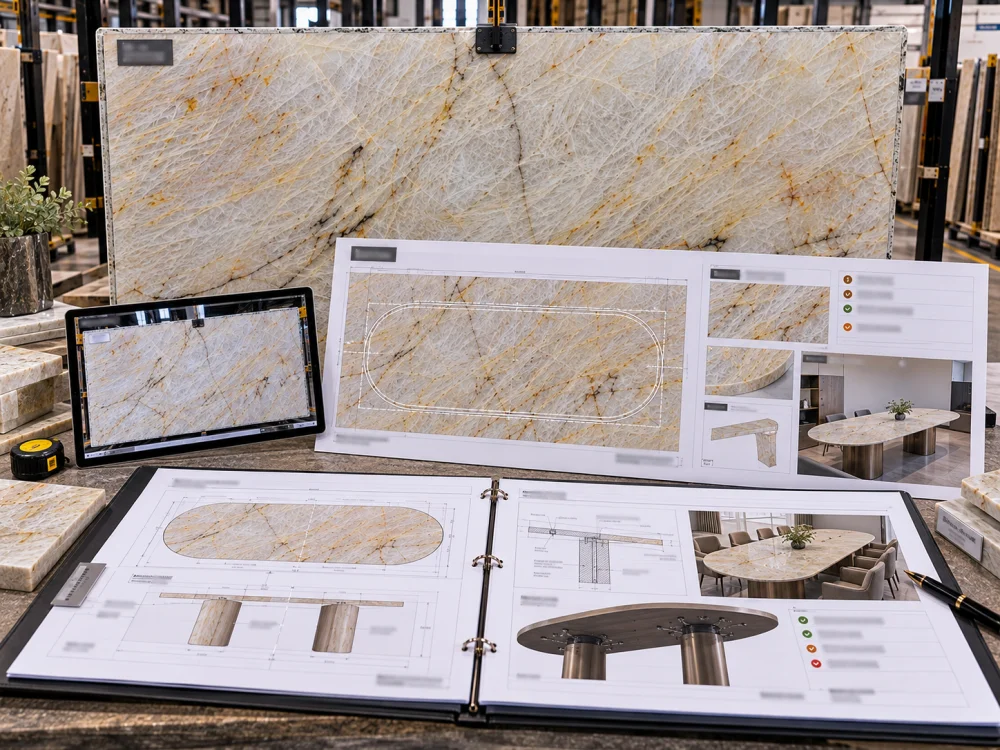
□ Exact power-module model identified
□ Current manufacturer document available
□ Visible module position confirmed
□ Applicable lid / access movement reviewed
□ Stone opening based on current confirmed information
□ Remaining Quartzite around opening reviewed by fabricator
□ 개구부가 실제 슬래브 배치와 비교되어 확인됨
□ Below-table module envelope coordinated
□ Furniture / support interface reviewed by responsible parties
□ Cable path identified for project coordination
□ Current table drawing revision confirmed
□ Responsible parties have completed the reviews required before stone cutting
이 모듈은 석재 개구부, 노출된 상판 위치, 남아 있는 석재 형상, 슬래브 패턴 배치, 하부 가구와의 접합부 및 케이블 라우팅 조정에 영향을 미칠 수 있습니다. 천연 석영암이 절단된 후에는 이러한 입력값을 변경하면 해당 부품에 대해 상당한 재작업 또는 교체가 필요할 수 있습니다.
정확한 모듈 모델, 현재 제조사 문서, 관련 하드웨어 형상, 장착 정보, 적용 가능한 덮개 또는 접근 부위의 이동 범위, 현재 회의 테이블 도면, 의도된 모듈 위치 및 하부 인터페이스를 이해하는 데 필요한 프로젝트 정보를 제공하십시오.
그렇다고 단정하지 마십시오. 시각적으로 보이는 또는 전체적인 하드웨어 치수와 석재에 필요한 개구부는 서로 다른 형상을 나타낼 수 있습니다. 책임 있는 제작업체는 석재 개구부를 설계할 때, 현재 승인된 프로젝트 및 제조사의 정보를 반드시 활용해야 합니다.
렌더링은 시각적 의도를 전달할 수 있지만, 일반적으로 이를 되돌릴 수 없는 개구부의 유일한 제작 기준으로 삼아서는 안 됩니다. 실제 하드웨어 모델과 최신 기술 정보는 절단에 앞서 현재의 도면과 반드시 일치시켜야 합니다.
네. 개구부는 선택한 판재의 일부를 제거하며, 이로 인해 최종 테이블 상판에서 어떤 정맥, 결정질 영역 또는 기타 자연적 특징이 남아 보이는지가 달라질 수 있습니다. 시각적으로 중요한 테이블의 경우, 절단에 앞서 실제 판재 배치도 위에 확인된 모듈 개구부를 겹쳐서 확인하시기 바랍니다.
전기 연결, 적용 가능한 안전 요건, 데이터 시스템 및 건축 설비 인터페이스는 해당 시스템을 담당하는 자격을 갖춘 당사자들이 결정해야 합니다. 쿼츠라이트 가공업체는 가공 범위 내에서 확인된 프로젝트 정보를 기반으로 석재 부품을 조정합니다.
기존 개구부, 상판 위치, 잔여 석재, 하부 인터페이스, 케이블 경로 및 슬래브 배치와 비교하여 새 모델과 현재 제조사 정보를 검토하십시오. 변경 사항이 가공되거나 시각적으로 노출되는 석재 배열에 영향을 미치는 경우, 절단 전에 해당 도면을 업데이트하고 검토 상태를 확인하십시오.
조쉬에게 천연 석영암 재질 선호도, 마감 테이블 치수 및 형태, 수량, 현재 도면, 표면 마감, 모서리 요구 사항, 선택한 전원 모듈 정보, 기타 개구부, 석재 인터페이스와 관련된 테이블 베이스 정보, 슬래브 배치 우선순위 및 배송 목적지를 전달해 주세요.
Planning a Custom Natural Quartzite Conference Table?
HRST STONE can coordinate selected slab references, tabletop CAD/shop drawings, actual slab layout, confirmed openings, edge fabrication, visible pattern placement, fabrication QC, trial assembly information where applicable, and reinforced fumigated wooden-crate packing around the confirmed furniture scope. Send Josh the table dimensions, quantity, selected Quartzite, finish, edge design, current power-module information, table-base information relevant to the stone interface, drawings and delivery destination before the tabletop is released for cutting.
© HRST STONE / XIAMEN HRST STONE CO., LTD. 모든 권리 보유.