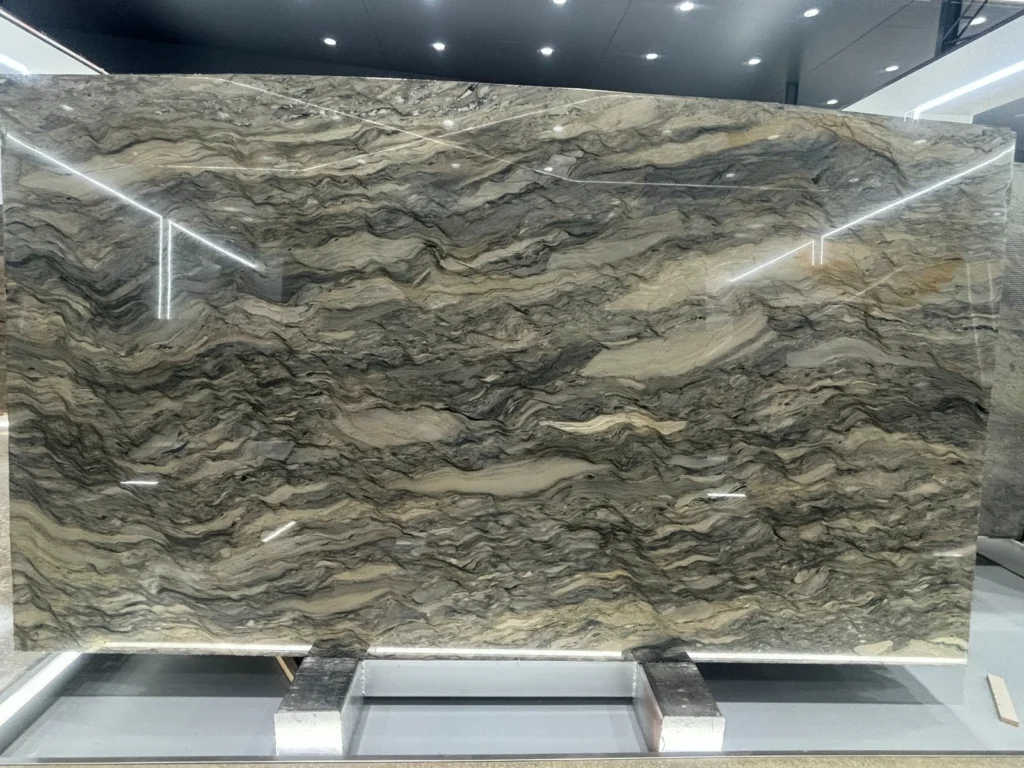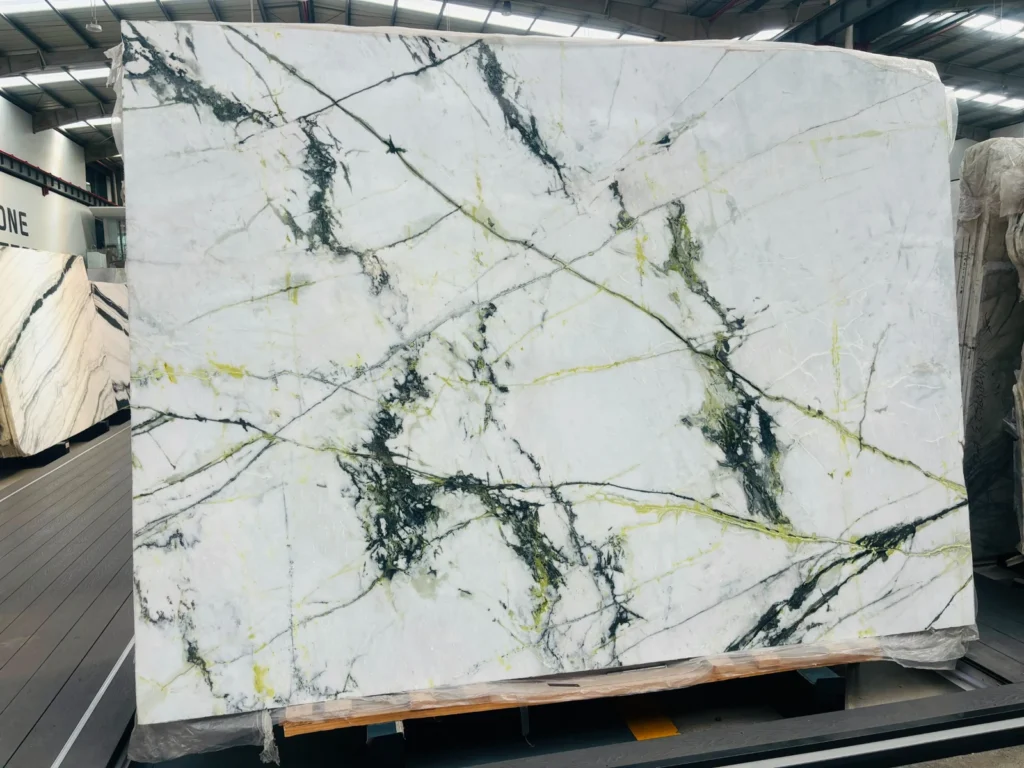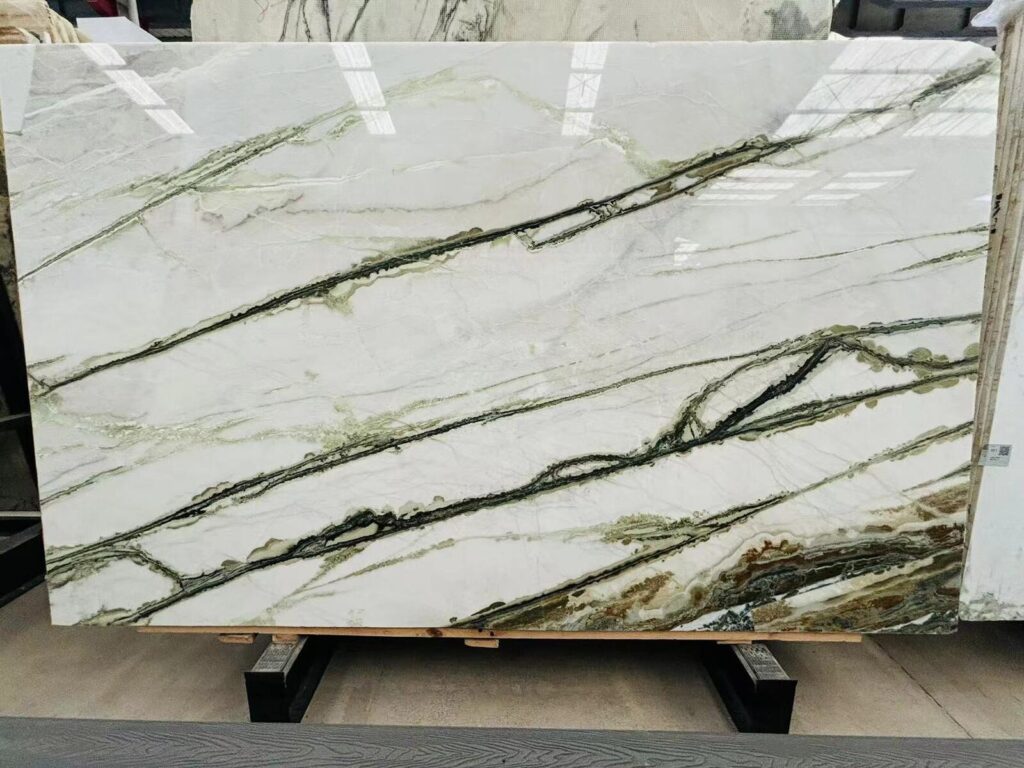
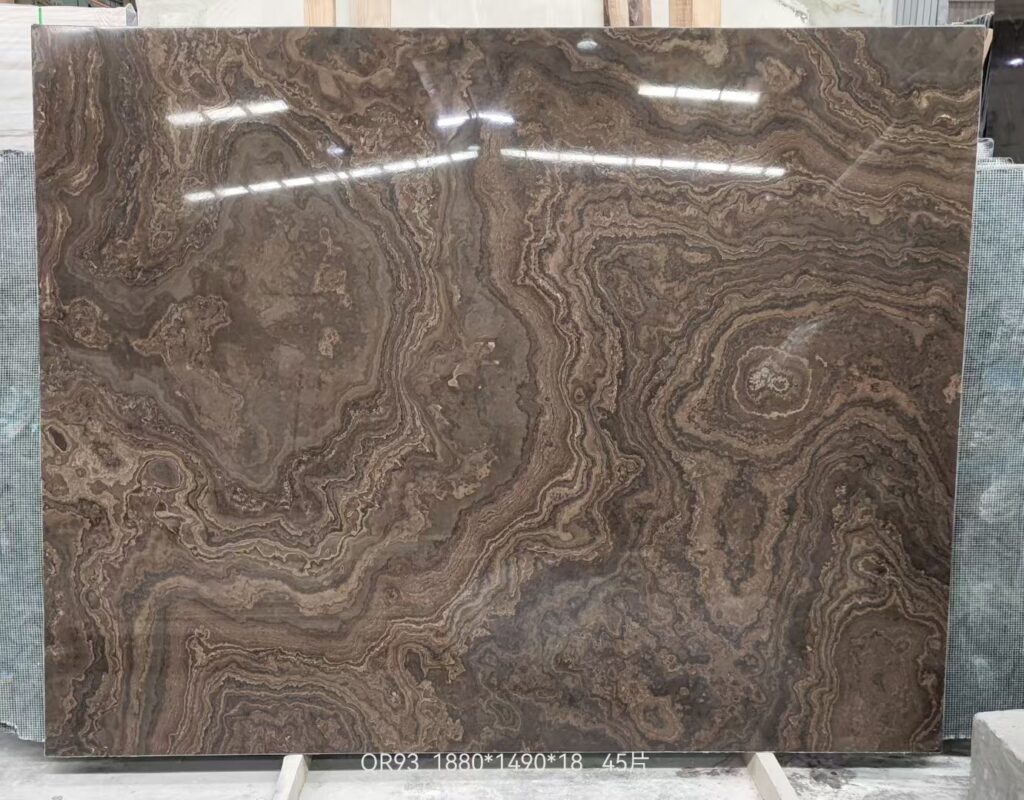

A Quartzite oval dining table can look dramatically different depending on where the same finished oval outline is placed on one natural-stone slab. Compare Option A and Option B using the identical tabletop template, actual slab reference and scale. Review the mineral features retained inside each crop, their relationship to the table’s long axis, the usable cutting area, curved-edge fabrication and furniture-base interface. Select the final position before cutting rather than assuming that two locations on the same slab will produce the same visual result.
あ Quartzite oval dining-table cutting layout is a scaled arrangement of the finished curved tabletop outline on an identified natural Quartzite slab. It determines which portion of the stone becomes the visible tabletop and which mineral features are excluded during fabrication.
This decision is particularly important for natural Quartzite with distinctive directional veins, crystalline areas, colour transitions or prominent mineral features.
The same slab can support several potential design directions, but only the selected, technically feasible cutting layout should become the production reference.
A natural Quartzite slab is not a uniform sheet of colour.
Its surface may contain quieter mineral fields, broad directional bands, concentrated dark features, crystalline areas and subtle transitions between different tones.
An oval tabletop removes material around a curved perimeter. The finished table shows only the part of the slab that remains inside that outline.
Changing the position of the outline can therefore change the entire composition.
For example, imagine a large Quartzite slab containing one strong diagonal mineral band and several quieter areas.
Cutting Option A places the oval close to the quieter area. The stronger mineral feature appears near one rounded end, producing a restrained overall tabletop.
Cutting Option B shifts the same oval toward the mineral band. That feature passes through the central dining surface, creating a more expressive and directional composition.
The commercial stone name, slab identity, finish and finished table dimensions have not changed.
Only the selected portion of the natural pattern has changed.
That is why a full-slab photograph cannot replace an actual tabletop crop review.
の Azul Macaubas Quartzite dining-table layout guide examines a related decision: whether a prominent natural blue band should be centered within the finished table or positioned differently for the intended architectural effect.
Both cutting alternatives should use the same finished tabletop geometry.
If one option is longer, narrower or more rounded than the other, the comparison is no longer evaluating only slab placement.
The approved drawing should identify the actual furniture outline.
という言葉がある。 oval can describe several different shapes in furniture design.
Examples include a true ellipse, an elongated rounded rectangle, a racetrack-shaped top with semicircular ends or a custom organic oval.
These outlines can have different end shapes even when their overall length and maximum width are similar.
The buyer should approve the actual CAD geometry or full-size template, rather than relying on an approximate sketch labelled “oval.”
The comparison should preserve:
The selected layout can then be translated or rotated over the slab without silently changing the furniture dimensions.
For irregular or rounded geometry, the Quartzite full-size template guide explains why the true finished outline, rather than a general radius description, should control the relationship between stone cutting and physical fabrication.
The same principle applies to a custom oval dining tabletop.
Begin with one identified, complete Quartzite slab photograph or a verified digital representation derived from the actual board.
The image should show the complete usable reference area, slab orientation and identifiable physical boundaries.
Then create two separate cutting-layout alternatives.

The oval may be positioned to emphasize a quieter or visually balanced region of the slab.
The goal might be to keep a major mineral feature closer to one end, distribute movement across the long dimension or preserve a calm central serving area.
This does not mean the finished table must have symmetrical veining.
Natural-stone balance is often about the relationship between features rather than perfect symmetry.
The oval may be shifted or rotated to place a prominent mineral band, crystalline area or colour transition within a preferred visible area.
This can create a more expressive table while retaining the same finished dimensions.
The designer must also consider what happens to the feature near the curved perimeter.
A dramatic mineral area may look attractive when fully visible but awkward if the oval outline cuts through its strongest part.
Translation moves the same outline across the slab without changing its angle.
Rotation changes the angular relationship between the oval’s long axis and the stone’s natural movement.
Both can produce different visual compositions.
However, rotating a template can also change whether it fits inside the usable slab boundary.
A design presentation should not digitally mirror or recolour the slab to create an attractive option that cannot be cut from the actual physical board.
Where the intended finished face and orientation matter, those assumptions should remain explicit.
The most useful comparison is not the entire slab with two outlines.
It is the actual visible stone area remaining inside each finished oval.
Both crops should be reviewed at the same scale and orientation.
Consider the relationship of the mineral pattern to the complete dining-table form.

Directional veining may reinforce the table’s elongated form when it follows the long axis.
Movement crossing the short direction may instead create a stronger transverse composition.
Neither direction is automatically better.
The appropriate choice depends on the intended furniture design and the actual stone pattern.
Check whether the most prominent feature falls near the middle, toward one end or along one side.
A central mineral feature can become the main design statement.
An offset feature may create a less formal, more natural composition.
The table should not be described as “centered” merely because the CAD outline is centered on the slab. Visual centering refers to the finished composition.
The two ends deserve particular attention because the curved outline removes different parts of the natural slab pattern.
A large crystal field may survive almost completely in one layout but be cut into a narrow fragment in another.
Look at both ends together rather than checking only the strongest feature near one edge.
Review how major mineral lines meet the finished curved boundary.
A line may run naturally off the edge or appear abruptly interrupted at a critical viewing point.
The perimeter also influences the final worked edge, but the appearance of the face should be evaluated independently from the technical edge construction.
Consider the view from the main entrance, both long sides of the table and the rounded ends.
Temporary dining accessories, chairs or decorative objects should not be used to hide inconvenient areas of the proposed tabletop crop.
Review the unoccupied tabletop first, then consider its intended position in the finished room.
The following example is illustrative. It is not based on a particular current HRST slab or customer order.
Assume one large natural Quartzite slab contains a quiet warm background, a directional taupe feature and a lighter crystalline area.
Two layouts use the same finished oval tabletop outline.
| レビュー項目 | Option A — Quieter Crop | Option B — Feature-Led Crop |
| Physical Source | Same identified Quartzite slab | Same identified Quartzite slab |
| Finished Oval Size | Identical approved geometry | Identical approved geometry |
| Main Mineral Feature | Located toward one rounded end | Crosses a prominent central area |
| Overall Appearance | Restrained and asymmetric | More directional and expressive |
| Curved Perimeter | Features taper toward the end | Major movement approaches a curved side |
| Material Feasibility | Check actual slab boundary and cutting allowances | Check actual slab boundary and cutting allowances |
| Suitable Visual Intent | A quieter dining-table composition | A statement tabletop with a stronger feature |
| Approval Decision | Pending buyer and fabrication review | Pending buyer and fabrication review |
Neither option should be declared the winner before the buyer reviews the actual crop and the fabricator confirms feasibility.
Option A may be preferred for a restrained dining room.
Option B may be preferred where the tabletop is intended to be the main visual feature.
The same natural stone can support both design intentions, provided the chosen layout is physically feasible.
The most visually attractive crop is not automatically the most practical cutting arrangement.
The full nominal slab size does not necessarily equal the area available for the finished tabletop.
Review the actual usable boundary and relevant material conditions.

Use current measurements of the actual slab.
A photograph should be scaled using reliable physical dimensions or another verified reference, not an assumed ratio derived from a perspective image.
A template that looks comfortably inside a slab photograph may be too close to the real edge when checked at full scale.
The fabricator should identify the machining allowances needed for the approved process, including relevant cutting kerf, edge finishing, trim and handling conditions.
Do not use the final polished outline alone as proof that sufficient processing area exists.
Check whether either proposed outline passes through areas requiring additional inspection or technical consideration.
Examples may include existing damage, repaired areas, significant fissures, localized mesh or backing conditions, or other physical characteristics relevant to the intended fabrication.
A natural mineral feature should not automatically be treated as a defect.
Equally, a visually desirable pattern does not remove the need to inspect the actual material before cutting.
A rotated tabletop may fit the overall slab dimensions but approach one irregular corner too closely.
Compare the entire perimeter, not merely the tabletop’s maximum length and width.
Large curved tabletops require appropriate cutting, edge processing, movement and support throughout fabrication.
The processing method should be selected by the fabricator for the actual stone, geometry and available equipment.
No universal minimum cutting-margin number should be assigned to every Quartzite slab.
Both options should therefore have two separate review results:
外観の好み: Which crop produces the intended finished appearance?
Fabrication Feasibility: Can that crop be produced safely and accurately from the identified slab?
This is different from choosing between two alternative cutting positions.
When a buyer reviews Option A and Option B over the same slab photograph, the two outlines may overlap.
If they overlap, they cannot represent two independent tabletops cut simultaneously from that slab.
The comparison only shows two potential uses of the same physical material.
If the buyer wants two actual dining tables, the fabricator must prepare a separate combined cutting layout showing both complete pieces within the usable slab area.
That layout must account for:
Two alternative crops should not be presented as a confirmed two-table yield.
Similarly, do not quote a precise waste percentage from an unscaled marketing photograph.
Oval cutting may leave curved or irregular offcuts around the finished top.
Some pieces might be suitable for smaller furniture components, samples or other approved uses.
Others may be too narrow, irregular or otherwise unsuitable.
Potential reuse should be assessed from the actual cutting layout and material condition.
The buyer should not sacrifice the principal dining-table composition merely because a theoretical nesting arrangement appears to save more stone, unless material efficiency is a stated design priority.
A flat digital outline primarily shows the top surface.
The finished oval dining table also has a visible perimeter, actual stone thickness and specified edge profile.
These become particularly important at the rounded ends.

The tabletop may use an eased, bevelled, rounded or another approved edge profile.
For a curved perimeter, the profile should remain consistent as the direction of the edge changes.
A straight worked-edge sample may not completely demonstrate the final result around a tightly curved end.
Stone movement that appears calm on the top surface may be more noticeable where a major feature meets the finished perimeter.
The cut edge can expose a different section of the natural mineral structure than the polished top face.
Compare the important perimeter areas for both proposed crops rather than approving only the central top view.
Where the design requires a visually thick tabletop, additional stone components may be needed to create a fabricated edge.
The cutting layout must then include the corresponding strips or returns, not just the oval top.
Do not assume that a curved mitred fascia can be produced in one continuous piece from an arbitrary offcut.
The actual construction should be confirmed by the furniture fabricator.
For complex or organic shapes, verify the finished perimeter with the approved CAD or physical template before machining.
Where a representative curved edge is needed, it should be made from suitable actual material and reviewed for geometry, finish and assembly compatibility.
Yes, but the base should be treated as a separate furniture-design input rather than an afterthought.
The same oval top can be paired with different supports, such as twin pedestal bases, a central base or a frame designed for the actual furniture dimensions.
The base can affect both the finished appearance and the physical support conditions.

A prominent mineral area near one end may look balanced when the table uses two separated pedestal bases.
The same feature may appear different when paired with a large central base.
Review the table from the intended room views.
The fabricator should know whether the proposed base requires particular connection positions, inserts, backing or other approved interfaces.
Any machining or reinforcement associated with the base must be coordinated with the actual tabletop construction.
The tabletop’s size, thickness, weight, loads and support arrangement require the responsible furniture or structural designer’s assessment.
A visually attractive mineral crop does not establish structural adequacy.
Do not relocate a base connection, reduce the stone section or introduce an unreviewed underside opening solely to preserve the preferred pattern.
The chosen base should also be compatible with the intended seating arrangement, table height and knee clearance.
For a luxury dining table, approval should consider the complete furniture composition, not only the stone laid flat on a factory surface.
For an efficient approval meeting, use one consistent comparison pack.
The first view should show the complete actual slab and the two alternative template positions.
The next views should isolate the actual finished crops.
A practical comparison pack includes:
View 1 — Source Slab: Complete current photograph with physical slab reference and scale basis.
View 2 — Cutting Option A: True finished oval outline shown in its first proposed position.
View 3 — Cutting Option B: The identical outline shown in its second proposed position or orientation.
View 4 — Finished Crop Comparison: Two equal-scale images showing only the stone that would remain inside each alternative tabletop.
View 5 — Furniture Context: A clearly identified visual simulation using the approved oval dimensions, edge concept and representative base.
View 6 — Fabrication Review: Current cutting-layout feasibility, identified allowances and outstanding technical questions.
Any room rendering or visual simulation should be labelled as such.
It should not be presented as a photograph of a completed table when the actual stone has not yet been cut.
Also keep camera perspective and stone orientation consistent between alternatives.
A larger or brighter rendering can make one option appear more attractive even when the physical crop is not necessarily better.
The decision record should identify one specific physical slab and one selected cutting option.
A message saying “Option B looks better” may be enough for early design discussion, but it is not a complete production reference.
The current approval should connect the option to its physical and drawing information.
| Approval Field | What Must Be Identified |
| Physical Slab | Current identifiable board, not only a commercial stone name |
| Finished Table Geometry | Current CAD outline, overall dimensions and relevant template revision |
| Selected Option | Option A or B with its actual placement and orientation |
| ビジュアル上の優先事項 | Main feature position, long-axis movement and important perimeter relationships |
| Stone and Edge Specification | Actual thickness, surface finish, edge profile and construction |
| Base Interface | Coordinated support and connection details, where relevant |
| Fabrication Feasibility | Confirmed usable slab, processing allowances and outstanding issues |
| Approval Authority | Decision owner, date, revision and exact approval scope |
| 本番リリース | Separate confirmation that required technical checks are complete before cutting |
の Quartzite layout approval guide explains why buyer acceptance of a slab position should be distinguished from final technical fabrication review and cutting authorization.
That distinction matters when the visually preferred crop is close to a slab edge or intersects a physical area requiring further examination.
Finished Top: Oval geometry according to the current approved drawing.
Selected Layout: Option B, as shown on the referenced cutting-layout revision.
Visual Scope: Approves the identified mineral composition within the finished top outline and the stated orientation.
Outstanding Scope: Final edge-processing feasibility, structural base connections and other unresolved technical items remain subject to the responsible reviews.
Production Status: Cutting release is separate from the visual selection unless expressly authorized by the project procedure.
Once the cutting layout is released, factory QC should establish whether the actual finished tabletop corresponds to the approved physical and drawing references.
Verify the complete oval outline, overall dimensions and relevant curve transitions using the agreed inspection method.
Do not assume that checking only the maximum length and width proves the complete perimeter geometry.
Compare the finished tabletop with the selected crop.
Confirm that the principal visual features occupy the intended areas and that the top was not unintentionally reversed or rotated during production.
Check the approved edge profile, consistent finishing around both ends, polished or honed surface relationship and treatment of the lower arris where relevant.
Verify any specified fabrication interfaces against the approved furniture drawings.
The factory QC record should not present dimensional inspection as proof of a complete structural design.
Check the complete stone surface and perimeter before packing.
For export, the protective system should support the actual large curved tabletop without leaving vulnerable edges unsupported.
Appropriate reinforced timber framing, suitable bottom restraint and carefully protected stone faces and perimeter edges should be selected for the actual geometry.
If the tabletop is delivered separately from its base, preserve matching piece identities and assembly information.
If the selected slab becomes unavailable, a different physical board should not automatically inherit the original cutting-layout approval.
If the oval dimensions, curvature or orientation are changed, review the affected pattern and cutting feasibility again.
The new proposal should identify what changed, preserve the original approved record and obtain the appropriate updated authorization.

Compare the actual retained stone inside two identical finished outlines, confirm both options are physically feasible and select the arrangement that best supports the intended furniture appearance.
切断前: Freeze the slab ID, oval template, selected crop, orientation, finish, edge detail and relevant base-interface requirements.
Buyer Next Step: Send HRST STONE the current full-slab photograph or slab reference, actual oval tabletop CAD or dimensions, intended room orientation, preferred mineral feature, edge specification, furniture-base drawing, quantity and destination. Request two clearly identified crop options and a fabrication-feasibility review before production release.
Yes. Moving or rotating the same finished oval outline can include different mineral features and exclude other parts of the slab. The resulting tabletop may look restrained, directional or highly expressive even though the material, slab and table dimensions are unchanged.
Use both, but make the final visual decision from the actual finished crop. The full slab establishes physical identity and available material. The cropped oval shows which veins, colour fields and crystalline features will remain visible in the finished dining table.
Moving the template changes its position without changing its angle. Rotating it changes the relationship between the tabletop’s long axis and the slab’s natural movement. Both can change appearance and cutting feasibility, so the selected position and orientation should be recorded.
Not automatically. If the two alternative outlines overlap, they represent competing cutting choices rather than two pieces that can both be produced. To make two complete tables, the fabricator must prepare a separate combined nesting layout with both outlines, machining allowances and actual usable slab boundaries.
Not always. Centering a prominent feature can create a dramatic visual focus, but an offset composition may be more appropriate for a restrained or asymmetrical design. Review the actual finished crop, both curved ends and the table’s intended room orientation.
A complete slab photograph is useful for identifying the source material, but it should be combined with an accurately scaled finished oval outline. A rectangular photograph alone does not show which areas will be removed by the curved cut or whether the template fits within the usable stone.
No. A visual crop approval establishes the selected tabletop pattern within its stated scope. Curved-edge machining, stone thickness, underside connections, base support and finished furniture construction require their own coordinated fabrication and technical review.
Send the identified Quartzite slab or current full-slab photographs, finished oval CAD or exact outline, table dimensions, stone thickness, surface finish, proposed edge profile, base details, preferred natural-pattern direction, important viewing positions, quantity and destination. State whether the request is for two alternative layouts of one table or a cutting plan for two actual tables.