簡単なまとめ
Choosing the direction of the blue bands in Azul Macaubas Quartzite is a finished-surface layout decision, not simply a preference for horizontal or vertical veins. Start with the actual selected slab, place the real finished-piece outline over it, compare alternative orientations, and then review the result from the main room sightlines. Islands, waterfalls, feature walls, seams, openings and adjacent finishes can all change how the same directional slab reads after fabrication.
Imagine one Azul Macaubas Quartzite slab.
Do not change the slab.
Do not change the kitchen.
Do not change the island dimensions.
Change only one thing:
Rotate the finished-piece outline.
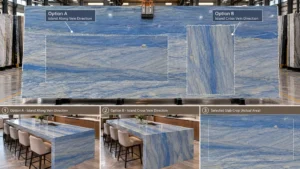
In one direction, the blue bands travel along the length of the island.
In another, they cross the island from side to side.
The material is identical, but the finished composition can feel completely different.
That is why choosing the direction of アズール マカウバス クォーツァイト should happen on the actual slab layout before cutting.
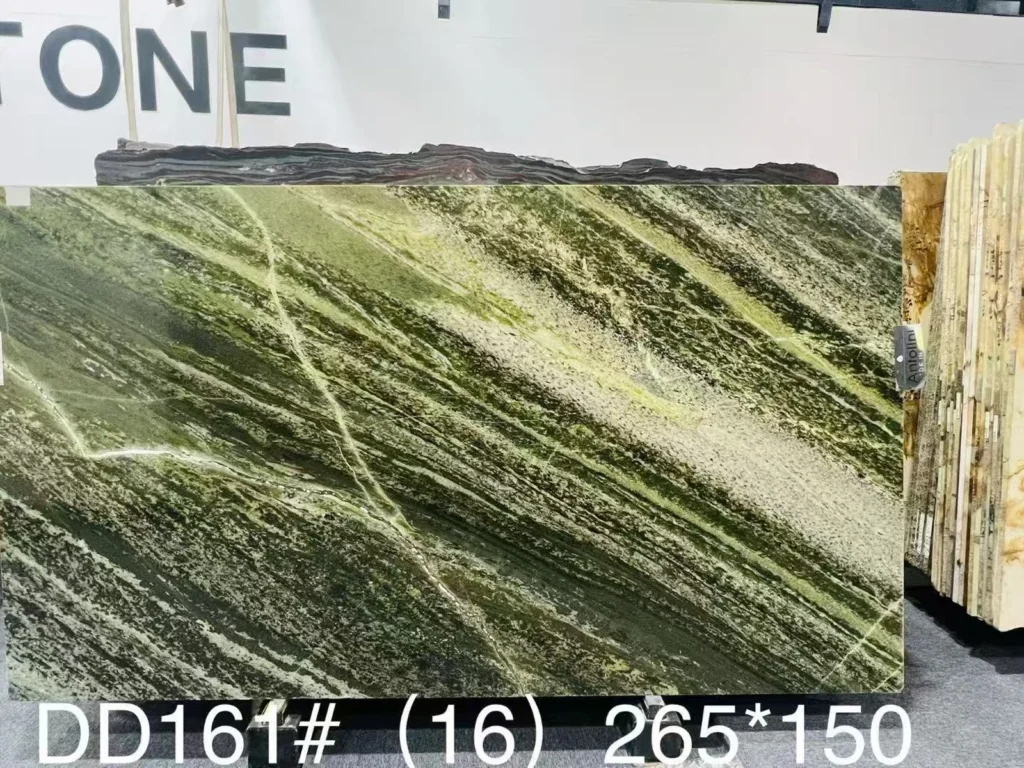
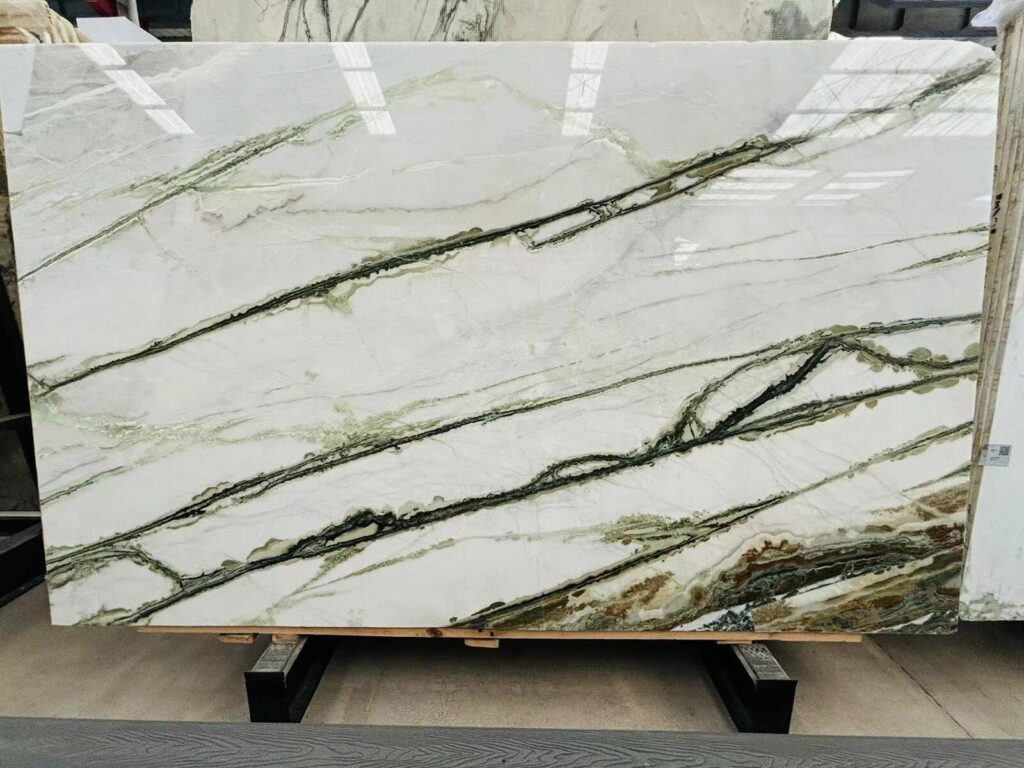
Azul Macaubas is a strongly directional Natural Quartzite. HRST’s current product page describes the material as a blue Quartzite with blue-to-white visual movement and natural variation between slabs.
But the commercial material name does not define the exact pattern of the slab in front of you.
One slab may contain:
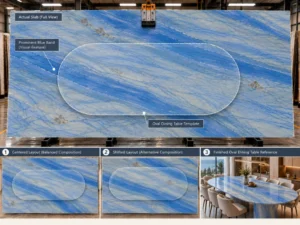
So begin with a complete slab photograph rather than a small crop.
If you are still selecting the material itself, review the current アズール マカウバス クォーツァイト slab and project options before deciding how its directional movement should be used.
A direction decision becomes useful only when it is connected to a real finished component.
For example, suppose the project needs a long kitchen island.
Do not compare two generic renderings.
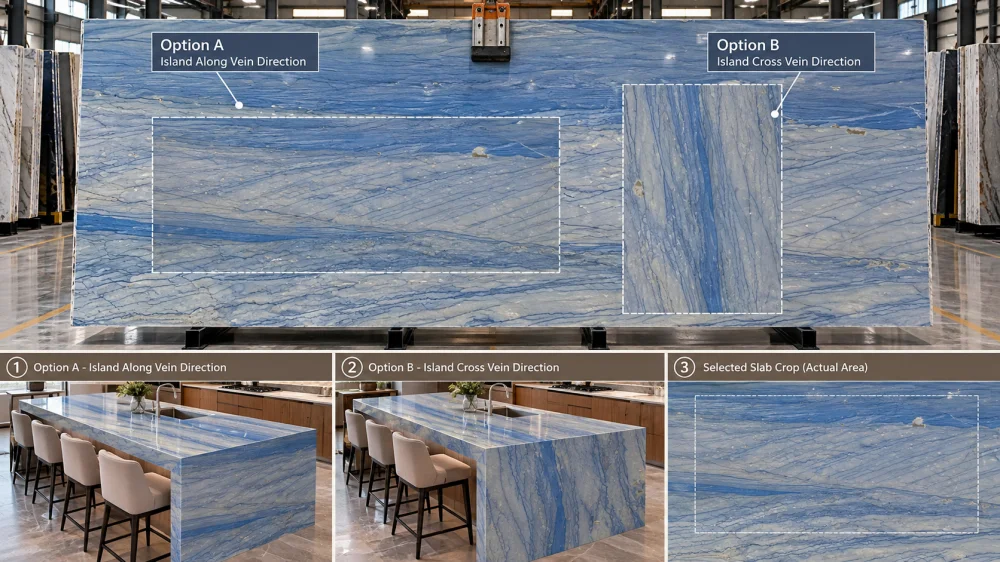
Compare the same finished-piece outline against the same slab.
That isolates the variable you are trying to decide: 方向を.
For a long rectangular island, one option is to position the piece so the dominant blue movement travels generally along its long axis.
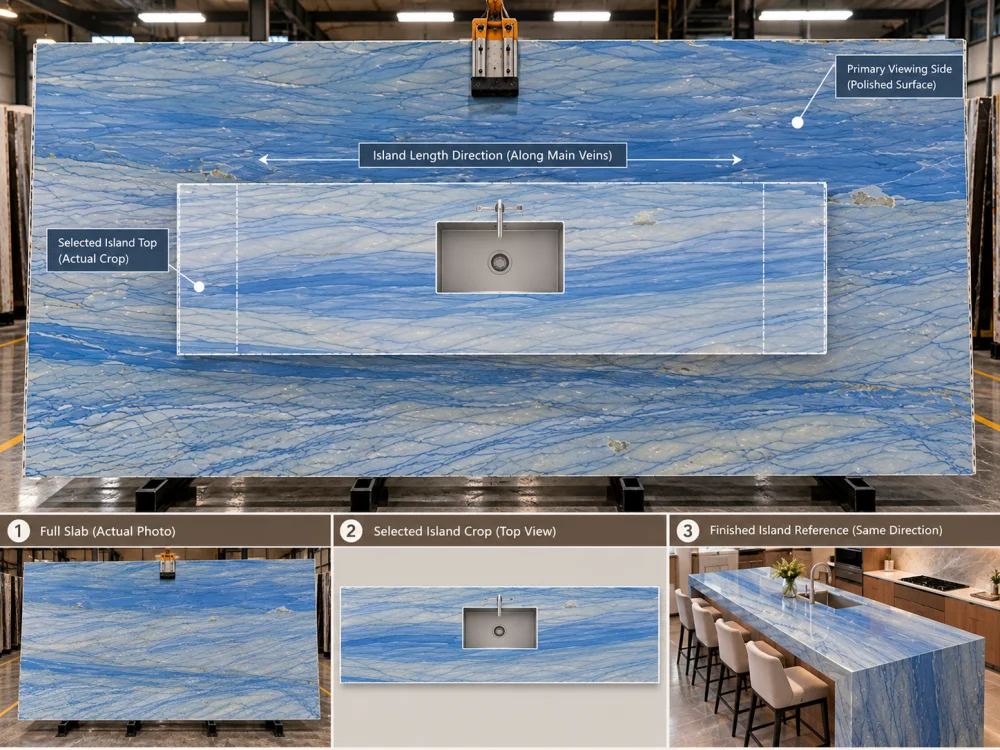
LONGITUDINAL READING
The eye tends to follow the major directional movement from one end of the finished surface toward the other.
This can emphasize the length of the island and allow long bands to remain visible across a large uninterrupted surface.
But do not decide from that description alone.
Check the actual slab.
A particular longitudinal position may place the strongest band:
The specific crop matters as much as the general direction.
Rotate the same island outline relative to the slab.
Now the bands may travel across the shorter dimension instead.
CROSSWISE READING
Instead of leading the eye toward the end of the island, repeated blue bands may become a sequence encountered across its length.
This can produce a very different rhythm.
It may also change which geological areas fit inside the finished piece and how much usable slab remains for other components.
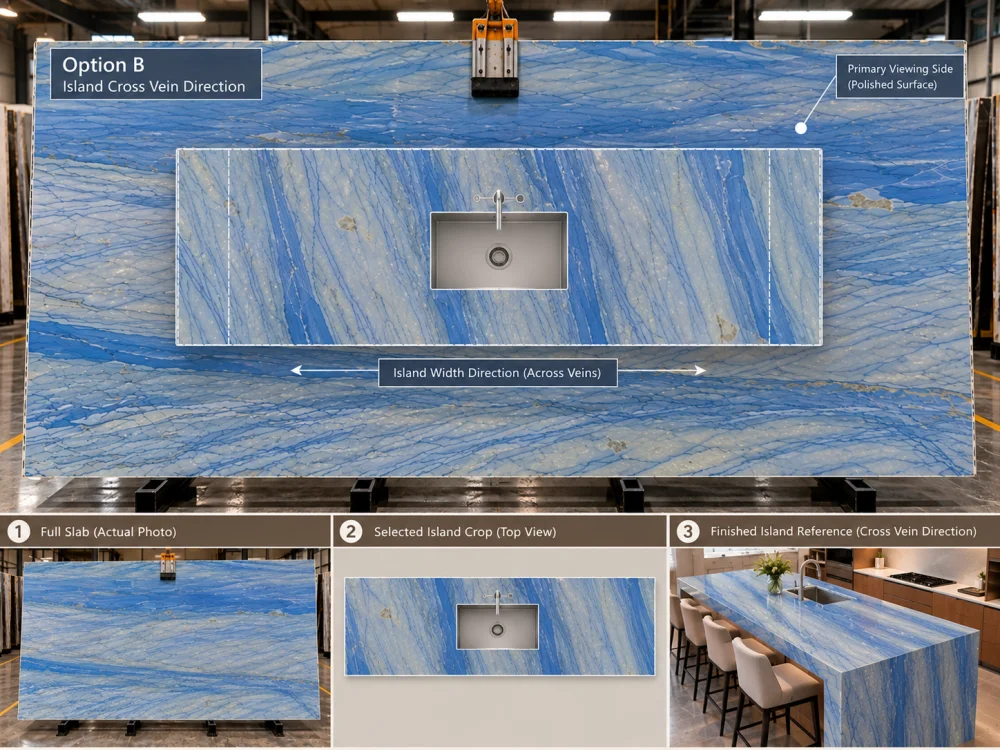
There is no universal rule that Azul Macaubas Quartzite should always run horizontally, vertically, lengthwise or crosswise.
より適切な問いは次の通りです
That turns a vague style preference into a project-specific layout decision.
A plan view is useful for cutting.
It is not always the best view for design approval.
Take the proposed Azul Macaubas piece and place it in its installed orientation.
Then ask where people will actually see it from.
ROOM ENTRANCE
What is the first major blue movement visible on approach?
SEATING SIDE
How do the bands read across the long visible edge?
WORKING SIDE
Do openings interrupt an important part of the pattern?
ADJACENT ROOM
Does the island read as one coherent directional composition from farther away?
Suppose an island is visible immediately from an open living room.
From that direction, the long side of the island becomes the dominant architectural face.
A band direction that looked balanced in an overhead cutting layout may read differently when viewed horizontally across the room.
That is why the sequence should be:
Now use the same material vertically.
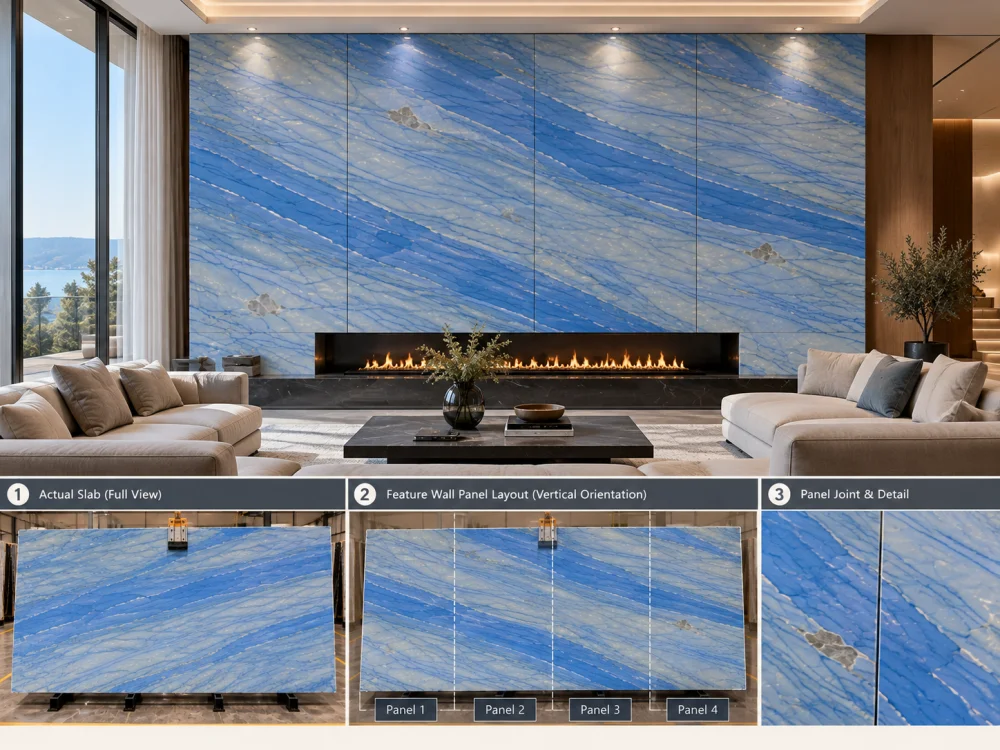
The design question changes.
For a feature wall, reception wall or fireplace composition, compare how the bands relate to:
A direction that works for a long horizontal island should not automatically be copied to a vertical wall application.
A waterfall island introduces a change of plane.
The project now has at least two important visible surfaces:
The designer may want the Azul Macaubas movement to create a deliberate relationship around that corner.
But a direction arrow alone cannot guarantee pattern continuity.
The actual result depends on the selected slab, cutting positions, mitre relationship, kerf, usable slab area and natural pattern.
Once the preferred visual direction is chosen, the 施工図用のクォーツァイトの鉱脈方向記号 guide explains how that intent can be tied to piece IDs, visible faces and actual slab layouts instead of relying on an isolated arrow.
A double-waterfall island should be reviewed as one composition.
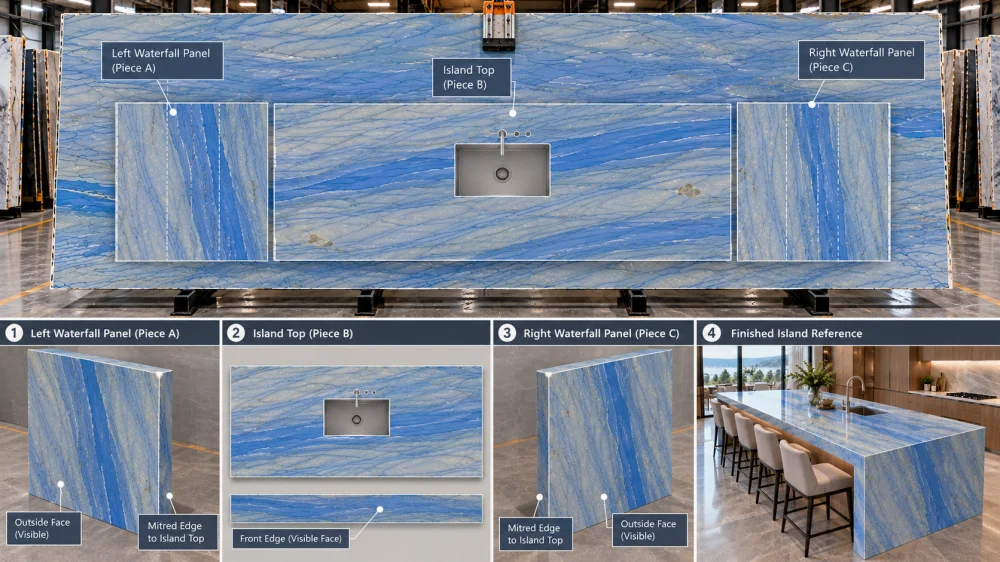
Do not optimize the left waterfall independently and then discover that the right side creates a completely different visual rhythm.
Review the top and both ends together before cutting.
Long countertops, walls or commercial surfaces may require more than one finished piece.
When a prominent Azul Macaubas band approaches a seam, show the seam on the actual slab layout.
Then ask:
IMPORTANT DISTINCTION
Correct direction does not automatically create pattern continuity across a seam. Direction and continuity should be reviewed as separate questions.
A sink or cooktop opening is not visually neutral.
Suppose the layout intentionally places a strong blue band through the center of an island.
If a large sink opening occupies the same area, part of that feature disappears.
Therefore, review band direction together with major openings rather than approving the two independently.
Azul Macaubas can become the strongest visual element in a room.
But it still exists beside other directional materials.
例えば:
The goal is not to make every direction parallel.
The goal is to understand whether the directions reinforce, balance or compete with one another.
Blue is particularly sensitive to surrounding colour relationships.
Rather than approving Azul Macaubas from an isolated photograph, compare the actual slab or representative current material reference with the project’s:
Then step back.
The direction decision should still work when the stone is read as part of the room rather than as a standalone slab.
Close inspection is useful for understanding local mineral detail.
Direction should also be reviewed from the distance at which the complete finished surface will normally be seen.
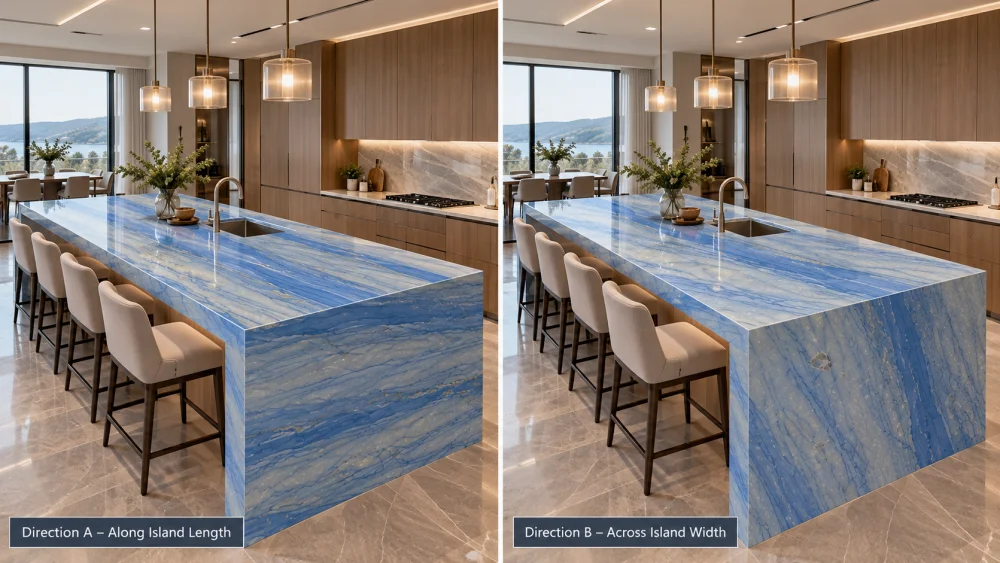
THE ROOM-DISTANCE TEST
Option A: View the finished-piece crop with bands running in Direction A.
Option B: Rotate the same piece against the same slab and view Direction B.
Then: Place both options in the same room orientation.
Decision: Compare which composition supports the project’s intended visual movement from the important sightlines.
Rotating a large finished piece can change how efficiently it fits within the available slab.
これは特に以下の場合に重要になります:
A preferred visual direction therefore needs to be checked against actual slab dimensions and the complete project cutting layout.
The best design discussion happens before the direction becomes an irreversible cutting instruction.
For a strongly directional Natural Quartzite, rotating or flipping a finished component can change the approved visual result even when its dimensions remain correct.
Keep those references connected through layout, fabrication and QC where direction is visually important.
For an Azul Macaubas direction-sensitive project, the visual approval does not need to become complicated.
It needs to become specific.
AZUL MACAUBAS DIRECTION APPROVAL
Material / Board ID: ________________________
Finished Piece: _____________________________
Drawing / Layout Revision: __________________
Primary Viewing Direction: __________________
Preferred Band Direction: ___________________
Visible Face Confirmed: _____________________
Relevant Seam / Waterfall: __________________
Major Opening Reviewed: _____________________
Approval / Comment: _________________________
If the project team is still debating the direction, do not continue discussing it abstractly.
Prepare two images.
OPTION A
Actual slab + actual finished-piece outline + Direction A + installed room orientation.
OPTION B
Same slab + same finished-piece outline + Direction B + same installed room orientation.
Change only the direction.
That makes the visual consequence much easier to judge.
There is no universal direction that suits every island. Compare the actual selected slab with the real island outline in at least the relevant alternative orientations, then review the resulting composition from the primary room sightlines before approving the layout.
Running the dominant movement along the long axis can emphasize the island’s length, but it is only one design option. The actual slab crop, openings, waterfalls, room views and other project surfaces may make another orientation more suitable for the intended design.
A sample can help review local colour and material character, but it cannot reliably show the full directional composition of a large slab. Use current full-slab images and the actual finished-piece outline for layout decisions.
Not for visually critical pieces. A direction arrow should be connected to the actual slab, piece ID, visible face, installed orientation, seams or waterfalls, and the current layout revision where those relationships matter.
Review the island top and waterfall face together on the actual slab layout. For a double-waterfall island, review the top and both vertical ends as one composition rather than selecting each piece independently.
Yes. An opening can remove part of a prominent blue band or change the balance of the finished surface. Overlay major openings on the proposed slab layout before approving the visual direction.
It can. Rotating a long or wide finished component changes how it fits within the actual slab and may affect the available material for waterfalls, backsplashes or other pieces. Check visual direction and cutting yield together before fabrication.
Send Josh the actual slab references or requested slab options, finished dimensions, quantity, current drawings, surface finish, visible faces, major openings, seams or waterfall requirements, adjacent finish references, primary room sightlines and the alternative band directions you want to compare.
Compare the Direction Before Cutting
HRST STONE can coordinate current Azul Macaubas Quartzite slab photographs, board references, CAD/shop drawings, alternative piece orientations, cutting layouts, visible-face relationships, waterfall planning, fabrication QC and export packing around the confirmed project scope. Send Josh the actual dimensions, selected or requested slabs, finish, openings, important room views and preferred band-direction options so the visual comparison can be completed before fabrication.
© HRST STONE/XIAMEN HRST STONE CO., LTD. 無断転載を禁じます。.