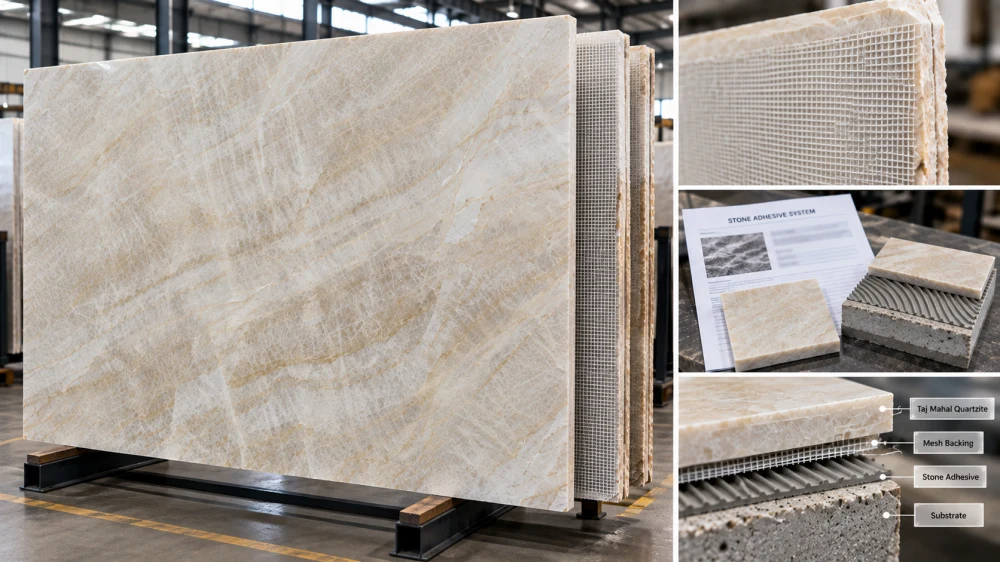
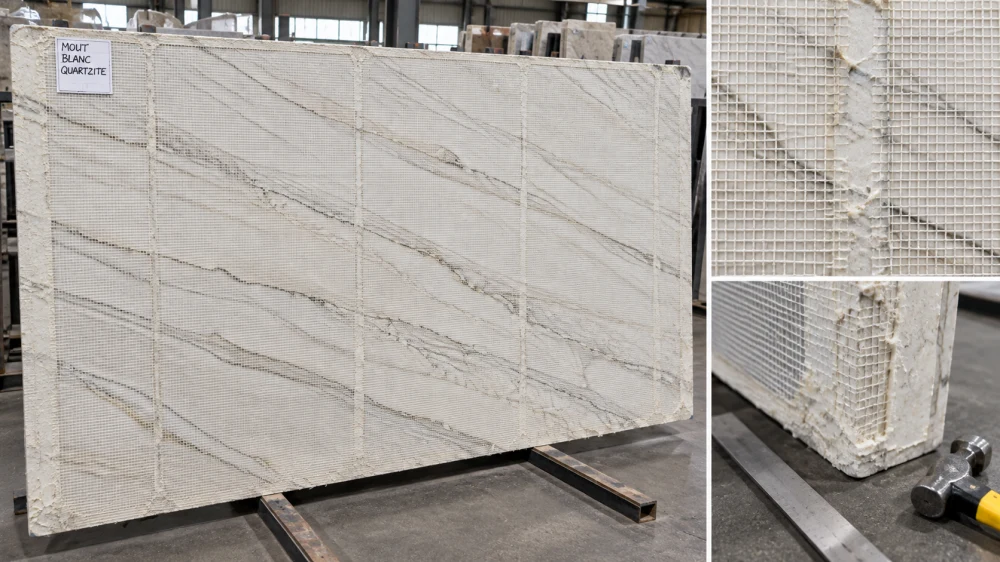
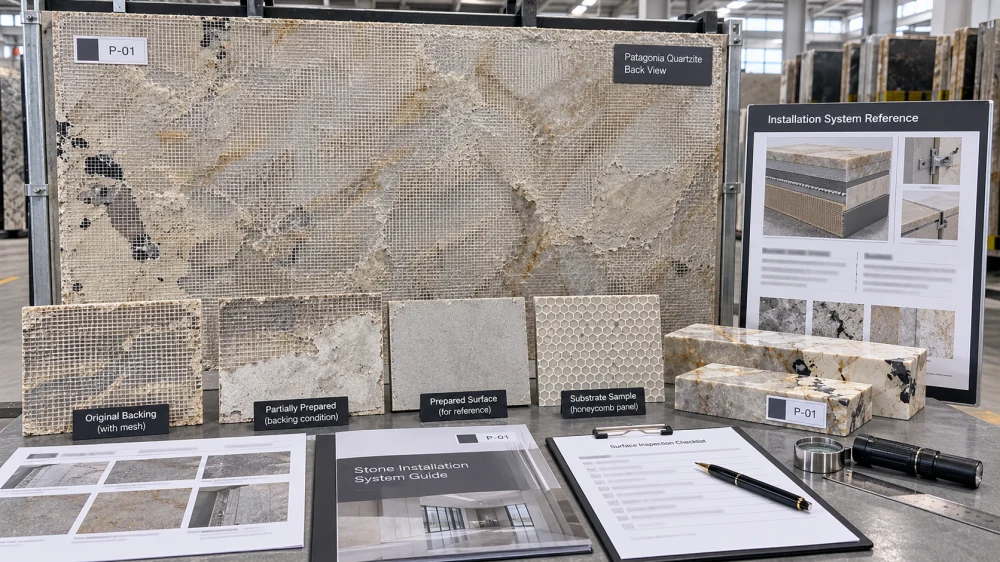
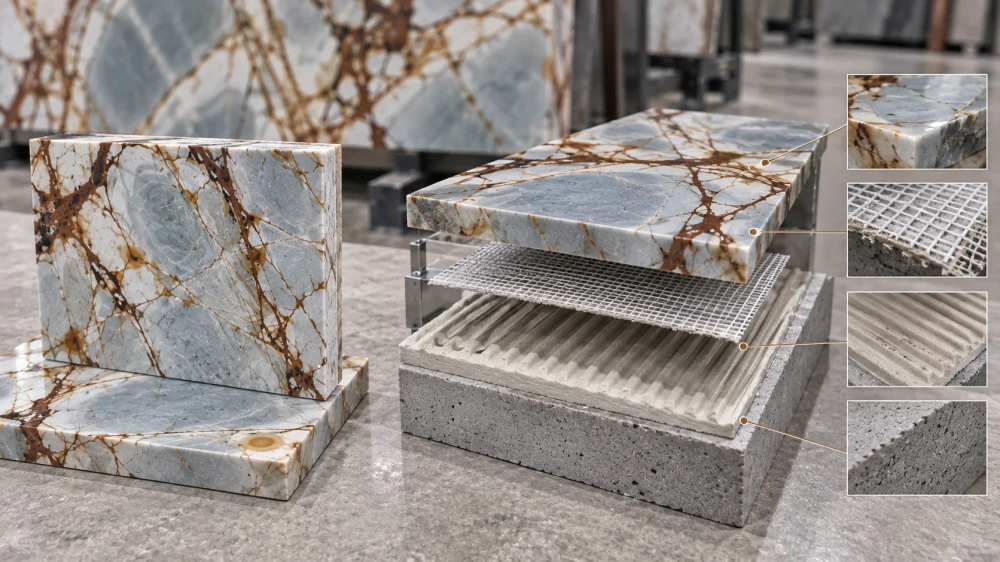
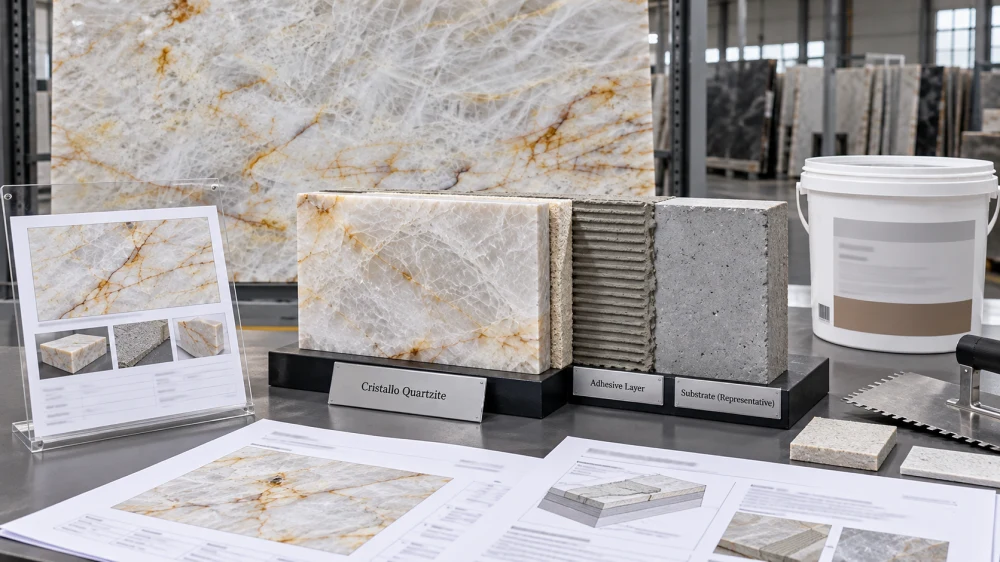
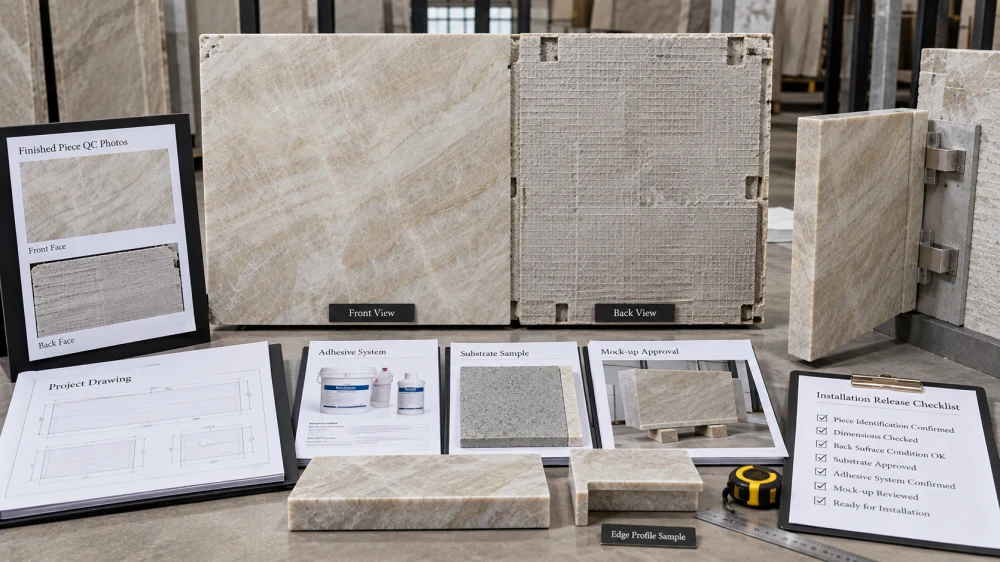
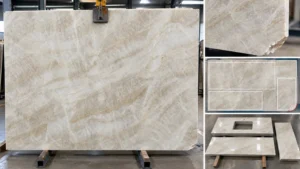
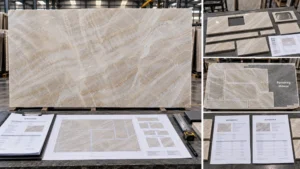
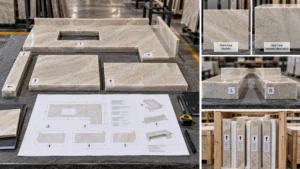
Mesh-backed Quartzite slabs should be reviewed as a complete bonding interface before installation. Do not assume that the adhesive will bond directly to Natural Quartzite, that all backing systems are identical, or that mesh should automatically be removed or retained. Identify the actual slab-back condition, backing or resin present, intended adhesive system, substrate, surface-preparation requirements, installation environment, and responsible system guidance. Where compatibility is uncertain or the consequence of failure is significant, use an appropriately controlled trial or mock-up before project release.
An installer receives a Natural Quartzite slab with mesh or another reinforcement visible on the back.
The front looks like the stone specified by the project. But the surface that will actually be bonded may be very different.
The adhesive may contact:
メッシュ裏打ちクォーツァイトスラブ―接着前の注意点
Natural Quartzite → resin → mesh → another backing layer
rather than bare stone.
That changes the question.
Instead of asking:
“Which adhesive works with Quartzite?”
the installation team should ask:
“What surface are we actually bonding to, and does the proposed installation system support that condition?”
Why Are Some Quartzite Slabs Mesh-Backed?
Natural stone slabs may receive backing or reinforcement during processing for handling, stabilization, or other production-related reasons.
The exact construction can vary.
A buyer or installer may encounter:
visible mesh reinforcement;
resin associated with the mesh;
localized reinforced areas;
broader back-surface treatment;
previous repairs;
combinations of mesh and other treatment; or
another supplied backing condition.
The presence of mesh therefore tells the installer that a backing condition exists. It does not, by itself, explain its chemistry, coverage, bond strength, intended installation method, or compatibility with a particular adhesive.
This creates a project-specific condition record instead of assuming that every slab sold under the same Natural Quartzite name has the same back treatment.
2. Identify What the Adhesive Will Actually Touch
This is the central installer question.
Bare Stone
The approved preparation exposes a stone surface for bonding.
Resin / Mesh Surface
The proposed adhesive contacts an existing factory-applied backing condition.
Mixed Surface
Preparation may expose more than one material or condition across the bond area.
These should not automatically be treated as equivalent substrates.
Our article on Quartzite resin treatments and adhesive selection makes the same broader point: adhesive decisions should start with the actual surface being bonded, existing treatment, bond purpose, and current product guidance—not the commercial stone name alone.
3. Do Not Assume the Mesh Must Be Removed
A common question is:
“Should we grind off the mesh before installation?”
There should not be a universal answer based only on the words “mesh-backed Quartzite.”
Likewise, leaving the backing untouched should not automatically be assumed acceptable for every adhesive system.
Installation Rule
Do not remove or retain a Quartzite backing system by habit. First identify the supplied condition and confirm the required preparation through the responsible installation system and current technical guidance.
4. Identify the Substrate Separately
Knowing the back of the Quartzite is only half of the interface.
The other half is the receiving substrate.
The installation team should identify the actual substrate defined by the project rather than simply writing “wall” or “floor.”
Relevant questions include:
What substrate is specified?
Is the substrate new or existing?
What preparation is required?
What environmental exposure applies?
What panel or component size is being installed?
What installation or fixing system is specified?
Are there movement, moisture, or other project conditions that the responsible system designer must address?
For facade applications in particular, bonding should not be isolated from the complete approved fixing concept. Our Natural Quartzite facade fixing guide explains why stone panels, fixing concepts, project drawings, interfaces, and responsible design professionals need to be coordinated as one system rather than treated as a generic slab-installation detail.
5. Read the Adhesive Manufacturer’s Current Documentation
Once the actual two sides of the bond have been identified, review the current technical information for the proposed adhesive system.
The responsible installer should check project-relevant requirements such as:
approved substrates;
表面処理の要件;;
application method;
working conditions;
curing conditions;
制限事項;;
environmental restrictions;
coverage or application requirements where specified;
storage requirements; and
メーカー推奨の試験または検証。.
A product description such as “for natural stone” should not automatically be interpreted as approval for every mesh, resin, backing, substrate, panel size, environment, or installation configuration.
Mesh Backing Changes the Compatibility Question
Known Condition
Do Not Assume
Confirm Instead
Slab has mesh backing
All mesh-backed slabs use the same system
Actual backing condition and available supplier information
Adhesive says “for stone”
It is compatible with every backing
Current manufacturer guidance for the actual interface
Mesh is visible
It must automatically be removed
Approved surface-preparation route
Small sample bonded successfully
Every slab and site condition is therefore approved
What the trial represented and what decision it supports
6. Distinguish Slab Reinforcement From Installation Bonding
Mesh or resin may have been applied during slab processing or reinforcement.
The installation adhesive has another function.
These should not be merged into one generic idea of “glue.”
例えば:
backing / reinforcement relates to the supplied stone condition;
repair resin may address localized stone features;
fabrication adhesive may be used for seams or miters; and
installation adhesive connects a fabricated component to an approved installation assembly.
Each can involve different materials, surfaces, purposes, and responsible parties.
7. Check Whether Fabrication Changes the Backing Condition
A full slab may arrive with one backing condition, but the finished component may not remain identical after fabrication.
Cutting, edge fabrication, openings, local reinforcement, handling provisions, or other approved fabrication operations can create different conditions across the back of the finished piece.
Before installation, review the actual fabricated component—not only a photograph of the original slab.
This becomes particularly important around:
シンク開口部;;
コンロ用開口部;;
narrow strips;
mitered edges;
waterfall components;
large wall panels; and
locally repaired or reinforced zones.
8. Treat Large Panels Differently From Small Samples
A small sample is useful for answering limited questions.
It cannot automatically reproduce every condition of a large fabricated panel.
Differences can include:
backing coverage;
stone variation;
panel dimensions;
weight;
handling;
substrate condition;
environment;
installation geometry; and
site workmanship.
This is especially important for feature walls and other large-format applications. Large Natural Quartzite panels should be coordinated with the approved project installation concept rather than extrapolating an entire assembly from a small sample alone.
9. When Is a Representative Bonding Trial Useful?
A controlled trial or mock-up may be useful when:
cristallo-quartzite-mesh-backed-bonding-trial
the backing material is uncertain;
compatibility with the proposed adhesive is not clearly established;
the Quartzite has unusual resin or repaired areas;
surface preparation is project-specific;
visual effects are a concern;
the installation condition is demanding; or
the responsible technical parties request verification.
Representative Trial Logic
Actual Quartzite → Actual Backing Condition → Intended Surface Preparation → Proposed Adhesive → Representative Substrate → Required Cure → Review → Recorded Decision
The closer the mock-up is to the actual interface, the more relevant the observation can be.
But a successful trial should still be documented according to what it actually represents rather than converted into a universal guarantee.
10. Record the Trial Conditions
“Test passed” is not enough information for a project record.
Record:
Quartzite reference;
sample or piece ID;
backing condition;
surface preparation;
adhesive product reference;
substrate used;
relevant application conditions;
curing period used for the review;
what was inspected;
result;
limitations; and
approving party.
This makes the trial traceable to the actual installation decision.
Do Not Confuse a Bonding Trial With Structural Approval
A bonding trial can help evaluate the particular interface represented by the test.
It does not automatically establish:
structural adequacy of a wall or facade system;
required mechanical fixing;
panel-size limits;
building-code compliance;
substrate design;
movement-joint design;
site waterproofing;
wind-load resistance; or
long-term suitability for conditions outside the tested scope.
Those questions belong to the appropriate project designers, system providers, installers, engineers, manufacturers, or other qualified responsible parties.
11. Record Who Owns Each Decision
Decision
Information Needed
Supplied stone condition
Slab / component reference, front and back photographs, available treatment information
Adhesive compatibility
Actual bonding surface, substrate, preparation and current system documentation
Surface preparation
Approved installation-system procedure for the actual condition
Panel support / fixing
Current project drawings, system requirements and responsible technical review
Installation release
Approved system information, resolved open items and named responsible party
12. Stop If the Backing Condition Changes
The approved installation basis should be reviewed if the actual delivered or fabricated material differs from the condition previously assessed.
例としては、
mesh is present where none was expected;
backing coverage differs materially from the reviewed sample;
a different treatment is identified;
the installation substrate changes;
the adhesive product changes;
surface preparation changes;
panel dimensions change significantly; or
the installation environment changes.
The purpose is not to create unnecessary delay. It is to prevent an approval made for one interface from being reused for a materially different one.
known repaired or reinforced areas where relevant;
fabrication drawings;
QC photographs; and
packing and piece identification.
The stone supplier should not replace the adhesive manufacturer, installation-system provider, structural designer, or qualified installer when those parties are responsible for final system suitability.
よくある質問
1. What is a mesh-backed Quartzite slab?
A mesh-backed Quartzite slab is Natural Quartzite supplied with mesh or another reinforcement system on part or all of its back surface. The exact backing construction can vary, so installers should record the actual supplied condition rather than assuming every mesh-backed slab is identical.
2. Should installers remove the mesh before bonding Quartzite?
Not automatically. Whether the backing should remain, be prepared, or be altered depends on the actual backing condition, proposed adhesive system, substrate, installation method, and current guidance from the responsible technical parties. Do not remove mesh solely because it is visible.
3. Can adhesive be applied directly over mesh-backed Quartzite?
That cannot be determined from the Quartzite name or the presence of mesh alone. First identify what material the adhesive will actually contact and confirm that the proposed system and surface preparation are suitable for that interface.
4. Is mesh backing the same as resin treatment?
Not necessarily. Mesh reinforcement, resin associated with the backing, localized repairs, slab-surface resin treatment, fabrication adhesive, and installation adhesive can perform different functions. Record the actual condition instead of grouping all of them under the word “resin.”
5. Why is the substrate important when installing mesh-backed Quartzite?
The installation bond connects two sides of an interface. The Quartzite backing is one side and the project substrate is the other. Adhesive compatibility, preparation, environmental conditions, and installation requirements therefore need to be reviewed against both.
6. Should a bonding trial be performed before installation?
A representative trial or mock-up may be appropriate when the backing condition, compatibility, surface preparation, visual effect, or installation condition is uncertain or when the responsible project parties require verification. Record exactly what materials and conditions the trial represents.
7. Does a successful bonding test approve the complete wall or facade system?
No. A bonding trial only provides information about the interface and conditions represented by that test. Structural design, mechanical fixing, substrate adequacy, movement, waterproofing, code requirements, environmental loads, and other system-level questions require separate project-specific review where applicable.
Final Bonding RuleDo not approve a bonding method because the material is simply described as “mesh-backed Quartzite.” Identify the actual back surface, determine what the installation adhesive will contact, confirm the receiving substrate, review the required surface preparation and current system guidance, and use a representative trial where the actual interface requires verification.
For project-based Natural Quartzite supply, HRST STONE can document slab identity, front and back conditions, visible mesh or reinforcement, fabrication details, finished-piece references, QC photographs, and packing records. Final adhesive selection, surface preparation, fixing design, and installation method should be confirmed for the actual project condition by the responsible installer, adhesive or installation-system provider, designer, engineer, or other qualified project party as applicable.
Hi, I am the author of this article. I have been working in the field of Natural Stone for more than 15 years. If you need customized Natural Stone services, please feel free to contact me.