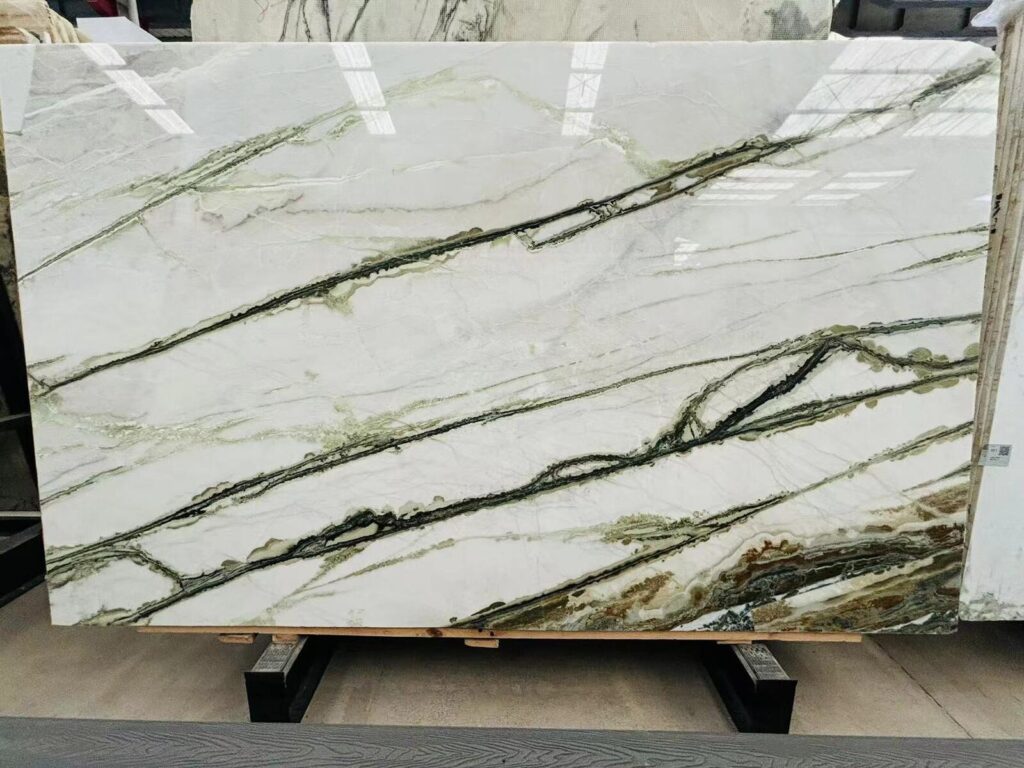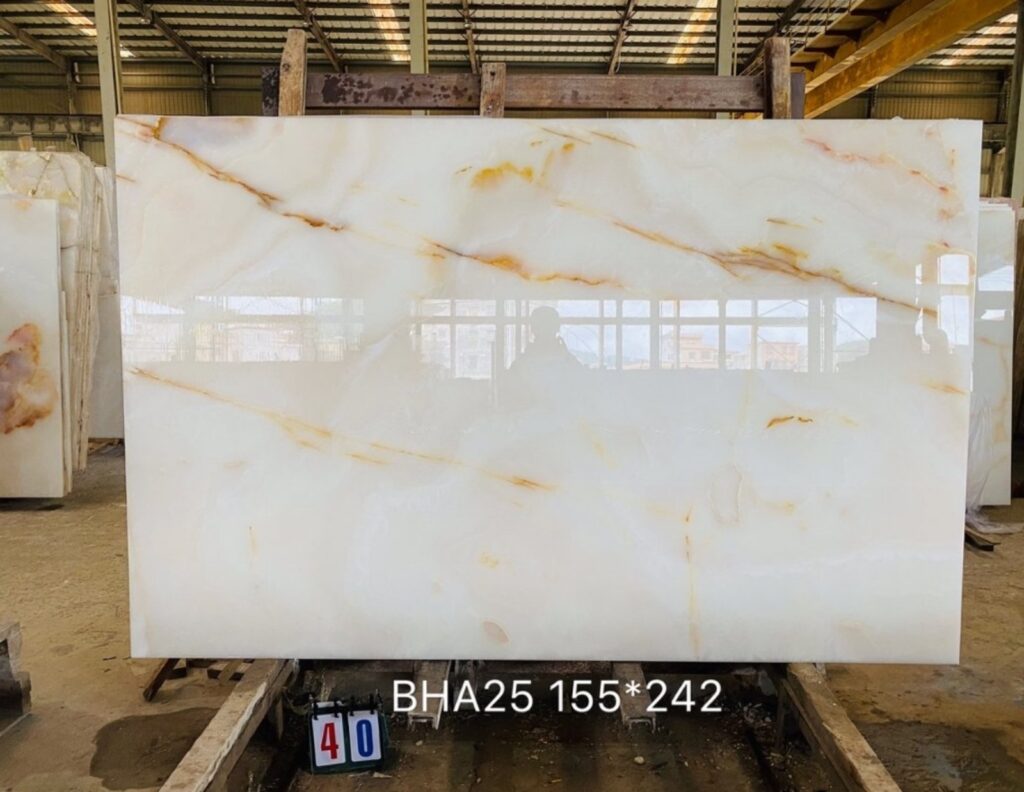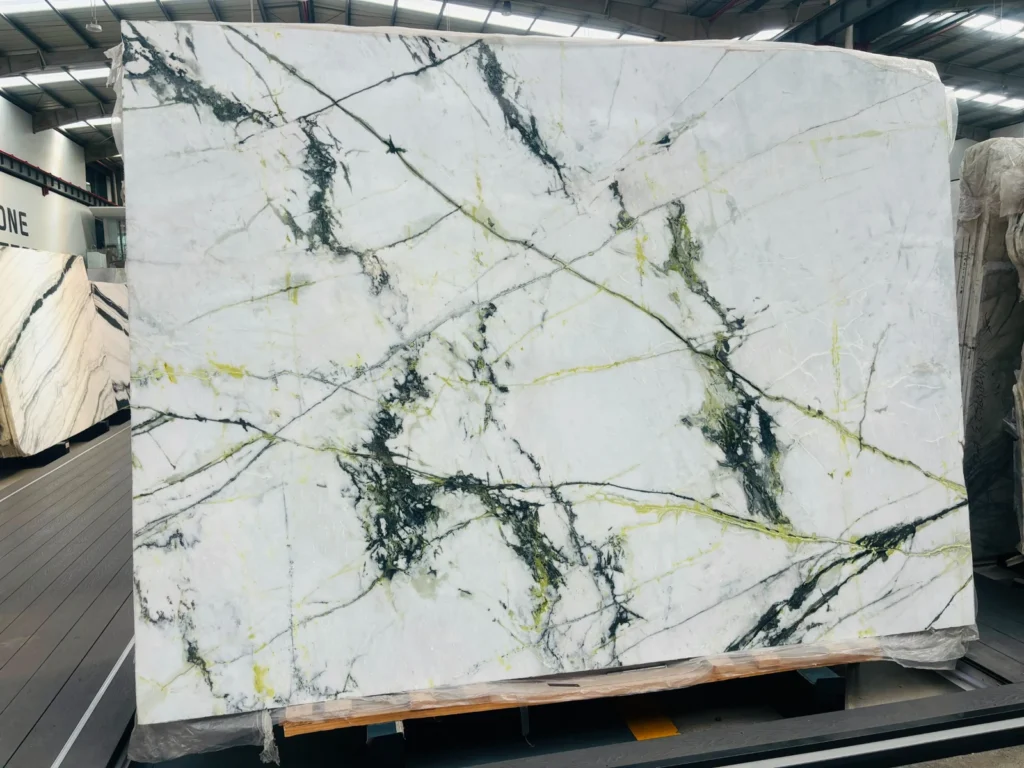

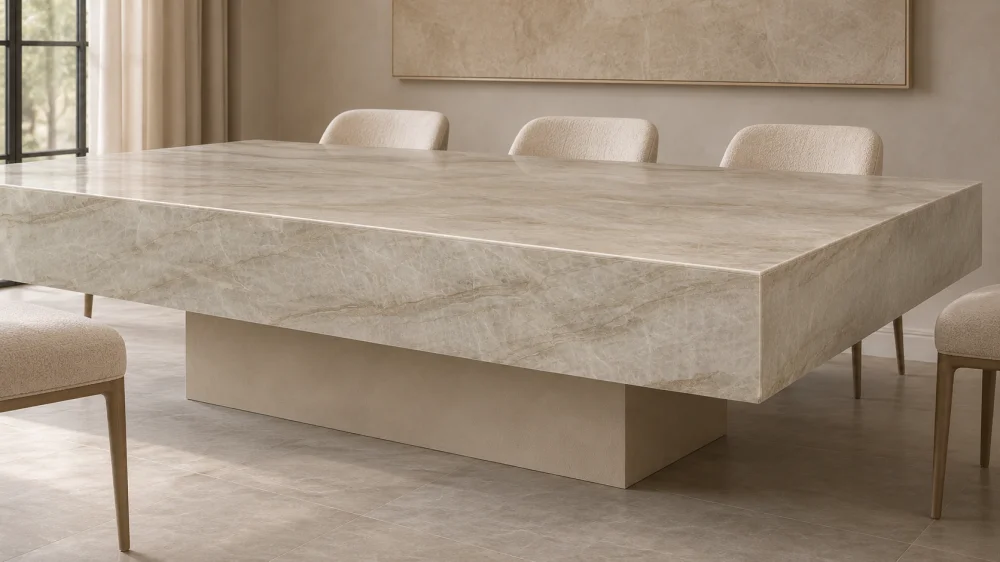
A Quartzite table apron should be coordinated with the tabletop as one finished corner assembly, not treated as a decorative strip added after the top has been cut. The designer and fabricator must review two different relationships: the joint between the horizontal top and vertical apron, and the corner where the front apron meets the side apron. Stone thickness, apron drop, joint geometry, natural veining, internal support and installation sequence all affect the result. The best corner detail is one that looks intentional, can be fabricated from the actual stone and works with the complete furniture structure.
संक्षिप्त सारांशA Quartzite table apron is a vertical element below the tabletop edge. It may create a thicker visual profile, conceal a support frame or form part of the furniture assembly. For a table with front and side aprons, review the horizontal top-to-apron joint and the vertical apron-to-apron corner separately, then approve them together. The final decision should use actual stone thickness, finished geometry, slab pattern, corner detailing, support information and a representative factory dry-fit where needed. A beautiful face sample does not prove a successful three-dimensional corner.
ए Quartzite table apron, also described as a stone fascia, skirt or apron panel depending on the furniture design, is a vertical stone component positioned below the edge of a tabletop. Its function may be visual, structural or a combination defined by the complete furniture system.
For a custom dining table, console or coffee table, the apron may change how substantial the top appears. However, the visible apron height does not automatically represent the actual structural thickness of the horizontal stone.
Before choosing a corner joint, establish why the apron is part of the furniture design.
A fabricated apron can make a relatively thin stone tabletop appear considerably thicker from the front and side.
For example, a tabletop constructed from a normal stone slab may be combined with a deeper vertical fascia to create a more substantial architectural profile.
This is a fabricated assembly, not necessarily a solid stone block.
Its apparent thickness and actual stone section should be documented separately.
An apron may conceal a metal frame, furniture substructure or fixing components beneath the tabletop.
In this case, its depth and position must be coordinated with the support system rather than selected from the external appearance alone.
A stone apron can also connect the tabletop visually to the table ends, legs or pedestal base.
Natural movement may continue from the top into the front fascia, or the design may deliberately create a controlled transition between the horizontal and vertical faces.
Some apron components may be designed to participate in the load-bearing assembly.
Others are simply facing pieces attached to a separately engineered structure.
Do not assume that the presence of a stone apron makes the tabletop self-supporting.
The structural function must come from the actual furniture design, connection details and responsible technical review.
A rectangular Quartzite table with a front apron and two side aprons creates a three-plane relationship at each outer corner.
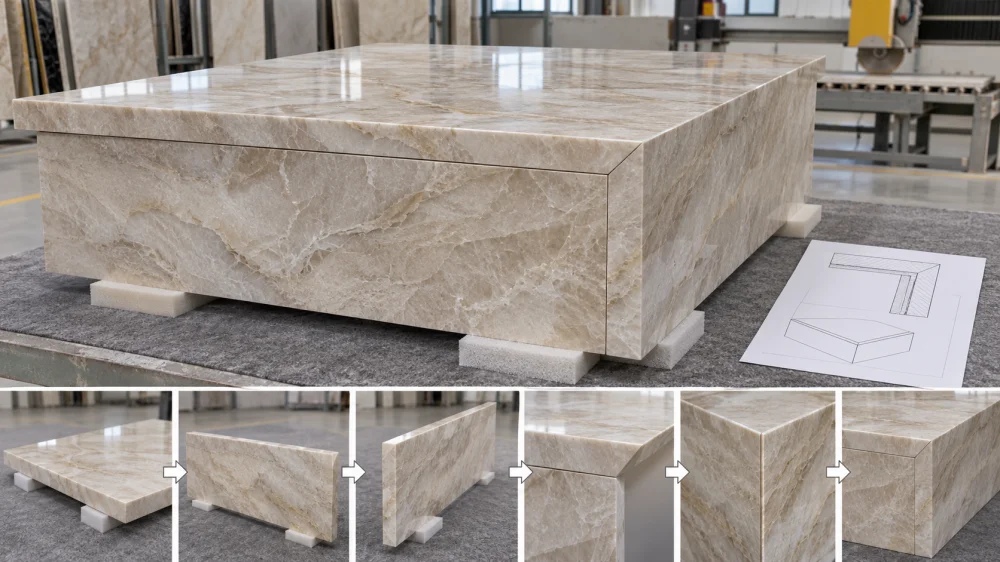
Those planes are:
1 — Horizontal Tabletop
The main working or display surface.
2 — Front Apron
The vertical stone face below the long edge.
3 — Side Apron
The vertical stone face below the end or short edge.
They create two important joint directions.
This joint runs along the tabletop perimeter, where the horizontal stone meets the vertical fascia.
Depending on the approved construction, the connection may use a mitred joint, a square laminated or butt-style arrangement, or another project-specific detail.
Its appearance affects whether the tabletop reads as:
This is the vertical corner where two apron pieces meet.
It affects the visual continuity of the fascia around the table end.
Even when Joint A looks excellent, Joint B can still look incorrect if:
The Three-Plane Corner TestReview the tabletop-to-front-apron connection, tabletop-to-side-apron connection and front-apron-to-side-apron corner as one finished three-dimensional relationship.
Two individually acceptable mitres do not automatically create an acceptable completed corner.
Different joint arrangements create different appearances and fabrication requirements.
The following comparison is a design-review framework, not a universal ranking of joint strength.
| Joint Strategy | Visual Result | Critical Review |
| Mitred Top-to-Apron Joint | Creates a continuous-looking thick edge | Mitre accuracy, joint appearance, edge finishing, material relationship and approved assembly method |
| Square or Butt-Style Joint | Creates a different, potentially more expressed top-to-apron relationship | Visible seam location, finish difference and compatibility with the design intent |
| Mitred Front-to-Side Apron Corner | Produces a controlled wrap at the vertical outside corner | Corner angle, piece height, alignment, pattern relationship and edge condition |
| Expressed Vertical Corner Joint | Makes the division between apron pieces intentional | Joint width, visible edge treatment, corner alignment and approved backing detail |
| Specially Fabricated Integrated Corner | May reduce or relocate visible joint lines | Stone availability, geometry, processing capability, handling and assembly feasibility |
A mitred joint is often selected when the designer wants the tabletop and apron to resemble one thick piece of stone.
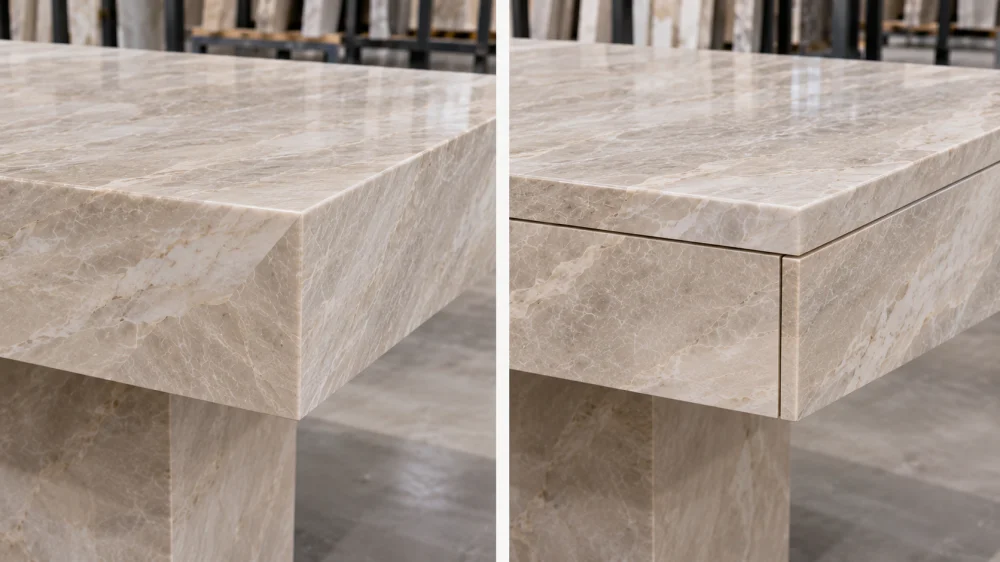
However, mitring is not automatically the best solution for every design.
For some furniture, an expressed joint may look more intentional and may be easier to coordinate with a modular assembly concept.
The project should choose the actual joint strategy before approving the final slab cutting layout.
संबंधित guide to visible mitred stone corners explains why a flat face sample cannot establish the final joint appearance, cut-edge relationship and pattern transition.
When the tabletop and aprons are shown as one visual block, the external dimensions must remain consistent with the actual fabricated assembly.
Several dimensions should be reviewed together.
Record the actual horizontal stone section rather than assuming the visible apron depth represents the thickness of the top.
The apron drop is the vertical depth of the fascia below its intended top reference.
The approved drawing should make clear whether the dimension includes the visible tabletop thickness or refers only to the projection beneath the horizontal stone.
The apron may align flush with the tabletop perimeter, sit slightly behind it or follow another controlled offset.
This affects:
Corner geometry should be established from the final outline.
A sharp rectangular corner, eased outer corner or rounded end can require different apron cutting and assembly strategies.
Apron height and position should be coordinated with:
A deeper apron may create an attractive thick-table appearance but make the table uncomfortable for seated users.
There is no universal apron-drop dimension that suits every dining table, coffee table or console.
Use the actual furniture height, seating arrangement and intended use.
Sometimes a strong visual relationship can be achieved, but it should not be assumed from a rendering.
Natural Quartzite has individual mineral movement, and cutting the stone into a horizontal top and multiple apron pieces changes which parts of the slab remain visible.
The project should distinguish three visual goals.
The main natural movement maintains a related direction between the tabletop and apron.
This can be effective even when every individual vein does not connect perfectly.
The top and aprons come from visually compatible stone areas, but the design accepts a change in the mineral composition at the joint.
This is often more realistic when the stone contains large crystalline zones or complex multidirectional movement.
The project intends a prominent mineral feature to turn from the horizontal tabletop onto a vertical apron.
This requires more precise slab planning.
The fabricator should review the actual pieces, cutting sequence, saw kerf, mitre preparation, material loss and final assembly geometry before suggesting that the feature will connect as intended.
A successful top-to-front-apron match does not guarantee the same match will continue around the side apron.
The front and side aprons may require a different stone-allocation decision at the vertical corner.
The Azul Macaubas Quartzite dining-table layout guide demonstrates why the natural stone movement and the actual finished furniture outline should be reviewed together before cutting.
Pattern Allocation RuleApprove the visible relationship between all three surfaces—not merely whether a vein looks attractive on the original slab.
Actual Slab → Tabletop Zone → Front Apron Strip → Side Apron Strip → Finished Corner Review
This question should be answered explicitly before the assembly is fabricated.
A visible apron may conceal a support frame without being responsible for carrying the main tabletop loads.
In another furniture design, an apron or frame component may form part of the structural system.
The designer should not infer the load path from external appearance.
For a custom Quartzite table, the support review can include:
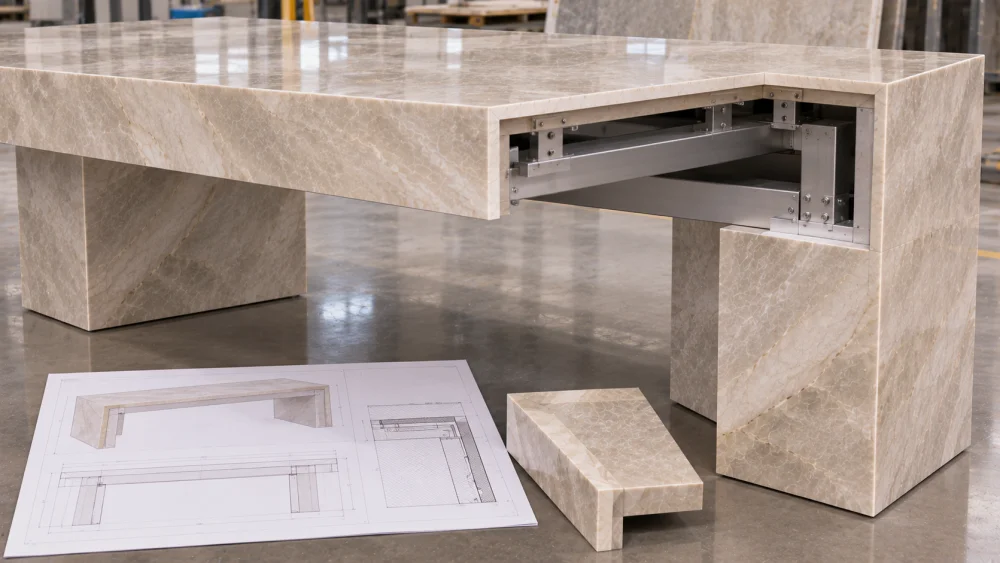
A mitred vertical fascia can make a stone table appear thick and solid.
That appearance does not establish the structural contribution of the fascia or adhesive joint.
Any load-bearing function must be established through the actual designed assembly and suitable technical evaluation.
A deep apron can conflict with internal metalwork or conceal a connection that installers must still be able to access.
The table designer and fabricator should coordinate:
Top Construction → Apron Geometry → Support Frame → Base Connection → Assembly Access
The Natural Stone Institute’s Dimension Stone Design Manual includes a dedicated chapter on Stone Furniture, addressing stone surfacing used for applications such as conference and smaller table tops. The complete furniture construction should be reviewed under the applicable project requirements rather than treating decorative stone detailing as proof of structural adequacy.
Not every tabletop has four square corners.
A rounded rectangle, oval or free-form Quartzite table introduces another challenge: the vertical apron may no longer be composed entirely of straight pieces.
A project may require:
Do not assume that a flat stone strip can simply be bent around the tabletop perimeter.
The selected solution should reflect the actual radius, stone section, proposed construction and fabrication capability.
For a rounded corner, the designer should identify whether the apron follows the full curve or stops before it.
That decision affects the furniture silhouette as well as the position of visible joints.
When the geometry is complex, a full-size template or representative physical corner can be more useful than an enlarged rendering.
The fabrication layout should identify the apron pieces before the tabletop is cut.
Otherwise, the best slab area may be used for the main top while the apron strips are later produced from unrelated remnants that cannot deliver the intended corner appearance.
A coordinated layout should include:
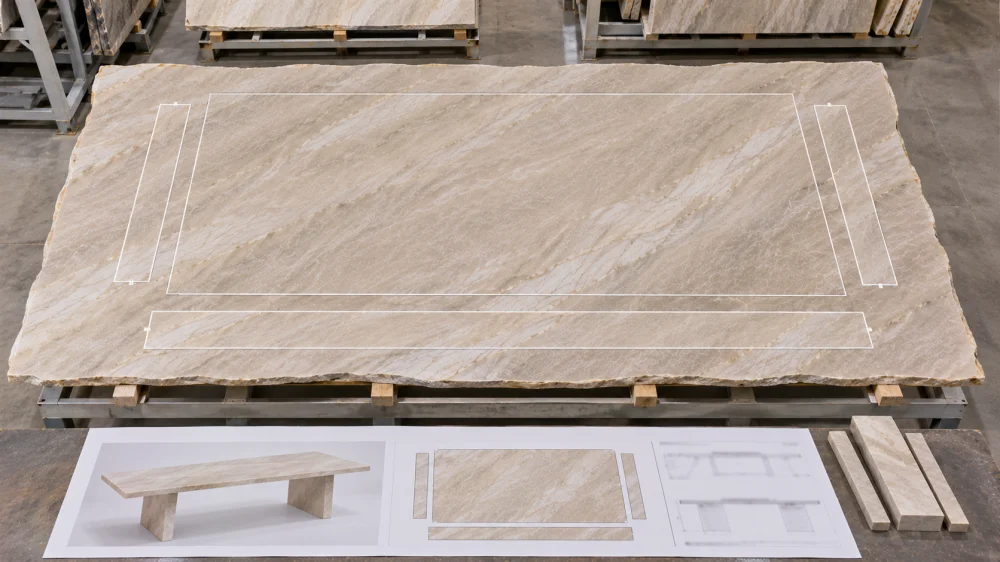
A simple example of piece identification is:
T-01: Main tabletop
A-F01: Front apron
A-S01: Left side apron
A-S02: Right side apron
These are illustrative identifiers, not a universal factory naming standard.
The same identifiers should appear in the current fabrication drawing, factory dry-fit record, QC photographs, packing list and site assembly documents.
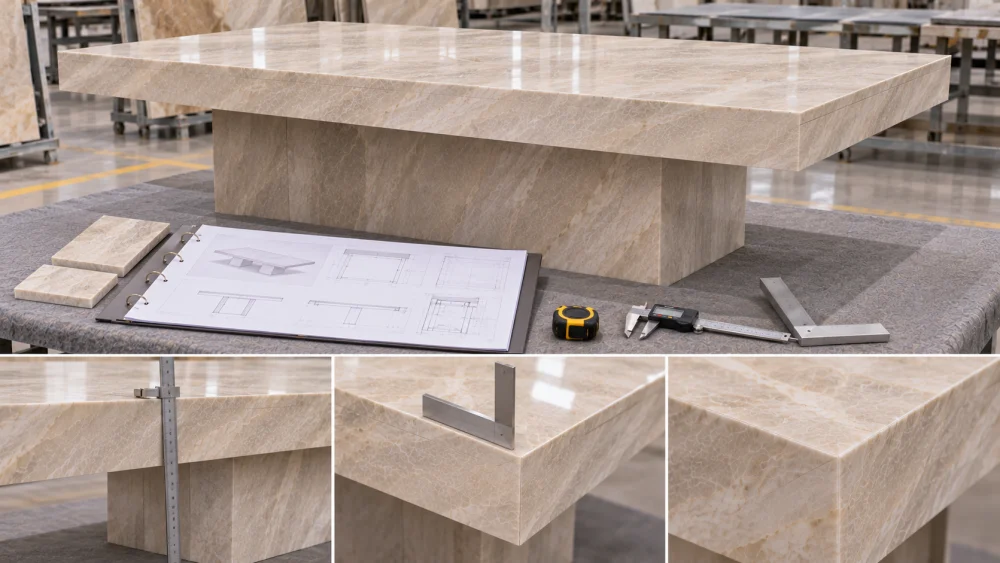
A representative factory dry-fit is especially valuable when the table uses a prominent mitred apron, complex corner geometry or multiple related stone pieces.
The dry-fit should demonstrate actual assembly compatibility.
It should not be limited to placing two polished stone samples next to each other.
Where required, inspect the following relationships.
| समीक्षा क्षेत्र | What the Dry-Fit Should Show |
| Top-to-Front Apron | Correct joint, finished profile and stone-face alignment |
| Top-to-Side Apron | Matching top reference and intended apron position |
| Front-to-Side Corner | Correct vertical corner joint and consistent apron height |
| Natural Stone Pattern | Accepted movement across the assembled faces |
| Internal Support | Support frame and fixing interfaces remain compatible with the stone assembly |
| Underside Access | Required connections remain accessible for assembly or future servicing |
| Final Corner Appearance | Consistent finished edges, joint appearance and intended outer profile |
The pieces should be safely supported on protected assembly equipment during the review.

The photographs should show the complete tabletop corner as well as the actual joint details.
If the furniture will be shipped in separate components, the mock-up should also verify the intended assembly interface rather than assuming that the factory-assembled condition can automatically be reproduced on site.
A carefully fabricated corner can still be damaged or misassembled after production.
The final inspection should confirm the current piece identification and revision, actual dimensions, apron drop, corner geometry, joint appearance, visible faces, edge finish, internal connection interfaces and overall assembly condition.
Measurements must be taken at defined physical locations. Numerical tolerances should come from the approved project requirements rather than being invented for a generic article.
For finished components, protect the polished faces, mitred edges, exposed corners and any protruding or vulnerable sections.
Where separated stone panels are packed vertically, use a suitable reinforced timber support system with closely arranged pieces and appropriate thin protective interleaving. Do not create large unsupported gaps between heavy stone pieces.
The actual packing method should reflect the component geometry, weight and agreed shipment conditions.
Identified table components should remain traceable to their assembly positions.
Before final assembly, confirm that the intended base, frame, supports and connection hardware match the current furniture drawings.
Do not use the apron corner joint to compensate for an incorrectly positioned base.
Where the table is delivered knocked down, install the components using the approved assembly sequence and suitable handling equipment.
Inspect all outer corners, exposed edges and joints after the table reaches its final position.
A change to the apron is not necessarily a local cosmetic change.
Increasing the apron drop can affect seating clearance.
Changing a mitred corner to an expressed joint can alter the visible furniture design.
Changing the side apron length or orientation may affect the relationship between the natural movement on the top, front and end.
A controlled revision should identify whether the change affects:
Do not automatically transfer approval from an earlier table corner after its actual geometry has changed.
Corner Fabrication DecisionA Quartzite table corner should be approved as one relationship between the horizontal tabletop, front apron, side apron and the support system beneath them.
Before cutting: confirm the corner scheme, actual dimensions, slab allocation, natural movement, internal construction and assembly method.
Before shipment: confirm the fabricated corner through current drawings, QC photographs and representative dry-fit evidence where required.
Buyer Next Step: Send HRST STONE the current table plan, elevations, corner sections, selected slab references, apron dimensions, base details and intended joint appearance for a coordinated fabrication review.
A Quartzite table apron is a vertical stone component positioned below a tabletop edge. It can create the appearance of a thicker top, conceal part of the furniture structure or participate in a specifically designed assembly. Its actual function should be defined in the furniture drawings.
No. Mitred corners can produce a continuous-looking thick stone profile, but an expressed joint or another corner detail may better suit the intended furniture design, assembly method or fabrication constraints. The decision should be based on the actual stone and completed three-dimensional corner.
A controlled visual relationship may be possible when all three pieces are planned from the actual slab. However, cutting loss, mitre preparation, natural variation and the different face orientations can affect continuity. Do not promise perfect three-face vein matching without reviewing the real fabrication layout.
No. An apron usually forms a vertical band beneath the tabletop edge. A waterfall end extends much farther downward and may form a full-height end panel or part of the table support. The construction, visual relationship and load path must be reviewed for the actual design.
Not automatically. A deeper apron can make the table look thicker without increasing the actual horizontal stone section. Any structural role of the apron must be established by the complete furniture design rather than inferred from its visible depth.
There is no universal apron depth. The design should consider overall table height, actual tabletop thickness, internal frame, seating clearance, chair-arm clearance, visual proportion and the approved furniture geometry.
A physical dry-fit can reveal differences in apron height, corner alignment, joint appearance, natural-stone movement, underside access and base compatibility that may not be clear in a flat drawing or isolated sample.
Send the selected Quartzite or current slab references, finished tabletop dimensions and shape, front and side apron dimensions, actual thickness, intended corner joint, surface finish, visible faces, natural-pattern priorities, base or frame details, required assembly method, quantity and delivery destination. Identify whether a representative corner mock-up or complete factory dry-fit is required before production approval.