
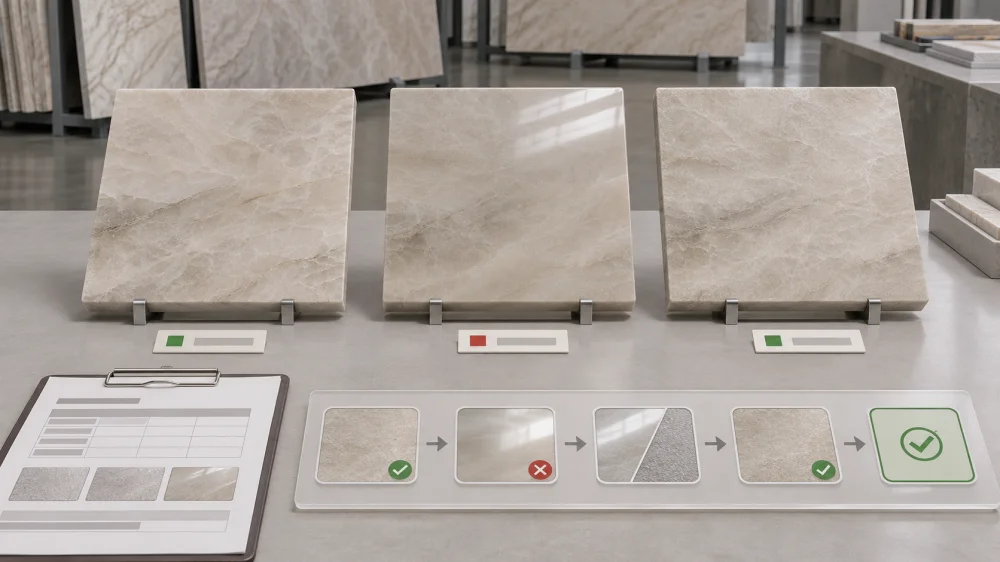
Quartzite sample rejection notes should describe what is visibly different from an identified approved or requested finish instead of relying on subjective labels such as “too rough,” “too shiny,” “not premium,” or “wrong texture.” A useful rejection note identifies the exact sample, Natural Quartzite material, intended finish, comparison reference, surface condition and viewing setup, then records whether the difference concerns sheen, texture, colour reading, uniformity, edge treatment or another observable characteristic. The note should also state what the supplier is being asked to correct and what evidence is required for the next review.
Résumé rapideDo not reject a Quartzite finish with phrases such as “too shiny,” “too matte,” “too rough,” or “doesn’t look like the sample” unless the reference and viewing conditions are identified. Record the sample ID, material, requested finish, approved or comparison reference, dry or wet condition, lighting, viewing angle and exact visible difference. Separate sheen from colour, texture from contamination, and surface finish from natural mineral variation. Then state the required next action: reproduce against the approved reference, prepare a revised sample, test a different finish process or hold production pending review.
UN Quartzite finish rejection note is a controlled project record explaining why a physical finish sample or production finish is not accepted and what must be reviewed or corrected before approval.
Its job is not to prove that the sample is objectively “bad.”
Its job is to make the difference understandable to another person who was not standing in the review meeting.
A factory should be able to read the note and answer:
Which sample was rejected? Compared with what? What was visibly different? Under what conditions? What must change before the next submission?
These phrases communicate a reaction, but they do not define a reproducible finish target.
“Too shiny” may mean several different things:
Likewise, “too rough” could describe:
If these conditions are not separated, the factory may make the wrong correction.
Rejection RuleWrite the observation before writing the judgment.
Weak: “Finish is too shiny.”
Stronger: “Sample F-03 produces noticeably sharper reflected highlights than approved Sample F-01 under the same low-angle light; the difference is strongest across the pale background zones.”
The first line of a rejection record should identify the physical sample.
Do not send:
“Please redo the honed sample.”
if three honed samples are currently circulating between the supplier, architect and client.
A controlled record can include:
| Sample Field | Ce qu’il convient de noter |
| Sample ID | One stable physical reference |
| Matériel | Natural Quartzite trade / project name |
| Relation de provenance | Actual selected slab / related slab group / representative sample / unknown |
| Requested Finish | Polished / honed / leathered / brushed / sandblasted / defined custom finish |
| Sample Status | Submitted / rejected / revised / approved / superseded |
| Comparison Reference | Approved sample ID or another clearly defined reference |
Le site Quartzite Sample Library control guide uses the same principle: a physical sample should have a stable identity, finish, source relationship, purpose and status rather than remaining an anonymous stone piece.
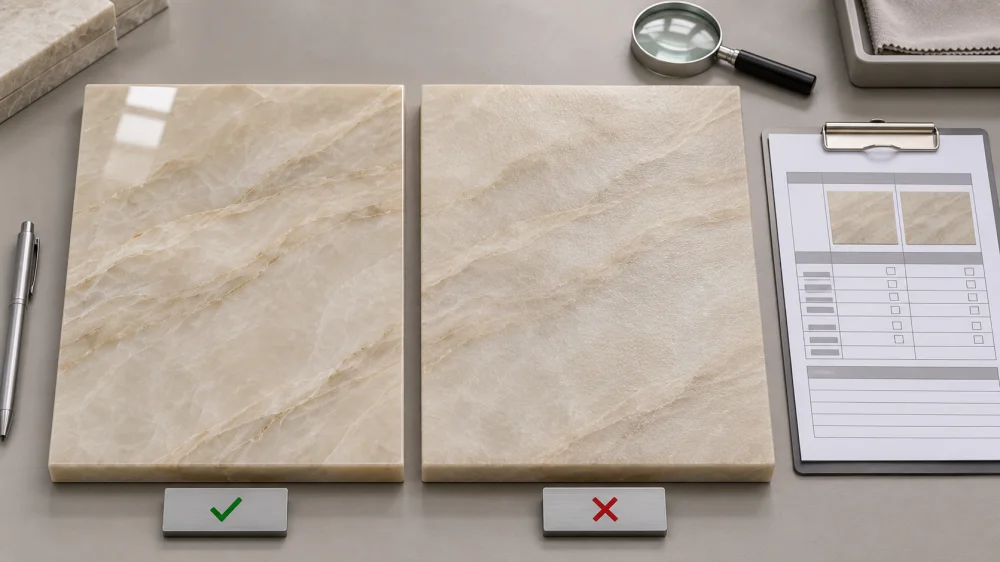
If there is no approved reference, say so.
A rejection note can still be valid, but it should state what target is being requested instead of pretending that a previously approved finish exists.
Finish names are useful, but the name alone may not define the final appearance precisely enough.
Natural Stone Institute terminology describes a polished finish as glossy and highly reflective and a honed finish as non-reflective to satin-like.
However, real project samples can still vary within those broad finish families.
Names such as brushed, antique or leathered are even less standardized across the industry. Different suppliers may use similar terminology for processes that produce different degrees of relief and sheen.
This means:
“Honed” is a finish category.
It is not necessarily a complete approval specification.
Similarly:
“Leathered” is not a universal texture depth.
A project-specific reference sample can therefore be more useful than the finish name alone.
Sheen is strongly affected by viewing angle and reflected light.
A finish can look relatively calm when viewed directly and much glossier when seen across a low-angle reflection.
For that reason, use at least two observations when sheen is the concern.

Use this to compare:
Use this to compare:
A better rejection note might say:
Example — Sheen RejectionSample: TH-F04
Requested Finish: Référence affûtée
Comparison: Approved TH-F01
Observation : TH-F04 appears similar in colour when viewed straight-on, but produces visibly sharper and brighter reflected highlights under the same low-angle light. The difference is present across most of the sample rather than one isolated mineral area.
Required Action: Prepare a revised honed sample closer to the reflected-light character of TH-F01 and resubmit both samples together for comparison.
This gives the fabricator much more information than “make it more matte.”
Texture should be described separately from sheen.
A low-sheen surface can still be very smooth.
A highly textured surface can still contain glossy mineral peaks.
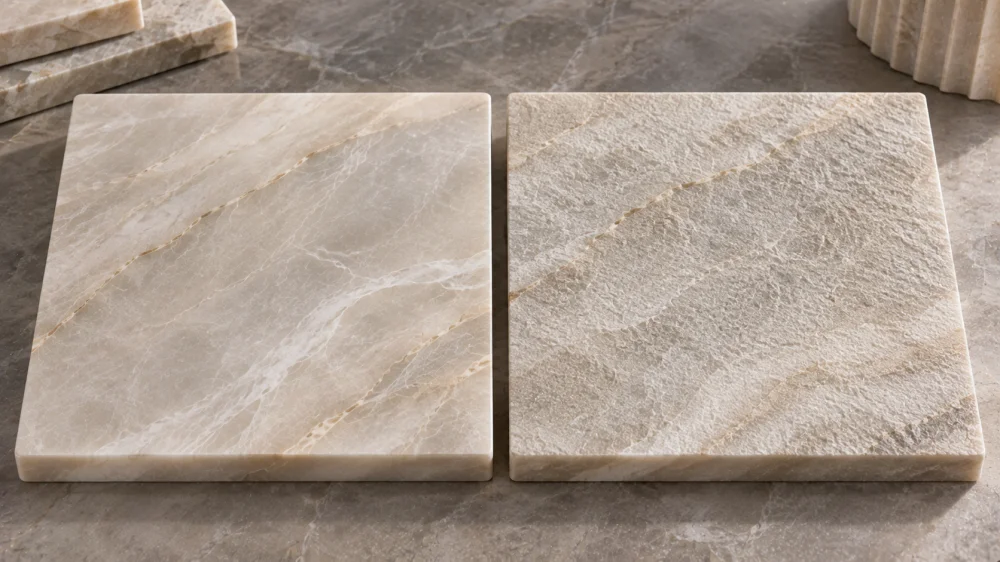
Useful texture observations include:
Do not attempt to turn subjective touch into an invented numerical roughness value unless the project actually has an agreed measurement method and acceptance criterion.
For a custom textured finish, the strongest practical control is often an identified approved physical reference combined with photographs and a known processing route.
Le relatif Quartzite sandblasted-finish guide explains why two surfaces can both be called “sandblasted” while showing different texture, sheen and colour response, and why the finish trial should remain connected to the actual production process.
This is one of the most important parts of a Natural Quartzite rejection note.
A sample can look lighter or darker because:
Do not automatically reject the finish because two unrelated samples have different colour.
Where practical, compare finish treatments on:
the same sample, adjacent related pieces, or closely related stone from the same slab group.
This reduces the amount of unrelated natural variation affecting the judgment.
A useful comparison hierarchy is:
Best Control: Same piece with controlled finish zones.
Strong Control: Adjacent offcuts from the same slab.
Useful Control: Identified pieces from the same slab group.
Weaker Control: Generic sample of the same commercial material name.
Poor Control: Internet photograph or unrelated showroom sample.
Comparison PrincipleWhen rejecting a surface process, reduce unrelated stone variation wherever practical.
If Sample A and Sample B come from visibly different mineral zones, record that limitation instead of describing every colour difference as a finishing defect.
Yes, especially when the sample has been rejected.
Combining them into one sentence often causes confusion.
| Review Field | Useful Description | Avoid |
| Colour Reading | Lighter / darker / warmer / cooler / lower apparent colour depth | Bad colour |
| Sheen | Sharper reflection / softer reflection / dull patch / uneven sheen | Too shiny |
| Texture | Greater relief / rougher tactile feel / directional marks / inconsistent texture | Too rough |
| Uniformity | Finish differs between centre and perimeter / local bands / repeated machine pattern | Looks uneven |
| Bord | Edge more reflective than face / edge texture not transferred / transition abrupt | Edge wrong |
This structure also helps when several people are reviewing the same sample.
One person may accept the colour while rejecting the sheen.
Another may accept the face finish but reject the processed edge.
Those are different decisions and should remain separate.
Lighting matters, but it should not become a vague excuse for every disagreement.
The purpose of recording viewing conditions is to make the comparison repeatable.
A simple record can state:
État de la surface : dry.
Light: neutral indoor review light plus low-angle reflected-light check.
Orientation: both samples placed side by side in the same direction.
Viewing: straight-on overall view and low-angle sheen review.
The project does not need a laboratory lighting system for every decorative sample.
It does need enough consistency that one sample is not reviewed beside a window in direct sun while the reference is photographed later under warm artificial light.
Where finish is especially sensitive, retain original photographs from the review setup.
Describe the visible condition before assigning a cause.
Le relatif Etching vs Staining on a Quartzite Sample guide uses the same principle: a dark area is not automatically staining, and a dull area is not automatically etching.
For a finish rejection, avoid statements such as:
“The honing burned the surface.”
“The sealer made it cloudy.”
“The stone absorbed something.”
unless those mechanisms have actually been established.
Instead write:
“The revised sample shows a lighter, cloudier appearance across the treated zone compared with the adjacent control. The difference remains visible when both areas appear dry. Cause has not yet been confirmed.”
This keeps the rejection technically useful without turning an observation into an unsupported diagnosis.
A face-only sample may not answer the production question if the final component has visible edges or multiple finish zones.
If the project includes:
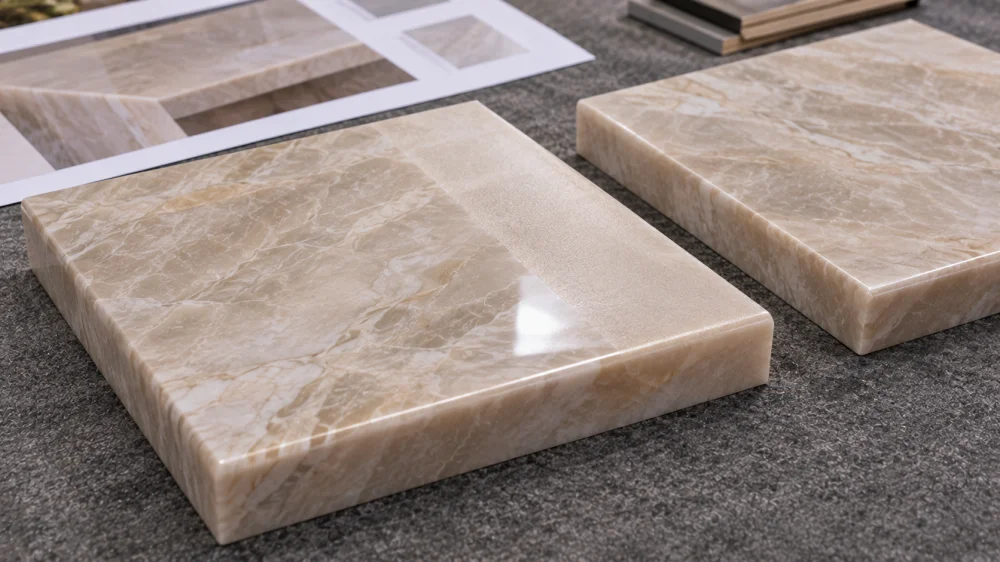
include that geometry in the approval sample where practical.
A polished edge beside a honed face can appear visually brighter even when both have been fabricated cleanly.
If that contrast is unacceptable, the rejection note should state the desired face-to-edge relationship rather than simply saying “edge doesn’t match.”
A useful rejection note has four parts:
1. Reference
Which physical samples or production pieces are being compared?
2. Observation
What can actually be seen or felt?
3. Scope
Which part is rejected: complete finish, sheen only, texture only, edge, local zone or transition?
4. Required Next Action
What should happen before approval is requested again?
| Weak Rejection | Actionable Rejection |
| Too shiny | More reflective than Sample H-01 under the same low-angle light; revise toward the softer reflected-light appearance of H-01. |
| Too rough | Surface relief is visibly deeper and more uneven than Sample L-02, particularly across the pale background zones; prepare a lighter-textured trial. |
| Colour wrong | Sample appears lighter and less colour-saturated than its untreated adjacent control after both surfaces are dry; review whether the finishing process can retain more of the original colour depth. |
| Doesn’t match | Face finish is acceptable, but the worked edge remains substantially glossier than the approved face reference; resubmit an edge sample with a closer face-to-edge sheen relationship. |
The next sample should not erase the history of the previous one.
Give the revised piece a new identity or revision relationship.
Par exemple :
F-01 → Rejected → F-02 Revised Trial
Retain the rejected piece long enough to make the next comparison meaningful where practical.
Do not send only the new sample and ask the reviewer to remember what the previous surface looked like.
The resubmission should include:

If the supplier changes several variables at once, state that clearly.
A revised sample made from a different slab, different mineral zone and different finish process may solve the appearance problem, but it is not a clean one-variable comparison.
A small sample can establish local surface character.
It may not prove how the finish will read across a large wall, long reception front, oversized island or several mineral zones.
Consider a larger sample or first-production review when:
Do not interpret this as a rule that every project needs a full-size mock-up.
The sample size should match the decision being made.
Approval Scale RuleSmall Sample → Local Finish Character.
Larger Mock-Up → Area Uniformity / Transitions / Viewing Behaviour.
First Production Piece → Transfer from Approved Sample to Actual Fabrication.
Keep each approval limited to what that stage actually demonstrates.
Projet : [Project Reference]
Sample ID: [ID]
Matériau : [Natural Quartzite Name / Reference]
Source Relationship: [Selected Slab / Related Slab Group / Representative / Unknown]
Requested Finish: [Polished / Honed / Leathered / Brushed / Sandblasted / Custom]
Comparison Reference: [Approved Sample ID / Control / Defined Target]
État de la surface : [Dry / Wet / Recently Cleaned / Unknown]
Viewing Conditions: [Lighting + Straight-On / Low-Angle / Other]
Rejected Area: [Whole Face / Local Area / Edge / Transition / Other]
Colour Observation: [Description]
Sheen Observation: [Description]
Texture Observation: [Description]
Uniformity Observation: [Description]
Edge / Transition Observation: [Description]
Known Process / Treatment: [If Confirmed]
Unknowns: [Liste]
Décision : Rejected / Accepted with Limitation / Further Review Required
Required Next Action: [Revised Sample / Process Review / Larger Mock-Up / First-Production Trial]
Next Submission Should Include: [Physical Sample + Comparison Reference + Images + Process Notes]
It can express the design concern, but the rejection record should describe the comparison more precisely. Identify the reference sample, viewing condition and whether the difference concerns sharper reflected highlights, higher overall sheen, uneven gloss or another visible condition.
Compare it with the intended physical reference and describe the difference in reflected-light behavior and colour depth. For example, state that the revised sample produces substantially less reflection and appears flatter or less colour-saturated than the approved honed reference under the same conditions.
Yes. Brushed, antique and leathered terminology is not completely standardized across the natural-stone industry, and process intensity plus mineral structure can produce different levels of relief and sheen. Use an identified project reference when the exact surface character matters.
Yes, but distinguish whether the colour difference may come from the finish process or from natural stone variation. Where practical, compare related stone under the same finish and viewing conditions before treating colour difference as evidence of a finish problem.
Not always, but retaining the physical rejected reference during revision can improve comparison. If it is returned, archived or replaced, keep its sample ID, photographs and rejection record so the next submission can still be traced to it.
Photographs are useful for documenting colour, sheen, texture and comparison areas, but they do not fully reproduce tactile texture or every reflected-light condition. For visually sensitive finish approval, keep an identified physical reference where practical.
Send the sample ID, Natural Quartzite reference, requested finish, approved or comparison sample, clear photographs under consistent viewing conditions, separate observations for colour, sheen and texture, edge or transition concerns, and the specific change required for the next sample. If the source slab relationship or finishing process is known, include that information as well.
Finish Rejection TakeawayA good rejection note does not need complicated technical language. It needs controlled references and observable descriptions.
Identify the sample, compare it with the correct reference under comparable conditions, separate colour from sheen and texture, record edge or transition differences, avoid diagnosing an unconfirmed cause, and tell the fabricator exactly what should be resubmitted.
Buyer Next Step: Keep the rejected sample and approved reference together until the revised finish has been reviewed so the decision does not depend on memory or unrelated photographs.