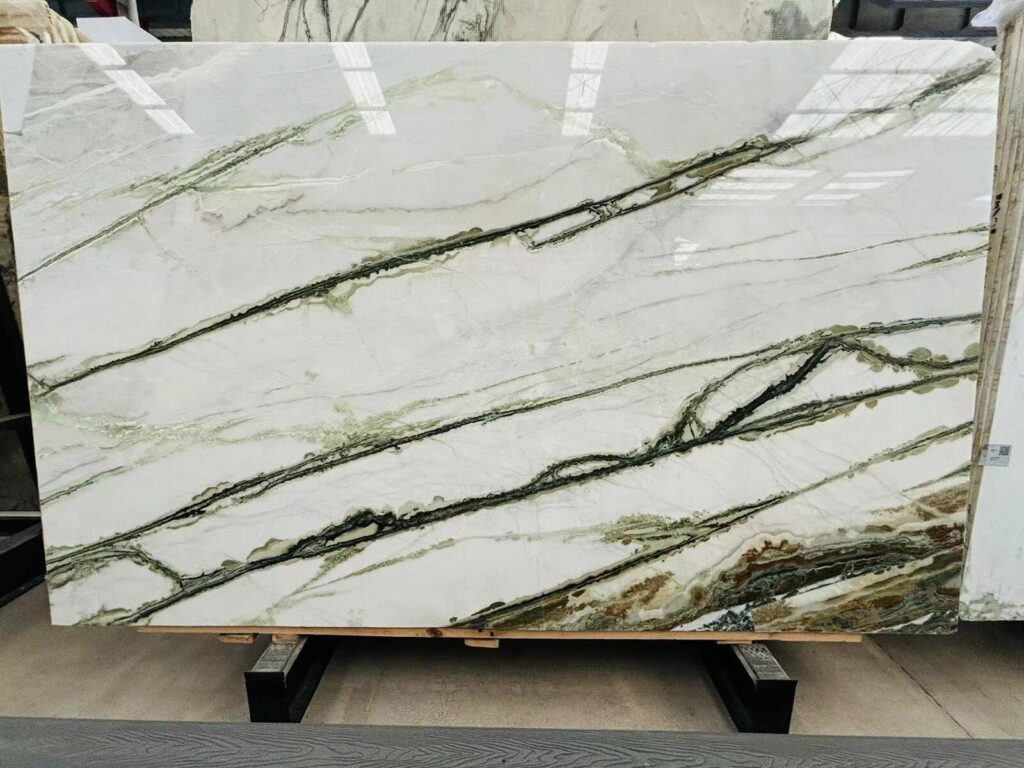

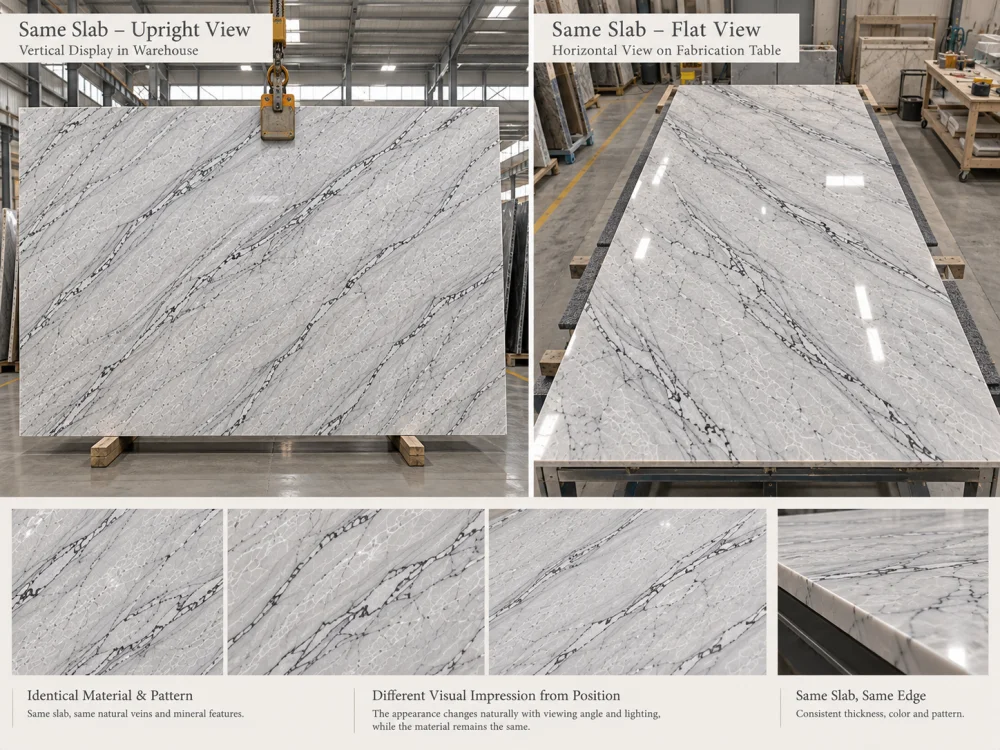
Kurze ZusammenfassungNatürlicher Quarzit kann unterschiedlich wirken, je nachdem, ob er im Plattenlager aufrecht oder auf dem Verarbeitungstisch flach betrachtet wird. Der Stein selbst hat sich dabei nicht unbedingt verändert. Vielmehr haben sich die Lichtverhältnisse, Oberflächenreflexionen, der Betrachtungswinkel, der Abstand sowie die Beziehung des Betrachters zum natürlichen Muster geändert. Die aufrechte Präsentation hilft Käufern, die gesamte Platte als vertikale Komposition zu erfassen; die flache Darstellung ermöglicht es ihnen, sich horizontale Anwendungen vorzustellen und bestimmte Bereiche von oben zu inspizieren. Keine der beiden Positionen allein lässt sich auf jede mögliche Endanwendung übertragen. Vergleichen Sie dieselbe identifizierte Platte unter dokumentierten Bedingungen und entscheiden Sie anhand der vorgesehenen Projektfläche, welche Sichtweise am wichtigsten ist.
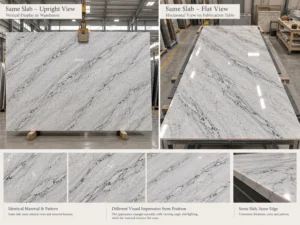
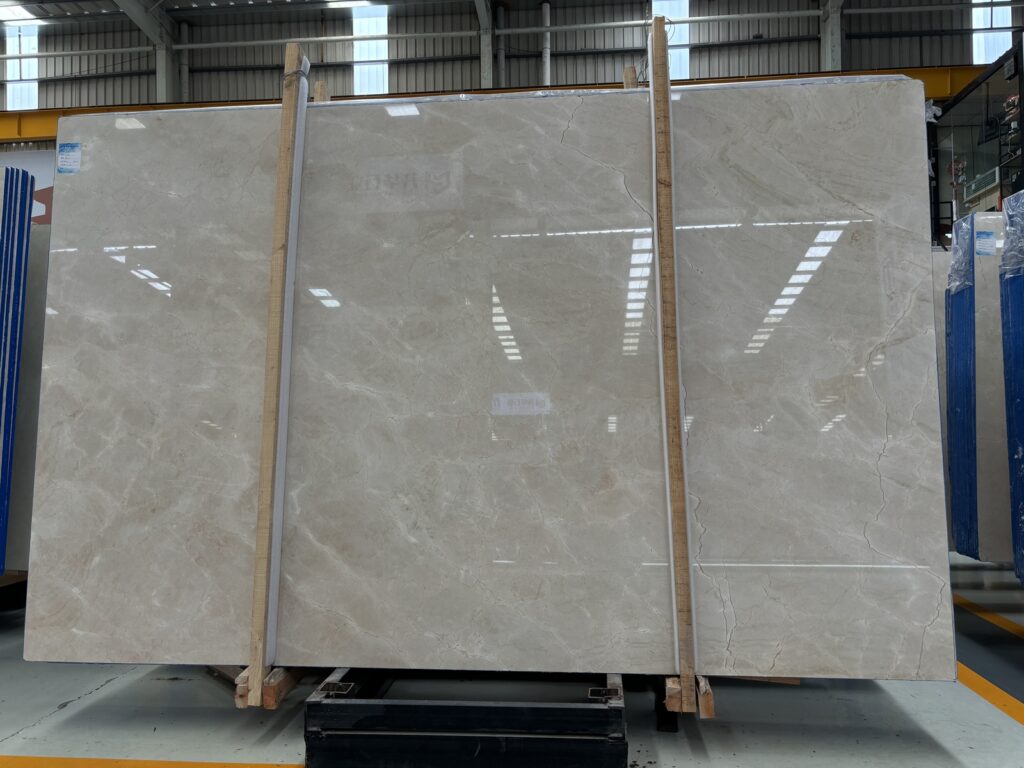
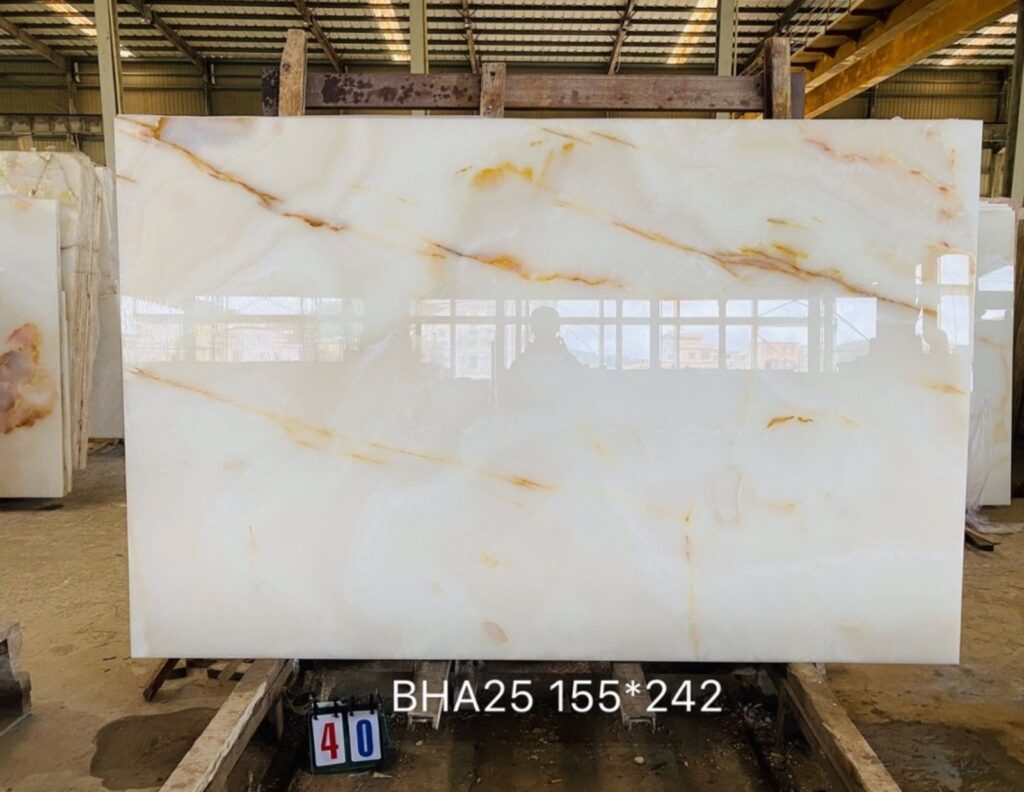
Ein Käufer steht vor einer großen Platte aus natürlichem Quarzit, die in einem Steinlager nahezu senkrecht präsentiert wird. Die Bewegung wirkt dramatisch, die kristallinen Bereiche sind leicht zu erkennen, und die gesamte Komposition erscheint wie eine architektonische Akzentwand.
Später wird dieselbe Platte horizontal positioniert, um sie bei der Fertigung zu begutachten. Die Oberfläche reflektiert nun das Deckenlicht, der Betrachter nähert sich ihr aus einem anderen Winkel, und einige mineralische Merkmale treten stärker hervor, während andere weniger deutlich sichtbar sind.
Hat sich der Stein verändert?
Nicht unbedingt. Der scheinbare Unterschied kann eher auf die jeweiligen Betrachtungsbedingungen zurückzuführen sein als auf eine tatsächliche Veränderung des Materials.
Verständnis Quarzitplatten aufrecht vs. flach ist besonders hilfreich, wenn eine Platte im Ausstellungsraum ausgewählt wird, später jedoch zu einer Kücheninsel, Arbeitsplatte, Esstisch, Wandpaneel oder Empfangsfläche wird.
Die Präsentationsposition einer Platte bestimmt, wie der Betrachter ihre Oberfläche wahrnimmt.
Bei einer aufrechten Darstellung steht die Platte oft einem Menschen gegenüber, der einige Schritte entfernt steht. Der Betrachter kann ihre gesamte Höhe und Breite mit einem relativ direkten Blick auf die Oberfläche erfassen.
Wenn dieselbe Platte flach liegt, steht der Betrachter vielleicht daneben und blickt aus einem schrägen Winkel nach unten. Einige Teile der Platte liegen näher an den Augen als andere, und das Deckenlicht kann sich auf der Oberfläche anders widerspiegeln.
Diese Unterschiede beeinflussen die Wahrnehmung, selbst wenn die Oberflächenbearbeitung, die Abmessungen und das geologische Muster des Steins unverändert bleiben.
| Betrachtungsfaktor | Aufrechte Präsentation | Flache Präsentation |
| Typische Position des Betrachters | Stehend vor der Platte | Stehend neben oder über der Platte |
| Gesamtmuster | Oft leichter als eine einzige vertikale Komposition zu lesen | Kann auch als horizontale Fläche oder aus einem schrägen Blickwinkel betrachtet werden |
| Beleuchtung | Die vertikale Seite interagiert mit den Lichtverhältnissen im Ausstellungsraum | Deckenleuchten und Fenster können unterschiedliche Reflexionen erzeugen |
| Nützlicher Anwendungskontext | Akzentwände, Wandpaneele, vertikale Möbeloberflächen | Arbeitsplatten, Inseln, Tische, horizontale Komponenten |
| Hauptbeschränkung | Vorhersagt nicht automatisch eine horizontale fertige Oberfläche | Vorhersagt nicht automatisch eine vertikale Installation |
Dies ist ein Unterschied in der Präsentation, nicht eine Rangfolge bezüglich der Inspektionsgenauigkeit. Beide Ansichten können nützlich sein, wenn sie eine definierte Frage beantworten.
Licht ist einer der stärksten Gründe dafür, dass dieselbe polierte Quarzitplatte in zwei Positionen unterschiedlich erscheinen kann.
Bei einer aufrechten Platte können Deckenleuchten ihre Oberfläche aus einem bestimmten Winkel beleuchten. Der Betrachter sieht dabei einen breiten, relativ ununterbrochenen Bereich des Steins – abhängig von der Lageraufstellung.
Liegt die Platte flach, können dieselben Leuchten sichtbare Reflexionen über die horizontale Oberfläche erzeugen. Diese Reflexionen können bestimmte Bereiche betonen, Teile des mineralischen Musters verschleiern oder den scheinbaren Kontrast zwischen hellen und dunklen geologischen Merkmalen verändern.
Eine polierte Oberfläche kann Fenster, Deckenleuchten, benachbarte Platten oder umliegende Farben reflektieren. Geschliffene und strukturierte Oberflächen verteilen Reflexionen dagegen anders, wobei das tatsächliche Erscheinungsbild von der Oberfläche und den Lichtverhältnissen abhängt.
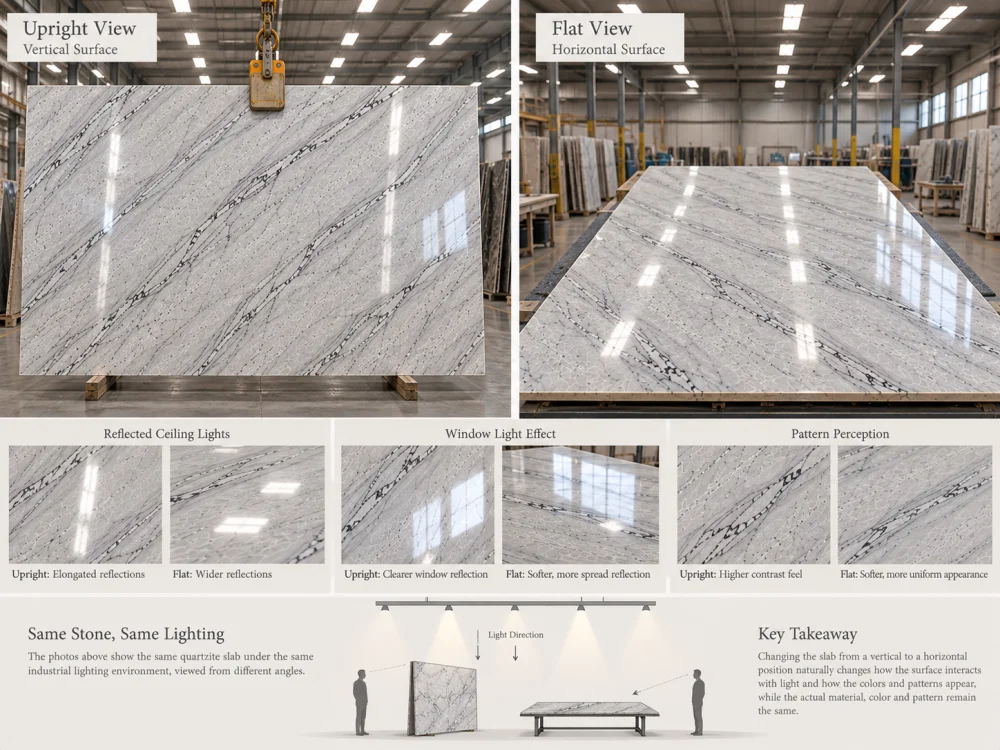
Stellen Sie sich eine helle Quarzitplatte mit sanften grauen Strukturen vor. Unter einer Betrachtungsbedingung erscheint ihr Hintergrund ruhig und relativ einheitlich. Unter einer anderen erzeugen reflektierte Deckenleuchten helle Flecken, die mit dem natürlichen Muster konkurrieren.
Die hellen Flecken sind nicht unbedingt hellere Mineralbereiche. Es kann sich um reflektiertes Licht handeln.
Ebenso kann ein dunkler wirkender Bereich teilweise durch die Umgebungshelligkeit oder den Blickwinkel des Betrachters entstehen.
Für farbsensible Entscheidungen vergleichen Sie den Stein unter kontrollierten, repräsentativen Lichtverhältnissen und nutzen Sie bei Bedarf physische Referenzen. Ein Ausstellungsraumbild allein reicht nicht aus, um eine präzise Farbanpassung im fertigen Raum festzustellen.
Licht, das in einem flachen Winkel über eine Oberfläche verläuft, macht Reflexionen und lokale visuelle Veränderungen deutlicher wahrnehmbar. Das kann nützlich sein, um einen Bereich genauer zu betrachten, der besondere Aufmerksamkeit verdient.
Allerdings beweist eine reflektierte Linie, die gekrümmt oder unterbrochen erscheint, noch keinen Flachheitsfehler. Eine Dimensionalitätsschwäche erfordert eine geeignete Messmethode und eine projektspezifische Referenz.
Die nützliche Unterscheidung ist einfach: Die visuelle Beobachtung zeigt, was untersucht werden soll; die technische Messung ermittelt einen messbaren Zustand.
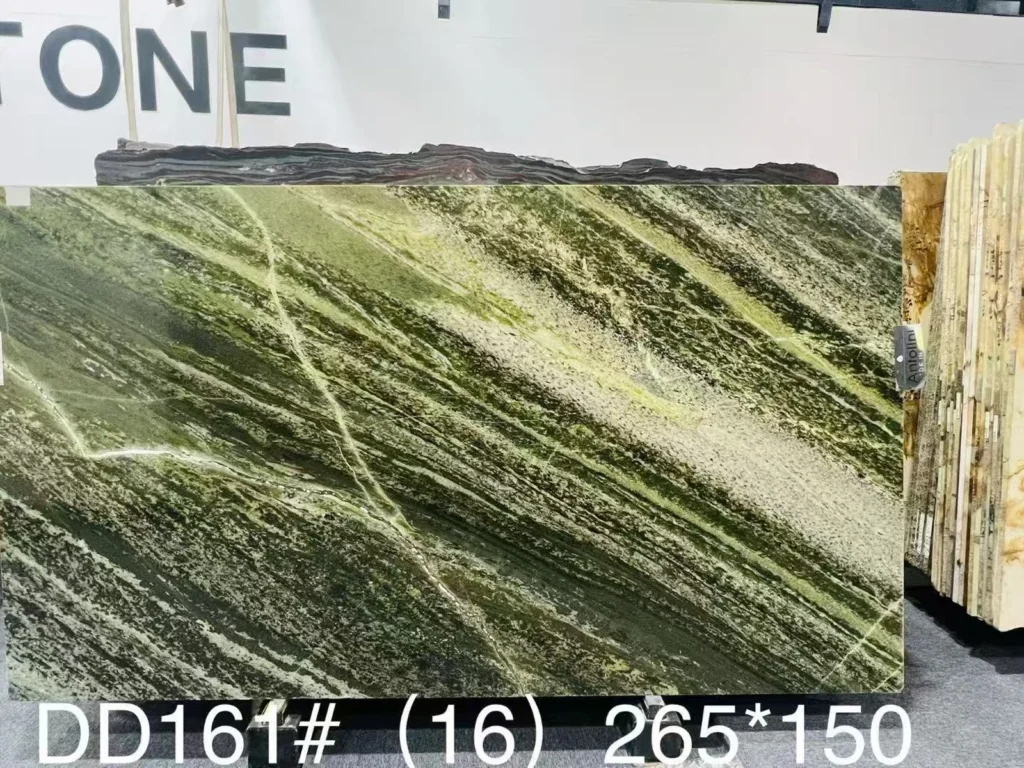
Natürlicher Quarzit weist häufig geologische Merkmale in verschiedenen Größen auf. Manche Platten besitzen breite Bänder oder kristalline Felder; andere wiederum zeigen kleinere Adern, unregelmäßige Mineralansammlungen oder starke Kontraste zwischen benachbarten Zonen.
Wenn man eine aufrechte Platte aus mehreren Schritten Entfernung betrachtet, neigt das Auge dazu, diese Details zu einer größeren Gesamtkomposition zusammenzufassen.
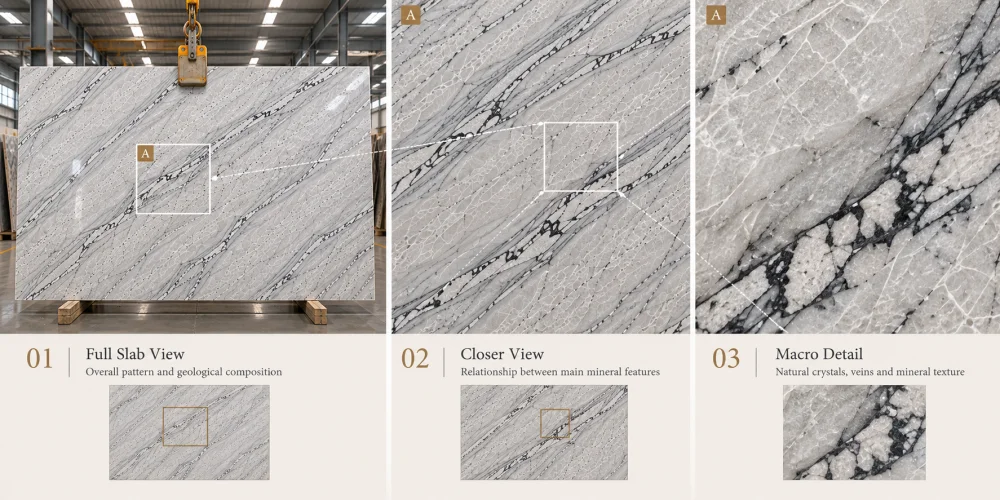
Move closer, and the individual veins, mineral boundaries, crystals, and localized variations become more prominent.
A flat slab introduces another viewing relationship. Someone standing beside a large board may be close to one end while the far end is viewed at a greater distance and a different perspective angle.
This can make the near portion visually dominant, even when the overall pattern is more balanced from a direct overhead view.
Whole-Slab Distance: Step far enough away to see the complete board. Use this view to understand the overall movement, dominant mineral areas, and general composition.
Working Distance: Move closer to examine the portions likely to become important finished surfaces. For a kitchen island, this may include the planned countertop crop and waterfall areas.
Detail Distance: Inspect a specific feature, finish, or local area that needs clarification. Keep the detail connected to its position on the full slab.
No single distance should be treated as sufficient for every decision.
Viewing Scale Rule
Whole Slab → Finished-Surface Area → Local Detail. Review all three scales when the project decision depends on both overall movement and particular natural features.
The finished use of the stone should guide the presentation review. A slab selected for a wall does not need to be evaluated in exactly the same way as one selected for a horizontal dining table.
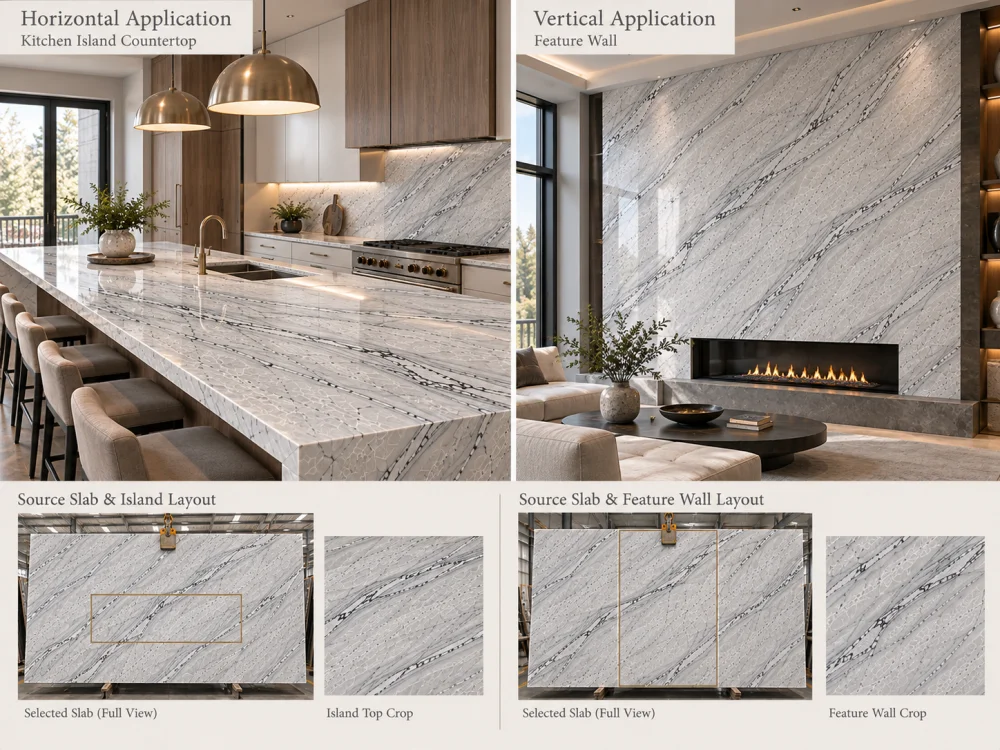
For a vertical feature wall, an upright slab presentation can provide a useful first impression of how the material reads as a large vertical composition.
However, the finished wall may be viewed from a greater distance, illuminated by different fixtures, or divided into several panels. The showroom view is therefore a reference, not a complete installation simulation.
For a kitchen island, the horizontal appearance becomes more important. A flat presentation may help reviewers consider how broad mineral features occupy a top surface.
Yet a person using the kitchen rarely views the entire countertop from directly overhead. Standing-height views and realistic room perspectives remain useful.
Where an island includes waterfall ends, the project contains both horizontal and vertical faces. Neither upright nor flat presentation alone describes the complete finished composition.
For a large table, the stone is experienced mainly from seated and standing positions around its perimeter.
A flat review can help the team examine the proposed tabletop crop, but it should be supplemented by an appropriate perspective view that considers the table’s actual dimensions and viewing height.
Bathroom vanities may combine a horizontal top with a vertical backsplash or front apron. The same stone can be experienced differently across these surfaces because their orientations and light exposure differ.
In these projects, it is more useful to identify the main finished planes than to declare one warehouse presentation universally preferable.
When a project requires both views, the comparison should preserve the identity of the stone and distinguish presentation effects from changes in the material itself.
Begin with the same identified slab and confirm which face and finish are being examined. If the slab cannot be safely moved or repositioned, use existing documented views or suitable controlled references rather than attempting an unnecessary handling operation.

Record the complete visible slab, its identification, presentation angle, approximate viewing distance, and lighting conditions.
Observe the overall direction of movement, relative size of mineral areas, and the way the pattern reads from the front.
Where a properly supported horizontal review is available, examine the same visible face and identify the changes in perspective, reflection, and visual emphasis.
Do not assume the lighting is identical merely because the review takes place in the same building. Rotating the slab changes how its surface faces the available light.
Connect the observations to the project drawing. If the stone will become a countertop, focus on the proposed horizontal finished area. If it will become a wall, evaluate the intended vertical composition.
For mixed-plane work, review each principal finished face separately and then consider the complete assembly.
This process is a comparison of visual evidence, not an instruction to repeatedly move large stone slabs. Slab handling must be carried out only by appropriately equipped personnel using suitable supports and established safety procedures.
Remote buyers may receive one photograph of a slab upright in a warehouse and another of the same slab lying flat on a fabrication table.
It is tempting to compare the photographs as though they were controlled images of the same scene. In practice, several variables may have changed simultaneously.
The camera may have moved closer. A wide-angle lens may exaggerate perspective. The slab may face a different light source. Automatic exposure or white balance may alter the apparent brightness or tone.
Even a correctly identified slab can therefore appear different across two photographs.
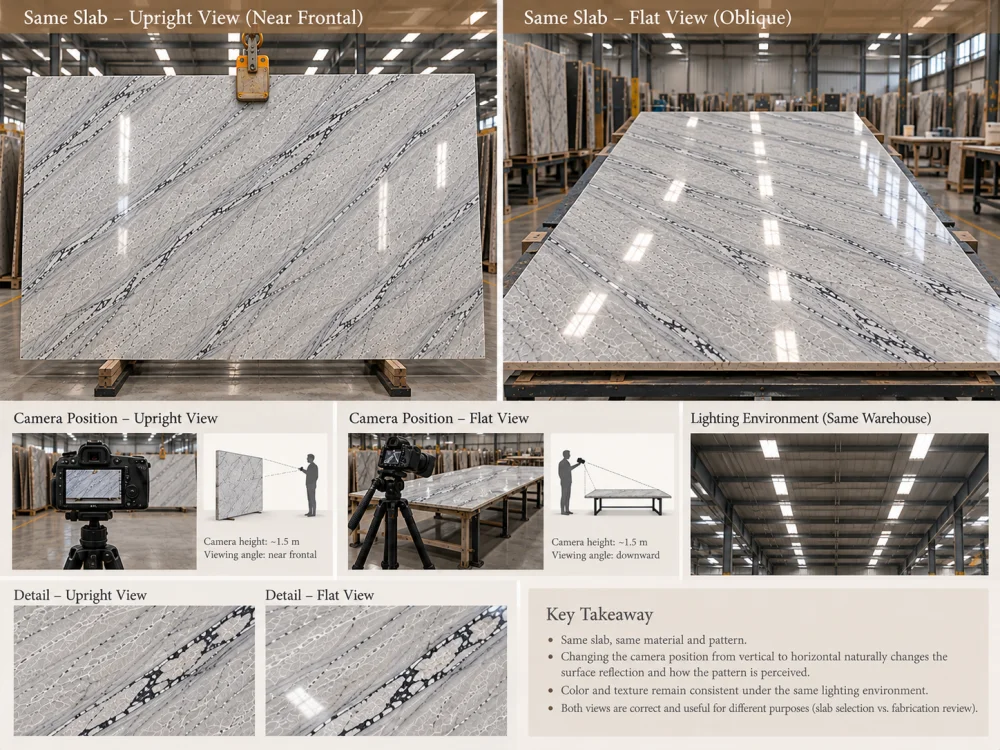
Before concluding that the material has changed, check whether the images show the same board, the same finished face, and the same surface finish.
Then ask for the available lighting and viewing information. If the difference matters to a material decision, request a targeted clarification rather than treating one photograph as automatically more truthful.
The related Quartzite slab showroom selection guide explains how complete slab photographs, board identification, and targeted details can support a more useful material review.
A change in appearance between upright and flat presentation does not automatically indicate a defect. Equally, a visually attractive slab display does not establish that every technical requirement has been met.
Consider three different observations.
Observation A: The natural veins appear more prominent when the slab is upright. This may be a matter of viewing distance, pattern scale, or perspective.
Observation B: The polished surface shows a strong reflected line when the slab is flat. This may be a reflection effect that warrants further review if it raises a specific concern.
Observation C: A local area appears different under another lighting condition. The team may need to examine whether the difference belongs to the stone itself, the surface finish, or the viewing environment.
None of these observations alone establishes a measurable defect, a petrographic classification, or a fabrication acceptance result.
Natural Quartzite should also be distinguished from engineered quartz. A commercial material name does not replace confirmation of the actual product being offered.
If a project raises a dimensional or material-condition question, record the relevant slab area and request the appropriate technical review. Keep that question separate from the aesthetic comparison of upright and flat views.
A useful slab-viewing record does not need to become a long production checklist. It should simply preserve the conditions needed to understand the visual decision.
If several people are reviewing the material, their comments should remain connected to the same slab evidence. The Quartzite slab selection with multiple decision makers guide explains how to distinguish visual preferences from technical and approval decisions.
The key point is that an upright display and a flat display are two different ways of observing the same natural material. A meaningful decision uses the view that answers the project’s question and recognizes what that view cannot prove.
The surface interacts differently with lighting, reflections, viewing distance, and perspective. The natural stone pattern may be unchanged even though certain features become more or less prominent.
Not universally. Upright viewing can help with the overall vertical composition, while flat viewing may be useful for horizontal applications. The better review is the one that matches the decision being made.
A properly supported flat review can be helpful where available, but it is not always necessary or practical. The project can also use actual slab photographs, a proposed cutting layout, and realistic finished-island views to evaluate the horizontal composition.
Changing presentation position does not by itself change the stone’s intrinsic color. It can change perceived appearance because the surface faces the light and viewer differently. Surface reflections and photographic settings may contribute further differences.
No. A photograph can document visual observations, but it cannot replace a defined dimensional measurement where flatness must be verified against a project requirement.
Confirm the slab identity, visible face, finish, presentation position, lighting, and camera conditions. Request complete slab views and targeted details that answer the actual project question.
Record the material and board reference, the viewing positions considered, important lighting and distance conditions, the intended application, the specific visual decision, and any issues requiring further review.
Review Natural Quartzite for Its Intended ApplicationFor an international Quartzite project, HRST STONE can help coordinate available full-slab photographs, identified material references, proposed stone layouts, relevant CAD/shop drawing information, and visual inspection records according to the confirmed scope. Send Josh the material name, project application, required dimensions, quantities, surface finish, and delivery destination to discuss the next review steps.
Copyright © HRST STONE / XIAMEN HRST STONE CO., LTD. Alle Rechte vorbehalten.