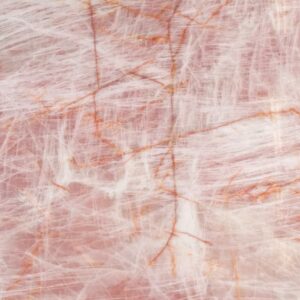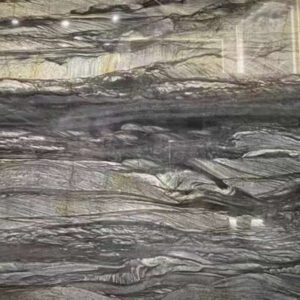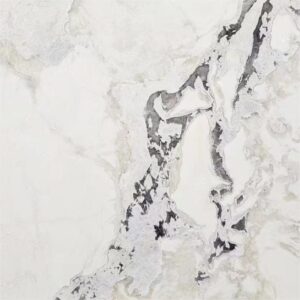

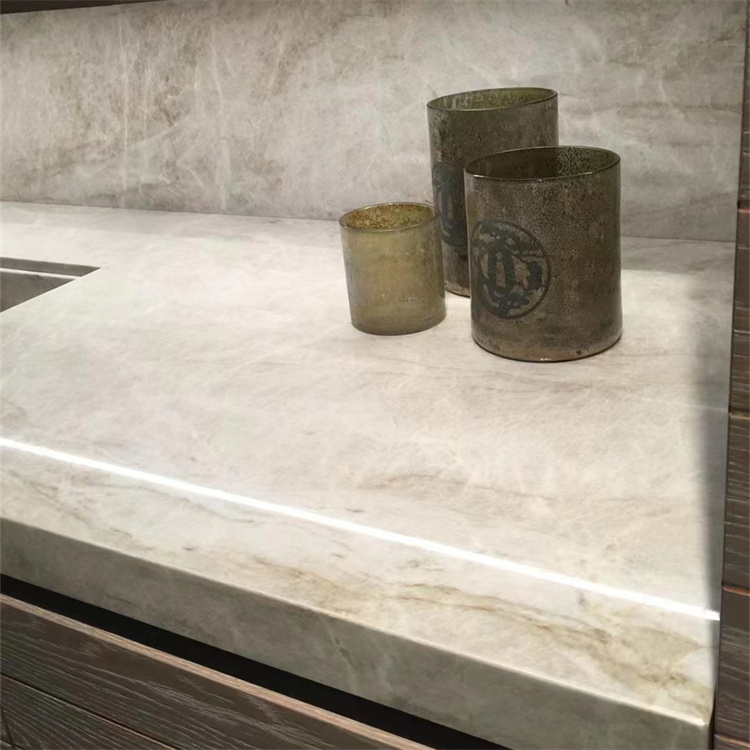
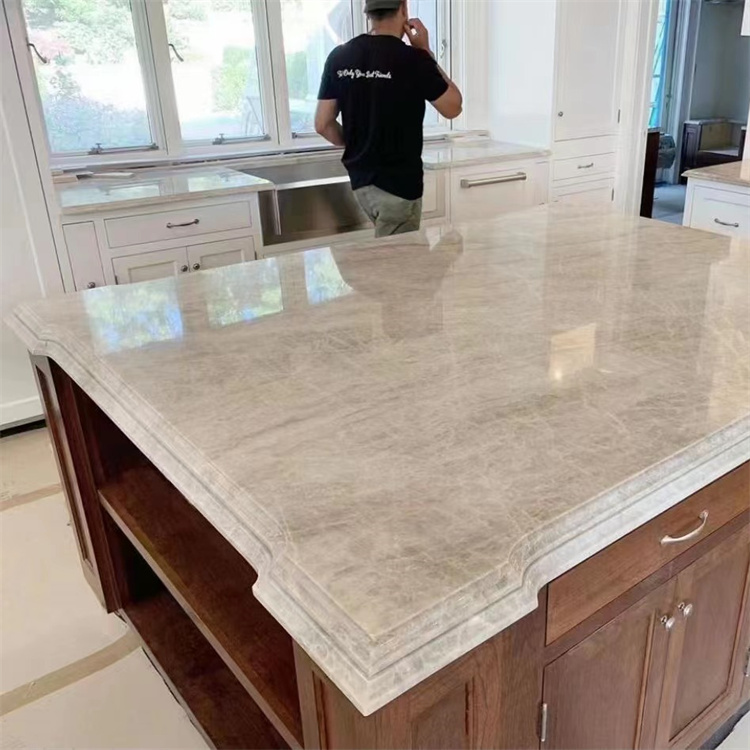
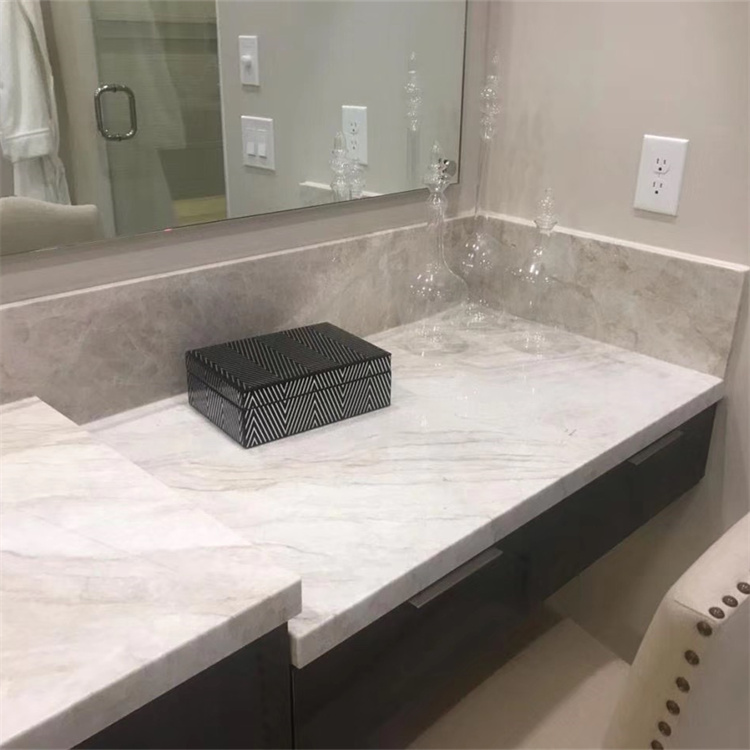
Taj Mahal Quartzite is a refined Brazilian natural stone characterized by a warm cream, light greige and beige background with soft taupe, pale grey and restrained golden-brown movement. Its low-contrast flowing pattern gives the material an elegant and architectural appearance, making it suitable for interiors that require natural stone character without overly dramatic veining.
Herkunft: Brasilien
18 mm / 20 mm
Soft Vein Movement
Maßfertigung

Natürlicher Quarzit
Brasilien
Cream / Beige / Taupe / Soft Grey
Platten / Fliesen / Zuschnitt nach Maß
Taj Mahal Quartzite Product Overview
Taj Mahal Quarzit, auch gesucht als Taj Mahal Stone oder Taj Quartzite, is widely selected for projects that require a softer natural palette. Its background generally ranges from warm cream and pale beige to light greige, with low-contrast taupe, grey and occasional gold-toned movement.
Compared with strongly veined exotic stones, Taj Mahal usually presents a calmer and more continuous composition. This makes a Taj Mahal Slab easier to coordinate with timber cabinetry, warm metals, neutral walls and a wide range of luxury interior finishes.
However, natural variation remains important. Some slabs appear lighter and more uniform, while others display stronger Goldader-Stein character or more visible taupe and grey movement.

Produktspezifikationen
| Artikel | Spezifikationsdetails |
| Materialbezeichnung | Taj Mahal Quarzit |
| Alternative Bezeichnungen | Taj Mahal Stone / Taj Quartzite / Taj Mahal Extra / Super Taj Mahal |
| Materialtyp | Natürlicher Quarzit |
| Herkunft | Brasilien |
| Primärfarben | Warm Cream, Pale Beige, Greige, Taupe, Soft Grey and Restrained Gold |
| Texturmuster | Soft flowing and cloudy movement with low-to-medium contrast natural veins |
| Verfügbare Dicke | 18 mm / 20 mm |
| Oberflächenbearbeitung | Poliert / Geschliffen / Lederbearbeitet / Gebürstet / Projektspezifische Oberfläche |
| Lieferformen | Platten, Fliesen, Arbeitsplatten, Inselplatten, Waschtischplatten, Rückwände, Wandpaneele, Kaminstücke, Tischplatten und Bartresen |
| Anwendungsbereich | Luxury Residential, Villas, Hotels, Kitchens, Bathrooms, Feature Walls, Fireplaces and Custom Furniture |
| Maßfertigung | Maßgeschneiderte Zuschnitte, CNC-Aussparungen, Gehrungen, Kantenausführungen, Wasserfallstücke, Rückwände, Wandpaneele, Kaminbauteile und Tischplatten |
How to Select Taj Mahal Quartzite
For Taj Mahal Quartzite, buyers should evaluate overall background warmth, vein intensity, direction and the balance between cream, beige, taupe and grey movement. A slab with very subtle movement may produce a calm minimalist result, while stronger taupe or golden structures can create more visual character.
Für ein Taj Mahal Counter, Taj Mahal Island or large feature wall, slab selection should also consider where sink openings, cooktops, seams and finished edges fall within the natural pattern.
If a lighter and cleaner result is preferred → Choose slabs with a larger cream or pale-beige field and restrained movement.
If a warmer result is desired → Choose slabs with stronger taupe and soft-gold areas.
If the project needs greater natural character → Choose slabs with more visible grey-beige flowing veins.
Wenn mehrere fertige Teile optisch miteinander verbunden werden sollen → Genehmigen Sie die vollständige Plattenzuweisung und den Zuschnittplan vor der Fertigung.
Taj Mahal Quartzite Applications
The warm neutral palette of this Luxury Beige Stone allows Taj Mahal to work across contemporary, transitional and classic luxury interiors without visually dominating surrounding materials.
Taj Mahal Island
Large kitchen islands allow the soft beige and taupe movement to remain continuous and create a refined centerpiece without excessive visual contrast.
Taj Countertop
Arbeitsplatten können mit Spülenöffnungen, Kochfeldaussparungen, Kantenausführungen und Nähten gefertigt werden, die auf die tatsächliche Plattenbewegung abgestimmt sind.
Taj Mahal Vanity
Vanity tops can use selected pale sections with basin openings, faucet holes, backsplashes and finished visible edges according to approved drawings.
Taj Mahal Wall
Large wall panels can create warm, calm architectural surfaces in villas, hotels, bathrooms and premium hospitality interiors.
Taj Fireplace
Fireplace surrounds can use the subtle natural movement to create an elegant focal point without the visual intensity of strongly veined exotic stone.
Maßgeschneiderte Tischplatten
Dining tables, coffee tables, consoles and bar tops can use selected slab areas as refined warm-neutral stone furniture surfaces.
Küche und Rückwand‑Koordination
A Taj Mahal Kitchen is one of the most common applications because the stone coordinates naturally with white, cream, greige, taupe and timber cabinetry.
Für ein Taj Backsplash, countertop and wall pieces should ideally be planned from the same slab group so the soft movement continues naturally between horizontal and vertical surfaces.
If the cabinetry is natural timber → Cream-beige slabs with restrained gold movement can create a cohesive warm palette.
If the cabinetry is dark → Lighter Taj Mahal slabs can provide strong but sophisticated contrast.
Waterfall Islands and Vein Continuity
A waterfall island is one of the strongest uses for Soft Vein Quartzite because the subtle directional movement can continue from the horizontal top down the vertical side without appearing overly busy.
For mitered waterfall construction, the slab should be mapped before cutting so the transition between the island top and vertical return appears natural.
If the island includes a sink or cooktop → Protect the strongest continuous vein sections from being unnecessarily removed by openings.
If several slabs are required → Group slabs by tone and vein direction before final allocation.
Wall Panel and Feature Wall Planning
A Taj Wall Panel installation can create a quiet luxury effect because the stone’s low-contrast movement remains visible without overwhelming the room.
For full-height walls or fireplace elevations, slab sequence and joint positions should be coordinated before cutting. The goal is to maintain natural movement while avoiding abrupt changes between adjacent panels.
Actual Slab Review → Wall Elevation → Panel Dimensions → Slab Sequence → Joint Position → Vein Coordination → Cutting Layout → Dry-Lay Review → Final Approval
Taj Mahal Extra and Super Taj Mahal Selection
Commercial names such as Taj Mahal Extra Und Super Taj Mahal may be used by suppliers for selected slab groups with specific visual characteristics. These names can be useful for market identification, but they should not replace actual slab inspection.
For B2B purchasing, the buyer should compare the actual background color, pattern density, slab dimensions and usable surface condition instead of assuming that every slab sold under an “Extra” or “Super” label has identical appearance.
Leitfaden zur Anwendungsauswahl
| Projektanforderung | Empfohlene Form | Auswahlpriorität |
| Akkzentkücheninsel | Large Taj Mahal Slab | Background warmth and waterfall continuity |
| Luxuriöse Arbeitsplatte | Taj Mahal Counter | Opening position and seam placement |
| Badezimmerwaschtisch | Taj Mahal Vanity | Tone consistency and edge quality |
| Akzentwand | Taj Wall Panel | Slab sequence and vein continuity |
| Fireplace surround | Taj Fireplace pieces | Pattern placement around opening |
Oberflächenbearbeitung und Fertigung
Polished Taj Mahal
A polished finish increases color depth and enhances the subtle beige, taupe and gold movement while maintaining a refined appearance.
Honed Taj Mahal
A honed finish reduces surface reflection and creates a softer matte architectural appearance that works well with contemporary interiors.
Gepflegte Oberfläche
A leathered finish can add subtle texture and lower glare for selected countertops, bar tops and design-focused applications.
Wesentliche Beschaffungsrisiken
A small sample cannot represent full-slab tone, vein direction or the balance between cream, beige and taupe movement.
Natural slabs can vary from warmer cream to cooler greige. Slabs for connected areas should be reviewed together before fabrication.
Important vein movement can be interrupted by openings or poorly positioned seams when slab mapping is skipped.
Terms such as Extra or Super can vary by supplier. Actual slab appearance and usable quality should always be verified directly.
Häufige Einkaufsfehler und deren Folgen
| Häufiger Fehler | Mögliche Konsequenz | Empfohlene Kontrolle |
| Ordering from a sample only | Unexpected slab tone or movement | Freigabe von tatsächlichen Plattenfotos oder -videos |
| Unverträgliche Platten mischen | Abrupt cream-to-greige differences | Prüfung aller Projektplatten gemeinsam |
| Kein fertiges Stücklayout | Poor vein continuity or misplaced seams | Approve cutting layout before production |
| Unvollständige Fertigungszeichnungen | Incorrect openings, miters or dimensions | CAD- oder Werkzeichnungen vor dem Schneiden genehmigen |
| Nur Vergleich der Plattenpreise | Unvollständiger Kostenvergleich des fertigen Projekts | Verwendbare Ausbeute, Fertigung, Verpackung und Logistik vergleichen |
Maßgeschneiderte Fertigung und Qualitätskontrolle
Taj Mahal Quartzite can be fabricated into countertops, waterfall islands, vanity tops, backsplashes, wall panels, fireplace surrounds, table tops, bar tops and other custom architectural components according to approved CAD or shop drawings.
Before cutting, actual slab identity, visible face, overall tone, vein direction, natural fissures or repaired areas, finished dimensions, cutout positions, seam locations and exposed edges should be reviewed.
Material Inspection → Actual Slab Selection → Tone & Vein Review → Slab Mapping → Drawing Approval → Cutting Layout → Cutting → CNC & Edge Fabrication → Surface & Edge Check → Dry-Lay Confirmation Where Required → Final QC → Packing Inspection
Verpackung und Projektlieferung
Finished Taj Mahal Quartzite components should be packed according to their dimensions, geometry, weight and breakage risk. Large islands, countertops with openings, wall panels and long furniture tops require suitable internal support during handling and international transportation.
Finished stone faces should be separated with soft non-staining protective materials. Exposed corners, polished edges, sink openings and vulnerable areas should receive additional cushioning before components are securely fixed inside verstärkte, begaserte Holzkisten.
Erforderliche Angaben für das Angebot
Für eine präzise B2B‑Kalkulation legen Sie bitte die wichtigsten Projektanforderungen vor, damit Plattenmenge, nutzbarer Ertrag, Fertigungskomplexität, Verpackung und Logistik gemeinsam beurteilt werden können.
Island / Counter / Vanity / Wall / Fireplace
Größen der fertigen Komponenten
Stückzahl oder Gesamtfläche
18 mm / 20 mm
Poliert / Geschliffen / Lederbearbeitet
Kanten / Ausschnitte / Gehrungen / Wasserfall
CAD / PDF / Ausführungszeichnungen
Hafen oder Lieferadresse
Taj Mahal Quartzite FAQ
1. Wie sieht Taj-Mahal-Quarzit aus?
[Taj Mahal Quarzit weist in der Regel einen warmen Cremetönung bis hin zu hellem Beige auf, durchsetzt von sanften taupefarbenen, grauen und zurückhaltend goldgetönten natürlichen Maserungen. Der genaue Farbton sowie die Intensität der Adern können von Platte zu Platte variieren.].
2. Ist Taj-Mahal-Quarzit ein natürlicher brasilianischer Stein?
Ja. Taj-Mahal-Quarzit ist ein brasilianischer Naturquarzit; daher variieren Grundton, Adernrichtung, natürliche Muster sowie die Mineralbewegungen von Platte zu Platte.
3. Kann Taj-Mahal-Quarzit für Küchenarbeitsplatten verwendet werden?
Ja. Die Anwendungen Taj Mahal Counter und Taj Countertop können mit Spülenöffnungen, Kochfeldausschnitten, Kantenprofilen sowie Fugen hergestellt werden, die auf das ausgewählte Plattenlayout abgestimmt sind.
4. Ist Taj-Mahal-Quarzit für Kücheninseln geeignet?
Ja. Anwendungen auf der Taj-Mahal-Insel sind besonders wirkungsvoll, da große Flächen dafür sorgen, dass die subtile Beige- und Taupe-Optik durchgängig und visuell beruhigt wirkt.
5. Kann Taj-Mahal-Quarzit für Spritzschutzflächen verwendet werden?
Ja. Taj-Backsplash-Elemente lassen sich mit Arbeitsplatten und Kücheninseln abstimmen, sodass die sanfte, natürliche Linienführung zwischen horizontalen und vertikalen Flächen nahtlos fortgesetzt wird.
6. Kann Taj-Mahal-Quarzit für Akzentwände verwendet werden?
Ja. Die Anwendungen Taj Mahal Wall und Taj Wall Panel schaffen warme, neutrale Architekturoberflächen, die sich für Villen, Hotels, Badezimmer und hochwertige Innenräume eignen.
7. Ist Taj-Mahal-Quarzit für Kamine geeignet?
Ja. Kamineinfassungen aus Taj können einen edlen Blickfang schaffen, bei dem eine dezente Steingestaltung den stark ausgeprägten Maserungen vorzuziehen ist.
8. Was ist der Unterschied zwischen Taj Mahal Extra und Super Taj Mahal?
Extra und Super sind Handelsklassen- oder Sortierungsnamen, die von Lieferant zu Lieferant variieren können. Käufer sollten den tatsächlichen Farbton, das Muster, die Abmessungen sowie die nutzbare Qualität der Platten vergleichen, anstatt sich ausschließlich auf die jeweilige Klassifizierung zu verlassen.
9. Which finish is suitable for Taj Mahal Quartzite?
Polished Taj Mahal emphasizes color depth, honed surfaces create a softer matte appearance, and leathered finishes add subtle texture for selected applications.
10. What affects Taj Mahal Quartzite price?
Price depends on slab selection, background tone, vein quality, dimensions, thickness, usable yield, finish, fabrication complexity, quantity, packing requirements and shipping destination.
Schlussbemerkung / Praktische Hinweise
Taj Mahal Quartzite is best suited to projects where warm neutral natural stone is intended to create a refined architectural backdrop rather than an aggressive focal pattern. Its cream, beige, taupe, soft grey and restrained gold movement works especially well for kitchen islands, countertops, vanities, backsplashes, feature walls, fireplaces and custom furniture. For B2B procurement, actual slab selection, tone matching, vein direction, cutting layout, finish approval, fabrication drawings, QC and export packaging should be evaluated together. If a lighter and cleaner result is preferred → choose slabs with larger cream fields and softer movement. If a warmer result is desired → choose slabs with stronger taupe and gold tones. If several finished pieces form one visual installation → approve the complete slab allocation and cutting layout before fabrication.