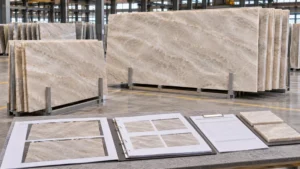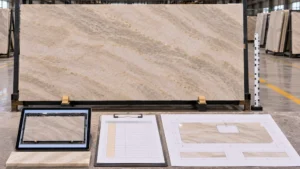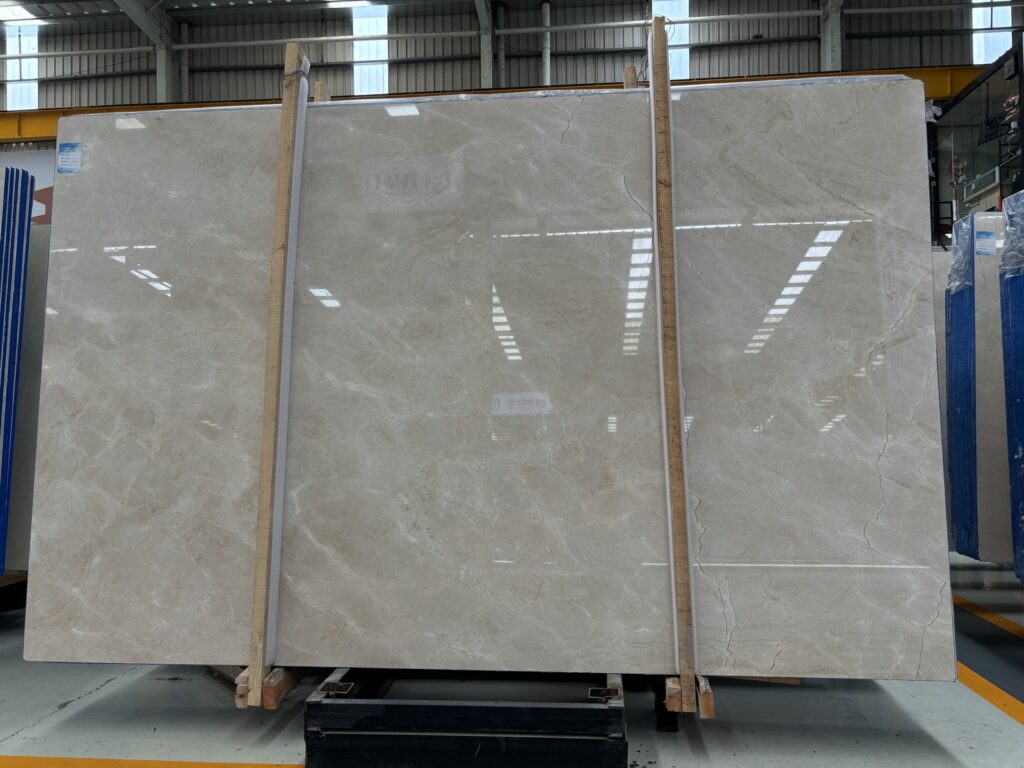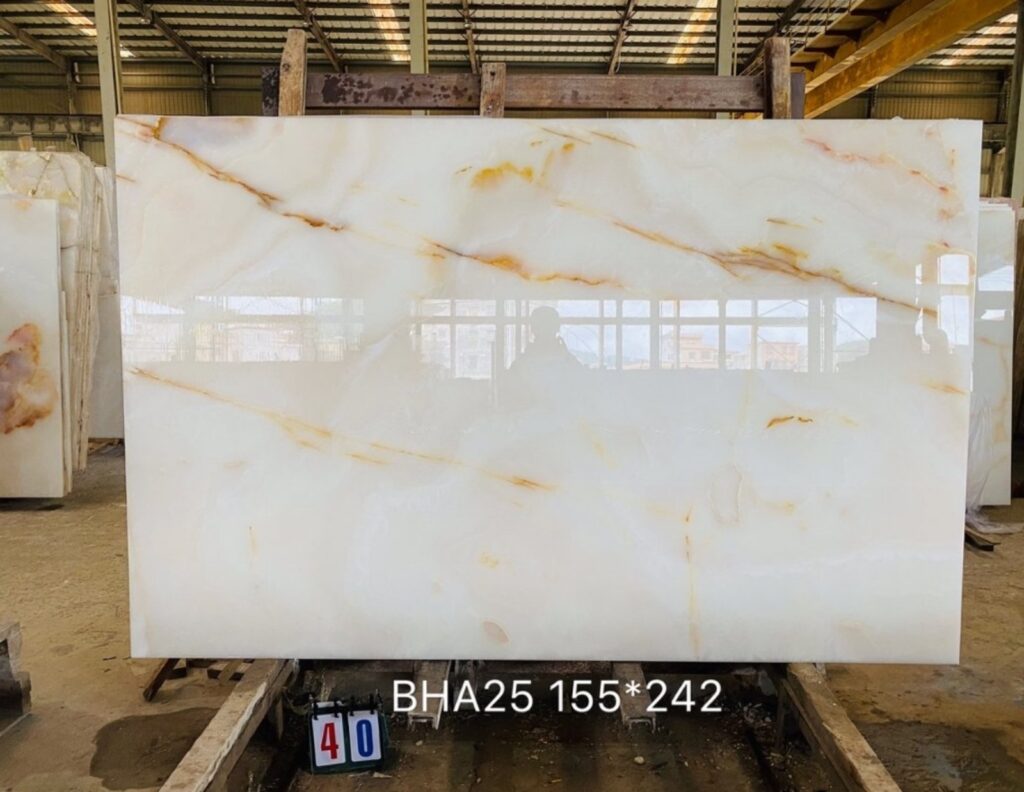


Kurze ZusammenfassungQuarzit in Räumen mit gemischtem Tageslicht und künstlichem Licht sollte anhand mehrerer repräsentativer Beleuchtungszustände geprüft werden, statt nur anhand eines einzigen attraktiven Fotos. Derselbe natürliche Quarzit kann je nach Änderung der Tageslichtintensität und -richtung sowie je nach Dominanz der elektrischen Beleuchtung wärmer, kühler, heller, dunkler, kontrastreicher oder reflektierender erscheinen. Die korrelierte Farbtemperatur hilft zwar zu beschreiben, ob eine elektrische Lichtquelle wärmer oder kühler wirkt, sagt jedoch allein nicht voraus, wie sich die jeweilige Mineralfarbe des Steins unter verschiedenen Lichtbedingungen darstellt. Prüfen Sie den tatsächlichen Quarzit oder eine ausgewählte Platte, die beabsichtigte Oberflächengestaltung, wichtige Betrachtungsrichtungen, das Verhältnis zu Fenstern, vorhandene elektrische Lichtquellen, ggf. den Dimmzustand sowie die umliegenden Schränke, Böden, Wände und Metallbeschichtungen. Trennen Sie die intrinsische Steinfarbe von der Beleuchtung und Reflexion und dokumentieren Sie anschließend, welche Tageslicht-, Mischlicht- und Abendbedingungen tatsächlich zugelassen wurden.
Eine helle Insel aus natürlichem Quarzit wird bei Tageslicht ausgewählt.
Der Hintergrund wirkt warm cremefarben.
Die taupe-graue mineralische Struktur erscheint zurückhaltend.
Die Küche ist installiert.
Am späten Nachmittag wird das Tageslicht aus den Fenstern schwächer und die Pendelleuchten eingeschaltet.
Die Insel erscheint nun an einem Ende wärmer und am anderen leicht grauer.
Nachts, wenn das Tageslicht verschwunden ist, wirkt derselbe Stein farblich tiefer, und einige Adern treten deutlicher hervor.
Am nächsten Morgen kehrt das ursprüngliche helle Erscheinungsbild zurück.
Hat sich der Quarzit verändert?
Nicht unbedingt.
Das Beleuchtungsgleichgewicht hat sich verändert.
Dies ist das zentrale Problem hinter Quarzit in Räumen mit gemischtem Tageslicht und künstlichem Licht.
Ein echtes Interieur weist selten einen einzigen, dauerhaften Beleuchtungszustand auf.
Die entscheidende Frage lautet daher nicht:
“Welche Farbe hat dieser Quarzit?”
Sondern:
“Wie zeigt sich dieser identifizierte Quarzit unter den Beleuchtungszuständen, die im fertigen Raum tatsächlich von Bedeutung sind?”
Der erste Schritt besteht darin, die intrinsischen Materialeigenschaften von der Beleuchtung zu unterscheiden, unter der sie wahrgenommen werden.
Der ausgewählte natürliche Quarzit verfügt über eine eigene physikalische Zusammensetzung aus:
Diese Eigenschaften gehören dem Stein.
Der Raum bringt eine weitere Gruppe von Variablen mit sich:
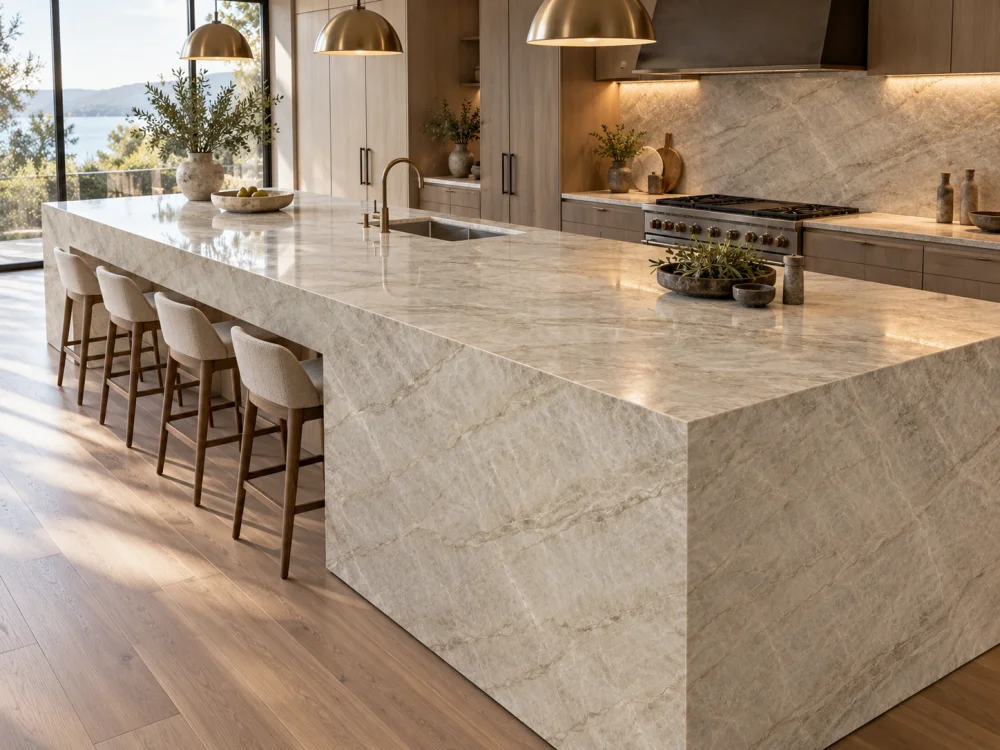
Wenn sich diese Variablen ändern, kann der Stein anders aussehen, obwohl die physische Platte unverändert bleibt.
Wenn ein heller Quarzit am Abend wärmer erscheint, fragen Sie zunächst:
Erst nach der Trennung dieser Faktoren sollte das Projekt entscheiden, ob der beobachtete Unterschied tatsächlich zum Stein selbst gehört.
Regel des Beleuchtungszustands
Steinfarbe + Oberflächenbearbeitung + Lichtspektrum / Farbgebung + Lichtrichtung + Intensität + reflektierte Umgebung + Betrachtungswinkel = Was der Betrachter sieht.
Daylight changes throughout the day.
A Quartzite selection approved at 10:00 a.m. is not necessarily being viewed under the same illumination at 4:00 p.m.
Depending on window orientation and building geometry, light may reach the stone:
Direction can change which mineral features appear prominent.
A bright midday room may allow daylight to dominate the complete surface.
Later, electric lighting may become visually important even before sunset.
This transition period is often where “mixed lighting” becomes most noticeable.
Direct sun can create strong highlights, shadows, and local contrast.
Diffuse daylight produces a much softer visual condition.
Do not approve a material only in an unusually dramatic patch of direct sunlight if that does not represent the normal use of the room.
A clear day and an overcast day may produce different light levels and directional character.
The objective is not to approve every possible weather condition.
It is to understand which daylight states materially affect the design decision.
Die Baustelle’s Quarzitplatten im aufrechten und im flachen Blickwinkel: Warum sich die Darstellung ändert guide explains the same underlying principle: when light direction, surface orientation, reflection, and observer position change, the same identified Quartzite may be read differently.
Electric lighting is often described with a correlated color temperature, or CCT.
This is useful, but it should not become the only lighting information attached to a colour-sensitive Quartzite approval.
Lower-CCT white light generally appears warmer.
Higher-CCT white light generally appears cooler.
This can influence the atmosphere of the room and the apparent relationship between stone, cabinetry, flooring, paint, and metal finishes.
Two electric light sources can have similar nominal CCT values while rendering particular colours differently.
This is why the project should not approve a sensitive Natural Quartzite palette based only on a number printed beside the fixture specification.
When available, record the selected fixture or lamp information rather than only writing:
“Warm white lighting.”
For a colour-sensitive project, the lighting designer or supplier may provide:
The stone supplier does not need to redesign the lighting system.
The stone-selection team does need to know which lighting condition is being used to judge the material.
There is no single CCT that is universally correct for every Natural Quartzite.
A warm cream Quartzite, icy-white crystalline Quartzite, green Quartzite, or blue-grey Quartzite may each interact differently with the complete interior palette.
The correct decision belongs to the project-specific lighting and design intent.
CCT Limitation
CCT helps describe whether the electric light appears warmer or cooler. It does not, by itself, guarantee how every Quartzite mineral colour will be rendered in the finished room.
Mixed lighting does not always illuminate a complete island or wall evenly.
One long Quartzite surface can exist in several lighting zones at the same time.
The part closest to glazing may be dominated by daylight.
It can appear:
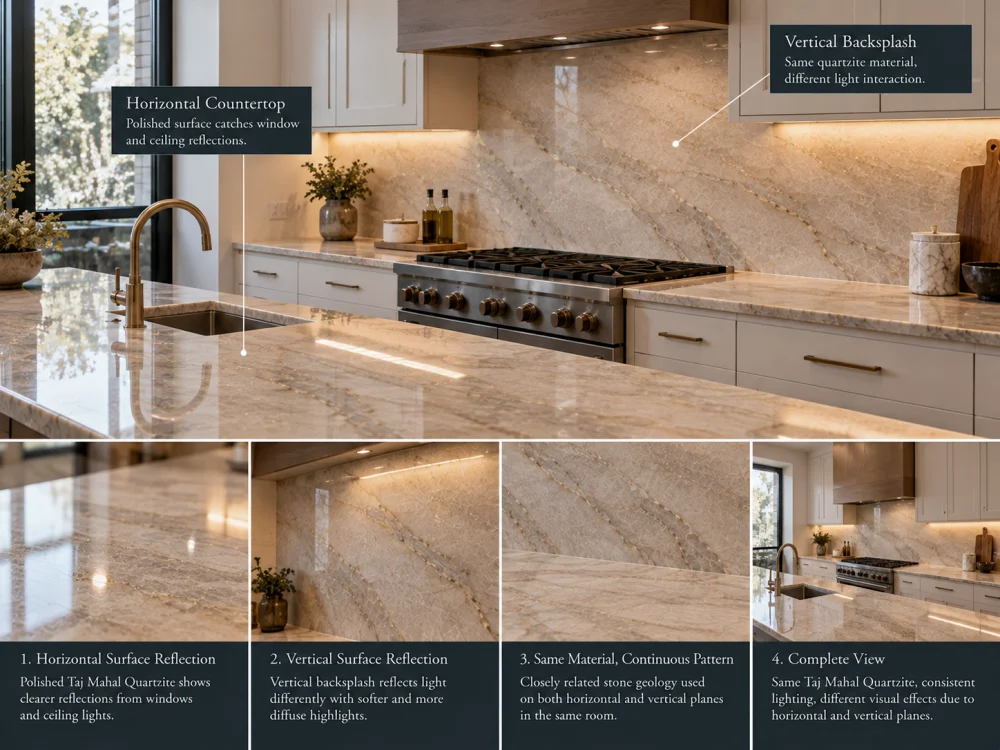
The opposite end may receive weaker daylight and more electric illumination.
The same stone background can therefore look different across the complete surface.
Local pendants can create brighter circles, directional highlights, or shadows.
The Quartzite underneath a pendant is not necessarily a different slab colour from the area between fixtures.
Perimeter countertops may be illuminated strongly by under-cabinet lighting while the island is primarily exposed to daylight and pendants.
Even when the same Quartzite is installed in both locations, the two surfaces may not appear identical at every moment.
A matching Quartzite backsplash faces light from another angle than the horizontal countertop.
This can create a visible difference between two pieces from the same slab family.
Before treating that difference as a slab-matching problem, compare the two planes under controlled lighting.
| Zone | Possible Dominant Light | Begutachtungsfrage |
| Near Window | Tageslicht | Does strong daylight change brightness or reflection? |
| Room Interior | Daylight + electric light | Does the stone maintain the intended colour relationship? |
| Under Pendant | Local electric light | Are highlights and shadows being mistaken for stone variation? |
| Perimeter Counter | Task lighting + ambient light | Does the same Quartzite read differently from the island? |
| Vertical Stone | Different incident and reflected-light direction | Is plane orientation contributing to the visible difference? |
Lighting review should use the intended Quartzite finish wherever practical.
A polished surface can create relatively strong reflections from:
These reflections can temporarily hide, strengthen, or visually overlap the natural stone pattern.

A honed or lower-sheen surface generally produces a softer reflected response.
The stone still responds to daylight and artificial lighting, but reflected objects may be less sharply defined.
A polished finish may be preferred for depth and clarity.
A honed finish may be preferred for a softer visual character.
The correct choice should be coordinated with:
A wet, dusty, recently cleaned, or processing-residue-covered stone surface can add another variable.
For colour-sensitive lighting comparisons, keep the reviewed stone clean and dry and record any exception.
Die Baustelle’s Quarzit-Mustermaßstab: Ablesen einer Platte aus Raumdistanz guide also explains why lighting can change which geological features dominate the composition without changing the actual slab pattern.
A Quartzite surface is rarely judged in isolation.
Mixed lighting can alter the relationship between the stone and the rest of the palette.
A warm-white cabinet may appear very close to a pale cream Quartzite during daylight.
Under evening lighting, one may become visibly warmer than the other.
This does not automatically mean either material is wrong.
The question is whether the complete evening palette remains intentional.
Timber can reflect warm colour into polished Quartzite.
When daylight reduces, the warm relationship between wood and stone may become more prominent.
Polished Quartzite may reflect appliance fronts or dark oven glass.
Those reflections can become stronger or weaker as the balance between daylight and electric lighting changes.
A large floor field can contribute reflected colour to both the stone and cabinetry.
Include flooring in a final material review when it occupies enough visual area to influence the room.
Walls surrounding a vertical Quartzite surface can also affect perceived warmth or coolness.
This is particularly important for large feature walls, fireplace surrounds, and full-height backsplashes.
For visually sensitive projects, a useful approval can separate several conditions.
The exact number should follow the real room.
A practical framework is:
Electric decorative lighting is off or secondary.
Prüfung:

This may be the most realistic daytime operating condition.
Prüfung:
Late afternoon or early evening may create the strongest competition between the remaining daylight and electric lighting.
This state can reveal colour differences that are not obvious under either daylight-only or night-only conditions.
At night, evaluate the Quartzite within the intended artificial-light environment.
Prüfung:
These are not universal mandatory stages.
They are a way to stop one photograph from being treated as a complete lighting approval.
Representative Lighting MatrixDaylight Dominant → What does the stone look like naturally?
Daylight + Electric → How do the two light systems interact?
Transition Period → Does colour balance become unstable or noticeably different?
Electric Dominant → Do we approve the normal evening appearance?
Lighting review and stone selection are connected, but they are not the same decision.
Confirms the identified Natural Quartzite boards and their:
Confirms which slab areas become which finished components.
This may include:
Confirms how the selected physical stone is accepted under representative project lighting conditions.
It does not change the material identity.
A client may approve a dramatic evening photograph while still disliking the stone under strong morning daylight.
Or the opposite may occur.
If both experiences are important to the finished project, record both.
Die Baustelle’s Cristallo-Quarzit bei ausgeschalteten Lichtern: Warum die Tagesgenehmigung wichtig ist guide demonstrates the same control principle in a more specialized lighting application: one lighting state should not silently become approval of another.
Not every project needs a full lighting mock-up.
But when stone colour and lighting are central to the design, a controlled physical review can reduce uncertainty.
Progress from:
Representative Sample → Actual Slab → Proposed Finished-Surface Area → Mock-Up Where Required.
Do not approve mixed-light reflections on polished stone if production will be honed.
Horizontal island, vertical backsplash, vertical wall panel, and table surface interact with the same room light differently.
The purpose is not to build an entire finished house inside the stone factory.
It is to answer specific questions.
Zum Beispiel:
Where available, record:
This makes the result repeatable enough to remain useful.

The strongest approval is not:
“Quartzite colour approved.”
A better record states what was actually reviewed.
Zum Beispiel:
“Selected Quartzite boards and polished finish approved for the kitchen island under representative daylight, normal daytime electric lighting, and the reviewed evening lighting condition. Window-side reflections and warmer evening appearance are understood as lighting effects. Final fixture selection remains under the lighting-design scope.”
□ Actual Natural Quartzite material identified.
□ Actual slab / board references confirmed where slab-specific approval is required.
□ Intended surface finish confirmed.
□ Main stone orientation identified: horizontal, vertical, or mixed.
□ Important windows and daylight directions identified.
□ Daylight-dominant condition reviewed where relevant.
□ Daylight + electric-light condition reviewed where relevant.
□ Transitional low-daylight condition reviewed if it materially changes the room.
□ Electric-light-dominant evening condition reviewed where relevant.
□ Fixture or light-source references recorded when colour-sensitive decisions depend on them.
□ CCT recorded where available but not treated as the sole predictor of stone colour.
□ Colour-rendering information recorded where useful.
□ Dimming / output condition recorded where it materially changes the result.
□ Polished reflections separated from intrinsic stone colour.
□ Window-side and room-side stone zones compared where illumination differs strongly.
□ Adjacent cabinetry, flooring, walls, metals, and appliances included where visually important.
□ Photography conditions documented when images are used for remote approval.
□ Lighting approval kept separate from slab, layout, and fabrication approval.
□ Approved lighting states and unresolved conditions written into the project record.
Der physische Stein kann unverändert bleiben, während sich die vorherrschende Beleuchtung ändert. Tageslicht variiert in Intensität und Richtung, während die abendliche elektrische Beleuchtung ein anderes Farberscheinungsbild, eine andere Farbwiedergabe, eine andere Leuchtenausrichtung sowie ein anderes Reflexionsmuster aufweisen kann. Polierte Oberflächen können zudem je nach Änderung der Raumbeleuchtung unterschiedliche Umgebungen widerspiegeln.
Es kann das wahrgenommene Farbverhältnis verändern. Die Farbwahrnehmung bei elektrischem Licht, die Farbwiedergabe, die umgebenden Oberflächenbeschichtungen, die Oberflächenreflexionen sowie die verbleibende Tageslichtmenge tragen allesamt dazu bei. Beurteilen Sie den Effekt nicht allein anhand des Farbtemperaturwerts (CCT); prüfen Sie den jeweiligen Stein unter den für das Projekt relevanten Lichtbedingungen.
Es gibt keinen universellen Kelvin-Wert, der für jeden natürlichen Quarzit optimal ist. Die Farbtemperatur (CCT) gibt an, ob eine weiße Lichtquelle wärmer oder kühler erscheint, beschreibt jedoch nicht vollständig, wie die Farben aller Mineralien im Stein wiedergegeben werden. Die Beleuchtung sollte entsprechend dem Gesamtdesign des Innenraums ausgewählt und anhand des jeweiligen Materials überprüft werden, wenn die Farbe von entscheidender Bedeutung ist.
Wenn der fertige Raum regelmäßig in beiden Lichtverhältnissen erlebt wird und der visuelle Unterschied für das Projekt von Bedeutung ist, ist eine Prüfung beider Zustände sinnvoll. Ein farbempfindliches Projekt kann zudem von einer Mischlicht‑ oder Übergangs‑Begutachtung profitieren, anstatt davon auszugehen, dass die Genehmigung für Tag und Nacht automatisch jeden Zwischenzustand abdeckt.
Eine lange Insel kann mehrere Beleuchtungszonen durchqueren. Ein Ende kann von stärkerem Tageslicht durch Fenster geprägt sein, während das andere von Pendelleuchten, Deckenleuchten, Reflexionen an Schränken oder einer geringeren Umgebungshelligkeit dominiert wird. Vergleichen Sie beide Bereiche unter denselben kontrollierten Bedingungen, bevor Sie zu dem Schluss kommen, dass der Stein selbst eine unerwartete Farbabweichung aufweist.
Poliertes Quarzit weist in der Regel kräftigere und deutlicher ausgeprägte Reflexionen auf, sodass sich Veränderungen an Fenstern, Armaturen, Geräten sowie den umgebenden Farben auf der Oberfläche stärker abzeichnen können. Geschliffenes Quarzit hingegen erzeugt in der Regel eine sanftere Reflexion. Keine der beiden Oberflächen ist grundsätzlich überlegen; wählen Sie bei der Freigabe die für das jeweilige Projekt vorgesehene Oberfläche.
Senden Sie Josh das vorgeschlagene Material aus natürlichem Quarzit, soweit verfügbar aktuelle Plattenreferenzen, Projektzeichnungen, Anwendungsbereiche und fertige Abmessungen, Menge, beabsichtigte Oberflächenbearbeitung, Fenster- und Tageslichtsituation, verfügbare Lichtinformationen, wichtige Sichtbeziehungen, Schrank- und Bodenbelagsreferenzen, Fotos oder Renderings des Raums, Lieferort sowie den konkreten Beleuchtungsaspekt. Geben Sie an, ob sich die Frage auf die Farbwirkung bei Tageslicht, bei Abendlicht, auf Reflexionen, auf die Zonierung mit gemischtem Licht, auf die Plattenabstimmung oder auf das Verhältnis zwischen horizontalen und vertikalen Steinoberflächen bezieht.
Lighting Approval SummaryA Natural Quartzite should not be approved under a vague condition called “mixed lighting.” Separate the room into representative lighting states and record what each one is intended to answer. Compare the actual stone and intended finish under daylight-dominant, mixed daylight-and-electric, transitional, and evening electric-light conditions where those states materially affect the project. Record fixture information when it matters, but do not use CCT alone as a prediction of stone colour. Separate reflections from intrinsic mineral colour, compare different lighting zones across long surfaces, and include adjacent materials that influence the visual palette. Keep lighting approval distinct from slab selection, cutting-layout approval, fabrication approval, and the lighting designer’s technical responsibilities.
For project-based Natural Quartzite kitchens, islands, wall panels, reception surfaces, bars, and custom furniture in colour-sensitive interiors, HRST STONE can coordinate actual slab photographs, board references, finish samples, proposed cutting layouts, mixed-plane visual review, targeted project-lighting mock-ups where included in scope, fabrication QC, and export documentation. Send Josh the material, drawings, dimensions, quantity, finish, lighting context, adjacent finishes, visual concerns, and delivery destination before final stone approval.